The commuter train arrived twenty minutes ahead of schedule — a rare thing, and Nina took it as a good sign. She jumped down onto the platform with a heavy bag over her shoulder, adjusted her glasses, and started along the familiar path beside the tracks. In her bag were a jar of homemade adjika from her neighbor Zoya, half a kilo of coffee — which Galka never seemed to have — and a new book. Her sister had long been asking for “something about life, just without murders.” Nina had chosen Ulitskaya.
August was muggy, heavy with the smell of sun-warmed pine needles. As Nina walked, she thought how nice it would be to swim in Galka’s inflatable pool, drink coffee on the veranda, and go to bed at ten in the evening simply because she could. No Viktor. No endless talk about football. No plates left in the sink. Two days of silence.
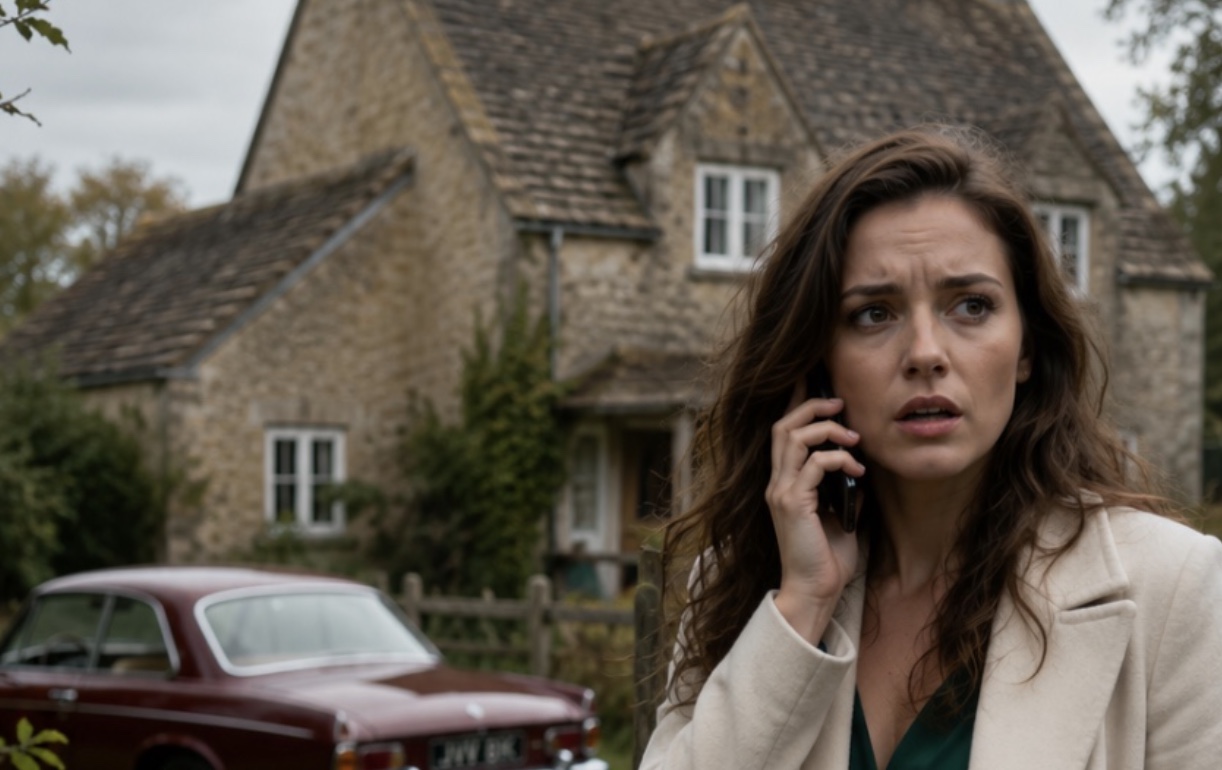
She turned onto the dacha street — the one with the crooked wooden sign that read “Beryozka Garden Association” — and immediately saw the car.
A silver Ford Focus stood by Galka’s fence.
Nina stopped.
She could not mistake that car. She had spent three years riding in the passenger seat. She knew there was a dent on the right side of the rear bumper from a parking post near the shopping center. She knew there was always a pack of wet wipes in the glove compartment and an old vehicle registration certificate in the name of Viktor Andreevich Semyonov.
Her husband.
Nina stood still for a second, then slowly set her bag down on the ground. She took off her glasses, wiped the lenses on the hem of her dress, and put them back on.
The car was still there.
She walked closer and looked through the window. His jacket was lying on the front seat — the same blue one she had bought him for his last birthday. There was a tiny coffee stain on the pocket, one he had never let her try to remove.
“I see,” Nina said aloud.
Her voice sounded calm. She surprised herself.
The gate was not locked. Nina pushed it open and stepped into the yard. On the veranda stood two glasses. One held red wine. So did the other. From the open door came music — something soft and jazzy, the kind Galka always played when she wanted to create an “atmosphere.”
Nina climbed the steps to the veranda. She picked up one of the glasses, looked at it, and set it back down.
“Galya!” she called.
The music stopped.
Then came a long, painfully awkward silence.
Then footsteps. Galka came out onto the veranda in her house robe, her hair loose, and her face looked unlike anything Nina had ever seen before. Not guilty. Not frightened. Just lost. Like someone caught not committing a crime, but doing something so personal she had no idea how to explain it.
“Nina,” Galka said.
“You’re not alone,” Nina said.
She did not ask. She simply stated it.
“I…” Galka faltered.
“Don’t,” Nina interrupted. “I see the car.”
They looked at each other. Galka was four years older and had always been considered the sensible one, the clever one, the one who had never married because she “hadn’t met anyone worthy.” Nina had always envied her a little — that freedom, that independence, that apartment that belonged only to her.
Now Nina looked at her sister and thought how different they were. They had never been alike. And yet they shared the same blood, the same mother, the same childhood in a two-room apartment on Chkalov Street.
“How long?” Nina asked.
Galka said nothing.
“How long has this been going on? I’m asking you.”
“Nina…”
“A year? Two?”
Galka lowered her eyes.
“A year and a half,” she said quietly.
Nina nodded. She picked up the glass of wine from the table, drank it down in one go, and set it back.
“You knew I was coming the day after tomorrow.”
“Yes.”
“He knew too.”
“Yes.”
“So you just…” Nina stopped, searching for the right word. “You simply decided to use these two days.”
Galka was silent. Somewhere inside the house — in the room behind the closed door — a floorboard creaked.
“Is he there?” Nina asked.
“Nina, please…”
“I’m not going to scream.” Nina did not know whether that was true, but her voice sounded steady. “Just tell me. Is he there?”
“Yes,” Galka said. “He’s there.”
Nina looked at the closed door. Then at the garden, where an apple tree was dropping small, hard fruit into the grass. Then at the pale August sky, empty of clouds.
“Tell him to come out,” she said.
“Nina…”
“Tell him. To come out.”
Galka turned around. The silence stretched for about ten seconds. Then the door opened, and Viktor came out onto the veranda.
He was dressed — for some reason, that was the first thing Nina noticed. Jeans, a white T-shirt. He looked to the side, not at her, not at Galka, but somewhere in the space between them, the way people look when they have prepared themselves for a conversation but have forgotten what they meant to say.
“Nina,” he began.
“Don’t.”
“I want to explain…”
“There’s no need to explain.” Nina raised her hand, and he fell silent. “I see everything I need to see.”
She looked at her sister. Then at her husband. Then at her sister again.
“A year and a half,” she said. “For a year and a half, you both looked me in the eyes. You came to our house for New Year’s. You sat at our table. You told me I looked good.”
“Nina, it’s not that simple…”
“Galya.” Nina’s voice grew quieter, and that was more frightening than shouting would have been. “Don’t tell me it isn’t simple. You are my sister.”
Galka looked at her. There were tears in her eyes — not from remorse, Nina understood. Just from discomfort. From the fact that everything had turned out this way — ugly, abrupt, without time to think it through and find the right words.
“I didn’t mean to…” Galka began.
“But you did,” Nina said. “You still did.”
She turned to Viktor.
He was looking at her now — directly — and there was something in his gaze that made something tighten inside Nina’s chest. Not guilt. Not regret. Something like relief, as if he no longer had to hide.
There it is, Nina thought. That’s what this is.
“You wanted me to find out,” she said.
Viktor did not answer.
“Otherwise you wouldn’t have left the car by the fence.”
“Nina…”
“Answer me.”
A long pause.
“Maybe,” he finally said. “I don’t know.”
Nina nodded. She picked up the bag she had brought with her and set it beside her on the veranda bench. She took out the jar of adjika and placed it on the table. Then she took out the coffee and set it next to it.
“This is for you,” she told Galka. “You asked for it.”
Galka stared at the coffee with an expression that was hard to name.
“Nina, what are you doing…”
“I brought you coffee.” Nina fastened the bag. “You always ask for coffee.”
“That’s not… Nina, you can’t just…”
“I can.” Nina lifted the bag. “And the book.” She took out Ulitskaya and placed it on the table beside the adjika. “You said you wanted one.”
Viktor was silent. Galka stared at the book.
“I need to think,” Nina said. “I’ll go to Zoya’s. She’s been inviting me for ages.”
“Nina…”
“Not today, Galya.” Nina looked at her sister for a long, calm moment. “We’ll talk. But not today.”
She went down from the veranda, crossed the yard, and stepped out through the gate.
The Ford Focus stood by the fence. Nina walked past it without turning around. She tried not to look at the dent on the bumper.
Beyond the gate, the path ran between two old wooden fences with peeling paint. It smelled of currants and hot dust. Somewhere far away, children were shouting — probably swimming in the river.
Nina walked and thought about nothing.
Or rather, she thought about everything at once — about a year and a half, about the New Year’s table, about Galka’s laughter, about Viktor looking away, about the two glasses of red wine on the veranda, about how she had ridden the train thinking of an inflatable pool, coffee, and silence. About Ulitskaya, whom Galka would now read instead of her.
At the crossing with the main street, she stopped, took out her phone, and found her neighbor’s number.
“Zoya Petrovna,” she said when the woman answered. “It’s Nina. You once said you had a spare folding bed…”
“Nina! Of course, come over! I’m just putting a pie in the oven!”
“All right,” Nina said. “I’ll be there in half an hour.”
She put the phone away and stood for a moment at the intersection of two dacha roads — to the left, the road led to the station; to the right, toward the river.
Then she chose the right.
Zoya’s place was a longer way around, across the little bridge, about forty minutes on foot. But Nina needed to walk.
Zoya Petrovna had lived alone ever since her husband Arkady died three years earlier. She kept chickens, grew strawberries, and every year preserved so many jars that the cellar shutters would not close until December. She loved Nina — called her “a clever girl,” treated her to jam, and never asked unnecessary questions.
Nina entered the yard and set her bag by the porch.
“Well, Ninochka,” Zoya said, peering out of the kitchen window, “will you have some tea?”
“I will,” Nina said.
“Sit down, sit down. The pie will be ready in twenty minutes.”
Nina sat on the bench by the porch. The yard was quiet — only the chickens murmured softly in their pen, and the wind stirred the leaves of the birch tree by the gate.
She took out her phone.
There were no messages. Not from Viktor. Not from Galka.
Nina did not know whether that was good or bad. Maybe they were talking now. Maybe they were silent. Maybe Viktor had already gotten into his silver Ford and driven away — to the dacha of the wife who had arrived a day early.
She suddenly wondered what he would say at home. He would invent something. He always invented something — explanations for being late, reasons for his moods, excuses for phone calls taken in another room. Nina used to think she had simply grown used to not noticing.
Now she understood that she had noticed everything.
She had just kept putting it all into some drawer and pushing it deeper inside.
Interesting how much must be stored there by now.
“Nina,” Zoya called, “come into the kitchen and tell me everything.”
“Zoya Petrovna, I don’t want to tell anything.”
“Then don’t,” Zoya agreed easily. “Just sit. The pie is delicious all by itself.”
Nina got up and went into the kitchen. It smelled of cinnamon and something apple-like. On the table stood a large yellow teapot, two glasses in metal holders — Zoya drank tea only that way, “Soviet-style” — and a little dish of caramels.
“Sit,” Zoya said without turning away from the stove.
Nina sat.
For a while, they said nothing. Zoya stirred something in a small pot. The clock on the wall ticked. Outside the window, the chickens discussed their business.
“Zoya Petrovna,” Nina finally said. “Did you know?”
Zoya turned around and looked at her without surprise.
“About what?”
“About Galka.”
A pause.
“I didn’t know anything,” Zoya said. “Maybe I guessed. But it wasn’t my business.”
“Why didn’t you tell me?”
“What would I have said?” Zoya shrugged. “‘Nina, I think…’? Who knows what I think. I’m old. I think many things.”
Nina looked at the yellow teapot.
“A year and a half,” she said.
“Lord,” Zoya whispered.
“Yes.”
Zoya took the pot off the stove and placed it on a trivet. She came to the table and poured tea — first for Nina, then for herself. She took a caramel, unwrapped it, and put it in her mouth.
“Are you crying?” she asked.
“No.”
“Good.” Zoya was silent for a moment. “You’ll cry later.”
“Maybe,” Nina agreed.
“Does he love her? Or is it just something like that?”
“I don’t know.”
“Did you ask?”
“No.”
“You’ll ask later.”
Nina picked up her glass. The tea was hot, strong, and smelled of blackcurrant leaves.
“Zoya Petrovna,” she said. “Can I stay for a few days? Not two, but… I don’t know. As long as it takes.”
“You can stay until the snow falls,” Zoya said without hesitation. “I’ll set up the folding bed in the small room. It’s nice there. Cool.”
“Thank you.”
“Nothing to thank me for.” Zoya stood and went to check the pie. “Will you eat?”
“I will.”
“Then that’s settled.”
Viktor called at eight in the evening.
Nina was sitting on Zoya’s porch, watching the sunset — pink, calm, making no promises. The phone vibrated in her hand, and she stared at the screen for several seconds before answering.
“Nina,” he said.
“I’m listening.”
A long pause.
“Where are you?”
“At Zoya’s.”
“I want to talk.”
“I know.”
“Can I come?”
Nina looked at the horizon. The sun had almost disappeared, leaving a long orange streak behind it.
“Not today,” she said.
“Nina…”
“Viktor. Not today. I will listen to you. Just not today.”
A pause.
“All right,” he said.
“Go home.”
“Yes.”
“And take your jacket. It’s on the back seat.”
A different kind of pause followed. Surprised, perhaps.
“You saw it.”
“I saw everything, Vitya.”
She put the phone away and remained sitting on the porch. From inside the house came the smell of cooling pie and the quiet sound of the television — Zoya was watching something about nature.
Then a message came from Galka.
Just one word: “Nina.”
Nothing else.
Nina looked at the word. Then she slipped the phone into her pocket, stood up, and went inside.
“Zoya Petrovna,” she said, “could I help you with the chickens in the morning? I don’t know how, but I can learn.”
Zoya looked at her over her glasses.
“Of course you can. We get up at six.”
“All right,” Nina said. “Wake me up.”
She went into the small room, where a folding bed with clean sheets had already been set up. She lay down without undressing and stared at the ceiling.
A year and a half.
All that time, she had made soup, gone on business trips, bought Viktor jackets, and called her sister every two weeks — “How are you, Galka? Aren’t you lonely all by yourself?”
She wondered how they had answered those calls. Each in a separate room? Or side by side? Or…
Nina stopped herself.
Enough.
Not today.
She turned onto her side and closed her eyes. Somewhere beneath the window, leaves rustled. The chickens in the pen had quieted down. The room smelled of wood and fresh linen.
Tomorrow, she would get up at six. She would learn how to feed chickens. She would drink the coffee she had brought for Galka and leave the book to her sister.
And then — she would see.
The life she had known three hours earlier had ended at the bend of a dacha road, beside a silver Ford Focus with a dent in its bumper.
Another life was beginning.
Nina did not know what kind.
But six in the morning was a good time to find out.