The tea in my mug had gone cold a long time ago, but I still kept my fingers wrapped around it, as if the ceramic could somehow keep me steady.
At the large dining table — the one Pasha and I had spent three months choosing — sat my parents. My mother, with the perfect manicure I had paid for last month. My father, with the new phone I had given him for his birthday. And my brother Lyosha, wearing yet another wrinkled T-shirt, with the permanently offended expression of a man convinced the whole world owed him something.
“Katerina, are you listening to me?” my mother’s voice rang out like a stretched wire. “Or have you gone deaf from happiness?”
I said nothing.
Pasha was in the kitchen, just beyond the wall, but I knew he was listening. He always listened when they came over. Not because he liked eavesdropping, but because over the past two years he had learned one thing very well: a quiet evening never stayed quiet when my family was around.
“Mom, I already told you,” I said, trying to keep my voice from shaking. “We can’t give Lyosha two hundred thousand. We have our own mortgage, and—”
“What do you mean, you can’t?” my father interrupted, putting down his fork. “You and Pasha earn good money. He’s a programmer, you work in marketing. And your brother is a creative person. He needs a powerful computer for his self-development.”
Lyosha, who until then had been staring at his phone, lifted his head and grimaced.
“For work, Dad. For work. I edit videos.”
He did not edit videos.
He watched streams sixteen hours a day and, once every six months, posted a compilation of cats on TikTok. But my parents believed with sacred devotion that somewhere beyond the horizon, fame was waiting for their genius son. It had been waiting for ten years.
“Lyosha doesn’t work anywhere,” I said quietly.
I had repeated that sentence so many times that it felt worn out, like an old record. “If he needs a computer, he can save up for it himself.”
My mother stood up.
She had a way of standing that made the whole room shrink to the size of a matchbox.
“You are greedy, Katya. I didn’t raise you like this.” She took a step toward me, and I instinctively pressed back against my chair. “Did we give you an education? We did. Did we feed you? We did. And now you turn your nose up at your own family. Your brother is in trouble, and all you can say is, ‘Save up for it yourself.’”
“What trouble?” my voice cracked. “He just wants a new toy!”
“Don’t you dare!” my father barked. “Don’t you dare dismiss your brother’s needs.”
Needs.
I looked around the living room.
The sofa Pasha and I had saved for during half a year. The curtains I had sewn myself because we couldn’t afford ready-made ones. My salary went into our shared budget. Pasha’s did too. And every month, like clockwork, came a call from my mother.
“Katya, Lyosha needs money for a tutor.”
“Katya, Lyosha is depressed, he needs a better laptop.”
“Katya, your father and I can’t manage, you’re our daughter.”
Meanwhile, Lyosha changed girlfriends every six months, took taxis everywhere, ordered sushi, and firmly believed that his sister was obligated to pay. Simply because she had been born first.
“I said no,” I repeated, staring at the wall. “We don’t have extra money.”
“You’re lying.” My mother narrowed her eyes. “You’re just selfish. An ungrateful egoist who forgot who put her on her feet. We invested so much in you, and you won’t even help your brother.”
“Help?” I stood up so abruptly that the chair scraped loudly across the floor. “I’ve been helping him for five years! Did I pay for his first car? I did. Did I pay for those English courses he attended three times and then abandoned? I did. Did I pay for repairs in your apartment when both of you ‘couldn’t find the money’? Yes! And what did he do? He never even said thank you once!”
“Family isn’t about thank you,” my father snapped. “Family is duty.”
“Whose duty? Mine?” I was almost shouting now. “Does he have any duties? Has he ever lifted a finger for anyone?”
Lyosha rose from his chair slowly and lazily, like a seal dragging itself across a beach.
“Listen, sis,” he said, his voice dripping with wounded entitlement. “Maybe you should keep quiet. You live like royalty, and you don’t care about your own brother. What, is it really so hard for you? If I were in your place—”
“If you were in my place, you wouldn’t do anything except play video games,” I breathed.
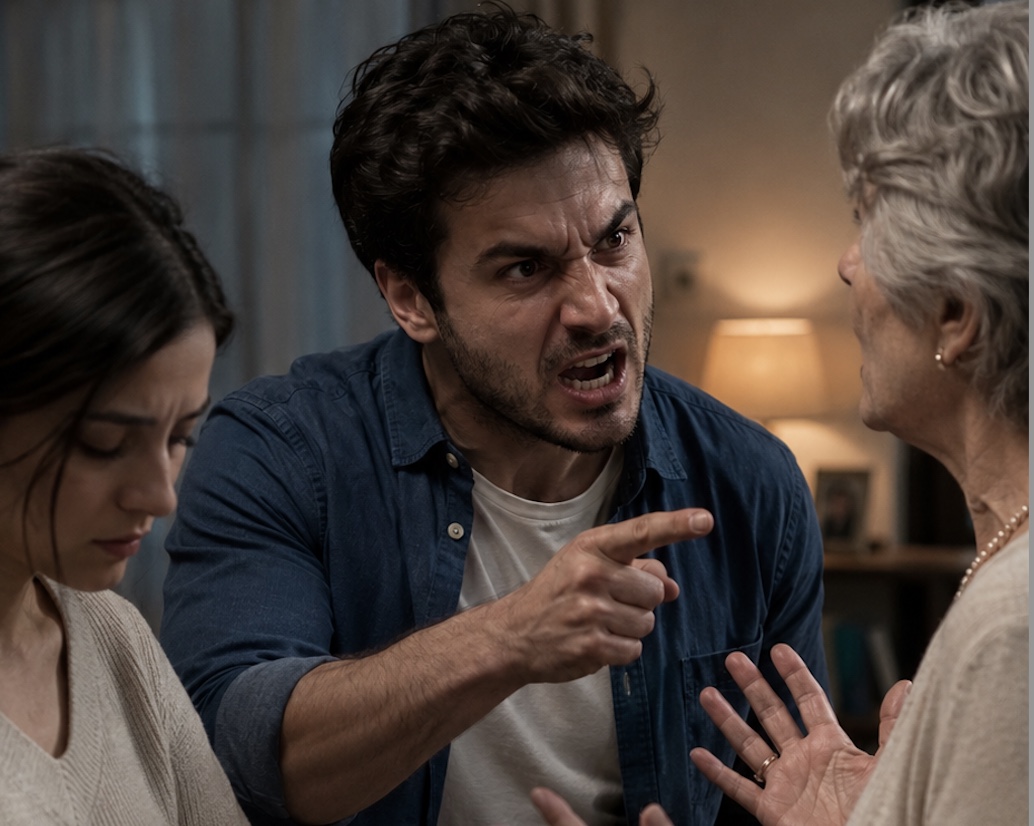
And that was when my mother exploded.
She rushed toward me so quickly that for a second I thought she was going to hit me. Her face turned red, her eyes looked completely unfamiliar, and she screamed at me — in my own home, at my own table, in front of my husband, who heard every word.
“You! Don’t you dare! You greedy, cold-hearted, worthless girl! We raised you, and now you think you’re better than us! Ungrateful! You would begrudge your own brother a piece of bread! How dare you even open your mouth after everything we’ve done for you!”
I froze.
My mind went empty, like a phone whose battery had suddenly died.
She had never spoken to me like that before.
Never.
Lyosha smirked.
My father turned toward the window, as if nothing was happening.
And then the kitchen door opened.
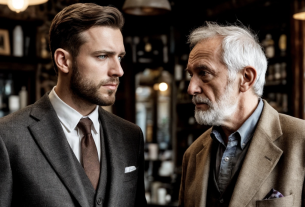
Pasha came out slowly. He always moved calmly, like a large cat. He wiped his hands on a towel, hung it over the back of a chair, and stepped directly between me and my mother.
He was one meter ninety tall, with shoulders like a coat rack. My mother had to tilt her head back to look at him.
At first, he did not shout.
“Ma’am,” he said quietly, and somehow that quietness was more frightening than yelling. “I’m going to ask you to watch your language.”
“Oh, watch my language?” my mother jerked toward him, but didn’t dare come closer. “She is my daughter!”
“Your daughter is my wife,” Pasha said without raising his voice. “And right now, you are standing in our home. The home we bought. With our own money. Money we earned while your son”—he nodded toward Lyosha—“was lying on a couch.”
“How dare you!” my father shouted, jumping up.
“I haven’t even started yet,” Pasha said, turning his eyes toward him.
My father sat back down almost immediately.
And then Pasha roared.
I had never heard him like that before.
“BE QUIET, I SAID!” His voice struck the walls so hard the chandelier trembled. “YOU ARE IN OUR HOME!”
Silence fell.
Complete silence.
Even Lyosha dropped his phone.
Pasha looked at them one by one, slowly. Then he spoke again, almost in a whisper — but that whisper cut sharper than his shout.
“You came into our home. To us. And started insulting my wife. My. Wife. At my table.” He took a step toward my mother, and she stepped back. “You think she owes you something? What do you owe her? You raised a daughter — that was your responsibility, not a paid service. She didn’t sign a contract with you. She owes you nothing. And she owes your son even less.”
“But she’s his sister…” my mother squeaked.
“And he is a grown man,” Pasha said, turning to Lyosha. “You are twenty-five. You are healthy. You are not helpless. Why should I buy you a computer? Why should my wife carry an adult man on her back? Who are you to her? Her child? No. You are a parasite. And I’m saying that to your face.”
Lyosha turned pale.
He opened his mouth, then closed it again.
“And you,” Pasha said, turning back to my parents, “you have been feeding this habit for years. You convinced her that she was obligated. But now she has me. And I will not let anyone hurt her. If you ever come here again with demands, you will be thrown out. If you ever call her greedy again, I will forget that you are her parents. Do you understand me?”
My father said nothing.
My mother stared at the floor.
I stood behind Pasha and could hardly breathe.
Because no one — no one, ever — had defended me like that.
All my life I had believed love meant giving. That if I didn’t give money, I was a bad daughter. That if I refused my brother, I was selfish. I had grown so used to their voices being louder than mine that I had forgotten something very simple: I had my own home now. And my own family.
Pasha took my hand.
His palm was hot.
“And now,” he said calmly, as if nothing extraordinary had happened, “I’m going to ask you to leave. Tea is over.”
They left without a word.
Lyosha went first, without even saying goodbye. My father followed him, pulling on his jacket. My mother lingered at the doorway and looked at me. There was something in her eyes — shame, anger, confusion, maybe all of it at once — but she didn’t say anything.
Then the door closed.
I stood in the middle of the living room, shaking.
Not from cold.
From the feeling that something inside me had turned upside down.
Pasha came over, wrapped his arms around me, and held me close.
“How are you?” he asked into my hair.
“I…” My voice was hoarse. “I don’t know. I’m scared. They’ll never forgive this.”
“You don’t owe them forgiveness,” he said, kissing my temple. “Do you hear me? Not a single coin. Not a drop of guilt. You are my wife. And I won’t let anyone hurt you. Even if those ‘anyones’ are your mother and father.”
I burst into tears.
For the first time in many years, not from helplessness — but from relief.
That evening, we ordered pizza, watched a stupid movie, and didn’t discuss anything.
The next day, my mother sent me a message:
“You could have answered us yourself instead of hiding behind your husband. We are still your parents, after all.”
I deleted it.
And I didn’t reply.
Because Pasha was right.
This is our home.
And people who come here with shouting and demands no longer have the right to call themselves family.
Family is not the people who demand from you.
Family is the person who stands at your back when you have forgotten what it feels like not to be afraid.
And I was not afraid anymore.
For the first time in my life.