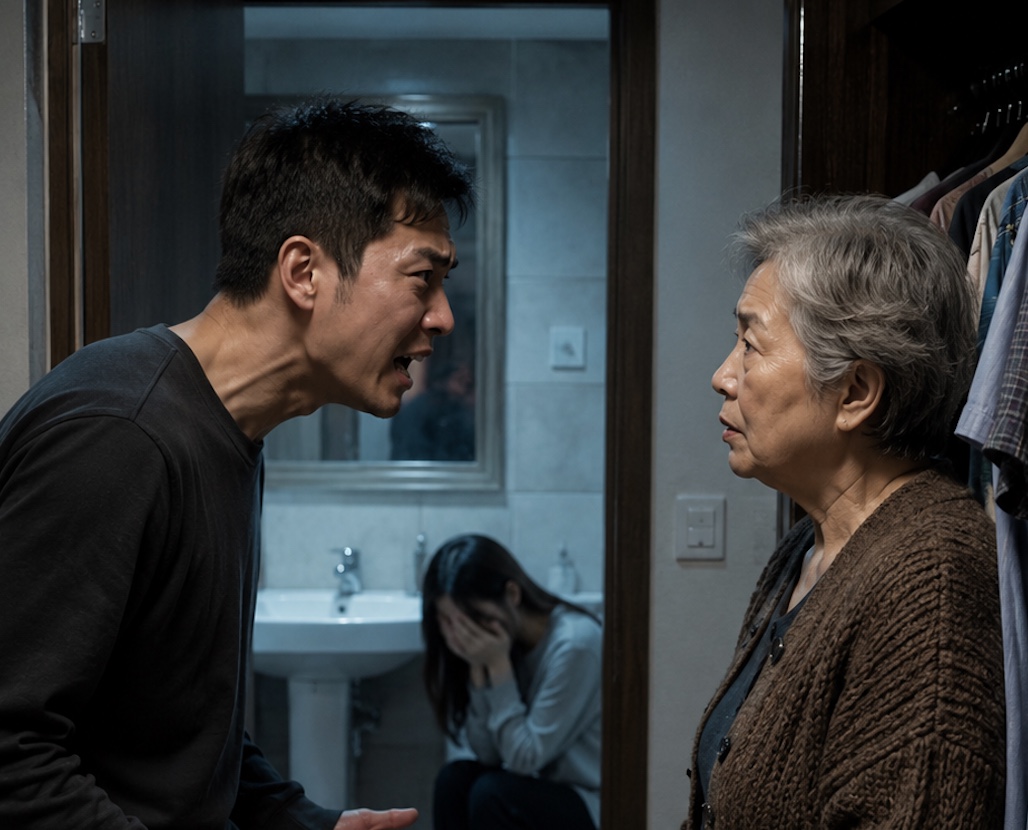
“What is this supposed to be?!”
Dinner did not begin with the clinking of cutlery, but with the rustling of plastic bags. Instead of sitting down at the table, Valentina Sergeyevna stood by the open kitchen cabinet, towering over her son and daughter-in-law like a monument to perfect order. The kitchen smelled less of fried potatoes and more of sterile hospital cleanliness — a mix of bleach and lemon air freshener that her mother-in-law sprayed every two hours.
“Dasha, you bought rice in a soft package again,” Valentina Sergeyevna said evenly. There was no open aggression in her voice, only the tone of a doctor informing a patient about an advanced cavity. “I told you, bugs appear in those bags. Warehouses are completely unsanitary.”
Dasha froze with her fork halfway to her mouth. The potatoes she had fried half an hour earlier, hurrying to have dinner ready before her husband came home, suddenly seemed bland and cold. She slowly placed her fork on the edge of her plate.
“It was the only rice at the store near our building, Valentina Sergeyevna. And we’ll eat it within a week. Nothing will have time to grow in it.”
“Optimism is wonderful, but pantry moths don’t ask about your plans,” her mother-in-law replied.
With one swift motion, she cut open the package with scissors and began pouring the rice into a glass jar with an airtight lid. In the quiet kitchen, the sound of grains falling into the jar seemed deafening, like hail beating against a roof.
“I labeled the jars with a marker so you won’t confuse long-grain rice with parboiled rice. Order on the shelf means order in the stomach.”
Ivan, sitting across from his wife, lowered his eyes to his plate and tried to make himself invisible. He chewed quickly, barely looking up. All he wanted was to eat after his shift, but the atmosphere at the table was thick as jelly.
“Mom, sit down already and eat,” he muttered with his mouth full. “The potatoes are getting cold. Dasha made them well, with onions, just how you like them.”
“I can’t eat when there’s chaos around me, Vanya,” Valentina Sergeyevna said, slamming the cabinet door shut and immediately opening the refrigerator.
The second act of the performance began — the inspection of perishable food. Her mother-in-law moved like an experienced inventory clerk searching for missing stock. She pulled out food, turned it over in her hands, sniffed it, and wrinkled her nose with disgust.
“Tell me, Dasha, how many days old is this cheese?” she asked, holding a piece of Russian cheese wrapped in plastic film between two fingers as if it were a dead mouse.
“Two days. We opened it on Monday.”
“It has suffocated. Look at the edges. They’re whitish. Plastic wrap is death for cheese. Cheese needs to breathe. I gave you a special ceramic cheese box. Where is it?”
“It’s bulky. It takes up half the shelf,” Dasha answered quietly, feeling a dull irritation begin to boil inside her. “It’s more convenient for us in plastic wrap.”
“Convenience should never come at the expense of health,” her mother-in-law shot back. “I’m throwing this away. The last thing you need is mold. Treatment is expensive these days, and you have a mortgage coming up — assuming Vanya gets his bonus, of course.”
The dull thud of the cheese hitting the bottom of the trash bin sounded like a verdict. Next came the opened carton of milk — “open for more than a day, already a bacterial broth” — and half a lemon — “dried out, no vitamins left, only acid.”
Dasha stared at the trash bin. Their money was lying there. Their breakfast. Their right to decide what to eat and how to store their food.
She looked at her husband. Ivan was carefully spreading butter on bread, pretending to be deeply interested in the pattern on the tablecloth. He had chosen the ostrich strategy: if he did not look at the problem, maybe his mother would calm down and sit down for tea.
“And this too,” Valentina Sergeyevna said, walking to the sink and picking up the dish sponge. “Dasha, how many times have I told you? A sponge must be changed every three days. Salmonella collects in the porous structure.”
“I changed it yesterday morning,” Dasha said, her voice harder now. “It’s new.”
“It smells damp. That means you don’t squeeze it out properly. Moisture is a breeding ground for microbes. I’ll throw it away. Take a new one from the pack. I bought antibacterial ones for you. They cost more, but health is more important.”
The nearly new sponge flew into the trash.
Dasha pushed her plate away. Her appetite was gone completely. She no longer felt like the mistress of the kitchen, not even like a guest, but like a careless servant being scolded for poor work. Every movement her mother-in-law made, every jar she shifted from one place to another, felt like a tiny act of aggression disguised as care.
“Thank you, I’m full,” Dasha said, standing up from the table.
“Where are you going? You barely ate,” Ivan said, lifting frightened eyes toward her. He understood the spring was tightening, but he did not know how to stop the mechanism.
“I don’t want any more. I’ll take a shower while you two… make things cozy.”
“Go, dear, go,” Valentina Sergeyevna nodded, already wiping the countertop with a special microfiber cloth. “Just don’t turn the water on too strongly. The meters spin like crazy. And dry your towel properly. Yesterday it was damp. I went in to check. Mold in the bathroom is harder to get rid of than cockroaches.”
Dasha left the kitchen, feeling that heavy, assessing gaze on her back. She knew that as soon as the door closed, Valentina Sergeyevna would start washing the dishes again because Dasha “didn’t rinse off the detergent thoroughly enough.” And Ivan would sit there listening to a lecture about how important it was to organize household life properly if one wanted to live long.
In the hallway, Dasha pressed her forehead against the cool wall. She wanted to scream, but she only clenched her fists. This was their home, yet there was less and less room for them in it every day. Her mother-in-law was not merely cleaning the apartment — she was methodically erasing every trace of other people’s habits, smells, and lives, centimeter by centimeter.
Dasha went into the bathroom and locked the door behind her. That click of the latch was the only sound in the apartment that gave her the illusion of safety. Here, among the tiles and the sound of running water, was her last fortress.
She went to the sink, wanting only to wash her face and rinse away the sticky feeling of someone else’s presence. But her hand froze in the air before reaching the shelf with her cosmetics.
The shelves were empty. Or rather, they were not empty — but her life was no longer on them.
The colorful jars of creams had vanished. The tubes she had arranged in a way that was convenient for her were gone. The micellar water she always left open had disappeared. Instead of her usual creative mess, there was a frightening symmetry. Every bottle was lined up by height, labels facing forward like soldiers on a parade ground. The toothbrushes stood in the cup at perfectly even angles, not touching one another with their bristles.
Dasha opened the cabinet under the sink. There, in a plastic container from IKEA, lay all her cosmetics, dumped into a pile.
“What’s taking you so long in there?” Ivan’s muffled voice came from behind the door.
Dasha did not answer. She took out her favorite moisturizer. The lid had been screwed on so tightly that the plastic had turned white. Someone clearly believed she did not close her things tightly enough.
But the worst part was not the rearranging. The worst part was realizing that someone else’s hands had touched every item, judged it, wiped it, and decided whether it deserved to remain in plain sight.
She left the bathroom, feeling a string inside her tightening. She needed to change clothes. To take off her office clothes, put on a home T-shirt, and hide under the blanket.
The bedroom door was slightly open.
Valentina Sergeyevna was standing by the dresser. The very dresser where Dasha kept her underwear. The top drawer was pulled out all the way. Her mother-in-law was holding Dasha’s lace panties — black, delicate, bought for a special occasion.
She was not just holding them. She was stretching the waistband, testing its strength, and lifting the fabric to the light as if searching for holes.
“Valentina Sergeyevna, what are you doing?” Dasha’s voice trembled — not from fear, but from disgust. It felt as though she had been stripped naked in the middle of a crowded square.
Her mother-in-law slowly turned her head. There was not a trace of embarrassment on her face. Only practical concern.
“Oh, you’re already out. Good. Dasha, we need to have a serious talk about your wardrobe,” she said, carefully placing the underwear back into the drawer — not carelessly, but folded into a tight little roll. “I decided to apply the vertical storage method. It fits thirty percent more, and you can immediately see where everything is.”
“That is my underwear,” Dasha whispered, stepping closer. “You have no right to touch it.”
“I’m not touching it. I’m optimizing the space,” Valentina Sergeyevna replied calmly. “Besides, I noticed almost all of it is synthetic. That’s harmful for women’s health. A greenhouse effect, no ventilation. I put aside the things that absolutely cannot be worn. They’re in the bag. I’ll use them as rags or throw them out.”
Dasha looked down at the floor. Near her mother-in-law’s feet stood a black trash bag, and through it she could see the straps of her bras.
“Vanya!” Dasha shouted without taking her eyes off the bag. “Vanya, come here!”
Ivan appeared in the doorway a second later, chewing an apple. He saw the open dresser, his mother standing over his wife’s underwear, and Dasha’s pale face. The apple stopped crunching.
“Mom? What are you doing here?” he asked, taking a step forward and realizing that the situation had gone beyond awkward. It had become something pathological.
“Ivan, tell your wife not to be hysterical,” Valentina Sergeyevna said calmly, taking another pair of panties from the drawer and beginning to fold them into a triangle. “I’m organizing the underwear drawer. It was a complete mess. Things were lying in lumps. I washed everything on a delicate cycle because, judging by the smell of fabric softener, Dasha pours it by the liter, and that’s an allergen.”
“You… you washed my underwear?” Dasha leaned against the doorframe. The air in the room suddenly seemed catastrophically thin.
“Of course. By hand, with baby soap. The washing machine ruins lace, though this lace is cheap anyway. China, probably. Threads sticking out everywhere. I cut off a couple of loose threads, by the way.”
Ivan looked at his mother’s hands. In them, as if it were something ordinary, lay his wife’s intimate life, turned into a household object. A shiver went through him. For the first time, he did not see it as “Mom’s care.” He saw it as something unnatural.
“Mom, please put the things back,” he said quietly. “This is too much. You can’t go through someone’s underwear. It’s… personal.”
“Personal is when your underwear is in your own pocket, Vanya. When it’s lying in my house, in a shared dresser, it becomes a matter of hygiene and aesthetics,” Valentina Sergeyevna snapped. “I don’t want you getting moths or dust mites. I removed the unnecessary things. I bought organizers with compartments. Look how convenient it is. Every pair has its own little home.”
She pulled the drawer out farther. There, in gray fabric compartments, lay panties and socks sorted by color. It looked like a store display, but the sight gave off the coldness of a grave.
Dasha stepped toward the dresser, sharply snatched the underwear from her mother-in-law’s hands, and threw it inside.
“Get out,” she said. “Get out of our bedroom. Right now.”
Valentina Sergeyevna raised her eyebrows as if she had just heard a stool speak.
“Lower your tone, dear. I only want what’s best for you. You’re young, foolish, and you don’t understand how to run a household. Without me, you’ll be buried in filth.”
“Mom, leave,” Ivan said, approaching his mother and taking her gently but firmly by the elbow. “Please. We can handle our socks and underwear ourselves. Go drink some tea.”
“I haven’t finished,” Valentina Sergeyevna resisted. “There’s still the bottom shelf with your T-shirts. You fold them wrong. They get wrinkled.”
“Mom!” Ivan shouted.
It was so unexpectedly loud that the hallway seemed to echo.
Valentina Sergeyevna pulled her arm away. She straightened her flawless house robe, looked at her son with offended virtue, and then shifted her gaze to Dasha.
“You two are so nervous. I’m telling you, it’s because of the synthetic fabric. The skin can’t breathe, and that’s why you’re so irritable. By the way, I put cotton bedding on your bed instead of that silk nonsense. Slippery, uncomfortable, and vulgar-looking. Sleep on something proper.”
She turned and left the room, leaving the door wide open.
Dasha stood there staring at the “optimized” drawer. It felt as though she had been turned inside out and folded into that organizer too. She grabbed the bag of “rejected” underwear, pressed it to her chest, and walked to the bathroom.
“Dasha…” Ivan began.
“Don’t,” she said without turning around. “Just don’t.”
The bathroom door clicked again. This time, the sound was like the cocking of a gun. Dasha turned the water on full blast so the stream would drown out her sobs, but Ivan, left standing in the perfectly cleaned bedroom with someone else’s bedding, heard them anyway. Or thought he did.
He looked at his T-shirt, which his mother had probably also planned to “optimize,” and felt nausea rise in his throat.
Night brought no relief to the apartment. The silence that should have been saving felt thick and cottony, as if the walls were absorbing every sound only to send it later to the control center — Valentina Sergeyevna’s room.
Dasha lay turned toward the wall, covered with the blanket up to her head. She was afraid to move, afraid the creak of the bed would become a reason for another inspection. Ivan lay beside her, staring at the ceiling, where dust motes danced in the strip of light from the streetlamp — the only thing in this house that moved chaotically and without control.
“Vanya,” Dasha whispered, barely audible, without emerging from under the blanket. “I can’t do this anymore. It feels like my skin is itching from this bedding. Or from her eyes.”
“Endure it a little longer, Dasha,” he whispered back, placing his hand over hers on top of the blanket. “She’s just lonely. She needs time to get used to the fact that we live by our own routine. Tomorrow I’ll talk to her about the closets. I promise.”
“You promised that a week ago.”
Ivan said nothing. He had no answer. He felt like a tightrope walker balancing over a chasm. On one side was his love for his wife; on the other, the paralyzing habit of obeying his mother’s authority, always served under the sauce of “unconditional love.”
At that moment, the door handle slowly moved downward.
No knock. No question of “May I come in?” The door simply opened, letting a sharp light from the hallway into the bedroom’s darkness.
Dasha instinctively curled into a ball and held her breath. Ivan sat up abruptly in bed, squinting against the light.
Valentina Sergeyevna entered the room as if it were her private office and the sleeping people were simply part of the interior, like a sofa or floor lamp. She was wearing a nightgown and the same robe, buttoned all the way up.
“Mom?” Ivan’s voice sounded hoarse. “What happened? It’s two in the morning.”
Valentina Sergeyevna did not even look at him. She walked straight to the window, slippers slapping against the floor.
“A draft,” she declared firmly. “I can hear it whistling through the cracks. You’ll freeze your kidneys, and then you’ll be running to doctors with my money.”
She went to the window and began tugging at the thick curtains, checking whether they lay tightly against the windowsill. The sound of fabric moving in the nighttime silence was like metal scraping.
“Mom, there is no draft. We closed the window. Please leave, we’re sleeping.”
“You’re not sleeping, you’re whispering,” she said, running her hand over the windowsill and then touching the radiator. “Dry. The air is too dry. I told you, you need a humidifier. Dasha, do you hear me? That’s why your hair splits — not enough humidity.”
Dasha did not answer. She lay motionless, pretending to be asleep, though her heart was pounding so hard she could hear it in her ears.
Valentina Sergeyevna stepped away from the window, but she did not go toward the door. Instead, she turned to the wardrobe standing against the wall across from the bed.
“I need a blanket,” she announced to the room. “The checkered one. My room is chilly, and I protect my joints. Of course, you probably shoved it into the farthest corner, like all normal things.”
“Mom, take any blanket from the living room!” Ivan was no longer whispering. He put his feet on the floor, feeling a hot wave of anger rising inside him. “Don’t rummage through our wardrobe at night!”
But the wardrobe door had already slid aside with a soft rumble. The hallway light fell onto the shelves. Valentina Sergeyevna began methodically shifting stacks of sweaters and jeans, searching for “that very” blanket, though she knew perfectly well it was in the sofa in the living room.
“What a mess…” she muttered under her breath. “Pilled clothes. Sleeves not straightened. Dasha, how do you fold turtlenecks? The neck will stretch.”
She pulled at the edge of a box standing on the upper shelf. It was an old shoebox covered in gift paper. Dasha’s private box. There were no shoes inside. It held letters Ivan had written to her during business trips, tickets from their first travels, and printed photos they did not want displayed.
“Don’t touch that!” Ivan shouted, jumping to his feet.
Too late. Valentina Sergeyevna had already lifted the lid.
“What is all this waste paper?” she asked, bringing a photo closer to her eyes. In it, Dasha and Ivan were making silly faces on a beach. “Good Lord, Dasha, look at yourself. That swimsuit is digging into your sides. And you, Vanya? What kind of grimace is that? Is this how an engineer should look? Disgraceful. If someone saw this…”
“No one is supposed to see it except us!” Ivan rushed toward his mother and tried to snatch the box away, but she clutched it with unexpected strength.
“I’m just checking what kind of junk you keep. A dust collector. Paper collects mites,” she said, pulling out a folded sheet of paper.
It was one of those letters — intimate, silly, and tender — the kind people write only at the beginning of a relationship.
She unfolded it.
Ivan froze. Dasha finally sat up in bed. The blanket slipped down, revealing her trembling shoulders.
“My sweet little baby bear…” Valentina Sergeyevna read aloud with absolute, icy contempt. “Seriously? Vanya, you allow yourself to be called a baby bear? A man? This is degradation. Kindergarten, honestly. I thought you had a serious relationship, but this is just… vulgarity.”
“Put it back,” Dasha said quietly. Her voice sounded like ice cracking. “Put it back right now.”
“I’ll put it back when I finish organizing,” Valentina Sergeyevna said, tossing the letter into the box with disgust, as if it had dirtied her hands. “This should be burned. Grown people wasting time on nonsense. You’d be better off thinking about the mortgage instead of writing silly notes. And by the way…”
She turned back toward the depths of the wardrobe, still holding the box.
“I was looking for the blanket and found this.”
From under a stack of sweaters, she pulled out a small, pretty box. A pregnancy test. Positive.
The very one Dasha had taken two days earlier and had planned to show Ivan in a special moment, at the restaurant she had booked for Friday.
Silence fell over the room — so thick and heavy it felt as if the air had turned to concrete.
“So that’s why my food makes you nauseous,” Valentina Sergeyevna said slowly. “And I thought you were just being picky. So, you got yourself knocked up.”
Ivan looked at Dasha. His eyes widened. He looked at the test in his mother’s hand, then back at his wife. Joy, shock, and horror at the way he had learned the news mixed on his face into a terrible mask.
“Dasha?” he breathed.
“Congratulations,” his mother said dryly, throwing the test back into the wardrobe like a used tissue. “Now it’s clear why you’re so hysterical. Hormones. But don’t worry, I’ll take the upbringing into my own hands. Otherwise, the child will grow up into the same little baby bear, completely unfit for life. You two can’t be trusted with children. You can’t even fold socks properly.”
Dasha stood up. She was no longer trembling. She walked over to Ivan, who stood in the middle of the room crushed by the scene, and looked at him.
There were no tears in her eyes. Only the emptiness of scorched earth.
“She found out before you,” Dasha said in a dead voice. “She stole even this from us.”
Valentina Sergeyevna snorted and finally closed the wardrobe door.
“Don’t be dramatic. I simply found an item. If you scatter intimate things anywhere, be prepared for someone to come across them. And besides, it’s stuffy in here. I’ll bring the watering can. I think the soil in the pots on the windowsill is dry.”
“There are no pots here, Mom,” Ivan said, staring at one point.
“Then there will be. I’ll bring them. And water them. The atmosphere in here is… unhealthy.”
She turned and left, leaving the door open. The hallway light hit their eyes, illuminating the ransacked wardrobe, the open box of letters, and the ruined life that five minutes earlier had still seemed whole.
Ivan heard water running in the kitchen. His mother was filling the watering can. She was really going to come back.
Ivan stared at the empty doorway where his mother had just disappeared. In his usually calm, rational mind, something clicked. It was the sound of a snapped cable — one that had held for years the bridge between filial duty and common sense.
He looked at Dasha. She was sitting on the edge of the bed, arms wrapped around herself, staring into nothing. There was no hysteria in her eyes, only the dull, hopeless exhaustion of a person whose most private secret had been gutted and put on display, after first being evaluated for usefulness.
“Go wash your face,” Ivan said quietly. His voice sounded strange, metallic. “Dasha, go to the bathroom. Pack your toothbrushes, toothpaste, your creams. Everything that fits in the toiletry bag. Quickly.”
“Why?” Her lips barely moved.
“Do what I’m saying. Please.”
Like a puppet, Dasha stood and dragged herself toward the bathroom connected to the bedroom. A second later, the sound of running water came from inside, followed by a muffled sob that she immediately buried in a towel.
Ivan yanked the suitcase from under the bed. He opened it without caring that its wheels scratched the parquet.
At that moment, shuffling steps sounded in the hallway. Valentina Sergeyevna was returning. In her hands, she held a plastic jug of water.
She entered the room with the expression of a victor ready to show mercy to the defeated.
“I brought settled water,” she announced, heading toward the empty windowsill. “If you don’t have flowers, I’ll water the air. The humidity will rise.”
She tilted the jug and splashed some water directly onto the windowsill, then onto the floor, pretending to aim at invisible pots. A puddle spread across the laminate like a dark stain.
Ivan straightened. He threw a stack of his T-shirts into the suitcase without folding them, then turned to his mother. His face was white as chalk.
“Mom,” he began, and there was no warmth left in that word. “Put the jug down.”
“Don’t order me around. I know better how to humidify a room,” she muttered without looking at him. “And what is that suitcase? Are you going on a business trip in the middle of the night? Don’t make me laugh. Dasha needs rest, not being shaken around on a train.”
Ivan stepped toward her, blocking her path to the wardrobe, where she was probably about to search for a cloth to wipe up the very puddle she had made. He looked directly into her eyes, and for the first time that evening, Valentina Sergeyevna took a step back.
“Mom, you entered our bedroom without knocking for the third time tonight to water flowers that don’t exist! You are digging through my wife’s clothes in the wardrobe! This is too much! My wife is crying in the bathroom! I love you, Mom, but we cannot live like this! We’re moving out right now!”
Valentina Sergeyevna froze. The jug tilted in her hand, and a thin stream of water poured onto her perfectly ironed robe, but she did not even notice.
“What nonsense are you talking about?” Her voice trembled, then immediately hardened into steel. “Moving out? Where? At night? With a pregnant wife? Have you lost your mind, Ivan? This is my apartment, my home. I set the rules of hygiene and order here. Without me, you’ll be covered in moss within a week!”
“Then let it be moss,” Ivan said, returning to the suitcase and beginning to shove in Dasha’s things: jeans, sweaters, the very “wrongly folded” underwear. He threw everything into one chaotic pile — a chaos that was worse than death to his mother. “We’ll get a hotel. Tomorrow we’ll find an apartment. Any apartment. Even a basement, as long as it has a lock on the door that only we can open.”
Dasha came out of the bathroom holding her cosmetics bag. Her face was wet, her eyes red, but her gaze had become firm. She walked to the nightstand and swept chargers and documents into a bag.
“Dasha, tell him!” Valentina Sergeyevna turned to her daughter-in-law, searching for an ally in her victim. “Tell this idiot you can’t leave! You need a routine, a proper diet! I’ve already made a menu for the week! Who will steam your food for you? Him?”
“I’d rather eat dry crusts, Valentina Sergeyevna,” Dasha said quietly but clearly, zipping up her bag, “than choke down your soup under your microscope.”
“Oh, so that’s how it is…” Red blotches spread across the older woman’s face. “There’s gratitude for you. I accepted you. I took out my best plates for you. I washed your dirty underwear by hand so you, you slob, wouldn’t catch an infection. I warmed a snake at my breast!”
“Enough!” Ivan roared. He slammed the suitcase shut and pulled the zipper closed. The sound was sharp and final. “Not one more word about Dasha.”
He picked up the suitcase and slung his laptop bag over his shoulder. Dasha threw a coat over her home clothes. They did not change. They were fleeing as people flee a burning house, saving only their lives.
“If you walk out that door now,” Valentina Sergeyevna hissed, her voice like a nail scraping glass, “you can forget about coming back. I’ll change the locks. I’ll unregister you, Ivan. You are no son of mine if you choose this… defective girl and her spawn over your mother!”
Ivan stopped in the bedroom doorway. Slowly, he took a bunch of keys from his pocket — the same keys with the little teddy bear keychain his mother had given him when they moved in.
He opened his fingers. The keys fell to the floor, straight into the puddle of water Valentina Sergeyevna had poured there. Drops splashed onto her slippers.
“We’re not coming back,” he said. “Don’t even hope for it. And you don’t need to change the locks. The road back here is closed to us.”
They went out into the hallway. Valentina Sergeyevna rushed after them but stopped at the boundary of her “sterile zone” — the doormat by the entrance.
“You’ll regret this!” she shouted at their backs as they put on their shoes, fumbling with the laces. “You’ll crawl back when she can’t iron your shirts! You’ll drown in dirt! You are nothing without me!”
Ivan opened the front door. Cool, fresh stairwell air hit their faces, smelling of dust and freedom. To them, that smell seemed sweeter than the most expensive perfume.
“Goodbye, Mom,” he said without turning around.
The door slammed shut.
Valentina Sergeyevna remained standing in the perfectly cleaned hallway. In the silence of the apartment, she could hear water dripping from the kitchen faucet that had not been closed properly. She looked at the puddle by her feet, at the keys lying in the water, and pressed her lips together with disgust.
“Pigs,” she whispered into the emptiness. “Tracked dirt everywhere. Now I’ll have to wash the floor again.”
She turned and went to get a cloth, already planning exactly how she would rearrange the furniture in the freed room to destroy any trace of their presence.
Life was returning to its usual sterile course, where she had absolute control over every speck of dust, and no one dared breathe incorrectly in her presence anymore.
But somewhere at the edge of her consciousness, very deep down, a cold needle of loneliness pricked her. As always, she drowned it out with thoughts of a full cleaning.