Kira bought the apartment when she was thirty-one, after eight years of saving, two rented rooms, and one miserable communal flat where the neighbor behind the wall blasted the radio at full volume every morning at six. The two-room apartment on the second floor, in a quiet neighborhood near the park, had not come to her by chance or inheritance. She had paid for it herself, down to the last coin, and she remembered every month of those eight years: how she gave up trips, how she set aside money from every paycheck, how she once sold her car just to cover the final missing amount.
When she signed the purchase agreement, her hands trembled — not from fear, but from that feeling that comes only once in life: when something huge, something you have worked toward for a long and difficult time, finally becomes yours.
She remembered leaving the bank, walking to the nearest bench, sitting down, and simply staring at the keys in her hand. Ordinary keys. Two of them on a ring. Nothing special at first glance. But they were keys to her door, her lock, her apartment — and that changed everything.
People passed by. Someone was talking on the phone, someone was carrying heavy bags, and no one even looked in her direction. But inside her, something quiet and enormous was happening, something that did not need witnesses. She remembered walking away from the bank, reaching the corner, stopping on the sidewalk, and standing there for several minutes, looking up at the sky. She simply needed somewhere to exhale. Eight years was a long time, and they had finally ended exactly the way she had wanted.
The apartment was hers. Not family property, not something shared, not something bought together with someone else. It was hers personally, purchased before any marriage and before she had even met Maxim. It was a foundation she had built with her own hands. She understood very well what that meant legally, and even better what it meant to her personally.
Since childhood, Kira had watched her mother live in an apartment that had belonged first to her grandmother, then passed to her uncle, and later became the subject of court disputes. Through all of it, her mother had felt like a guest there — someone tolerated out of pity. Kira had promised herself that her life would not be like that. She would live where she chose, in an apartment that belonged to her without conditions, without anyone else’s decisions hanging over her. It was not a whim, and it was not stubbornness for the sake of stubbornness. It was a necessity she understood too well.
Kira was the kind of person who disliked uncertainty — not because she was afraid, but because she was used to clarity. When something was decided, she needed to know it completely, without “maybe” or “we’ll see.” That was exactly why she dealt with documents: not because any threat had appeared, but simply because she wanted everything arranged properly.
Order in paperwork gave her the same feeling as order in her apartment: everything was understandable, everything had its place, nothing unnecessary was lying around. It was not paranoia. It was her way of living.
The day after the paperwork was completed, Kira went back to the lawyer once more — not because she doubted anything, but because she wanted to make sure everything had been done cleanly. The lawyer, an older man with the habit of speaking slowly and only to the point, reviewed the papers, nodded, and said that everything was correct. It could not be challenged. The apartment had been hers, was hers, and would remain hers.
Kira thanked him, stepped outside, and felt what she always felt after making the right decision: not joy, not even relief, but something calm and solid. Like firm ground beneath her feet. She had done what she believed was necessary, had done it properly, and now she could move forward.
She did not tell Maxim about that visit. Not because she was hiding anything — she simply saw no point. It was her matter, she had handled it, and it was closed. Their relationship had always worked that way: each of them dealt with what belonged to their own area of responsibility. Maxim did not ask about her work matters unless she chose to tell him. Kira did not interfere in his work decisions unless he asked for advice. It was not distance. It was respect for boundaries. Sometimes she thought that this was what held them together more strongly than anything else.
Maxim appeared in her life a year after she bought the apartment. They met at a party hosted by mutual acquaintances. He worked for a construction company, spoke little, seemed reliable, and knew how to listen. Kira liked that. After several men who could only talk about themselves — their achievements, their plans, their views on life — a person who could simply sit beside her in silence without making it awkward felt rare.
They began dating. Then he started staying over on weekends. Then he brought some of his things. Then he moved in the rest. It all happened gradually, without loud announcements or grand decisions. At some point, his toothbrush was simply in her bathroom, and his jacket was hanging in her hallway.
A year and a half later, they got married. Quietly, without a lavish celebration: the registry office, a small restaurant dinner for twelve people, and a week by the sea. Kira did not need extravagance. She needed clarity. And she had it.
Their married life was steady. Maxim was a calm man, without demands or tantrums. He worked, came home, did not create scenes, did not start fights. Kira genuinely valued that. She herself was practical, not prone to unnecessary emotions. If something could be solved, it should be solved, not suffered over. If something needed to be discussed, it was better to say it directly than to circle around it with hints and hurt feelings.
That directness sometimes surprised people. Some mistook it for coldness or rudeness. But Maxim had gotten used to it, and it seemed to suit him. He did not need to guess her mood or decode what she meant. She said what she thought and expected the same from him.
About a year after the wedding, Kira started thinking about the documents. Not out of anxiety and not because she distrusted her husband — simply because she was used to keeping things in order. The apartment was her personal property, acquired before marriage, which meant that, formally, Maxim had no rights to it. They lived together, he paid half the utilities, contributed to the household, and Kira decided it would be right to give him some official basis for living there.
Not because he pressured her. Not because he had asked. He had never said anything of the kind. She simply decided it herself, with a clear head.
She thought for a long time about how to do it properly. She spoke with the lawyer she trusted, studied the options, and calculated the consequences of each one. In the end, she decided to draw up a gift deed for a small share — minimal, formal, but legally meaningful. Enough for Maxim to have a registered right to live there. Not enough for him to do anything with the apartment without her consent.
Control remained with her, and she understood that clearly. She had bought the apartment herself, had carried the responsibility for it herself, and she was the one who had to remain its owner. It was not greed and it was not distrust. It was the logic of a person who knew how to think several steps ahead.
She explained it to Maxim briefly: she wanted to transfer a small share to him so that he would have an official right to live there, while everything else would remain hers. He listened, shrugged, and said, “All right, if you think that’s best.”
He did not get into the details. That was typical of him. If Kira had decided something and explained it in general terms, he usually did not demand long explanations. He signed the documents without many questions. Kira placed everything into a folder and put it on the shelf.
She thought that was the end of the story.
She was wrong.
Tamara Sergeyevna, Maxim’s mother, found out about the deal a few days later. Kira still did not know who had told her. Perhaps Maxim had mentioned it casually during one of his conversations with his mother. Perhaps his mother had caught something in his tone when she called to ask how things were going. Tamara Sergeyevna was a woman attentive to details, to words, and to everything that remained unspoken between words.
She called her son every two or three days, asking about his life, work, and apartment. The word “documents” caught her ear, and that was enough for her to decide that she needed to come and see everything herself.
She arrived on Saturday afternoon. She called an hour beforehand and said simply, “I’ll be there.”
Kira hung up and stood by the window for a few seconds. She was not afraid of the conversation. Rather, she understood that it was inevitable, and she was glad it would happen now, while she was calm and prepared, not later, at some inconvenient moment. She went to the kitchen, cleared unnecessary things from the table, and put the kettle on.
Maxim was lying on the sofa with a book. Kira told him, “Your mother is coming.”
He looked up, nodded, and went back to reading. That, too, was typical of him. He did not get nervous in advance. Sometimes Kira envied him for that.
Tamara Sergeyevna did not ask whether it was convenient and did not check whether they had plans. That was her usual style: she did not come to visit; she arrived. Kira opened the door, greeted her evenly, and offered tea. Tamara Sergeyevna accepted, went into the kitchen, placed her bag on a chair, and spent several minutes talking about traffic and how long it had taken her to get there from the other side of the city.
Kira listened and answered briefly. She already understood that the conversation about traffic was only the introduction. The real subject would come later.
And it did.
“Maxim said you had some documents drawn up for the apartment,” Tamara Sergeyevna said once the mugs and sugar bowl were on the table. “Show me what they are.”
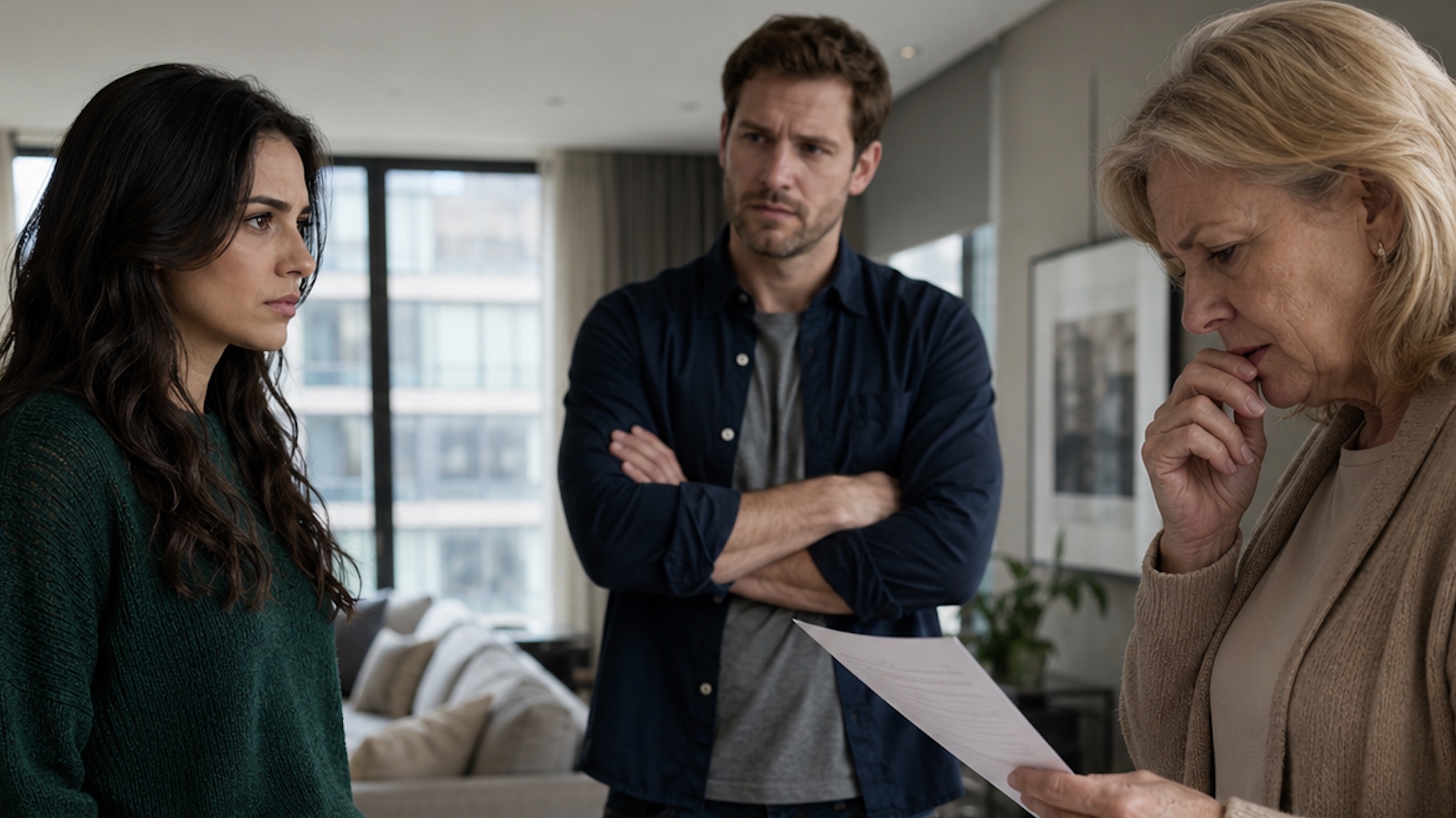
Kira brought the folder. Calmly, without rushing — she kept everything in order. She placed the folder on the table and opened it to the right page. Tamara Sergeyevna pulled it closer and began to read.
She read for a long time. Slowly, carefully, running her finger along the lines, the way people read legal texts when they are not used to them but are determined to understand every word. Sometimes she went back to the beginning and reread certain paragraphs. Her face was focused, and with every minute it grew more tense.
Kira stood beside her and watched. Not anxiously — she simply observed. Maxim sat slightly to the side at the table, scrolling through his phone.
Finally, Tamara Sergeyevna looked up. She looked at Kira the way people look when they expected one thing and received something entirely different.
“Kira, what kind of share is this for my son?” she asked.
Her voice carried exactly what Kira had already seen in her eyes: not confusion and not a real question, but dissatisfaction. The disappointment of expectations that had not been met.
“It’s a gift deed for a share in the apartment,” Kira replied evenly. “It says so there.”
“I can see what it says. I’m asking why it is so small. He lives here. He is your husband. What are these crumbs supposed to be?”
Maxim lifted his head from the phone. For the first time, he looked at the documents properly — not the way he had looked when signing them, skimming over the page, but attentively, with the expression of someone who was only now beginning to understand what the conversation was really about.
“Mom,” he said carefully.
“What, ‘Mom’?” Tamara Sergeyevna did not take her eyes off Kira. “I’m asking a normal question. My son lives in this apartment. You are a family. Why is the share so tiny? Is that fair?”
Kira waited a second. Not because she did not know what to answer — she did. She was simply choosing how to say it. Without excess, without sharpness, but clearly enough that there would be no room for misunderstanding.
“Tamara Sergeyevna,” she said calmly, “this apartment was bought by me before I met Maxim. Before the wedding, before we lived together — long before. It is entirely mine, and legally that is beyond dispute. The share I decided to transfer was my personal decision. I had the right not to transfer anything at all. I chose to transfer exactly as much as I considered appropriate.”
“But since you were transferring something, you could have given more,” her mother-in-law insisted. “At least half. He’s your husband, not some stranger.”
“I transferred exactly what gives him the official right to live here. That is the purpose of this document. I did not plan anything beyond that.”
“Then why even start all this if it’s so little?”
Kira looked straight at her — without irritation, without challenge, simply straight.
“Because I decided to do something for my husband that I considered right. And I did it. Whether you think it is a lot or a little does not concern me. This is my property, and I manage it as I see fit. I do not need anyone’s approval for that.”
The kitchen fell silent. Tamara Sergeyevna stared at her with the expression of someone accustomed to pressure eventually producing a result. She seemed to expect Kira to soften, justify herself, explain more — or at least become nervous. But Kira stood still, without unnecessary movements, without the smile people put on when they want to ease tension while preparing to give in.
“Maxim,” his mother said, turning to her son and searching for support. “Do you understand what this means? You live here. You invest in this home. And you have this.”
Maxim looked at his mother. Then at Kira. Then at the documents. The pause was long.
“Mom,” he finally said, “Kira explained to me how it was arranged. The apartment is hers. She decided what to transfer. I agreed then, and I agree now.”
“That’s because you didn’t understand it then!”
“Or because I trust my wife,” he replied quietly, without hesitation.
Tamara Sergeyevna opened her mouth, then closed it. She looked back at the papers, as though hoping to find something there that would change the situation. But the documents were the same. The letters did not rearrange themselves, and the conditions did not change simply because she refused to accept them.
“I just don’t understand,” she said at last, now more quietly, without her earlier force. “You could have done it properly. Like family.”
“Like family is exactly how it was done,” Kira said. “I gave my husband an official right to live in my apartment. That is family. Everything else is your expectation, Tamara Sergeyevna. My obligations here are different.”
Her mother-in-law found nothing more to say. It was not surrender exactly. It was more like the pause of a person who had run into a wall and realized there was no point in striking it again. Tamara Sergeyevna was an intelligent woman. She knew where she could push and get results, and where pressure would only strengthen the other person’s position.
This was that kind of case.
Kira was not angry, not defensive, not apologetic. She simply stood there and stated facts. It is impossible to argue with such people because they do not give emotions for others to grab onto.
Tamara Sergeyevna finished her tea, which had gone completely cold by then, glanced once more over the documents — now without the narrowed eyes with which she had studied them at first — and closed the folder. She did not touch it again.
The conversation was over.
Tamara Sergeyevna remained in the kitchen for another twenty minutes, talking about unrelated things: the country house, the neighbors, how the windows should probably be replaced before winter. Kira answered shortly and politely. Maxim warmed up the tea, placed cookies on the table, and sat beside his mother.
Everything looked peaceful.
But the topic of the share — a larger share, a fair share — was not raised again that evening.
Nor afterward.
When her mother-in-law left, Kira put the folder back in its place, rinsed the mugs, and wiped the table. Maxim stood in the kitchen doorway, watching her.
“Are you angry?” he asked.
“No,” she answered honestly. “A little tired. But not angry.”
“She didn’t mean harm. She’s just worried about me.”
“I understand,” Kira said.
And it was true. She did understand. A mother wants her son to have more, to be protected. That is a normal desire. But trying to secure that protection at the expense of someone else’s property — that was another matter entirely.
“You explained everything correctly,” Maxim said after a pause.
Kira looked at him.
“Do you really think so, or are you just trying to calm me down?”
He did not answer immediately. He was silent — not avoiding the question, but thinking.
“I think so,” he finally said. “It’s your apartment. You worked for it for eight years. No one has the right to tell you how much of it you should give away.”
Kira nodded. She did not become emotional, did not break into a smile. She simply nodded. Sometimes that is enough.
The folder with the documents lay on its shelf. The share remained exactly as it had been — small, precisely calculated, arranged exactly the way Kira had considered right. No more and no less. And the question of Maxim having been given too little never came up again — not during Tamara Sergeyevna’s next visit, not in phone calls, not in any other form. It was as if that Saturday conversation had never happened. Or perhaps it had happened, but had put everything in its proper place, and that was enough.
Life went on.
Kira remained the owner of her apartment — not because she wanted power over her husband, but because she believed it was right to preserve what she had built herself. This was her foundation. She had never asked anyone to divide it. And she had no intention of giving it away on someone else’s instructions.
Tamara Sergeyevna made a few other attempts — not as direct, but still noticeable. A couple of times she began conversations about how young people should think about the future, how anything can happen in life, how things should be arranged so that no one regrets anything later. Kira listened and noticed the same thing every time: beneath those general words there was always one specific intention — to get the share reconsidered.
But she never allowed the conversation to drift where it was being pulled. She answered calmly, changed the subject, or simply said, “Maxim and I have discussed everything. Everything is fine with us.”
That phrase, spoken in an even voice, was usually enough to stop the matter from going further.
Maxim almost never interfered in those conversations. Kira did not resent him for it. She understood that it was difficult for him to take sides when his mother was on one side and his wife on the other. He stayed neutral and silent.
But once, when they were alone and Kira asked him directly, “How do you really feel about all this?” he answered without pause:
“I think you did the right thing. The apartment is yours. You decide.”
Then he added quietly:
“I’m not going to demand anything. You know that.”
Kira looked at him and nodded.
She knew.
Sometimes, in the evenings, when the apartment was quiet and Kira sat by the window with a cup of tea, she thought about how easily people begin to reason about what belongs to someone else. How quickly another person’s property becomes “shared” in their eyes if someone close to them is nearby.
Tamara Sergeyevna was not an evil person. She was simply used to believing that if something concerned her son, then it concerned her too. Kira did not agree with that. Quietly, calmly, without scandal — she simply did not agree, and that was all.
One day, after everything had settled down, several weeks after his mother’s visit, Maxim asked her:
“Do you regret arranging it that way?”
Kira thought for a second — not because she doubted herself, but because the question was honest and deserved an honest answer.
“No,” she said.
Then she added:
“Do you?”
He shook his head.
“No.”
They sat in silence for a while. Sometimes the most important conversations look exactly like that — short, without unnecessary words, and all the more precise because of it.
Some things are easiest to understand in hindsight. Kira thought more than once that if she had given in back then — not to crude pressure, but to quiet, almost invisible pressure in the form of questions and hints — it would never have ended. Give in once, and that becomes the starting point: you agreed before, so you can agree again.
She had seen how that worked. She had watched other people say, “So what? It’s a small thing. Why fight over it?” And then it turned out that a whole life had been built out of such small things.
Kira did not want that life.
So whenever someone tried to move her boundary — whether harshly or gently — she simply stood her ground. Silently, calmly, without drama.
She stood there, and that was all.
The documents remained on the shelf. Everything had been arranged correctly. And if anyone ever tried to raise the question of the share again, Kira already had her answer.
The same answer as before.
In an even voice, briefly, without unnecessary words.
Because her position was simple and steady — just like that apartment on the second floor near the park, the one she had once bought entirely on her own.