Olga bought the apartment when she was twenty-eight, and it was probably the only major thing in her life that she had done entirely for herself, without looking back at other people’s advice or expectations. It was a two-room apartment on the fifth floor of a brick building, with separate rooms and a small storage closet where she immediately put up a shelf for her books.
The ceilings were high, the windows looked out onto a courtyard with chestnut trees, and in the mornings the bedroom was so quiet that she could hear a balcony door slamming somewhere far away. Olga remembered the first time she crossed the threshold of that apartment with the keys in her hand. It was still empty then, smelling of fresh plaster and renovation dust, and she felt something simple and important — something she could not immediately name. Later, she found the word for it: freedom. Not loud, not revolutionary, but quiet and real, like the right to decide for herself where the sofa should stand.
She spent almost a year and all her savings on the renovation. She painted the walls herself, chose tiles slowly and carefully, dragged rolls of linoleum home from the market, and argued with the plumber about the pipes. Her friends laughed and said, “Ol, just find yourself a husband already. Why do you need to do all this alone?” Olga laughed back, but she did everything her own way. By the time the last lamp appeared in the hallway and proper curtains finally hung on the windows, she felt something close to completeness. This home was hers. Not temporary — real.
Igor had grown up in a family where his mother made the decisions. It wasn’t obvious right away, but Olga understood it during the first year of their relationship: when he called his mother before buying a new jacket, when he asked her advice about whether to change jobs, when he mentioned her opinion in conversations as if it were the final argument. Olga did not judge him for it. People grow up inside the systems they are raised in. But she understood that if she said nothing, that system would eventually spread to her too. She would also be pulled into the circle of things Lidia Pavlovna believed she had the right to comment on. And the apartment — her apartment, bought before him, before the wedding, before everything — would end up inside that circle as well.
Olga had never considered herself someone who defended her boundaries easily. Quite the opposite: for a long time, she had been the kind of person who preferred to stay silent just to avoid creating tension. Her childhood had taught her that, as had several years working in a team where open conflict was considered bad manners. She knew how to agree, how to give in, how to find compromise even where, in truth, there was none. But the apartment stood apart in her life. It was not simply property. It was proof of something she could present only to herself: that she could do it. That she had managed. That she did not need to wait for someone to help her or give her permission.
Igor came into her life a year and a half after she moved in. They met through mutual acquaintances, then crossed paths by chance a few more times, and then began dating — carefully, without grand declarations, like people who were already a little tired of loud promises. Igor was calm, reserved, worked as an engineer at a factory, and never pretended to be someone he wasn’t. Olga valued that. During the first few months, they met on neutral ground — cafés, movies, walks. Then he started coming to her place.
At first, only on weekends. Then on weekdays. Then, one ordinary evening, she realized that his toothbrush was standing in her glass, his jacket was hanging by the door, and his kefir and that particular mustard he bought at the market had appeared in her fridge. Olga did not object. She liked that the apartment had become warmer — not in terms of temperature, but in that other sense that is hard to explain and easy to feel. They never discussed it formally. One morning, he simply packed a backpack at his parents’ place and brought over more things.
They registered their marriage without much fuss. They signed the papers at the district registry office, invited ten people from each side, and set the table at home. Olga wore a simple ivory dress. Igor looked slightly lost, like a man for whom everything was going better than expected and who did not know how to react to it. The photos turned out lively. Overall, everything was good.
The first months after the wedding passed peacefully. The issue of the apartment never came up at all — it simply did not exist in their conversations. Olga did not think about it, and Igor apparently did not either. They lived the way people live when they have just begun building a shared household: getting used to each other, arguing over small things, going grocery shopping together, watching TV series in the evenings. Ordinary life. Nothing alarming.
Lidia Pavlovna appeared gradually.
At first, she visited rarely — once a month, sometimes less. She brought something with her: a jar of jam, homemade pies, sometimes a sack of potatoes from the dacha. Olga accepted everything, thanked her, and offered tea. Her mother-in-law was a large, solid woman with a habit of speaking slowly and weightily, like someone used to being listened to. During the first visits, she stayed within bounds — asked about work, inquired about health, gave cooking advice, which Olga listened to politely.
But little by little, something began to change. The visits became more frequent. Lidia Pavlovna started coming without warning. She would simply ring the intercom and say, “I was nearby, so I stopped in for a minute.” Those minutes stretched into several hours. She walked around the apartment as though evaluating it — not out of curiosity, but in a different way, methodically, with narrowed eyes. She paused by the walls, looked at the windows, peered into the storage closet.
One day she asked whether Olga had the documents for the apartment.
“Of course,” Olga replied, and said nothing more. The subject closed as quickly as it had opened, but an unpleasant feeling remained. Like a splinter — tiny, almost invisible, but noticeable if pressed.
She mentioned it to Igor briefly, without alarm, simply as a fact: your mother asked about the documents today. Igor shrugged. She’s just interested, that’s normal. Olga nodded. Maybe it was normal. Maybe she was imagining things.
But Lidia Pavlovna kept returning. And each time, she asked questions — unobtrusive, seemingly casual, but always about the apartment. About the square footage. About the neighbors. About how much similar apartments in the area were worth now. Olga answered briefly. Inside her, something slowly tightened, like a rope being pulled from both ends.
There was one detail in all this that Olga did not forget. A few weeks before that November visit, Lidia Pavlovna had called her — not Igor, but her — and casually mentioned that Sveta had long wanted to live separately, but had no opportunity to do so. Olga had replied with something polite and neutral, not attaching much importance to it. Now, sitting in silence after the guests had left, she remembered that call and understood that it had not been accidental. It had been reconnaissance. A quiet, cautious test — how would Olga react, was there a place where pressure could be applied? Back then, no pressure had been applied; the remark had simply passed by. Now they pressed harder, and directly.
One November evening — Olga had just come home from work, was reheating soup in the kitchen, and thinking about nothing in particular — the intercom rang. She opened the door without asking who it was. She thought it was Igor, who had some meeting that day and might have forgotten his keys.
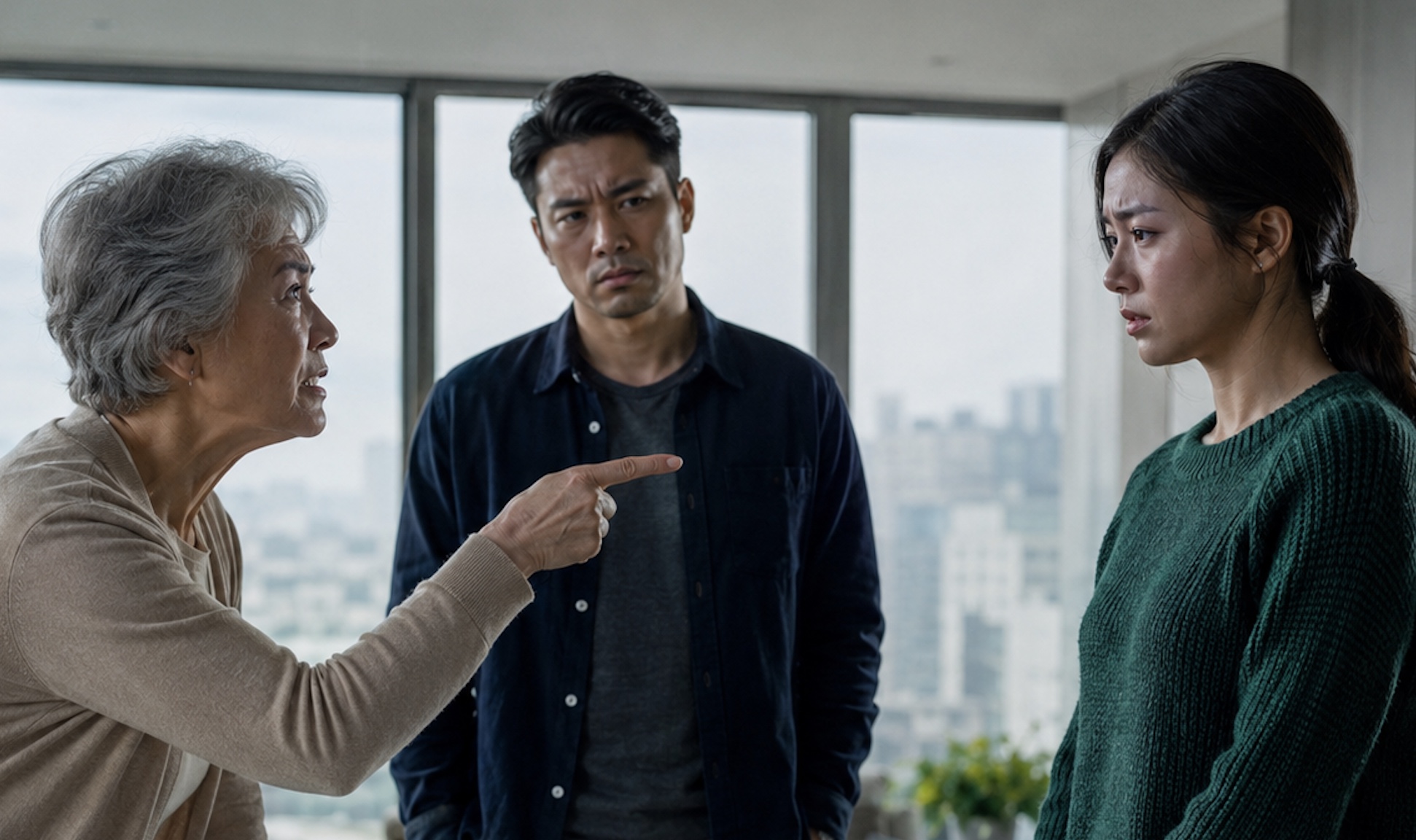
But Lidia Pavlovna appeared at the door. Beside her stood Sveta, Igor’s younger sister, twenty-six, unmarried, living with their mother. Sveta smiled broadly and somehow too cheerfully. Lidia Pavlovna stepped into the hallway without waiting to be invited.
“We won’t stay long,” her mother-in-law said in a tone that did not allow objections.
Olga looked at them both. Something about the scene — two women arriving together, without warning, with the particular air of people who had prepared a conversation in advance — immediately displeased her. But she silently stepped aside and let them into the corridor.
Igor arrived twenty minutes later. By then, his mother and sister were already sitting in the living room, drinking tea that Olga had poured mechanically, out of habit. He took off his coat, came in, greeted them — calmly, routinely, like a person who had known they would be there. Olga noticed it. And remembered.
They sat down. Lidia Pavlovna placed her cup on the table, straightened her back, and said clearly, without introduction, without unnecessary words:
“Olga, we have gathered today to discuss your apartment — the one you bought before marriage.”
The room went quiet.
Olga did not answer right away. She looked at her mother-in-law for several seconds, calmly, without interrupting. Then she shifted her gaze to Sveta. Sveta looked off to the side, like someone who had come to support the conversation but was now beginning to doubt whether she should have. Then Olga looked at Igor. He sat holding his cup with both hands and stared at the table. Silent.
“We were thinking,” Lidia Pavlovna continued, as if the pause had not bothered her, “that in your situation it would make sense to reconsider how the housing is officially arranged. Igor lives here now too. He is your husband. Logically, he should also have some official connection to this property. Everything should be arranged properly.”
Sveta nodded with the expression of someone who had just remembered why she was there.
“Yes, exactly. And besides, if something happens — you never know. It’s better for everything to be done sensibly.”
“We simply want what is best,” her mother-in-law added. “For the family.”
The word “family” sounded like an argument — like something after which disagreeing became awkward, almost indecent. Olga knew this technique well: wrap a demand in concern, and then refusal looks like selfishness. She had heard similar things before, in other contexts, from other people. She knew how to recognize it.
“And also,” Sveta found the courage to continue, “we were thinking maybe you could consider an exchange? Or you and Igor could move somewhere together, buy something bigger, and this apartment could then… well, be used for other needs. Our family has needs too.”
She said the last sentence a little more quietly, but the meaning was clear.
Olga slowly straightened. Not sharply, not theatrically — she simply drew herself upright, like a person who had made a decision and would no longer bend over it. She looked first at her husband — still silent, still staring at the table — then at Lidia Pavlovna, then at Sveta. She studied them carefully, without anger, but also without the softness they had apparently expected to find.
“Do I understand correctly,” she said evenly, “that you came here to discuss how to dispose of my apartment?”
Conversations about housing have a special nature. People rarely speak directly in them. Instead, they use enveloping phrases about family, about the future, about what would be better for everyone. Olga sat and listened, and at some point a clear picture formed in her mind: if she kept silent now, if she nodded or said, “Let’s think about it,” this conversation would become the first in a series. Then there would be another one, and another after that. Each time a little more confident, a little further. That is how any pressure works when it is not stopped immediately: it takes silence as consent. Olga knew that. And so she did not remain silent.
She and Igor had another conversation later — a calm one, without tension, about two weeks afterward. Olga asked him directly: he had known in advance that his mother was coming to raise this subject, and he had not warned her. Why? Igor thought before answering. Then he said, “I thought she would just talk, and nothing special would happen.” Olga replied, “Something special happens precisely when you decide that nothing special will happen.” After that, they both fell silent. Not resentfully — each was simply processing something of their own. Then he said, “You’re right.” Olga nodded. That turned out to be enough.
She was not thinking about strategy in the exact moment she began to speak. The words came on their own — without preparation, without rehearsal, simply as something that had long been clear and had finally found a chance to be said. This is my apartment. It is not up for discussion. That happens sometimes: a person does not know they are capable of something until they end up in a situation where it becomes necessary.
Lidia Pavlovna opened her mouth, but Olga did not let her seize the initiative.
“This apartment was bought by me before marriage. With my money. It is registered in my name. Igor did not contribute financially to its purchase — that is a fact, and you both know it.” She turned slightly toward her husband. “You know it too.”
Igor lifted his eyes. There was something awkward in his face — not repentance, not disagreement, but that in-between expression people have when they find themselves caught between two fires and would prefer everything to somehow resolve itself.
“I understand that you may have some thoughts about living space,” Olga continued, now addressing all three of them. “But those thoughts have nothing to do with something that personally belongs to me. I do not intend to discuss how my property should be used. Not today. Not another time.”
Lidia Pavlovna straightened up. The gesture showed that she intended to continue, that she still had arguments, that she was not used to being stopped mid-sentence like this. She drew in a breath.
“Olga, you misunderstood. We don’t want to offend you, we simply…”
“I understood exactly what you said,” Olga replied. Quietly, but without the slightest hesitation. “You came here to discuss my apartment. I heard you. And I am telling you: it is not up for discussion.”
Something shifted in her mother-in-law’s voice. There was less confidence now. She tried again — softer, from another angle.
“But you are family. And property matters in a family are better decided together. That doesn’t mean we are claiming anything…”
“Lidia Pavlovna,” Olga said her name calmly, without irritation, the way one puts a full stop at the end of a sentence. “If you had come simply as a guest, I would pour more tea. But you came here to discuss what should be done with someone else’s property. That is a different conversation. And that conversation will not happen.”
Sveta was silent. Her cheerfulness had evaporated somewhere between Olga’s first and second replies. She held her cup of tea and looked from her mother to her sister-in-law, and from her face it was clear that the plan that had seemed so logical at home was somehow not working here.
Lidia Pavlovna stood up. The movement was sharp enough to signal offense, but not loud enough to turn into a scandal. She took her bag and adjusted the coat she had never taken off.
“Well then,” she said. “We only wanted to talk as a family.”
“As a family means respecting what belongs to another person,” Olga replied. “Come another time. Just to visit.”
They left. The door closed behind them — it did not slam, it simply closed, which in a way was more eloquent than a slam.
The apartment grew quiet. Olga stood in the hallway and listened to the sound of the street outside. Then she turned around.
Igor was sitting in the living room. He was still holding his teacup and staring into the space in front of him. He looked as if he had just watched a film and failed to understand the ending.
Olga came in and sat opposite him. Not beside him — opposite him. She looked at him.
“You knew they were coming to have this conversation,” she said. Not as a question, but as a statement.
Igor was silent for a moment. Then he said:
“Mom told me… that she wanted to bring up the subject. I thought she would just talk.”
“And you didn’t warn me.”
“I thought it would go normally.”
Olga looked at him for some time. Then she said:
“Normally is when a person knows what awaits them in their own home. Do you understand that they were counting on my apartment? That this wasn’t a family conversation, but something completely different?”
Igor did not answer immediately. Then he said quietly, somewhat embarrassed:
“Mom thinks that since we’re married…”
“No,” Olga interrupted, and this time there was something firmer in her voice than before. “Marriage does not automatically turn someone else’s property into shared property. Especially if it was bought before marriage. You know that. They know that. I know that.”
She stood up and took from the table the cup Lidia Pavlovna had left unfinished.
“I need you to understand one thing,” Olga said, standing in the doorway between the living room and the hallway. “I am not against your family. I am happy to welcome them. But what happened today was an attempt to make a decision about someone else’s property. Without my knowledge, while expecting me to sit there silently. And you allowed it to happen.”
Igor raised his eyes to her.
“What do you want from me?”
“I want you to be on my side in your own home,” she said simply. “Not against your mother. Just on my side.”
She went into the kitchen, placed the cup in the sink, and turned on the water. Outside the window stood the chestnut trees — already completely bare, only branches left. November was doing its work methodically and without sentiment.
That conversation with Igor lasted a long time. Not just that evening — in general. They returned to it several times over the following days, reworded things, clarified, disagreed here and there. Igor was not a bad person. He was simply used to his mother’s initiatives unfolding without his interference. Olga explained that this no longer worked. Not because she was against his mother, but because there are things that cannot be allowed to move on their own.
There had been one moment in that conversation — after Lidia Pavlovna stood up and took her bag, but before she walked out the door — when Olga caught Sveta’s gaze. Sveta was looking at her without resentment, rather with a kind of surprise, almost childlike. As if for the first time she was seeing a person say no so simply, without apologizing for that no. Olga thought briefly: perhaps it will be useful to her too. Perhaps one day she will find herself in a similar situation and remember that no is a complete sentence that requires no explanation.
Though, of course, she said none of this to Sveta. She simply walked them to the door, locked it, and returned to the kitchen, where the soup she had been heating before they arrived was still sitting on the stove, untouched.
Lidia Pavlovna called three days later — calmly, as if nothing had happened — and said she would bring a pie over on the weekend. Olga replied, “All right, we’ll be glad to see you.” No one returned to the subject of the apartment. Not a week later, not a month later. Either they had understood that the conversation was closed, or they had decided to wait for another moment. Olga did not know for certain. And she did not think about it for too long.
Sveta, in that situation, was the person Olga understood best. A young woman living with her mother, slightly envious of someone else’s independence, arriving at another person’s home with another person’s idea — not her own, but her mother’s — and then sitting there with a cup of tea, not fully understanding how everything had gone wrong. Olga was not angry with her. There was nothing to be angry about. She had simply made it clear — quietly, without emphasis — that what they wanted would not happen. That was enough.
Later, much later, Olga sometimes thought about that episode — not often, but when she did, she noticed something important in it. Not in what she had said, but in how she had said it. Without shouting, without tears, without that vengeful pleasure people sometimes mistake for victory. Simply calmly and clearly: this is mine, and it is not up for discussion. She had not proven her right — she had simply named it. The difference, as it turned out, was enormous. When you prove something, you almost admit that the right itself is in question. When you simply state it, there is no question. No one had taught her that. She had reached it herself, in forty minutes of a November evening, over cups of tea that no one ever finished.
In the next few weeks, Olga caught herself several times waiting for a continuation. She expected Lidia Pavlovna to call with a new approach, find another angle, bring in someone else. But there was no continuation. Her mother-in-law visited once a month, with a pie, and behaved evenly. Sveta sometimes wrote something neutral in the family group chat. No one returned to the conversation about the apartment. Either they had truly understood, or they were simply waiting. Olga decided not to investigate. Some things are better left where they stop on their own.
She washed the dishes, put back on the shelf the book she had moved before the guests came, and went into the storage closet to check whether the coffee had run out. There was coffee. The bookshelf stood exactly where she had once placed it. Everything was in its place — exactly where she herself had decided it should be.
The apartment was hers. That changed nothing. And that, perhaps, was the main thing.