The country house had come to Eva from her grandmother, Nina Fyodorovna, who had lived on that plot of land for almost thirty years. It was a small wooden house with a veranda, an apple orchard, a well, and garden beds that her grandmother planted every spring with such seriousness, as if she were preparing for a long siege. Eva remembered the smell of that house — dry wood, Antonovka apples, and a faint trace of resin from the boards warmed by the sun. To her, that scent was more than just a smell. It was childhood, summer holidays, her grandmother’s hands sorting berries on the veranda, and a kind of silence that never existed in the city.
When Nina Fyodorovna passed away, Eva handled everything legally: she accepted the inheritance, transferred the documents into her name, and paid the taxes. There were no disputes with relatives. Her grandmother had said clearly while she was still alive who the house would belong to, and everyone had accepted it. Eva went there every summer, sometimes in spring, sometimes in autumn — not for any specific reason, but simply to be in a place where she had once felt happy. She had never thought of the country house as an investment or an asset. It was a place, not a piece of property.
Artyom, for his part, had only been to the house twice during their entire relationship. The first time was when Eva invited him at the beginning of summer because she wanted to show him a place that meant a great deal to her. He came, looked around, and said it was a nice plot, peaceful. He spent the whole evening on his phone, and at night he slept badly — he was used to city noise, and the silence bothered him. The second time, he came to help nail a few boards back onto the fence. He was in a hurry, did the job quickly, and left. Since then, the country house rarely came up in their conversations. Eva did not insist. It was her place, and she did not need anyone else to share its meaning.
A lot was tied to that house for Eva — things that could not be explained briefly. They were not just memories, but something more solid, almost like a foundation. Her grandmother had taught her everything there: how to make jam, how to tell whether currants were ripe, how to know when the soil had warmed enough for planting. As a child, all of it had seemed boring. Later, after her grandmother was gone, it became important. Eva rarely spoke about it out loud. Some things are kept privately, not put on display.
She had also bought her city apartment herself, before Artyom appeared in her life. She took out a mortgage, paid it off over several years, and sometimes had very little money left at the end of the month, but she managed. She did not complain, did not ask for help — she simply kept going because that was how she was used to living. Eva was one of those people who do not talk about their difficulties, but never forget them either. Everything she had, she had either earned herself or received from someone dear to her. She had never taken what belonged to others. And she had no intention of giving away what was hers.
Artyom entered her life unexpectedly — through mutual friends, at some noisy dinner where there were too many people and the music was too loud. He was sitting in the corner, drinking beer and reading something on his phone with the air of a person who was not especially interested in being there. Eva had thought, He seems normal. She sat beside him, they started talking, and unexpectedly, for both of them, they talked until two in the morning — about books, cities, and the strange way time worked. He walked her home. She gave him her phone number. He called the next day.
The first months were easy. Artyom was attentive, calm, and not demanding. He did not try to seem better than he was, did not pretend to be someone else. He was simply himself, and that won her over. When he began staying overnight at her place, then for several days at a time, Eva did not object. When his things appeared in her wardrobe, she only smiled. When he moved in the last box, they both acted as if it had happened naturally. A year later, they registered their marriage quietly, without a lavish wedding — just two witnesses and dinner at their favorite restaurant. Eva wore a new dress and thought that it felt right. That this was how it was supposed to be.
At first, no one raised any questions about her property. Artyom never called the apartment or the country house “ours.” He said “your apartment,” “your country house,” and Eva found that natural and right. He understood that she had brought into the relationship things she had built before him, and he respected that. At least, that was how it seemed during the first year.
Zinaida Petrovna did not appear in their life immediately. At first, she kept her distance — calling once a week, visiting on holidays, behaving politely. Eva did not feel anything especially warm or cold toward her. She was an ordinary mother-in-law. An older woman who loved her son and asked how the young couple was doing. Nothing alarming.
But gradually, something began to change. Zinaida Petrovna started visiting more often. First once every two weeks, then once a week, then without warning at all — simply calling from downstairs: “I was nearby, I’ll come up for a minute.” That minute stretched into three hours. She looked around, asked questions, and sometimes gave advice no one had asked for. Eva did not get openly angry, but something inside her tightened every time she saw her mother-in-law’s name on her phone screen.
Zinaida Petrovna had a talent for creating an atmosphere of inevitability. That was her special gift — speaking about things as if they had already been decided and simply had not yet been put into words. She did not ask permission; she announced plans. She did not seek anyone’s opinion; she shared her own and expected everyone else to fall into step. It worked with people who did not know how, or did not want, to object. Artyom, it seemed, had grown up exactly like that — used to the idea that his mother’s words were the plan. Eva was not that kind of person. She never had been.
At first, Eva blamed the increasingly frequent visits on ordinary maternal attachment. Zinaida Petrovna had raised Artyom alone — his father had left when he was seven — and since then she had held on to her son with the special kind of grip found in women for whom their child has become the main project of their life. Eva understood that and did not judge her. But understanding something did not mean accepting every form it took. There was a difference between the two, and Eva felt it clearly.
The country house drew Zinaida Petrovna’s particular interest. It began with simple questions — where it was located, whether it was far from the city, how large the plot was. Eva answered briefly, without details, because there were no joint plans and nothing to discuss. But her mother-in-law did not let the subject go. At the next meeting, she returned to it again — was there a bathhouse, how many rooms were in the house, were the facilities inside or outside? Eva answered evenly and patiently, though privately she wondered why Zinaida Petrovna needed to know all this.
Artyom did not react to these questions at all. He did not support the conversation, but he did not stop his mother either. He simply sat nearby and said nothing. A couple of times Eva caught herself thinking that his silence said more than any words could. But she was in no hurry to draw conclusions. Perhaps he really saw nothing unusual in his mother’s curiosity.
Meanwhile, Galina kept talking. She had a gift for filling any pause — not out of nervousness, but simply by nature. She spoke about how they had once known a woman with a country house near Serpukhov, how they used to go there every summer, and how wonderful it had been until that woman sold the plot and moved to another city. Then she talked about mushrooms — apparently there would be a lot of them that year, she had heard it on the radio. Then she mentioned that her husband had long wanted a vegetable garden, but there was only so much one could grow on a balcony, just cherry tomatoes, and what kind of garden was that? Her words flowed in a smooth stream, and carried along in that stream — quietly but confidently — was the idea that a country house was a resource, and it would be a shame not to use it. Especially when there was such a wonderful big family that needed somewhere to go.
Sitting at the table, Eva watched the conversation unfold and thought how strangely some people were made. They see something that belongs to someone else — a house, a piece of land, a thing — and begin talking about it as if it is already partly theirs. Not necessarily out of malice. Not even always out of greed. They simply never stop to ask: Was I invited into this? They think that if something exists and is within reach, then it can be discussed, planned around, divided up. Eva had met people like that before. They did not consider themselves rude. They were simply built that way.
At the end of August, Zinaida Petrovna came to visit not alone. She brought her sister — a large, loud woman named Galina — Galina’s husband Viktor, who kept silent and nodded at everything, and an adult niece, Nastya, with her husband. Five people in total. Eva opened the door, saw the whole group, and felt a slight unease — not because there were many guests, but because no one had warned her. The day before, Artyom had only said, “Mom will stop by. She wants to introduce you to my aunt.” He had not mentioned anyone else.
Eva made tea, set the table, smiled, and answered questions. The relatives were talkative — especially Galina, who could speak loudly, quickly, and without pauses, leaving no room for anyone else to interrupt. Eva listened, nodded, and occasionally replied.
The conversation shifted to the country house about half an hour after everyone had sat down. Zinaida Petrovna began as if casually: “You know, Eva has a country house, a very nice place, quiet, surrounded by nature.” Galina immediately brightened. “Oh, a country house, how wonderful. We love going out of town.” Nastya asked how far it was. Viktor nodded. The conversation began rolling forward on its own, gathering confidence like a snowball.
Zinaida Petrovna talked about how nice it would be for the whole family to go there on weekends. How one could relax in nature in a way that was impossible in the city. How a country house was not just a place, but an opportunity to gather together, which was important for family ties. Galina agreed loudly and happily, adding that they had always lacked a good place outside the city. Nastya had already started calculating aloud which weekends might work — September would still be warm, and mushroom season would begin.
Eva stood by the window and listened. She did not interrupt. She looked at these people, whom she was seeing for the first time in her life, and watched them discuss her country house — her grandmother’s home, the smell of warm boards, the apple orchard, the well — with such businesslike certainty, as if the matter had already been settled. As if her presence there was just a formality.
Artyom sat at the table and said nothing. He did not join the conversation, but he did not stop it either. He simply sat there and looked into his cup of tea. Eva caught his eyes once. He gave a slight shrug, as if to say, Well, Mom is talking. That was enough for Eva to understand: he was not going to interfere.
Zinaida Petrovna put the final point on the conversation with the confidence of someone used to having her words treated as instructions.
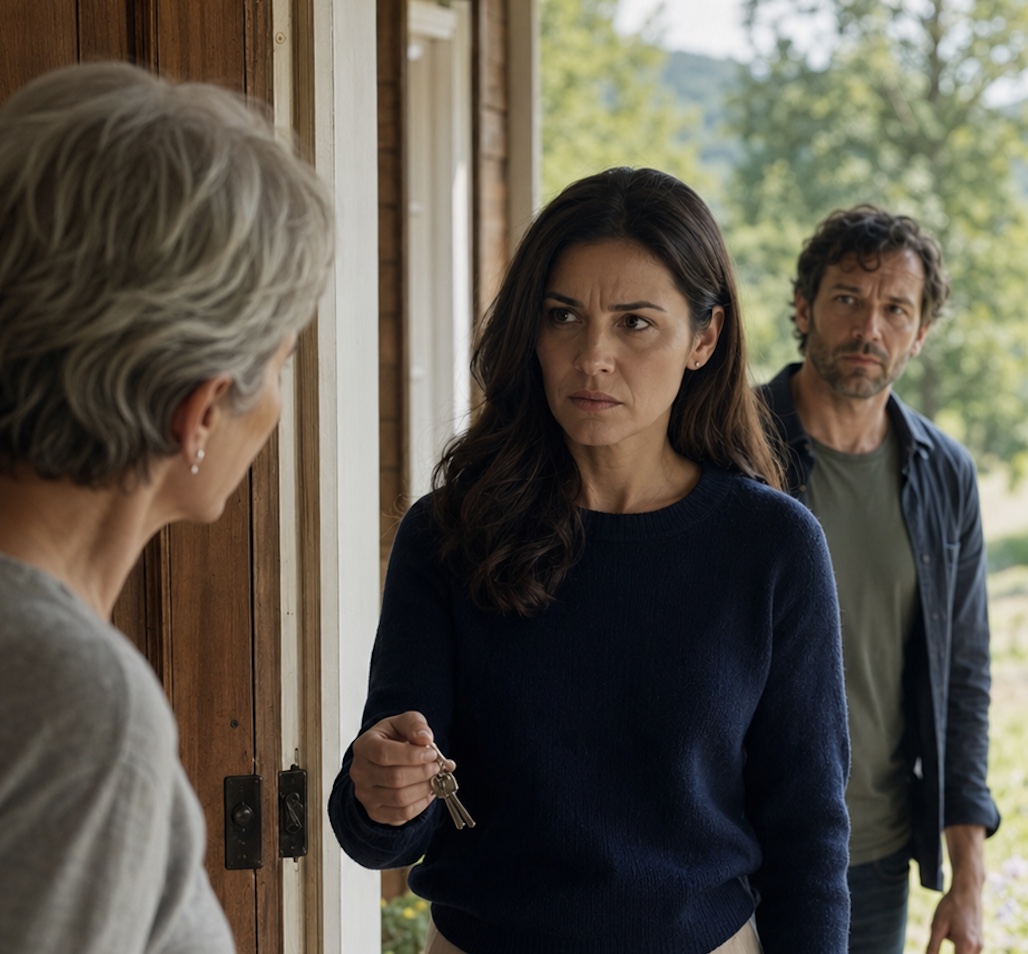
“We need to make spare keys so everyone can go whenever they want. It would be inconvenient to arrange it every time.”
The room went quiet. Galina stopped talking. Viktor nodded automatically, then froze halfway through the motion. Nastya looked at her aunt.
Eva slowly straightened. She did not rush. She set her cup on the table carefully, without a sound. Then she looked at Zinaida Petrovna with a long, calm gaze. Not angry. Not hurt. Simply attentive.
“The country house is mine,” she said evenly. “And there will be no keys for your relatives.”
She did not raise her voice. She did not add anything unnecessary. She said it the way one states a fact that does not need proof.
The relatives exchanged glances. Galina opened her mouth, but for the first time that evening, said nothing. Nastya suddenly found something very interesting in the pattern of the tablecloth. Viktor stopped nodding completely.
Zinaida Petrovna did not give up immediately. She stayed silent for a moment, then spoke again — more quietly, but with the same confidence, only now there was a faint note of offense in her voice.
“Eva, why are you being like that? We are family. It’s just a chance to spend time in nature. I don’t understand why we can’t do this like normal people.”
Eva looked at her without irritation. Without any desire to argue. With the calm firmness of a person who had made her decision long before she was forced to say it out loud.
“Zinaida Petrovna,” she said, “only the person who owns property has the right to decide what happens to it. The country house belongs to me. This is not up for discussion.”
Her mother-in-law looked at her son. Artyom raised his eyes from his cup, then lowered them again. He remained silent.
Zinaida Petrovna pressed her lips together. A particular kind of silence settled over the room — the kind where everyone understands everything, but no one knows what to say next.
Eva went into the kitchen and put the kettle on. From there, she could hear quiet voices in the living room — cautious, subdued. Then the conversation shifted to something else on its own. Galina remembered the weather. Nastya mentioned work. Viktor began nodding again. Life returned to its usual course, as if nothing special had happened.
But the subject of the country house — trips, keys, weekends together as a family — was not raised again that evening. Nor afterward.
As she was leaving, Galina said something along the lines of, “You are a very independent woman, Eva.” It did not sound like a compliment, nor exactly like a reproach. More like a slightly bewildered observation. Eva understood that, for this group of people, independence was something unfamiliar. They lived in a system where everything was shared, everything was divided, everything was discussed collectively — and perhaps that approach gave them a sense of family, warmth, and belonging. Eva respected that. But her grandmother’s house was not part of that system. And it never would be.
Nastya was the last to leave. In the hallway, while putting on her jacket, she said quietly:
“I’m sorry if something went wrong.”
Eva looked at her. A young woman who had clearly found herself in someone else’s story and did not fully understand what had happened. Eva did not explain.
“It’s all right,” she said. “It was nice to meet you.”
And that was true — in the sense that the meeting had taken place and had put everything in its proper place.
After that conversation, Eva caught herself thinking about it for several days. Not because she doubted whether she had done the right thing. She did not. It was simply interesting to watch how differently people reacted to the word no. Some accepted it immediately and never returned to the subject. Others pretended to accept it, then tried again later — from another angle, with different words, through another person. Zinaida Petrovna, it seemed, belonged to the second group. But this time, apparently, something in Eva’s answer convinced her not to try again. Maybe her tone. Maybe her look. Maybe she had simply sensed that this wall would not move.
Artyom returned to the conversation late that evening, after the guests had left. He asked why she had needed to be so harsh. Eva was surprised.
“I spoke completely calmly,” she replied.
“Mom was offended.”
“Your mother suggested handing out keys to my property to people I met today. I explained that this would not happen. That is not harshness. That is simply an answer.”
Artyom was quiet for a moment. Then he said she could have been more understanding — his mother had only meant well.
Eva looked at him. Not accusingly. Rather with the attentive curiosity one has when something has just become a little clearer.
“Artyom,” she said, “if you want to give someone keys to your property, please do. I will not object. But I will not give away keys to mine. This is not up for discussion, and it does not depend on who feels offended.”
He said nothing. He went into the other room and turned on the television.
Eva poured herself tea and stepped out onto the balcony. The city murmured below with its usual late-night noise — doors slamming somewhere, a car honking in the distance, someone laughing in a neighboring building. She stood there, holding the hot mug with both hands, and thought about her grandmother. About how she used to sweep the veranda every morning — not because it was dirty, but out of habit, out of love for her home. About the apples falling into the grass with soft, muffled thuds. About the fact that some things matter not because they cost a lot, but because they are precious for another reason.
The country house had been her grandmother’s. Now it was Eva’s. And that was enough.
Artyom never returned to the subject again — not a week later, not a month later. Life went on in its usual way: work, dinners, conversations about this and that, weekend trips together. Eva did not know whether he had accepted her position or had simply decided not to argue with something he could not change. That mattered, of course. Accepting something and agreeing with it are not the same thing. But she did not try to find out. Some questions are better left unanswered until life answers them in its own time — naturally, without force.
Zinaida Petrovna called a few days later as if nothing had happened, to talk about something else. Eva answered politely and briefly. No one returned to the subject of the country house. Galina and Nastya did not appear again. Viktor, most likely, continued nodding somewhere else.
Artyom said nothing more. Maybe he accepted it. Maybe he simply stepped back. Eva did not investigate. Some things do not need a final conversation. It is enough that everything has become clear.
The conversation with Artyom after the guests left had been short — not because Eva did not want to talk, but because there was very little left to say. Everything that needed saying had already been said. Artyom was offended — not loudly, not with a scandal, but quietly, withdrawing into himself for a couple of days and becoming a little drier in conversation. Eva did not try to pull him out of that state by force. She understood that he had found himself between his mother and his wife, and that was an uncomfortable place to be. But it had been his choice to remain silent and not interfere while the situation resolved itself. Now he had to live with the consequences of that choice. That was fair.
Sometimes she thought: what would have happened if she had stayed silent? If she had nodded politely and said something vague — “We’ll think about it,” “We’ll see.” Most likely, a specific request would have appeared a few weeks later: such-and-such weekend, there will be six of us, you don’t mind, do you? She would have dodged it again. Then again. And then it would turn out that refusing was awkward — people had already made plans, already got excited. Step by step, her country house would have stopped being only hers. No. Better to say it immediately. Better one awkward moment than endless retreat.
Eva was not a conflict-seeking person. She did not look for reasons to argue, and she took no pleasure in putting people in their place. But she knew how to see the boundary between what was hers and what belonged to others — and how to mark that boundary clearly when necessary. Without unnecessary words, without drama, without pages of explanation. Just draw a line and make it clear that it exists. She had not learned that skill at once. Life had taught her. There had been times when she had stayed silent and endured, and it had led to nothing good. Now she preferred to speak immediately, calmly, and clearly.
Eva valued silence. Not silence as the absence of people — she liked people, knew how to enjoy guests and noisy gatherings. She valued silence as a state in which she did not have to justify herself to anyone, explain her decisions, or pretend that everything was fine when it was not. It was an expensive thing — not in terms of money, but in terms of worth. The country house gave her exactly that kind of silence. Perhaps that was why the conversation had struck her so sharply — it had felt like an intrusion not merely into a house, but into the space where she could be herself.
She went to the country house at the beginning of September — alone, the way she liked. She opened the house, aired out the rooms, and gathered the apples that had ripened over the summer. She sat on the veranda, drank tea, and listened to the wind moving through the leaves in the garden. It was quiet and good.
September air at the country house was different — dense, slightly sweet from fallen apples, carrying a chill that could already be felt in the mornings but still retreated by noon. Eva sat on the veranda in her grandmother’s old rocking chair, wrapped in a blanket, looking out at the garden. The apple trees stood quietly, heavy with fruit. The grass beneath them was scattered with yellow, brown, and red spots — apples that had fallen on their own, without waiting to be picked. Somewhere in the branches, a bird rustled. It was so peaceful that it seemed if one sat long enough and quietly enough, time itself would slow and stretch like honey from a spoon. Here, everything remained what it was — the house, the garden, the scent of wood and apples.
And so did she.
That was what mattered most.
The country house was hers.
And so were the keys.