“There’s no place in this apartment anymore for a woman who smells of bleach and other people’s deaths. Take off the ring, Lena, and go back to your patients.”
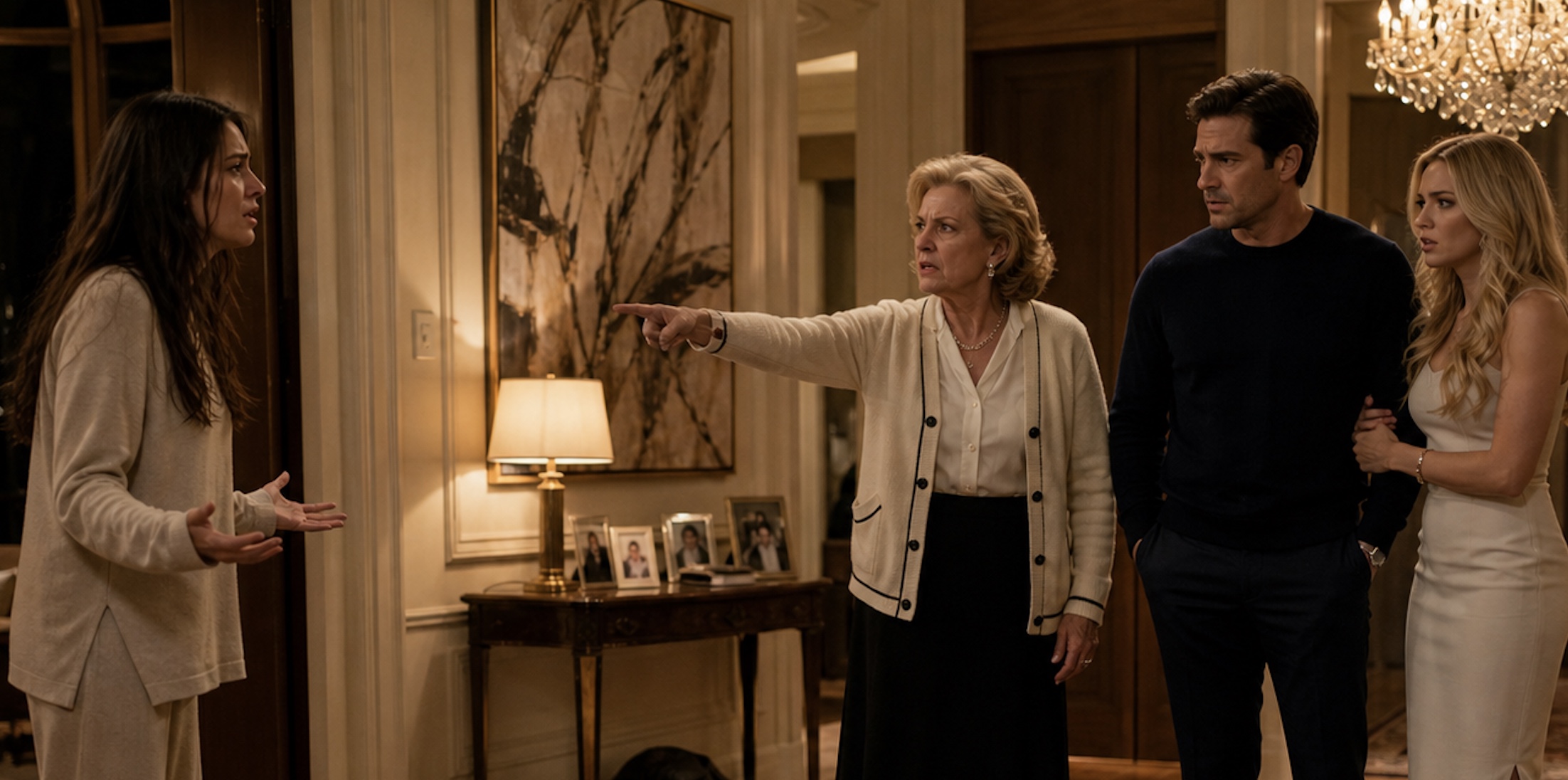
Raisa Pavlovna stood in the middle of the living room, pinching her nose with two fingers in theatrical disgust. In her other hand, she was holding my suitcase — the very one I had taken with me to a symposium in Munich. A second later, the lock clicked open, and my things — neatly folded dresses, anatomy books, underwear — spilled onto the parquet floor in a dirty heap.
Anton, my husband, stood by the window. He didn’t turn around. But beside him, glued to his side, stood Vika. Thin, pale, with frightened eyes and long hair. She looked like a porcelain doll you’d be afraid to break.
“Lena, try to understand,” Anton finally said, his voice dry as sandpaper. “Vika is pregnant. She needs proper conditions. And you… you’re always in the operating room. You didn’t even notice how we became strangers. Mom is right. This apartment is our family nest. This is where our heir should grow up.”
“Our family nest?” I slowly removed the medical mask that was still hanging around my neck. “Anton, are you serious? We bought this apartment four years ago.”
“We?” Raisa Pavlovna burst into a dry, barking laugh. “You contributed pennies from your hospital shifts! Anton paid the real money! My son is a successful realtor. He understands the value of property. You were just a guest here. A temporary misunderstanding.”
I looked at them and didn’t see people anymore, only characters in a badly written play. Yesterday, I had spent fourteen hours pulling a five-year-old boy back from the edge of death. My hands still remembered the rhythm of his heart. And now I was apparently supposed to cry over a pile of clothes on the floor.
“And where exactly am I supposed to live?” I asked, just to see how far they were willing to sink.
“In the dormitory at your little hospital!” my mother-in-law snapped. “That’s where you belong. And leave the keys on the nightstand. Don’t even think about taking any appliances. Everything here was bought with my son’s money.”
Anton finally walked over to me. In his eyes, I saw no shame. Only impatience. He wanted me gone as quickly as possible, so this scene could be replaced by a new one — one where he was the great father, the master of the house, the man in control.
“Lena, let’s not make a scene. I’ll send your things by courier. Leave the car. It’s registered in my name. The lawyer will send the papers tomorrow.”
Without saying a word, I walked over to the pile of my belongings. I found my phone among them. The screen was lit up — a missed call from my brother.
“All right,” I said. “I’ll leave. But remember this: every wall has ears. And every deal has another side.”
“Are you threatening us now?” Raisa Pavlovna planted her hands on her hips. “Who do you think you are? A girl from the suburbs whom we brought into decent society! Go on, get out before I call the police and report you for loitering.”
I didn’t bother gathering my things. Why would I? There was nothing in that heap worth more than my dignity. I simply put on my coat, took my bag with my documents, and walked out the door.
Behind me, I heard her voice again:
“Shut the door properly! There’s a draft!”
I took the elevator down and stepped out into the courtyard. The air was sharp and biting. I sat on a bench and dialed a number.
“Kostya?” My voice did not tremble. “Do you remember that apartment in Golden Keys — the one your foundation rented to Anton with an option to buy?”
“Of course, Lena. Why? Has he decided to close the deal?”
“No, Kostya. He decided he already owns it. He threw me out.”
Silence settled on the other end of the line. Heavy, like a slab of lead. My brother Kostya did not like it when someone hurt his sister. Especially when the people doing it were living thanks to his generosity.
“His lease expires in three days,” Kostya said, his voice turning to steel. “We won’t renew it. The purchase agreement will be canceled due to breach of confidentiality terms and moral conduct clauses. Lena, where are you?”
“I’m on a bench, Kostya. Outside my so-called family nest.”
“Stay there. A car will come for you in ten minutes. And get ready — tomorrow your mother-in-law has a scheduled appointment at our clinic. Remember? She still thinks Anton arranged her free treatment through his connections.”
“I remember,” I said, smiling faintly. “I signed her medical quota myself.”
Kostya’s car took me to his country house. It was quiet there, smelling of wood and peace. My brother didn’t ask unnecessary questions. He simply poured me tea and placed a folder in front of me.
Not a blue folder. A gray one, made of thick cardboard, stamped with his foundation’s seal.
“Look, Lena,” he said. “Anton paid the rent regularly, but everything was registered under a legal entity. He convinced his mother that the apartment was already his property. Showing off, as usual. He thought that since he was my brother-in-law, I’d turn a blind eye to the remaining payment.”
“He didn’t know that the clinic where Raisa is treated belongs to you too?” I asked, watching the fire in the fireplace.
“It doesn’t belong to me. It belongs to you, Lena. It’s your share package — the one you inherited from Father. I only manage it. They both thought you were just an ordinary salaried doctor. But you’re the one paying the bills for her pacemaker.”
I closed my eyes. Vika appeared before me — that “porcelain doll.” She probably didn’t even know Anton was nothing more than a tenant with a pile of debts.
The next morning, I went to the clinic. Work is the best medicine. I held two consultations, and at eleven o’clock, Raisa Pavlovna was scheduled to enter my office. She had no idea that the “consulting doctor from Moscow” she had been promised was me.
The door flew open. Raisa Pavlovna swept into the room, her expensive dress rustling. Her face was filled with smug self-importance.
“Good morning, doctor. I was told you are the best specialist in…”
She stopped mid-sentence. Her eyes widened, and her mouth opened in a ridiculous little gape.
“You?” she hissed. “What are you doing here? Are you replacing someone? I’ll complain to management! I need a doctor, not…”
“Sit down, Raisa Pavlovna,” I said without lifting my eyes from her chart. “Your blood pressure is already higher than it should be. Do you want your pacemaker to start malfunctioning? By the way, the model is Aurora-7. A very expensive device. It was installed through the Mercy Program. Do you know who sponsors that program?”
My mother-in-law froze. Her arrogance began melting like cheap ice cream.
“My son arranged it!” she shouted. “He has connections!”
“Your son’s connections are limited to the rental department, Raisa Pavlovna. This, however, is my territory. Do you see this signature at the bottom of your referral? ‘Chief Expert of the Board of Directors, E. A. Vorontsova.’ That’s me.”
I slowly turned the monitor toward her.
“Your free medical quota was canceled today at eight in the morning. Due to… a change in the patient’s financial status. From now on, every day of treatment at this center will cost you thirty thousand rubles. Plus the cost of medical supplies.”
“You have no right!” she jumped to her feet, her face turning crimson. “This is illegal! I’ll file a complaint!”
“Please do. Our clinic’s lawyers will be happy to review it. In about three months. Right around the time you’ll need a scheduled battery replacement for your pacemaker. For now, please proceed to the cashier. Today’s visit must also be paid for.”
Raisa Pavlovna stormed out of my office without saying goodbye. I knew she would call Anton immediately. And I also knew Anton was about to receive another call — from my brother.
By lunchtime, my phone was exploding. Anton called every five minutes. I didn’t answer. Finally, a message arrived:
“Lena, what is this circus with the apartment? Why are people from the foundation calling and demanding that I vacate the premises by tomorrow? We have nowhere to go! Vika isn’t feeling well!”
I replied briefly:
“There are available rooms in the dormitory at the hospital. That’s where you belong. You said so yourself.”
That evening, I returned to the apartment building. Not alone. I came with two solid men from a security agency and a representative of the foundation.
The door was locked. Shouting could be heard from inside. My mother-in-law was shrieking, Vika was crying, and Anton was trying to prove something to someone over the phone.
“Open it,” said the foundation representative, applying the master key.
We entered.
The scene was almost epic.
In the middle of the living room stood the same suitcases Raisa Pavlovna had so eagerly packed for me. Only now, they were stuffed with Anton’s belongings.
“This is a hostile takeover!” Anton yelled when he saw me. “I’ll sue! I have a contract!”
“You have a lease agreement, and its term has expired,” the foundation’s lawyer said calmly. “You also have six months of unpaid utility bills, which the foundation has decided not to forgive. You have fifteen minutes to vacate the premises.”
Vika was sitting on the sofa, clutching her stomach.
“Anton, you told me… you said this was your home…” she sobbed.
“Mom said it was!” Anton barked, spinning toward Raisa Pavlovna.
My mother-in-law stood in the corner, pressing her handbag to her chest. She seemed to have aged ten years in a single evening. All her arrogance, all her “aristocratic” grandeur had evaporated.
“Lenochka,” she suddenly said, her voice turning syrupy sweet. “Why be so harsh? We’re family. We lost our temper, that’s all… Anton, tell her! You love Lena, don’t you?”
“Family ended yesterday, Raisa Pavlovna. When you threw my dresses onto the floor. Now we are simply parties in a legal dispute. And the owner’s side demands that the property be vacated.”
The security men began demonstratively carrying boxes toward the elevator. Anton rushed around the room, trying to grab the television, then the coffee machine.
“That’s mine! I bought it!”
“Do you have receipts?” I asked. “No? Then everything located in the apartment belongs to the landlord under the lease agreement unless proven otherwise. Leave the appliances alone.”
Twenty minutes later, they were standing outside the entrance: Raisa Pavlovna, Anton, and Vika. They had six suitcases and not a single key. Anton was frantically scrolling through his contacts, trying to find someone who could lend him money for a hotel.
“Lena, wait!” he ran toward my car as I was getting behind the wheel. “What about my mother? She has a heart condition! She needs treatment!”
“The paid department is always open, Anton. For anyone who has money. And you’re a successful realtor, aren’t you? Earn some.”
I rolled up the window. The car pulled away. In the rearview mirror, I saw Vika step away from them, dragging her small suitcase toward the bus stop. It seemed the porcelain doll was smarter than they had thought.
Six months passed.
A cardiologist’s life is an endless chain of other people’s lives, stitched back together piece by piece. Against that background, your own life starts to feel like a quiet harbor.
I sold that apartment. I didn’t want to return to a place that smelled of someone else’s greed. I bought a small house outside the city, with a garden and a veranda where I could drink coffee in the mornings and listen to the silence.
Anton tried to file for division of property, but my lawyer quickly cooled his enthusiasm by filing a counterclaim for unjust enrichment over the years he had lived on the foundation’s resources without full payment. He disappeared from sight soon after. People said he was working at some second-rate real estate agency, renting a room, and paying enormous child support to Vika. She did give birth after all, but she never married him.
Raisa Pavlovna… well, that was a story of its own.
Her pacemaker worked perfectly, but she had to pay full price for every checkup. She tried going to public clinics, but they politely explained that with such a complex model of equipment, it was better to consult the specialists at our center.
At the center of E. A. Vorontsova.
One day, she waited for me near the clinic entrance. She looked awful — a cheap coat, worn-out boots.
“Lena,” she tried to grab my hand. “Be human. Anton is completely drowning, he gives me no money. Help me get a quota for the battery replacement. You’re a doctor… you took an oath!”
I stopped and looked at her. Strangely, there wasn’t a drop of anger left in me. Only endless exhaustion.
“The Hippocratic Oath, Raisa Pavlovna, does not require me to support people who tried to trample me into the dirt. Are you alive? You are. Do you have the opportunity to receive treatment? You do. As for quotas… those now go to people who truly need them. Lonely pensioners. Disabled patients. But you are a woman of status, aren’t you? Your son is a ‘master of life.’ Let him take care of you.”
I walked past her.
My phone vibrated in my pocket. A message from Kostya:
“Tomorrow is the opening of the new wing. Will you come? As co-owner, you have to be there.”
“I’ll be there,” I replied.
I got into my new car — bought with my own dividends, not with my husband’s credit money.
Justice isn’t when you take revenge.
Justice is when everyone eventually ends up exactly where they deserve to be.
Anton — in a rented room with his empty arrogance.
Raisa Pavlovna — standing in line at the cashier’s desk.
And me — in the operating room, where decisions are made about who gets another chance at life.
I looked at my hands.
They were steady.
Tomorrow, I had a complicated surgery. A valve replacement for an elderly woman from an orphanage.
Free of charge.
Under my personal quota.
And that mattered far more than all the “family nests” in the world.
I pressed the gas pedal.
Ahead of me was the road — clean and open.
Just like my life.