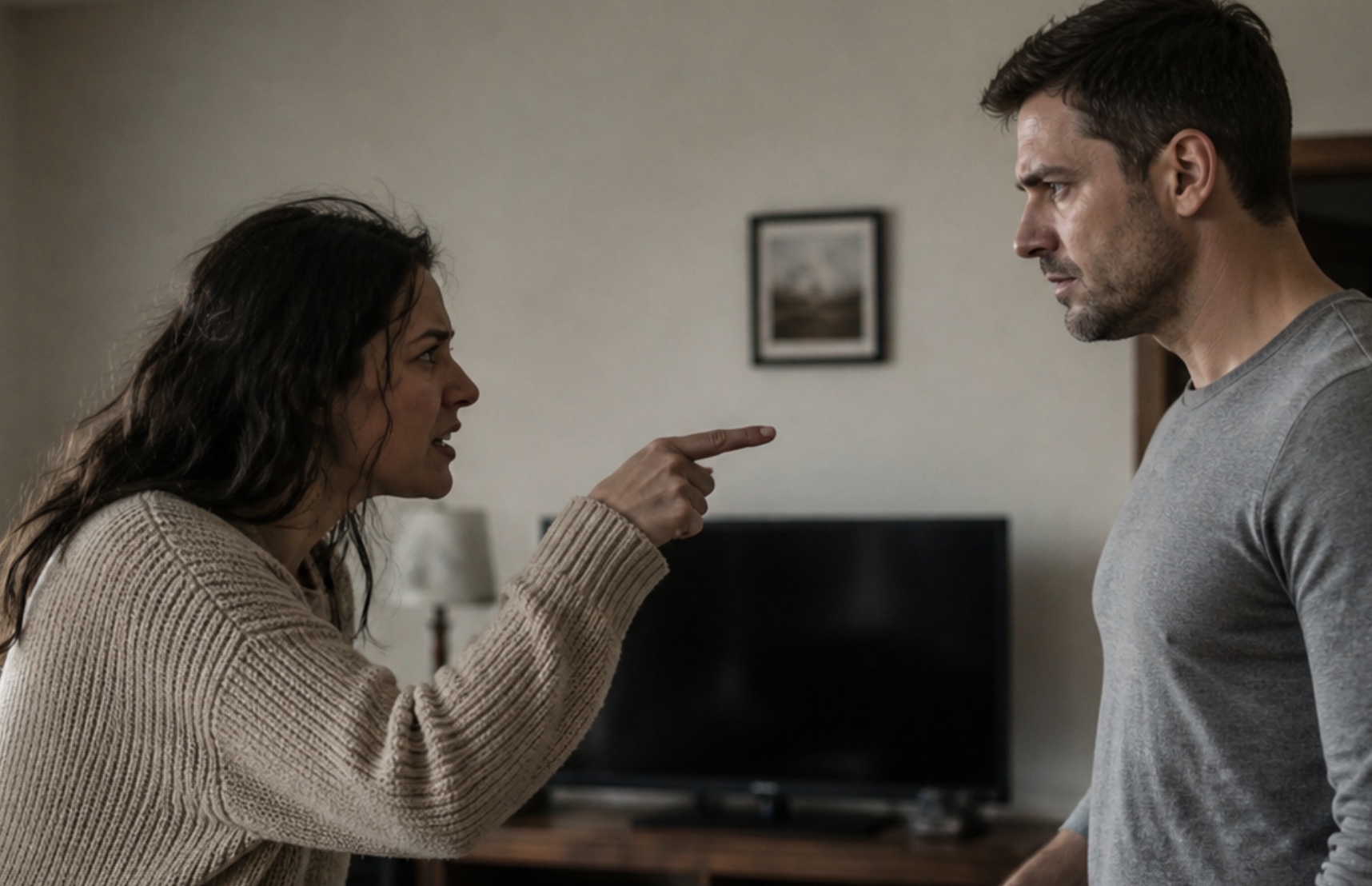
“Look at this beach — the sand is as fine as flour, and the sea entrance is shallow. I read reviews on three different websites,” Lera said, turning the laptop toward her husband and pointing at a bright, tempting photo of turquoise water. “And most importantly, the hotel was renovated recently. Even the bathrobes are new, not those old washed-out ones. Maxim, are you even listening to me?”
Maxim was sitting on the edge of the sofa, hunched over as if his stomach had suddenly started hurting. He kept fiddling with the TV remote, opening and closing the battery cover again and again.
Click. Click.
That sound was beginning to irritate Lera almost as much as the suffocating heat in the apartment. The air conditioner had broken the previous Thursday, and the repairman had promised to come only tomorrow. The air in the room felt sticky and heavy, soaked with the smell of hot asphalt drifting in from the street.
“I hear you, Lera, I hear you. The beach, the sand, the bathrobes,” Maxim finally said, lifting his eyes — but he did not look at the screen. He stared somewhere through her, toward the open balcony. “It’s beautiful, of course. But… maybe we shouldn’t be spending that much right now? I mean, Turkey is ridiculously expensive these days. Prices are sky-high, and people say the service has gone downhill.”
Lera slowly lowered the laptop lid, but did not close it completely. A bad feeling began to grow inside her — a cold shiver that did not belong in a room heated to thirty degrees. She had been waiting for this vacation for two years. Two years of saving, of refusing unnecessary purchases, of skipping Friday dinners out. They had been putting money aside for a proper, human vacation — the kind where you did not cook, clean, or worry about tomorrow.
“Maxim, we discussed this back in winter,” Lera said, her voice now firm, stripped of the playful tone she had started with. “We saved specifically for this hotel. The budget was agreed on. Three hundred thousand is sitting in the savings account. I’m not asking for diamonds. I just want to lie on a sun lounger and have someone bring me cold juice. What’s the problem? Did you find a better option?”
Maxim stood up and paced around the room, shoving his hands into the pockets of his house shorts. His movements were jerky and nervous. He stopped by the window with his back to Lera.
“There’s a more soulful option,” he muttered. “Aunt Valya called from the village. She says the summer is wonderful this year, the berries are out, the river has warmed up. The house is empty — we could stay there as long as we want. Fresh air, no chemicals, tomatoes straight from the garden. Maybe we should go there? For a couple of weeks. Grill some meat, go to the bathhouse. How is that not a vacation? And it would cost almost nothing.”
Lera stared at his broad back and could not believe what she was hearing. It felt like some idiotic joke, some kind of test. Aunt Valya’s village meant a crooked fence, an outdoor toilet, swarms of mosquitoes the size of sparrows, and garden beds that would have to be weeded because “it would be rude not to help when people let you stay.”
“Are you serious right now?” Lera stood up from the table, feeling irritation rise into her throat like a hard lump. “You’re suggesting that instead of an all-inclusive hotel, I should go feed mosquitoes and haul water from a well? Maxim, I worked like a horse for six months. I completed three major projects. I earned that damn sand and those bathrobes. What village? We have the money. Why do we need this cheap survival retreat?”
Maxim spun around sharply. His face had turned red, sweat glistening on his forehead. He looked like a schoolboy caught smoking — except he had decided to deny everything until the very end.
“Why do you keep going on about money?” he snapped with sudden anger. “Money, money, money! Happiness isn’t in money, Lera. You can rest without all that pretentious nonsense if your family is beside you, if people love each other. You said yourself you were tired of the city and the noise. There it’s quiet. Peaceful. And in that Turkey of yours? Crowds, drunk tourists, screaming children. Why do we need that?”
Lera stepped closer to him. She saw his shifting eyes, the vein twitching in his neck. She knew her husband too well. Maxim had never been a fan of rustic vacations. He liked comfort, soft mattresses, and good whiskey at the bar. If he was now so passionately selling her the idea of “paradise in a shack,” then this was not about fresh air or emotional simplicity at all.
“Open the banking app,” she said quietly, but with pressure.
“Why?” Maxim pretended not to understand, though he immediately took a step back.
“Open it and show me the vacation account. Right now.”
“Lera, don’t start. My phone’s charging in the bedroom,” he said, trying to squeeze past her toward the door, but Lera blocked his way.
“I’ll bring it,” she said, without taking her eyes off him. “Or you can tell me the truth here and now. Why are we supposed to go to the village, Maxim? Where did the three hundred thousand go? Did you crash the car? Do you owe someone money? What happened?”
Maxim let out a heavy sigh, ran his palm over his face, wiping away sweat, and dropped back onto the sofa as if all the air had been let out of him. The springs creaked sadly beneath him. He sat with his elbows on his knees, his fingers clenched together so tightly his knuckles turned white.
“There is no three hundred thousand,” he forced out, staring at the floor. “The account is empty. I withdrew everything three days ago. And I didn’t book any tickets.”
The room became so quiet that Lera could hear a fly buzzing against the windowpane. Her legs suddenly felt weak. This was not just disappointment. This was betrayal. They had saved every penny, cut their expenses, and she had worn the same old boots all winter so they could go to the sea in summer.
“Where?” she managed to say. Just one word. “Where did you put the money? Did you gamble it away? Were you scammed?”
Maxim raised his head. There was no remorse in his eyes. Rather, there was defiance mixed with some strange, incomprehensible pride.
“I spent it on something important,” he said, straightening his back and trying to look confident. “Don’t look at me like I committed a crime. I’m a man of my word, and I control my own finances. Unexpected expenses came up. They couldn’t be postponed.”
“Unexpected expenses worth the price of a decent used foreign car?” Lera felt rage starting to boil inside her. “We live in my apartment. We pay your car loan out of the shared budget. What kind of personal unexpected expense could you possibly have on that scale without me knowing?”
Maxim was silent. His jaw muscles tightened and shifted. It was obvious he was choosing his words, trying to build a defense, but the truth was too ugly to simply place on the table. Lera understood: there had been no emergency. It was something else. Something personal. And judging by his posture, something deeply insulting to her.
As if deciding to jump into icy water, Maxim suddenly exhaled and shoved his hand into the pocket of his shorts. He pulled out his phone, but instead of opening the banking app she had demanded, he opened his photo folder and, without looking her in the eye, held the device out to her.
“Here,” he muttered, as if that one word explained everything. “Look. This is a whole different level.”
Lera took the phone automatically. On the screen, in high resolution, was a panoramic photo of a huge hotel complex. Snow-white buildings buried in palm trees, cascading pools of turquoise water, a private water park, and a beach lined with white cabanas instead of ordinary umbrellas. In the corner of the picture was the logo of a famous premium chain — the kind where one week’s stay cost more than their combined income for half a year.
“Beautiful,” Lera said slowly, feeling everything inside her tighten into a hard knot. “Only I don’t understand. We were looking at a four-star hotel on the second line. You said this one would be too expensive even if we sold our kidneys. Where is this photo from, Max?”
Maxim walked to the window and back, nervously rubbing his neck. He clearly felt like a hero being unfairly scolded, not like a husband caught in a lie.
“It’s not for us, Lera,” he finally said, stopping in front of her, though his eyes kept darting around the room, clinging to the spines of books on the shelf. “It’s a booking for Sveta and the boys. I paid for their trip. Full package: flights, transfer, ultra all-inclusive. They fly the day after tomorrow.”
The phone almost slipped from Lera’s hands. She looked from the glossy picture of paradise to her husband’s sweaty, flushed face. Her mind refused to accept it. Three hundred thousand. Their money. The money she had saved from bonuses, denying herself manicures and new clothes, had gone to send his ex-wife and children from his first marriage to warm themselves by the sea under luxury cabanas.
“You paid for… what?” Lera’s voice became quiet, almost rustling — but there was more danger in that softness than in any shout. “You took our savings and bought a vacation for your ex-wife? Maxim, have you lost your mind?”
“Not for my ex-wife!” Maxim exploded, throwing his hands up. “For the children! My sons! Do you have any idea what it’s like to listen to Sveta nag me every single day? ‘Lena’s husband sent the kids to the Maldives, Tanya’s husband took theirs to the Emirates, and you, father of the year, can only take them to the park on weekends?’ I’m tired of being a small-change wallet to them! I don’t want to be a failed Sunday dad who brings Chinese toys and ice cream. I want them to know their dad can do it. Their dad can give them a real holiday!”
He spoke with such heat, with such resentment toward the whole world, that he did not even notice how humiliating it sounded to the woman standing in front of him. He was justifying theft — because it was theft — with the desire to show off to the woman he had divorced five years ago.
“So, to prove to Sveta that you’re ‘a real man,’ you decided to rob me?” Lera placed the phone on the table face down, as if the photo burned her hand. “You decided that my wishes, my rest, my health are trash compared to your wounded ego?”
“Oh, why do you have to put it so crudely? Rob you…” Maxim grimaced as if from a toothache. “I simply set priorities. They needed it more. They’re growing up. They need impressions, immunity, memories. And you and I… Lera, we’re adults. We’re close. We don’t need to prove anything to anyone. We can do something simpler. You love me not for vacation packages, right?”
He stepped closer and tried to take her hand, but Lera recoiled as if he carried a disease. His touch felt sticky and dirty to her now.
“Simpler?” she repeated, looking at him with growing disgust. “So Sveta and the children get premium service and cabanas, while I get the village, mosquitoes, and Aunt Valya’s vegetable beds? Because I’m ‘close’ and I’ll endure it? Because you can save money on me so you can impress your ex?”
“What does Sveta have to do with this?” Maxim raised his voice again, irritated that his “noble” gesture was not being appreciated. “She just has different expectations! She would never go to the village. She would make such a scandal that the sky would seem too small. But you… you’re understanding, Lera. You’re a smart woman. I thought you would support me. We’ll spend the summer at the dacha, so what? Fresh air, nature, barbecue. I’ll cook myself, I promise. And the money… I’ll earn more, for God’s sake. It’s not the last money in the world.”
Lera looked at him and saw a complete stranger. He sincerely believed he had done the right thing. In his distorted reality, buying his children’s love at the expense of his current wife was normal. He feared a scandal from his ex-wife, but he was absolutely certain his wife would swallow it, understand, and forgive — because she was “convenient.”
“You don’t understand, Maxim,” Lera said slowly, feeling an icy wall rise inside her. “This is not about money. It’s about the fact that you just told me to my face that my comfort means nothing to you. You’re willing to feed me promises and ‘fresh air’ in the middle of nowhere, as long as Sveta doesn’t think you’re a failure. You are buying her respect with my life.”
“Oh, here we go,” Maxim snorted, dropping back onto the sofa and deliberately turning toward the TV. “Selfish woman. I’m trying for my children, and all she thinks about is her own skin. So what, you didn’t go to the sea. You won’t fall apart. We’ll go next year. Your sea isn’t going anywhere. The boys need it now, while they’re on school break. And anyway, I already paid. The money can’t be returned. So stop eating my brain. The topic is closed. Pack your things — on Friday we’re going to my aunt’s.”
He reached for the remote, making it clear with his whole body that the conversation was over. But for Lera, it had only just begun. In that stifling apartment with the broken air conditioner, she suddenly could not breathe — not because of the heat, but because she realized she was living with a man for whom she would always come second. Not a wife, but a reserve airfield from which he could unscrew the lightbulbs to illuminate the runway for others.
“Do you even hear me? I said the topic is closed!” Maxim barked without turning around, then raised the TV volume, trying to drown out not so much his wife’s voice as the rising hum of his own conscience, which he stubbornly mistook for righteous anger.
Lera walked to the wall and yanked the power cord out of the socket. The screen went black, plunging the room into thick, ringing heat. Maxim jerked, jumped up from the sofa, clutching the now-useless remote, his face twisting with fury. He looked like a spoiled child whose favorite toy had been taken away — except the toy in his hands had been Lera’s life, her time, and her resources.
“What are you doing? Have you completely lost your mind over your rags and beaches?” he hissed, taking a step toward her.
“Don’t you dare,” Lera said quietly, but so coldly that Maxim froze. “Don’t you dare shift the blame onto me. You lived at my expense for two years, Maxim. You put your salary into that account, and we lived on mine. We ate, drank, dressed ourselves. I thought we were building a shared future. It turns out I was simply sponsoring your vanity.”
“I’m a man! I have to help my children!” he shouted, thumping his fist against his chest, a gesture so theatrical it was nauseating. “You knew I had a past. You knew what you were getting into! And now you’re sending me a bill? You’re petty, Lera. I thought you had a generous soul, but you’re just a walking calculator.”
Something snapped inside Lera. Like the final string holding her within the boundaries of politeness and “female wisdom” had broken. She looked at this man — in crumpled house shorts, with his red, sweaty face, convinced of his own holiness — and understood that the love was gone. It had been burned out by this betrayal, cynical and calculated.
“So you decided we wouldn’t go to the sea this summer because you already paid for your first family’s vacation, and now there’s no money left! You deprived us of rest to satisfy their habits? Pack your suitcase and go to your ‘luxury suite’ with your ex. You are no longer welcome here!” his wife shouted at him — and there were no tears or hysteria in her voice, only steel and revulsion.
Maxim was stunned. He had expected tears, accusations, maybe even pleas for him to come to his senses — but not this. He was being thrown out. He, the benefactor, the heroic father, was being kicked out of the apartment he had sincerely considered his safe rear base.
“You’re throwing me out?” he smirked crookedly, trying to save face. “Over money? Seriously? Fine. Fine, go to hell. You think I’ll disappear? They’ll carry me around in their arms there. I gave them such a gift. Sveta will at least appreciate what kind of man I am, unlike you.”
He turned and walked into the bedroom. Lera heard him yank open dresser drawers, heard him throw clothes around. She remained standing in the living room, hugging herself with both arms. She was not hurt. She was disgusted. Disgusted that she had shared a bed with a man who considered her nothing more than a convenient function, a resource to use whenever the main “project” needed funding.
Ten minutes later, Maxim came out into the hallway with a large rolling suitcase — the very one they had bought together for their trip to Italy three years earlier. He was wearing jeans and a T-shirt, with a laptop bag hanging from his shoulder. He looked as if he were leaving on a business trip, not as if he had destroyed a family in fifteen minutes.
“The keys are on the cabinet,” he threw over his shoulder without looking at Lera. “And don’t hope I’ll crawl back. I’m going to the airport. My vacation is paid for, by the way. Five stars, first line. I’ll be drinking cocktails and looking at the sea while you rot here at your job and save for Turkey for another five years.”
He was absolutely sure of his rightness. In his picture of the world, everything fit perfectly: here he had been misunderstood and nagged, while there, in the world of luxury and paid bills, triumph awaited him. He had paid. Therefore, he was in control.
“Go, Maxim,” Lera said tiredly, leaning her shoulder against the doorframe. “Just leave. And take your pride with you. You’ll need it when you explain to Sveta why you showed up.”
“Be jealous in silence,” he snorted, opening the front door. “Sveta is a smart woman. She understands that a father and husband like me is not someone you lose. And you can bite your elbows.”
The door slammed. Lera was left alone in the quiet, overheated apartment. She walked to the window and saw Maxim leave the building, proudly rolling his suitcase across the asphalt. He took out his phone, probably calling a taxi to the airport — or straight to his ex-wife’s place. Lera watched his receding figure and felt a strange lightness. Yes, there would be no vacation. There was no money. But that weight, the one dragging her to the bottom with his endless selfishness, was gone too. She drew the curtain, cutting herself off from both the blazing sun and the man who had just traded their family for a pretty gesture meant for other people.
But Maxim did not feel like a loser. Sitting in the taxi, he was already imagining how he would enter the luxury suite, how the boys would throw themselves around his neck, and how Sveta, seeing him, would realize what she had lost. He had paid for this celebration. He was the main character. And heroes always received their reward. It never even occurred to him that the ticket he had so generously paid for did not include his name.
The taxi glided smoothly over the burning asphalt, carrying Maxim away from the home he had called his own for the past three years. Inside the car, it smelled of cheap pine-tree air freshener and someone else’s sweat, but Maxim did not notice. He leaned back against the seat and felt a strange, almost intoxicating relief. It was as if he had taken off tight shoes that had been hurting him all day. Lera, with her pettiness, her constant calculations and Excel spreadsheets, was in the past. Now he was headed to a place where, he was sure, he would finally be valued properly.
He pulled out his phone and dialed Sveta’s number. The rings stretched on for a long time, thick and slow, as if pushing through cotton. Maxim pictured how happy his ex-wife would be. He was not just a Sunday dad. He was a man who, with one gesture, had solved their summer vacation problem by transferring an amount equal to the price of a decent used car.
“Hello,” Sveta said at last. Her voice was dry and businesslike. In the background he could hear the noise of packing: zippers clinking on suitcases, children’s voices, some kind of thud.
“Hi, Sveta,” Maxim said, trying to fill his voice with velvet confidence. “How are you doing? Sitting on the suitcases already? I’m almost there. I’ll be at your entrance in about ten minutes. Come down and we’ll go to the airport together. I ordered a big taxi, a minivan, so everyone will be comfortable.”
There was a pause on the line. Not a theatrical pause, the kind where people search for the right words so they won’t offend you — but a dense, confused silence, the kind that follows when someone has heard something utterly stupid.
“What do you mean, together?” Sveta asked, and her tone instantly changed from businesslike to cautious. “Maxim, what are you talking about? What airport are you going to?”
“What do you mean, what airport?” Maxim chuckled, looking out the window at the apartment blocks rushing past. “Ours. We’re flying. Me, you, the boys. I paid for the trip, Sveta. The full package, just like you wanted. Lera threw me out, made a scene over the money, so now I’m a free bird. I decided there’s no point letting a good thing go to waste. I’ll come with you. I’ll build sandcastles with my sons, and you’ll get proper rest.”
The taxi stopped near a familiar building. Maxim paid the driver, generously rounding up the fare, pulled out his heavy suitcase, and whistling softly, rolled it toward the intercom. He already saw himself in a white polo shirt, sitting in the lobby bar with a glass of whiskey.
“Maxim, are you an idiot?” Sveta’s voice came through the phone not angrily, but with tired disgust. “You transferred the child support and the debt for the past six months, plus a gift for the boys. I bought the vacation packages. Three packages, Maxim. For me, Denis, and Artem. Your name is not on the voucher.”
Maxim froze with his finger suspended above the intercom button. The smile slid off his face as if scrubbed away with sandpaper. The heat outside suddenly became unbearable, the sun striking the back of his head like a heavy hammer.
“What do you mean, it isn’t?” he croaked, feeling everything inside him go cold. “I sent you three hundred thousand! That was for everyone! I thought… I meant for us to go as a family. For the children. You said yourself they need their father.”
“They need a father, not an extra mouth and a babysitter I’d have to watch to make sure he doesn’t get drunk by the pool,” Sveta cut him off. “You gave money — well done. You fulfilled your fatherly duty. For the first time in five years, by the way. But why did you think that bought you a ticket back into my life? We are divorced, Maxim. I have my life, and you have your Lera. Or maybe not anymore, if she threw you out. But that’s your own personal problem.”
“Sveta, open the door,” Maxim said, beginning to boil. He tugged at the entrance door, but the magnetic lock held firm. “I paid for this vacation! I have the right! I’ll come upstairs, we’ll change it, buy another ticket, I don’t know! You can’t just dump me. I’m out on the street!”
“Maxim, don’t embarrass yourself in front of the neighbors,” his ex-wife replied in an icy tone. “Nobody is buying anything else. The flight is in four hours. There are no seats. And I don’t have spare money — everything went on the hotel and the kids’ clothes. You wanted to be a good dad? Then be one. Wave goodbye to the plane. And if you have nowhere to live, that’s your own fault. You should have used your head instead of measuring your worth with your wallet.”
Short beeps sounded in the receiver. Maxim stood before the gray steel door, staring at his reflection in the polished intercom panel: a sweaty, confused man with a suitcase full of swim trunks, flip-flops, and hopes for a beautiful life.
He called again. The call was declined. Then again — “subscriber temporarily unavailable.” Sveta had either turned off her phone or blocked him.
A neighbor came out of the building, a plump woman with a little dog. She glanced at Maxim with curiosity, recognizing and not quite recognizing the former resident.
“Oh, Svetochka already left,” she informed him eagerly, seeing his confusion. “The taxi came five minutes ago. They loaded everything from the other side of the building. Flew off to the sea. The children were so happy, jumping up and down. What about you? Did you miss them?”
Maxim silently stepped aside to let the woman pass. Then he sat down on his suitcase right in the middle of the sidewalk. The sun beat down mercilessly. His phone vibrated in his pocket — a bank notification about the monthly card service fee being charged.
Balance: zero rubles, zero kopecks.
Lera had been right. He had wanted to buy love and respect, but all he had bought was loneliness at an inflated price. He took out his phone and opened the contact saved as “Wife.” His finger hovered over the call button. But he knew no one would answer there either. Lera was not the kind of woman who threw words into the wind. If she said “go,” then the locks were already changed, and his toothbrush was on its way down the trash chute.
Maxim was left alone in the center of the burning city. No money. No family. No home.
And somewhere in the sky, a plane was gaining altitude, carrying away the people for whom he had destroyed his life — the very people who, in the end, had needed him only as a line in a banking app confirming that funds had been received.