“I’m home!” came a voice from the hallway.
The key clicked dryly in the lock, and in the silence of the apartment, the sound cracked like a gunshot. Larisa flinched, even though she had been waiting for this moment for the last three hours, sitting on a stool in the dark kitchen. She did not go out to meet her husband in the entryway. She had no strength left for a forced smile or even a simple “hi.” The apartment was filled with the heavy, sticky smell of sickness — vinegar compresses, sweet fever syrup, and the anxious sweat of a mother. That smell had soaked into the curtains, the wallpaper, even into Larisa’s skin.
Dima came in loudly, as if he owned the whole world. He kicked off his boots, knocking one against the other, and hung up his down jacket with a noisy rustle. A gust of frosty outdoor air came from him, mixed with something else — something unfamiliar, yet painfully recognizable. The smell of another home. A warmth in which there was no place for Larisa.
“Lar, why are you sitting in the dark?” his voice sounded cheerful, far too energetic for a man who had supposedly been working on a job site until ten at night. “Is there anything to eat? I’m starving. Been on my feet all day, haven’t had a bite.”
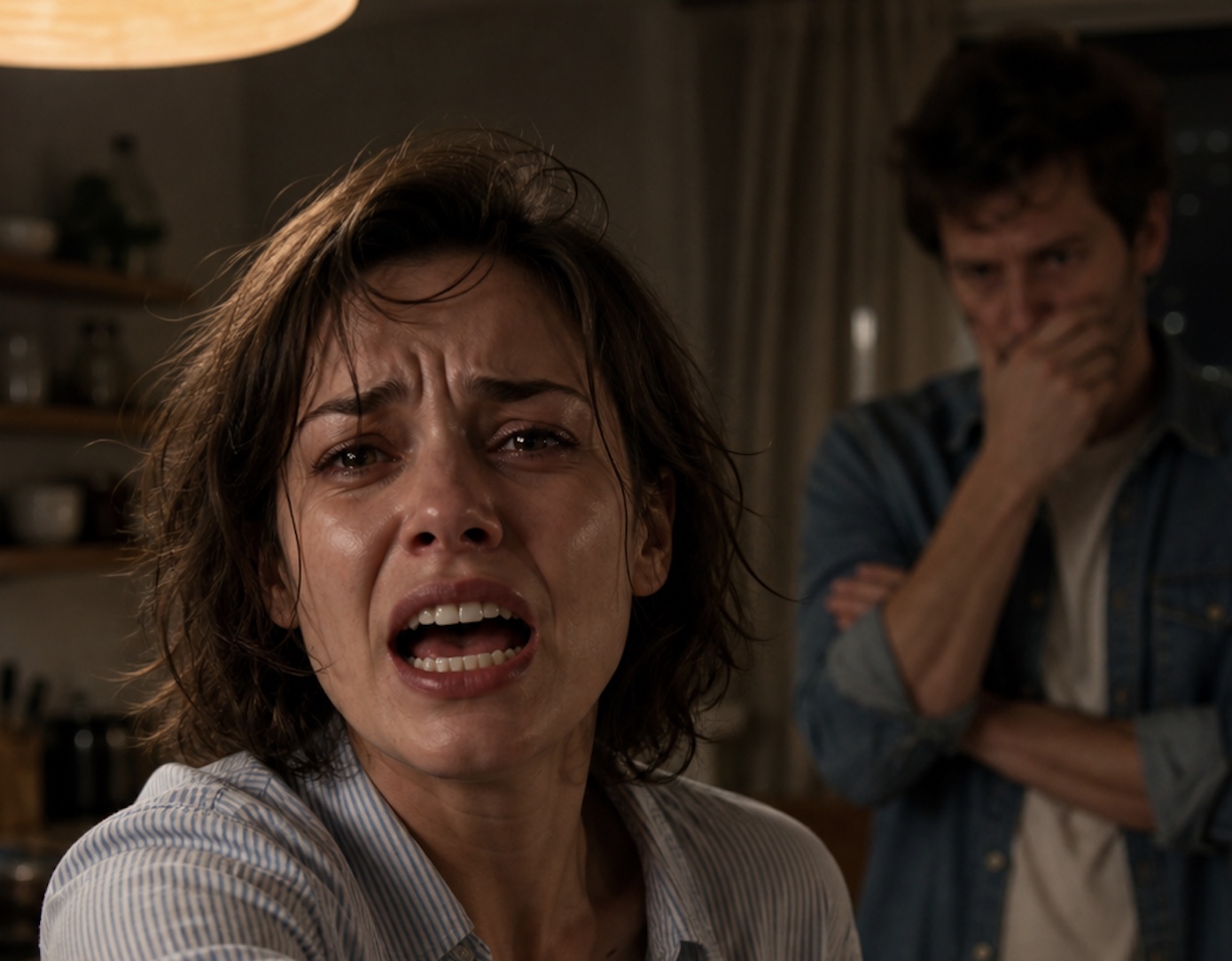
He flicked the light switch, and the harsh brightness hit her eyes. Larisa squeezed them shut and covered her face with her hand. She looked dreadful: her hair was tangled into a careless knot, purple shadows lay under her eyes, and her robe was wrinkled and damp in places from water.
“Quiet,” she whispered without lowering her hand. “Misha just fell asleep. Don’t rattle the dishes.”
Ignoring her tone, Dima was already digging through the fridge. He took out a pot of borscht, sniffed the air, and grimaced with irritation.
“Again with that vinegar smell? You could’ve aired the place out. It’s impossible to breathe in here. Like a hospital, honestly. Where’s the bread?”
He tore off the heel of the loaf with his hands, not bothering to use a knife, and bit into it greedily. Larisa watched him, and somewhere inside her, around the solar plexus, an icy lump began to boil. She did not see a tired husband who had returned from work. She saw a well-fed, satisfied male who had simply stopped by to spend the night.
“Dima,” she called, staring at his back. “Why do you smell like fried potatoes with onions? And vanilla. The same vanilla your ex-wife puts in her baking.”
He froze. For one second, he stopped chewing. Then he began working his jaw twice as hard, trying to swallow the piece of bread that had suddenly lodged in his throat. Slowly, Dima turned around, wiping his mouth with the back of his hand. In his eyes flashed that very look a schoolboy gets when he is caught with a cigarette — a mixture of fear and arrogant defiance.
“You’re imagining things,” he muttered, looking away. “I ate at the canteen. Everything stinks of something there. And what is this, an interrogation the second I walk in? I work, I provide for this family, and you’re sniffing me like a dog?”
“At the canteen? At ten at night?” Larisa rose from the stool. Her legs trembled from exhaustion. “You said you had an urgent installation job on the other side of the city. You said you’d be out of reach in a basement. But I checked the traffic map. There were no jams there. The entire city center was dark red, though. Right where Marina and the kids live.”
“So I stopped by!” Dima flared up, deciding that attack was the best defense. He threw the bread onto the table, scattering crumbs across the oilcloth. “I stopped by for half an hour! So what? Is that the crime of the century? Marina called. She had an emergency. I couldn’t just ignore it. I’m still a father, not some stranger off the street.”
Larisa came right up to him. In the bright kitchen light, she could see that he hadn’t merely “stopped by.” He was relaxed. His shirt was fresh, not soaked with sweat and construction dust. He was full and calm, while she had been losing her mind with terror here.
“An emergency?” she asked quietly, and there was more danger in that whisper than in any scream. “What kind of emergency, Dima? What happened there that made you silence your phone?”
“Her tap was leaking!” he barked, throwing his hands up in irritation. “The kitchen faucet broke loose! Water was pouring everywhere, she was panicking, the kids were crying. What was I supposed to say? ‘Sorry, dear, call emergency plumbing and pay five thousand’? She doesn’t have spare money, and you know that. I went over, shut off the water, ran out for a new gasket, fixed everything. I just helped!”
“You just helped…” Larisa repeated like an echo. “It took you three hours to change a gasket?”
“Well, first I had to buy it, then unscrew the old part, everything was stuck… Then we had some tea, I calmed her down. She’s a woman alone, it’s hard for her to handle all that by herself.” Dima said it with such confidence in his own righteousness that Larisa wanted to burst out laughing. Hysterically. Cruelly.
She remembered holding their one-year-old son in her arms an hour earlier while violent tremors shook his little body. She remembered how his small body burned like fire and his lips turned blue. How she dialed her husband’s number with one hand and tried to pour medicine into the child’s clenched mouth with the other. Rings. Long, indifferent rings. Then a rejected call. Once. Twice. Three times.
“Dima,” she said, and her voice rang like a stretched wire. “Do you understand what was happening here while you were drinking tea with vanilla buns? Misha’s fever hit forty. He started having convulsions. His eyes rolled back, and for a few seconds he stopped breathing. I called an ambulance. I was alone. I thought he was dying in my arms.”
Dima frowned. His face took on a skeptical expression.
“Why are you exaggerating? Kids get sick. That’s normal. A fever of forty is just a virus. You give him Nurofen and it passes. Why turn it into a drama? I came home, didn’t I?”
That was the last drop. The cup of patience that had been filling for months with his “quick stops,” his “help,” and his endless comparisons finally overflowed and shattered into pieces. Larisa felt a hot wave of rage rise from her stomach to her throat, sweeping away every trace of exhaustion and fear.
“I called you for three hours while our son had a fever of forty, and you kept rejecting my calls because you were fixing your ex-wife’s tap! You live there, and here you only sleep! I will not keep sharing my husband with another woman! Go back to her for good!”
“Keep your voice down, you idiot, you’ll wake the child!” Dima hissed, glancing nervously toward the bedroom door. “Why are you yelling? I explained everything. There was an emergency! I couldn’t pick up the phone with dirty hands!”
“The emergency was here!” Larisa jabbed a finger at her own chest. She was shaking. “The emergency is when your child is burning up and his father is eating potatoes in another house! You rejected the calls, Dima! You saw me calling and rejected them so you wouldn’t ruin your cozy evening with a ‘lonely woman’!”
“I didn’t reject them, I was busy!” he tried to shout over her, but his arguments sounded pathetic. “You’re selfish, Larisa! You only think about yourself! Those are my children too. They need help too!”
“Then go to them!” Larisa grabbed a kitchen towel from the table and threw it in his face. “Right now! Go fix taps, hang shelves, drink tea! But don’t come near me! To you, I’m nothing. A servant. An incubator! You didn’t even ask how Misha is now! You went straight for the food!”
She was suffocating. There was catastrophically little air in the cramped kitchen. Dima pulled the towel off his face, and his gaze became heavy and cold. There was no remorse in it. Only anger that he had, once again, not been appreciated — once again made guilty when he considered himself a savior.
Slowly, Dima picked up the towel from where it had fallen on the table and carefully, demonstratively folded it into four. His movements were deliberately calm, but there was a threat in that calmness. The muscles in his jaw twitched, betraying barely restrained fury. He did not feel guilty — not even a little. On the contrary, he was becoming more and more convinced that he was the victim of an unfair female tantrum.
“Are you done with your performance?” he asked in an icy voice, sitting down on the stool and pulling the bowl of cooling borscht toward himself. “Because if you’re not, you’d better be quiet. I’m not going to listen to this nonsense after a hard day.”
Larisa looked at him, and it felt as though a stranger was sitting in front of her. The man with whom she had shared a bed and a life had suddenly turned into a deaf wall.
“Nonsense?” she repeated, feeling her fingertips begin to go numb from helplessness. “So your son’s convulsions are nonsense? Me running around this apartment alone, not knowing whether he would survive, while you were tightening bolts in someone else’s kitchen — that’s nonsense?”
Dima inhaled loudly through his nose and slammed his spoon onto the table. Red borscht splashed onto the oilcloth.
“Why do you keep repeating the same thing? ‘Tightening bolts,’ ‘someone else’s kitchen’… Do you even hear yourself?” He leaned forward over the table. “Marina is a humanities person through and through. She can’t even hammer in a nail. Her hands just aren’t made for that. For her, a leaking tap is a catastrophe of universal proportions. And do you know how much plumbers charge these days? Five thousand just for a call-out! Five! She doesn’t have that kind of money. She spends every penny on the children. I saved that money. I saved it for the family!”
“For which family, Dima?” Larisa asked quietly. “For that one? Or for ours? Because in our family, hell was happening at that very moment.”
“Don’t twist my words!” he snapped, grabbing the spoon again. “I didn’t know Misha’s temperature would spike. I’m not psychic. But there, there was a real problem. Water was pouring out, the downstairs neighbors were already pounding on her door. If I hadn’t come, they would’ve stuck her with the repair costs. Who would pay then? Me again! So you should be thanking me for solving the issue with minimal damage.”
Larisa leaned her back against the cold refrigerator. His logic made her feel sick. This reinforced concrete, impenetrable male certainty that a technical problem mattered more than a living person.
“You don’t understand…” she whispered. “Dima, you really don’t understand? I called you forty times. Forty. Not once, not twice. Any normal person who saw that many missed calls from his wife with a small child would call back immediately. He would drop everything — the tap, the flood, the neighbors — and call back. But you… you just turned off the sound.”
“Because I was working!” Dima roared, finally losing control. “When I work, I don’t get distracted by women’s chatter! Marina was hovering over me, whining, handing me the wrong tools, getting in the way. I had to focus. I thought you were calling to ask what to buy for dinner or to complain about the weather. How was I supposed to know?”
“You could’ve answered for one second.”
“I could have! But I didn’t!” He slammed his palm against the table. “Stop making me out to be a monster! Is Misha alive? He is. Is he sleeping? He is. So you managed. You’re strong, Larisa. You always have everything under control. You know how to call an ambulance, you know how to give medicine. But Marina is different. She gets lost. She freezes over the smallest thing. She needs a man’s help, understand? And you’re like a man in a skirt — you carry everything yourself.”
Those words hurt more than a slap. “You’re strong.” How often do women hear that as a compliment, without realizing that it is really a sentence? Permission not to care. Permission to abandon them in trouble.
“So it’s my fault that I don’t freeze?” Larisa laughed bitterly. “It’s my fault that I saved our son while you saved… what? Your ex-wife’s linoleum?”
“My children live there too!” Dima spat out this argument like a trump card. “Olya and Pasha. They need water too — to wash, to drink. I can’t leave them without basic comfort. I’m a father, Larisa. I’m responsible for all my children. For those two and for this one.”
“This one?” Larisa felt the tears she had been holding back for three hours suddenly dry before they could fall. What remained was a dry, vicious clarity. “Misha is ‘this one’ to you? And they are ‘the children’?”
“Don’t cling to words!” Dima irritably stuffed a spoonful of cold borscht into his mouth. “You know exactly what I meant. I’m trying to be a good person. I didn’t abandon my ex-wife to fend for herself like some jerks do. I help. I’m involved. And instead of supporting me, you give me a scene out of nowhere. Selfish. You just want all my attention focused only on you. And you don’t care that someone’s tap burst.”
“I don’t care about her tap, Dima,” Larisa said firmly. “I don’t care about her linoleum, her neighbors, or the fact that she’s a humanities person. Because today I nearly lost my child. And his father, at that moment, was choosing between me and a faucet. And he chose the faucet.”
“Oh, enough!” Dima pushed the plate away dramatically. “You ruined my appetite. Impossible to eat when someone is buzzing in my ear. I’m going to sleep. I have to get up early tomorrow. I still need to stop by Marina’s before work and finish a few things. Seal it with silicone.”
He stood up, scraping the chair loudly, and headed toward the kitchen door without even looking at Larisa. He was going to sleep in a clean bed, certain he was right, leaving his wife alone in the cold kitchen, with the smell of medicine and the realization that she was completely, absolutely alone.
Larisa remained standing. Something inside her snapped. The thin thread that had held this marriage together stretched to its limit and broke with a soundless ring. She understood that this was not just a fight. This was the end. Because tomorrow he would go there again. “To seal it with silicone.”
Dima had already reached for the door handle, intending to leave the kitchen and disappear into the bedroom, when Larisa’s voice — quiet and frighteningly steady — made him stop. She was not shouting, not breaking down into hysteria, but there was steel in her tone, sharp enough to cut.
“Stop,” she said. “You said you’re going to her tomorrow with silicone. Now look under your feet.”
Dima frowned and looked down. He was standing in the hallway, right by the kitchen threshold. Sticking out from under his slipper was a piece of plastic baseboard that had come loose from the wall six months ago. Every time he walked past, he caught it with his foot, cursed, kicked it back into place, and promised himself he would “fix it over the weekend.” But weekends came and went, and the baseboard kept living its own stubborn life.
“So what?” he snapped, looking back at his wife. “Are you starting with petty things again? You’re comparing a flood emergency to a piece of plastic?”
“I’m not comparing plastic, Dima. I’m comparing attitude,” Larisa stepped toward him, blocking his way. “Our toilet tank has been leaking for a month. You hear it every night — the water running, the meter spinning. You say, ‘I’ll get to it.’ The bulb in the wardrobe burned out three weeks ago. I get dressed using the flashlight on my phone. You say, ‘I’ll buy one when I’m at the store.’ But the moment Marina calls and says, ‘Oh, something is dripping here,’ you leave work, buy parts with your own money, and fly over on the wings of love to save her parquet floor.”
“Because she’s alone!” Dima roared, his face blotching red. “She doesn’t have a man in the house! And you have me!”
“I have you?” Larisa laughed bitterly, and that laugh was more frightening than tears. “Dima, I have you only on paper. You’re listed in my passport and you take up space on the couch. In reality, you live there. You don’t just fix taps. You take her car for maintenance because ‘she doesn’t understand mechanics.’ You carry her heavy bags from the supermarket because ‘her back hurts.’ You listen to her whine about her boss for hours, while when I try to tell you about my day, you sit buried in your phone.”
Dima clenched his fists. He had nothing to say against the facts, and that only fueled his anger. He felt cornered, even though he genuinely believed he was doing something noble.
“Yes, I help!” he blurted out, staring at Larisa defiantly. “And you know why? Because there, they appreciate me! When I screw in a lightbulb for her, she says, ‘Thank you, Dima, you’re a real man, what would we do without you?’ She sets the table, she smiles. And you? You take everything for granted. Fixed it? Good, now take out the trash. Didn’t fix it? You nag me for weeks. There I feel like a needed man, a protector! Here I’m just a function. An ATM and a handyman who always gets blamed!”
Larisa looked at him, and the veil finally fell from her eyes. Everything made sense now. He did not need a family. He needed a stage where he could play the hero. And Marina, cunning and calculating, understood that perfectly. She fed his ego with vanilla buns and flattery while he spent his family’s time and money on her.
“So this is about a ‘thank you’?” Larisa asked quietly. “You sold our son’s health for cheap praise from your ex-wife? You’re more comfortable there because they flatter you, while here you’re expected to be responsible?”
“Here you expect the impossible!” Dima interrupted, pointing toward the nursery. “You made an elephant out of a fly! The boy has a runny nose and a fever. That happens to everyone. But you turned it into the tragedy of the century just so you could make me guilty. ‘I called forty times’… You could’ve called a hundred! I was busy doing something useful, not listening to your hysterics over a thermometer!”
“It wasn’t just a thermometer, Dima!” Larisa’s voice trembled, but she immediately steadied herself. “He had convulsions. Do you understand what that means? It means his brain was overheating. It means an ambulance, an injection, the fear that he might not wake up the same. And while that was happening, you were listening to how wonderful you are and eating potatoes. You traded your child’s life for another woman’s comfort.”
“Enough!” Dima slammed his fist into the wall so hard that his jacket fell from the hanger. “Shut up! I will not let you turn me into some scumbag! Marina is the mother of my children, and I will help her whether you like it or not. And if you’re so delicate that you can’t handle one fever without me, then you’re worth nothing as a mother!”
Silence dropped over the hallway. Heavy. Suffocating. Smelling of dust and betrayal. Larisa looked at her husband and saw how hard he was breathing, how his nostrils flared. He had said it. He had spoken what he truly thought.
“So that’s how it is…” she whispered. “Worth nothing, then.”
“Yes, exactly!” Dima tasted victory in the verbal fight and decided to finish her off. “You’re just jealous. You’re furious that I have a past I haven’t erased. Did you think I would forget them because of you? Dream on. My roots are there. People who respect me are there. And you… you’re just an eternally dissatisfied woman who can’t even glue a baseboard herself while her husband earns money.”
“Money?” Larisa narrowed her eyes. “Your money goes to gasoline so you can drive across the city to Marina, and to spare parts for her apartment. We live on my salary, and she receives your ‘care.’ I tolerated it because I thought you were simply a decent person. But today you showed me your priority. There, you are a husband. Here, you’re a tenant who insults the landlady.”
Dima bent down, picked up his jacket, and shook it hard.
“Oh, I’m a tenant now? Excellent. Wonderful. If I’m nobody here, if I’m a bad father and a terrible husband, then what the hell am I even doing here?”
He looked at Larisa expectantly. He was waiting for her to become frightened. Waiting for his usual manipulation — “I’m leaving” — to work, so she would rush to stop him, apologize, cry. He was used to that trump card beating every other card. But Larisa stood still, leaning her shoulder against the doorframe, and in her eyes there was only icy emptiness.
“Exactly,” she said evenly. “What the hell are you doing here, Dima? You have an early morning tomorrow. The silicone won’t apply itself.”
Dima choked on his outrage. She was throwing him out? Him? The provider and savior?
“You’ll regret this, Larisa,” he hissed, snatching his car keys from the shelf. “Oh, you’ll regret it. When you’re left alone with all your problems, don’t you dare call me. I won’t pick up. I have pride too, you know.”
“You don’t have pride,” she replied. “You have an inferiority complex that you treat at your ex-wife’s expense. Go, Dima. Go where you’re the hero. That vacancy is already taken here. I can manage on my own.”
Dima stood there with the keys in his hand, feeling the ground slip from under his feet. The script had broken. She wasn’t holding him back. She was sending him away. And from that realization, his anger turned into cold, calculated hatred.
Dima yanked the zipper of the sports bag he had pulled down from the storage shelf. The sound was sharp and shrill, as if the fabric itself were screaming in pain. He was not merely packing his things — he was staging a demonstration of intimidation, certain that at the point when he started stuffing socks into the bag, Larisa would break. She was supposed to stand in the doorway, spread her arms, and sob, begging him to stay. But Larisa stood with her shoulder against the doorframe, watching him with dry, inflamed eyes that held nothing but disgusted exhaustion.
“Do you even understand what you’re doing?” he threw over his shoulder, shoving jeans into the bag in a crumpled lump. “You’re destroying this family with your own hands. Over what? Over me helping my children? Over the fact that I’m a normal man who doesn’t abandon people in trouble?”
“You’re abandoning people in trouble right now, Dima,” Larisa answered. Her voice was quiet, but every word landed in the room like a heavy stone. “Over there, in his crib, lies your son. He just survived a seizure. And you’re stuffing your underwear into a bag because your ego got bruised.”
For a second, Dima froze, looking toward the child’s crib in the corner of the room. In the dimness, only a small blanket could be seen rising and falling with the child’s heavy breathing. For a brief moment, something resembling conscience stirred in him, but he immediately crushed it with his usual defense mechanism. “She brought this on herself. She pushed me too far. I can’t live under this pressure.”
“Don’t hide behind the child!” he hissed, lowering his voice so he wouldn’t wake Misha, though there was more poison in that whisper than in a shout. “Mishka will grow up and understand that his father didn’t leave him. He left a hysterical mother who wouldn’t let him take a step. You’ll suffocate him with your care just like you suffocated me. ‘Where are you?’ ‘Who are you with?’ ‘Why do you smell like cutlets?’ What difference does it make what I smell like if I bring money home?”
He rushed to the wardrobe, sweeping his shirts from the shelves. Hangers clattered against one another, creating a nervous, rattling rhythm. Dima moved chaotically, yet with a strange, vengeful precision. He took not only clothes, but also the expensive drill Larisa had given him for his last birthday, and even a half-used bottle of cologne.
“I’ll take everything,” he hissed. “So nothing of mine hurts your proud and independent eyes. You’ll spin around on your own now. We’ll see what tune you sing when the tap starts leaking or a socket begins to spark. Will you call a ‘husband for an hour’? Fine. Get your wallet ready.”
Larisa said nothing. She watched him the way one watches a natural disaster — with horror, yet knowing it cannot be stopped. Only one thought kept spinning in her head: how had she not noticed before that she had been living with a man who hated her? Not merely stopped loving her, but truly despised her for daring to demand his involvement.
“The keys,” she said when he zipped the bag. “Leave the keys on the table.”
Dima straightened up, slung the bag over his shoulder, and looked at her with a triumphant smirk. He had been waiting for this moment. The final chord, when she would understand that he was leaving for real, not pretending.
“Here,” he threw the key ring onto the polished side table. The metal hit the wood with a dull thud, leaving a scratch. “Choke on your control. I’m going where I’m wanted. Where people are happy to see me. Where a woman knows how to be grateful instead of nagging her husband for being late from work.”
“From work at your ex-wife’s,” Larisa corrected him. “Don’t confuse the terms, Dima. You weren’t working. You were playing family there while your real family was falling apart here.”
“Go to hell,” he threw at her as he passed, deliberately bumping her shoulder. “Live however you want. Stew in your bitterness. Maybe now I’ll finally live normally.”
He went into the hallway and struggled into his boots without untying the laces. Larisa did not go to see him off. She remained standing in the bedroom doorway, guarding her son’s sleep as if afraid Dima might take even the air from the apartment with him. The front door slammed. Once. Hard. Final. Cutting off the past.
Then the lock clicked — not because Dima had closed it, but because Larisa walked over and turned the latch twice.
The stairwell was cold and smelled of stale cigarette smoke. Dima went down the stairs, feeling the bag pull at his shoulder, but along with that weight came a strange, angry lightness. He felt like a prisoner who had escaped from jail. “I’m right,” he repeated to himself in time with his steps. “I’m absolutely right. You can’t treat a man like that. I’m not a slave.”
He stepped outside. The frosty air struck his face, cooling his burning cheeks. Dima stopped beside his car, tossed the bag into the back seat, and got behind the wheel. The interior was dark and quiet. For a second, he closed his eyes, picturing the apartment he had just left: the smell of medicine, vinegar, the silent reproach in his wife’s eyes. He shuddered. No, he would not return there. Never. Enough.
He pulled out his phone. The screen lit up brightly in the darkness of the car. His finger slid through the contacts by habit and tapped a name that, in truth, had never really left the top of his call list. The rings lasted a long time.
“Hello?” Marina’s sleepy, soft voice sounded like music to him. “Dima? What happened? Have you seen the time?”
“Marin, are you awake?” he asked briskly, starting the engine. There was not a drop of regret or sadness in his voice. Only businesslike energy and the anticipation of comfort. “Put the kettle on. And take out that tincture we didn’t finish.”
“Dima?” His ex-wife’s voice became anxious and, at the same time, interested. “Where are you? Did something happen with Larisa?”
“There is no Larisa anymore,” he cut her off sharply, pulling out of the courtyard. “That’s it. I’ve had enough. I’m coming to you. For good. With my things. Will you take in a refugee? Because I got my brain eaten over your tap, can you imagine? She said if I fixed it, I should live there.”
There was a brief pause on the line, and then a warm, enveloping laugh.
“Well, if she said it, then you should obey. Come on, you poor thing. There are potatoes left; I’ll warm them up. And by the way, take another look at the tap. I think it’s dripping again…”
Dima smiled, looking at the empty night road.
“I’ll look at it, Marin. I’ll look at everything. Now I’ve got plenty of time for that.”
He pressed the gas, speeding away from the home where, in a dark apartment, a young woman slid down the wall to the floor, listening to the hoarse breathing of her sick child in the silence — and finally, for the first time in that endless evening, allowed herself to cry without a sound.
But Dima no longer saw any of that.
He was driving home.
To his real, first, and, as it turned out, only family — where what waited for him was not problems and responsibility, but warm potatoes and the endless repair of old plumbing.