“You didn’t slice the bread for the table again!”
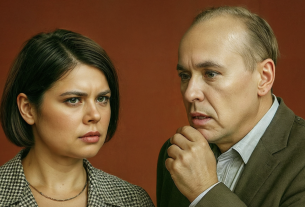
It wasn’t a request. It was a statement of fact, delivered in the tone of someone who was used to things happening after she spoke. Aunt Lyudmila had a special way of saying such things: without raising her voice, without even looking at you, as if she were speaking to a piece of furniture.
A piece of furniture that was expected to work.
Nadya took off the apron and calmly sat down.
She didn’t hang it on the hook. She took it off and threw it over the back of the chair. Then she picked up a glass of water from the table and took a sip, looking out the window. Outside, there was an ordinary courtyard, ordinary cars, ordinary people who, at that moment, didn’t have to prove anything to anyone.
The table grew slightly quieter.
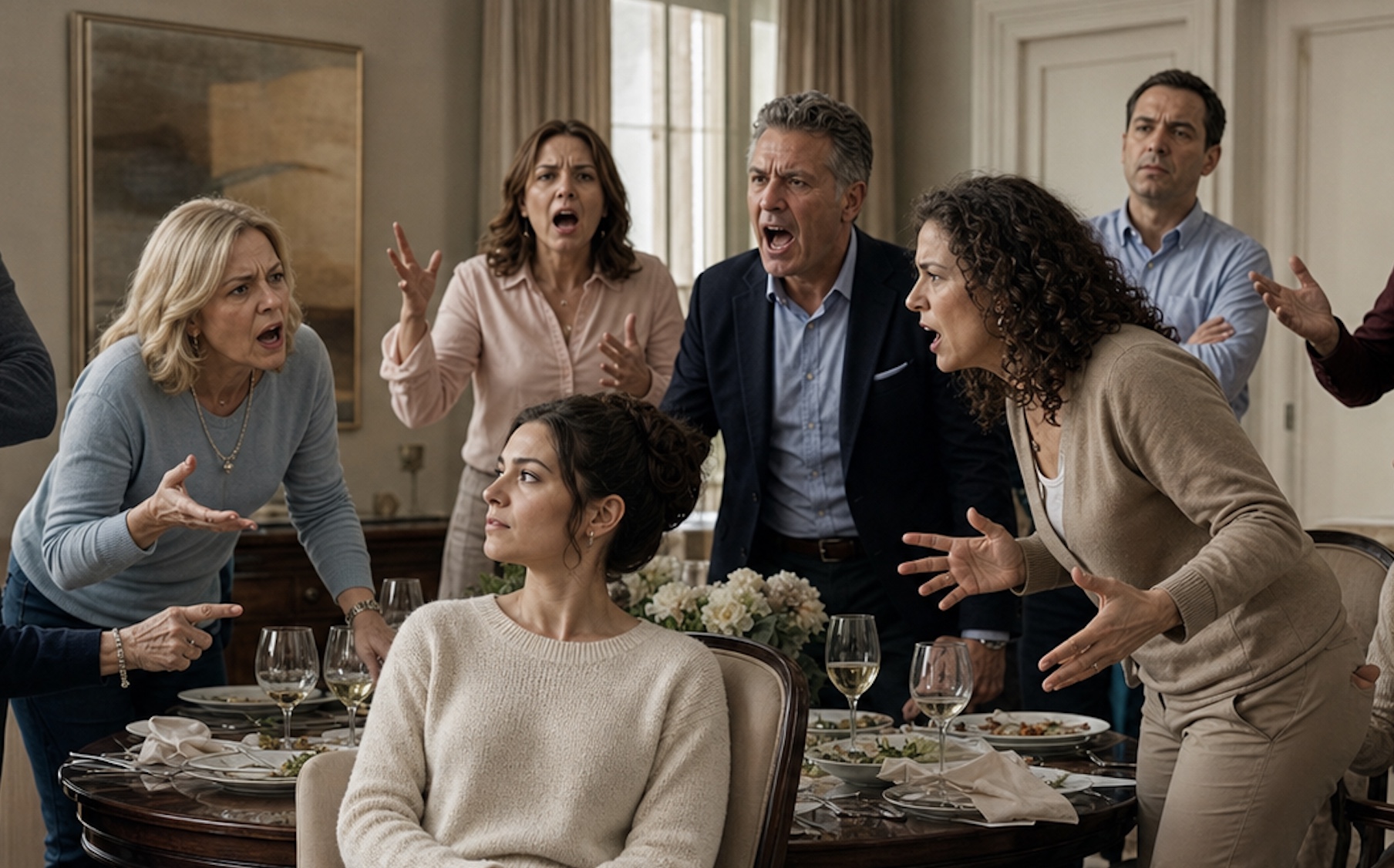
It was Grandma Roza’s birthday. She had turned eighty-two: sharp-minded, sharp-tongued, and absolutely convinced that a woman in the kitchen meant order, while a woman at the table was already a matter for discussion. About twelve people had gathered. The old apartment on Sadovaya Street, with its high ceilings and the smell of mothballs drifting from the wardrobe, was packed with relatives like sardines in a tin.
Nadya had arrived first.
As always.
She helped set the table, sliced the cheese, took the chicken out of the oven, arranged the plates, found the corkscrew because no one else knew where it was kept — even though everyone had been in that apartment a hundred times. Then the others arrived. Her cousin Stas with his wife Oksana, who always brought the same cake from the supermarket and always received compliments for it. Uncle Felix, who had the talent of taking the best armchair before he had even managed to remove his coat. Aunt Lyudmila, her mother’s older sister, a woman with the posture of a school principal and the eyes of a tax inspector.
And her mother.
Her mother, who had whispered to Nadya in the hallway, “You understand, don’t you? Just don’t argue with anyone today.”
Nadya had nodded then.
She always nodded.
She was thirty-four years old. She worked as an art director at a small agency, rented an apartment ten minutes from the city center, ran along the embankment in the mornings, and read before bed — not social media, but real books. She had her own life, clear and carefully built.
But the moment she crossed the threshold of this apartment, something inside her tightened, as if she were sixteen again and afraid to say one word too many.
She had thought about it more than once. Family was gravity. Not always warm, not always kind, but impossible to cancel. It pulled you in and crushed you at the same time.
She put on the apron automatically every time. She arrived, and she went straight to the kitchen. It was like a reflex, like a trained response: you are here, so you work. No one asked. No one said thank you. It was simply assumed.
But today, something clicked.
“Nadyusha, the salad still needs mixing,” her mother said without looking up from her phone.
“I’m sitting,” Nadya replied.
A pause.
Her mother raised her eyes.
“What?”
“I’m sitting. You can mix the salad yourself.”
She said it calmly. Without anger, without challenge — simply as a fact. But everyone at the table heard it. Uncle Felix stopped chewing. Oksana pretended to study the pattern on the tablecloth. Stas suddenly started coughing for no clear reason.
Aunt Lyudmila looked at Nadya for a long moment, with her signature blend of surprise and condemnation.
“Are you feeling all right?”
“Perfectly,” Nadya said. “Thank you for asking.”
Grandma Roza watched all of this from the end of the table. Eighty-two years was a lot. It meant she had seen all kinds of things: revolutions in manners, the collapse of the Soviet Union, three generations of family dramas, and more birthdays than she could count. She had small, clever eyes and a habit of staying silent exactly when everyone expected her to speak.
Now she was silent.
But she was looking at Nadya, and there was something like interest in that look.
Lyudmila, meanwhile, changed tactics. That was her style — she didn’t press straight ahead; she circled around.
“Well, young people are like that now,” she said, not addressing anyone in particular. “They love comfort. Working, not so much.”
“Lyudmila Vasilyevna, I work from eight in the morning,” Nadya said in the same even voice. “Five days a week. Sometimes six.”
“I’m not talking about work. I’m talking about home. About family. Felix and I had things differently. I cooked, I cleaned, and I never sat down at the table until everyone had eaten.”
“And how was that?” Nadya asked. “Were you happy?”
Lyudmila opened her mouth.
Then closed it.
Felix stared down at his plate with the expression of a man who would have preferred not to exist.
After that, the conversation somehow broke apart into several smaller ones. Stas started talking about his car. Oksana asked Nadya’s mother for some recipe. Lyudmila turned toward the window with the expression of someone who had been deeply wounded.
Nadya ate.
Calmly, without rushing.
The chicken was good — she had cooked it herself, after all. But she wasn’t thinking about the chicken.
She was thinking about how this wasn’t the first time. How every holiday was the same film, only before, she had accepted her role without asking questions. Waitress. Dishwasher. Organizer. The person who would arrange everything, do everything, and then quietly clean up after everyone.
And then one day someone says, “You understand, don’t you?” — and suddenly you do understand.
Just not the thing they meant.
Oksana’s cake was cut after the main course. Nadya stood up — but not to get the knife. She picked up her bag and said:
“I’ll step out for a bit. I need some air.”
“Where are you going?” her mother said a little too loudly.
“Outside. It’s stuffy in here.”
Lyudmila muttered something — probably about “today’s generation” and “no respect.” Nadya was already walking toward the door.
The stairwell was cool and smelled of old wood. She went down to the first floor, pushed through the heavy door, and stepped out into the most ordinary courtyard, between old poplars and parked cars.
She took out her phone and wrote to her friend from work, Sveta:
I’m in family hell. I’ll tell you later.
Sveta replied instantly:
Survive. You can do this.
Nadya almost smiled.
She stood there for about five minutes. Then she went back inside — not because she had to, but because Grandma Roza had turned eighty-two today. And that still mattered.
But she would never put on that apron again.
When she returned, something interesting was happening at the table.
Grandma Roza was speaking. Not loudly, but clearly enough that everyone else had fallen silent.
“Lyudochka,” she said, looking at Lyudmila, “do you remember how, on my sixtieth birthday, you left right after the main course because Felix wanted to go home?”
Lyudmila stiffened.
“Mama, that was twenty years ago…”
“Twenty-two,” Grandma corrected. “I remember very well. I didn’t say anything then. But I’ll say it now: it hurt me. And Nadya probably gets hurt too sometimes. That’s all I wanted to say.”
She picked up her fork and calmly cut herself a piece of cake.
Oksana stared at her phone with such intensity one might have thought there was a live broadcast from outer space on the screen. Stas examined the ceiling. Felix coughed again.
Nadya returned to her seat, picked up her glass, and looked at her grandmother.
Grandma Roza glanced at her briefly. There was no special sign, no grand gesture. Just a look. But there was something in it… as if an old woman who had seen everything had finally decided to tell the truth.
And that, perhaps, was the best birthday gift.
Not for Grandma Roza.
For Nadya.
Lyudmila stayed silent for exactly three minutes. Nadya knew because she watched the old pendulum clock on the wall, the one that had been hanging in that apartment for as long as she could remember. Three minutes is a long time for a person who has something to say.
On the fourth minute, Lyudmila put down her fork.
“So,” she said, and her voice had returned to that old tone — official, prepared, commanding. “I don’t understand what is going on today. Mama, you just, in front of everyone…”
“Told the truth,” Grandma Roza interrupted calmly.
“You called me ill-mannered!”
“I didn’t say that. I said it hurt me. Those are different things, Lyudochka.”
Lyudmila looked at her husband. At that moment, Felix was carefully spreading butter on a piece of bread, even though no one had asked for butter, and there hadn’t even been butter on the table before. No one knew where it had come from.
“Felix,” Lyudmila said.
“Hm?” He didn’t look up.
“Do you hear what’s happening?”
“I hear,” he said. “Good cake, by the way.”
Stas choked. Oksana widened her eyes at him. Nadya watched all this and felt something like lightness — strange and unexpected, like when you’ve been carrying a heavy bag for a long time and suddenly set it down.
“Nadya,” her mother said her name as if it were a warning. “Do you even understand what you’ve done?”
“I haven’t done anything. I simply didn’t go slice the bread.”
“But it had to be done!”
“Why did it have to be?” Nadya looked straight at her mother. “Everyone has hands. The knife is on the table. Why does it have to be me?”
Her mother opened her mouth, then closed it. Then opened it again.
“Because you… you always…”
“Exactly,” Nadya said. “Always. That’s why everyone thinks it’s supposed to be that way.”
A special kind of silence fell over the table — the kind that comes when everyone has heard everything, everyone has understood everything, but no one knows what to do with that understanding.
Grandma Roza drank her tea. She looked completely serene, like a person who had come to watch a play and was satisfied with the first act.
Lyudmila gathered herself. You could see it in the way she straightened her back and folded her hands on the table.
“I’ll speak plainly,” she began. “Nadya, it seems to me that you’ve picked up some… ideas. You’ve watched something, read something on the internet about how people should live. But family is not the internet. In a family, there are rules.”
“What rules?” Nadya asked.
“Well…” Lyudmila waved her hand vaguely. “Respect for elders. Care. A woman should…”
“What should a woman do?”
“Well, you understand.”
“No,” Nadya said. “Explain it.”
It was a simple question. But for some reason, simple questions are the most uncomfortable ones. Lyudmila felt that; her cheeks turned slightly pink.
“Are you doing this on purpose?”
“No. I truly want to understand the logic.”
“Logic!” Lyudmila almost laughed. “Listen to her. She wants logic. Nadya, I have been in a family for forty years. I know how it works.”
“And how does it work?”
“Well, like Felix and me! I cook, I take care of the house, he works — and everything is normal!”
Felix raised his head. His face wore the expression of a man who had suddenly been dragged into a conversation he had very much hoped to avoid.
“Lyudmila,” he said carefully, “that’s not entirely accurate…”
“Felix!”
“I’m just saying, you worked too. Twenty years in accounting.”
“That’s different!”
“How is it different?” Nadya asked.
Suddenly, Stas spoke. He had been silent all evening — Nadya’s cousin, three years older than her, always slightly ironic, always a little off to the side. But now it seemed he couldn’t help himself.
“Listen,” he said, “maybe we should just slice the bread and calm down?”
“Stay out of it, Stas,” Oksana snapped.
“I’m calling for peace.”
“You’re calling for bread. Those are different things.”
Nadya looked at Stas. He caught her gaze and gave a tiny shrug. It was almost a gesture of alliance.
Unexpected.
“Stas is right about one thing,” Nadya said. “Slicing bread takes two minutes. Stand up and slice it, Lyudmila Vasilyevna. The knife is right there.”
Lyudmila looked at her as if Nadya had suggested she dismantle a car engine.
“You’re… saying that to me?”
“To you. Or to Stas. Or to Uncle Felix. Honestly, I don’t care.”
“Nadya!” Her mother said her name again — this time not as a warning, but almost as a plea.
But Nadya looked at her mother calmly.
“Mom, you can also get up and slice it. I don’t mind.”
And her mother — perhaps the most surprising thing that happened that entire evening — stood up. Silently, she took the knife. She sliced the bread. She placed the plate on the table. She did all of it with the expression of a person who herself did not understand how it had happened.
There was a pause at the table.
Then Grandma Roza said:
“Good bread. Nadya bought it?”
After that, Lyudmila went out to smoke on the balcony — even though everyone knew she had quit three years earlier. She simply needed somewhere to go.
Felix seized the moment and quietly said to Nadya, while no one else was listening:
“You did well. She’s just… that kind of person. Used to giving orders.”
“I know,” Nadya said.
“She’s not evil. She’s just built that way.”
“Felix Romanovich, I’m not angry with her. I’m just tired of pretending everything is fine.”
He nodded. Was silent for a moment. Then he said quietly, almost to himself:
“I understand. I get tired sometimes too.”
Nadya looked at him — this large, slightly heavy man with his neat mustache, who had spent forty years beside Lyudmila and had learned to become almost invisible. And something in him — some hidden tiredness, familiar and honest — struck her unexpectedly.
Lyudmila returned from the balcony not calmer, but apparently recharged.
“I want to say one thing,” she announced, sitting down. “While everyone is here. Nadya, you are a grown woman, I understand that. But you live alone. You have no family, no children — and you’re teaching us how things should be. That is… well, strange, don’t you agree?”
The table went quiet again.
But now the silence was different.
Nadya felt something tighten inside her — not from hurt, but from recognition. There it was. The real weapon. They always kept it in reserve, like a trump card they pulled out when all the others had been beaten.
“So, until I have a husband and children, my opinion doesn’t count?” she asked.
“That’s not what I said.”
“That is exactly what you said.”
“Nadya, you simply… you don’t know what a real family is.”
“But I do know what it means to come to every holiday and leave last with the dirty dishes. That must count for something, no?”
Her mother said quietly:
“Stop it.”
But Lyudmila could no longer stop. That was another thing about her — she always went all the way to the end, even when the end was clearly going to be a bad one.
“You think you’re smarter than everyone. It shows. Working at that agency of yours, drawing little pictures…”
“I’m an art director.”
“Yes, yes. Very important work. And when was the last time you helped your mother? Really helped her?”
And this was interesting.
Because Nadya visited her mother every week. She drove her to the doctor in February when her knee hurt. She paid for the bathroom repairs last autumn. She simply didn’t talk about it at the table because she believed it was personal.
“Lyudmila Vasilyevna,” Nadya said, “you don’t know what goes on between me and my mother. It is none of your business.”
“How is it none of my business?! She is my sister!”
“And she is my mother. So it is not your business.”
Her mother suddenly got up from the table and went into the hallway. A minute later, there was the sound of water — maybe she was washing her hands, or maybe she was just standing by the sink. Sometimes people need to leave the room so they don’t cry in front of everyone.
Grandma Roza placed her cup on its saucer.
“Lyudmila,” she said, “you’re tired.”
“Mama, I’m not…”
“You are tired. I can hear it. Go home. Sleep. Tomorrow everything will look different.”
There was no anger in her voice and no irony. Just a fact. Like a diagnosis from someone who had earned the right to give one.
Lyudmila looked at her mother. Something in her — just a little — wavered.
“I only wanted…”
“I know,” Grandma said. “You wanted what was best. You always want what is best. Only sometimes, what is best is to keep quiet.”
Felix was already standing up and reaching for his coat, looking like a man who had been waiting for this moment all evening. Oksana quickly put her phone away. Stas poured himself some water.
Nadya stepped out into the hallway, where her mother stood leaning against the wall, staring somewhere past the mirror.
“Are you angry with me?” her mother asked quietly.
“No.”
“I just didn’t want a scandal.”
“I know,” Nadya said. “But it happened anyway. Scandals happen, Mom. It’s normal.”
Her mother looked at her in a new way — a little confused, as if her daughter had said something obvious that, for some reason, she herself had never thought of.
“Come on,” Nadya said, taking her hand. “There’s still cake left.”
They returned to the table. Lyudmila and Felix were already leaving; from the hallway came the rustle of coats, a short “thank you for the evening,” and the sound of the door closing. Stas caught Nadya’s eye and discreetly gave her a thumbs-up. Oksana pretended not to notice.
Grandma Roza waited until Nadya sat down, then pushed a plate of cake toward her.
“Eat. You spent a lot today.”
“Spent a lot of what?”
“Yourself,” Grandma said simply.
Nadya looked at her. At those eighty-two years, at her hands with raised veins, at her perfectly calm eyes. She wanted to ask: had you always known how to do that, or did you learn? To stay silent when needed, to speak when it mattered, and never confuse one with the other?
But she didn’t ask.
She simply ate the cake.
She went home by taxi, watching the night city through the window: the yellow streetlights, the empty intersections. Something inside her felt strange. Not light, not heavy — something else entirely. Like after a conversation that should have happened a long time ago.
Two months later
Lyudmila called first.
It happened on a Wednesday at half past seven in the evening. Nadya had just returned from work and hadn’t even taken off her coat yet.
“It’s me,” Lyudmila said. Her voice was ordinary. No principal-like tone.
“I can hear that,” Nadya said.
A pause.
“I’m calling about something practical. Mama’s blood pressure has gone up, and she refuses to see a doctor. Could you… well, talk to her? She listens to you.”
Nadya was silent for a second.
“All right. I’ll stop by tomorrow.”
“Thank you,” Lyudmila said.
Then, a little more quietly, she added:
“And one more thing. Back then, at the birthday… maybe I said too much. You’re a smart girl. I’m just saying.”
Nadya almost smiled.
For Lyudmila, that was practically a public confession in the middle of a city square.
“I understand,” Nadya said. “Give Felix my regards.”
She went to see her grandmother the next day. She brought medicine, sat in the kitchen for an hour, and drank tea. Grandma Roza told her something funny and lively about the neighbor from the fifth floor. Her blood pressure turned out not to be as terrible as everyone had feared.
As Nadya was leaving, she put on her coat in the hallway and noticed the old apron hanging on the hook — faded, covered in tiny flowers, and seemingly eternal.
She didn’t take it.
She simply looked at it.
And walked out.