The heavy shoebox slipped from Oksana’s hands, hit the dusty attic floorboards, and sent a fan of yellowed school notebooks flying across the room. She picked one up, opened it at random to a page dated on her tenth birthday — May 20, 1994 — and read:
“I baked two cakes.
I took one into the house for little Oksanochka. The second one went to the summer kitchen for Pasha. Igor once again forbade the boy from coming out into the yard while we had guests. Pasha spent the whole evening sitting by the door, listening to the music from their celebration.”
Oksana read the paragraph three times.
There had never been any Pasha in her family.
She had grown up in a spacious brick house in Boyarka. Her father, Igor Nikolaevich, worked as the chief doctor of the district hospital, and her mother was the principal of the local gymnasium. A perfect, respectable family. The old summer kitchen at the far end of the yard had always been locked with a heavy barn padlock, and the ground around it was overgrown with tall nettles. From early childhood, Oksana had been told she was not allowed to go there: dangerous pest-control chemicals and rusty tools were stored inside. Her grandmother spent a lot of time there, but explained it by saying she “needed a quiet place for her seedlings.”
Oksana’s fingers left damp marks on the dusty paper as she turned the pages of the diary.
“September 1996. Pasha has badly outgrown his shoes. My son-in-law refused to give money again. Said he wasn’t obliged to spend a kopeck on that bastard, that he could wear hand-me-downs from the neighbors’ children.”
Oksana dropped the notebook, ran down the creaking stairs into the yard, and headed straight for the old summer kitchen. The lock on the door was covered in a thick layer of rust. She found a heavy crowbar in her father’s garage and struck the shackle with all her strength. On the third blow, the metal cracked.
There were no chemicals inside.
It smelled of old paper and stale air. Along one wall stood a narrow metal-framed bed with a sagging mesh base. And on the faded wallpaper were dozens of drawings scratched in blue ballpoint pen. One of them showed a well-dressed woman, a tall man, and a little girl with bows in her hair. Off to the side, separated from them by a deep, thick line pressed into the wallpaper, stood a small faceless boy.
Oksana did not pack a bag. She got into her car and drove to Kyiv, to Pechersk, where her parents had moved ten years earlier, leaving the house in Boyarka to her grandmother, who had since passed away.
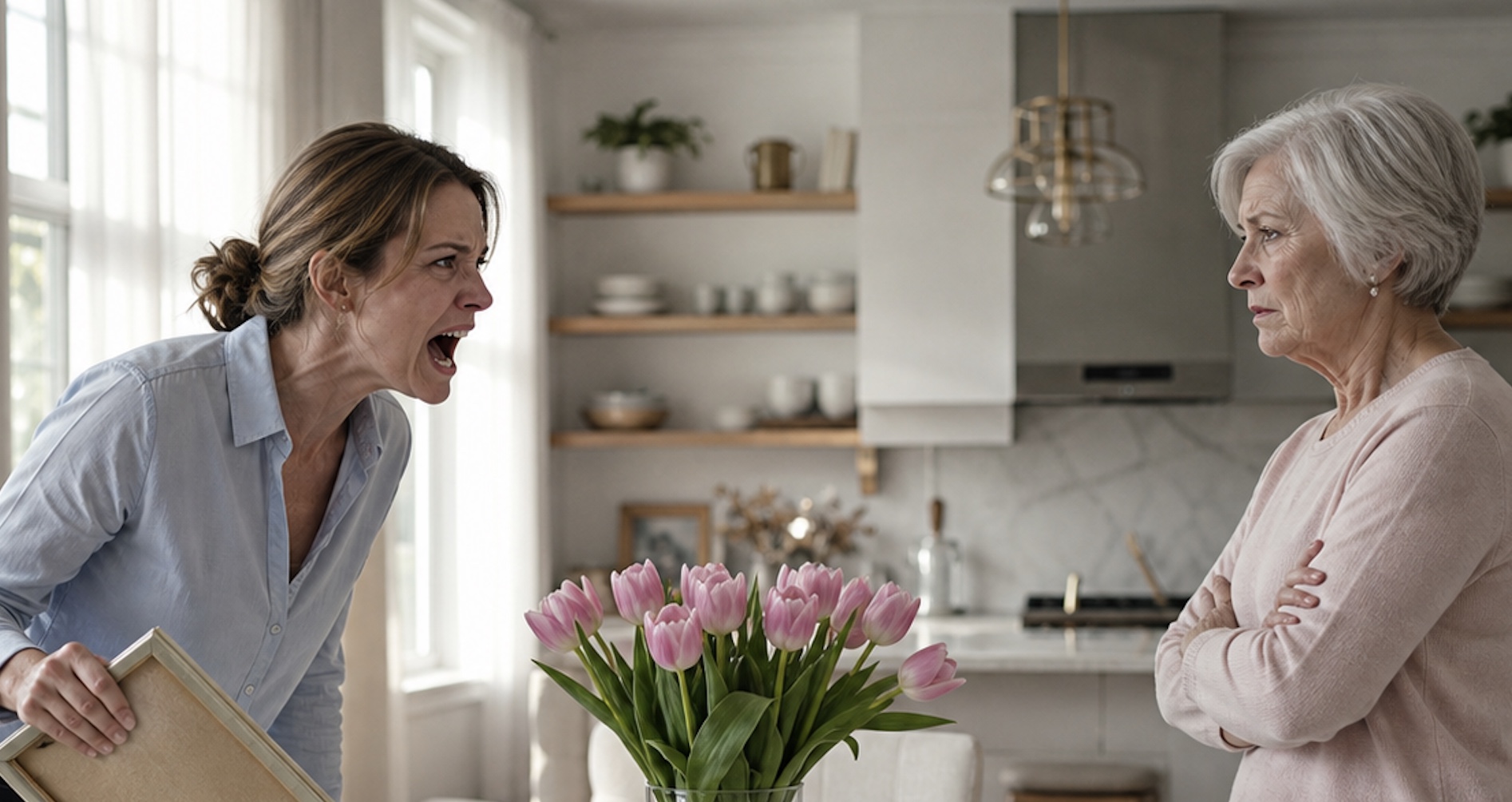
Her mother was sitting in a spacious, bright kitchen, sorting through dry-cleaning receipts. Oksana silently placed the open notebook and a photo of the wallpaper from the summer kitchen in front of her.
Her mother glanced briefly at the pages. Her face did not change. Only her hands slowly pushed the receipts aside.
“Why were you digging through that garbage?” she asked in a flat, ordinary voice.
“Who lived in the summer kitchen, Mom?” Oksana leaned on the countertop with both hands, towering over her.
“My youthful mistake,” her mother said, taking a sip of water from her glass. “Before your father, I was a naïve fool. Got involved with some… lowlife. Gave birth. The child had problems from birth, a birth injury, limped badly. Then I met Igor. He was a promising surgeon from an educated family. When he proposed, he gave me a strict condition: no other man’s baggage in his house.”
‘
“You locked a living child in a shed?!” Oksana slammed her palm onto the table so hard the glass jumped.
“Don’t dramatize. Nobody locked him up,” her mother frowned, as though they were talking about an annoying dog. “He simply lived in the back yard with Grandma. We fed him, clothed him. What was I supposed to do? Send him to an orphanage? Igor gave us status, money, your brilliant future. Pashka knew the rules: don’t let Igor see you, and don’t come near you. At sixteen, he stole money from my mother and ran away. That solved the problem.”
Every word from her mother sounded like a report on a completed task.
Oksana remembered how, at eleven years old, she had found a homemade wooden sword in the yard. Her father had brutally beaten a local stray dog with a broom, deciding it had dragged trash in from the street. But it had been her brother’s toy.
She turned and left the apartment without another word.
Oksana spent the next two months searching. She hired a private investigator and dug through archives. It turned out Pavel had never stolen any money. Her grandmother had given him her own savings so he could get as far away as possible from his stepfather, who had begun raising his hand to him.
Now Pavel lived in a suburb of Dnipro. Oksana had expected to find a broken man living on the margins, but the address led her to a large auto repair station. The office door was opened by a tall, solidly built man with a hint of gray at his temples and motor oil ingrained into his fingers. He looked at Oksana while leaning heavily on a cane.
“Hello, Oksanka,” he said calmly, gesturing toward a chair. “I knew sooner or later you would find those notebooks. Grandma promised not to throw them away.”
They sat in his office. Pavel pulled a gray plastic folder from the bottom drawer of his desk and slid it toward her.
“I don’t blame you. You were a child and knew nothing,” he said. “But if you came for the truth, then take all of it.”
Oksana opened the folder. Inside were bank statements and receipts from a private cardiology clinic in Munich, dated 2019. The very same documents for the payment of her father’s complex heart valve replacement surgery. Back then, the family had claimed that Igor Nikolaevich had sold an elite plot of land near Kyiv and taken on enormous debt to save his life.
But in the “Payer” field, the name Pavel appeared everywhere.
“They didn’t sell any land,” her brother stated dryly. “Your father found my number himself when he had only a few weeks left to live and there were no quotas for a free operation. He begged over the phone. Cried. Said that if I helped him, he would gather the whole family, publicly acknowledge me as his son, and ask forgiveness for every day I spent in that summer kitchen.”
“And you transferred fifty thousand euros? Why?” Oksana stared at the numbers, unable to believe her eyes.
“I wanted to see if there was anything human left in him. Or maybe I simply wanted to buy myself a father,” Pavel said with a bitter smile. “The money was sent on Thursday. On Monday, the surgery was successful. And on Tuesday, he blocked my number.”
Oksana looked at the man whose childhood had been stolen for the sake of comfort and “status,” only for his success to be used again with cold-blooded cynicism.
She remembered her father’s last anniversary. How he stood at the head of a long restaurant table, raised a glass of expensive cognac, and delivered a pompous toast about honor, conscience, and unbreakable family values while his colleagues applauded him with admiration.
She took out her phone and opened the family chat, “Relatives,” which had more than forty members — aunts, uncles, cousins, and her parents’ colleagues.
Oksana photographed her grandmother’s diary, the receipts from the clinic in Munich, and a fresh photo of Pavel standing in front of his auto service station.
She attached the files and quickly typed:
“Meet Pavel. My older brother, whom Igor and Antonina hid in a shed for sixteen years to protect their reputation, and then five years ago squeezed money out of for surgery in Germany. My brother is alive. And as far as I’m concerned, both of you are dead.”
She pressed Send, waited until the message was marked as read by the first five relatives, left the chat, and blocked her parents’ numbers forever.