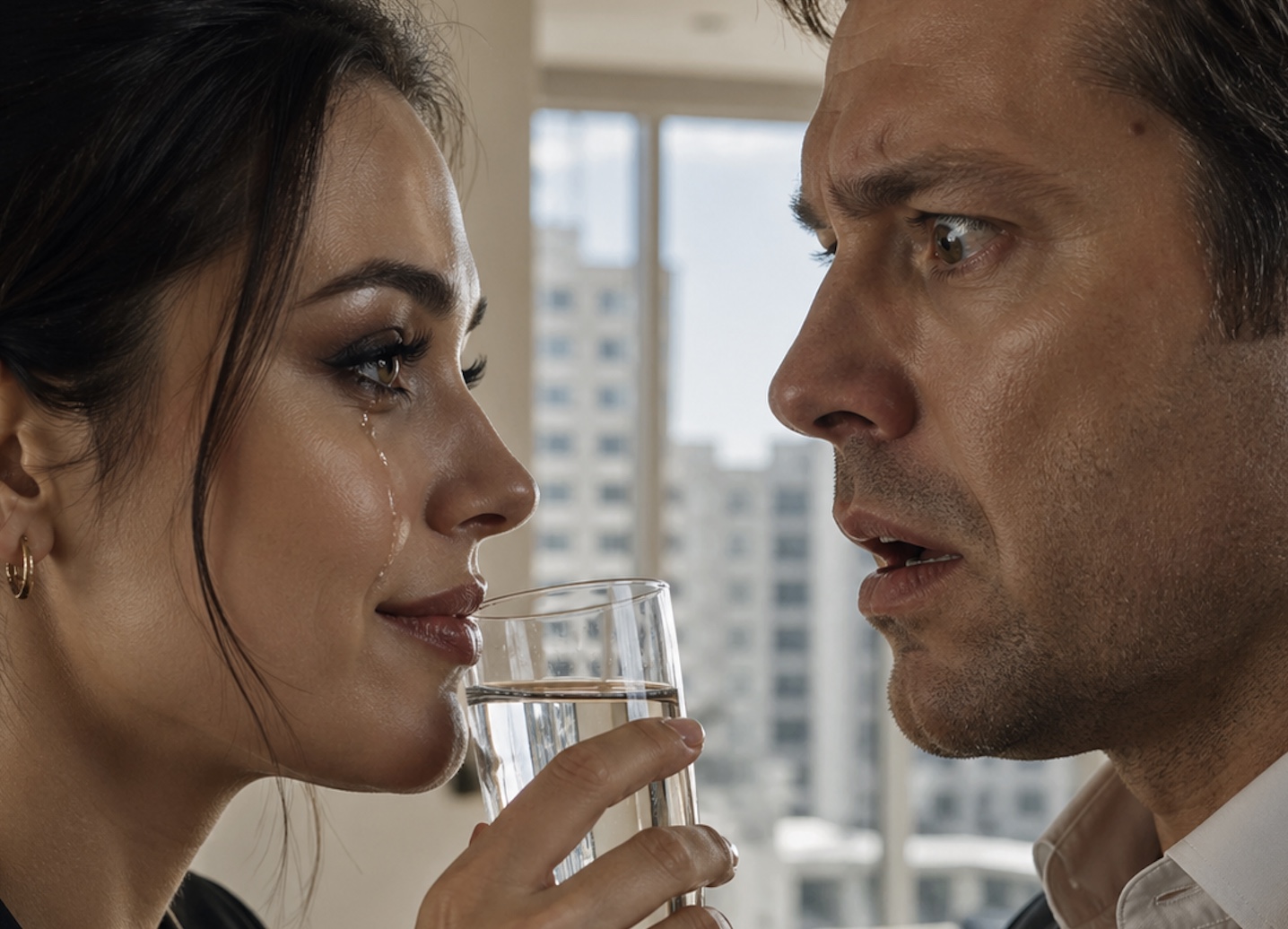
He kept complaining about water marks on the glasses — until I found the receipt he’d carelessly left behind
“You left streaks on the glasses again. Is it really that hard to dry them properly after washing? I’m not asking for the impossible. Just basic neatness. A woman is supposed to create comfort, not live in mess.”
Anna stood by the kitchen sink in silence, watching her husband turn a clear glass in his hands and lift it toward the morning light with visible irritation. There it was indeed — a tiny, almost invisible trace left by a dried drop of water. The clock showed 7:30 a.m. By then, Anna had already made syrniki, brewed fresh coffee in a cezve, ironed her husband’s office shirt, and packed him a homemade lunch. She herself had only managed to drink half a cup of tea, now long gone cold.
“I’m sorry, Maxim,” she said quietly, taking the glass from his hands. “I’ll wipe it again. The towel must have been a little damp.”
Maxim let out a heavy sigh, putting on the performance of a man heroically enduring the hardships of family life. He tugged at his perfectly pressed cuffs, sat down at the table, and began eating breakfast.
“You see, Anya, a home reflects a person’s inner world,” he began, launching into one of his usual morning lectures while neatly cutting off a piece of syrnik. “My mother always said that you can judge how much a woman respects her man by the shine of the dishes and the cleanliness of the baseboards. I work, I provide for us, I hold a management position. I want to come home to a perfect house. Is that really too much to ask?”
Anna said nothing. She kept polishing the poor glass with a dry napkin.
She worked too.
Five days a week, from nine to six, she held a job as a senior economist at a furniture factory. Her salary was only slightly lower than her husband’s, but in their family that fact somehow never counted. Maxim sincerely believed that his work was exhausting intellectual labor that required full rest afterward, while his wife’s job was merely a light warm-up before her real responsibilities began: cooking, laundry, ironing, and cleaning.
He rejected every piece of modern technology that could make life easier. In his view, a dishwasher wasted too much water and left a chemical residue on the plates. A robot vacuum was, according to him, a useless toy that could never clean the corners properly. Even the multicooker sat abandoned on the top shelf because, in his words, “food from it has no soul.”
After seeing him off to work, Anna dressed in haste, put on a little makeup to hide the deep shadows under her tired eyes, and rushed to the bus stop.
The ride to the factory was the only time she had to think.
Lately, her thoughts had been dark.
They had been married for five years. In the beginning, Maxim had seemed merely organized and particular. Anna had even liked the fact that he folded his clothes into neat stacks and loved order. But over time, that neatness had turned into domestic tyranny. He could run a finger along the top edge of an interior door and start a scandal over a single speck of dust. He demanded freshly cooked meat for dinner every evening and refused on principle to eat soup from the day before.
At lunch, Anna sat in the factory cafeteria with her colleague and longtime friend, Svetlana. Svetlana was bright, blunt, and never one to hold back.
“You look like you spent the whole night unloading coal wagons,” Svetlana said, pushing a plate of fresh buns toward her. “Eat. You’ll blow away in the wind. What now — your beloved husband doing another white-glove inspection?”
Anna weakly picked at her salad with a fork.
“This morning he lectured me because of a glass. A drop of water dried unevenly. Sveta, I’m so tired. Last night I was scrubbing the bathroom tiles until midnight because he decided the grout looked darker than usual. My hands are like sandpaper from all the cleaning products. No hand cream helps anymore.”
Svetlana snorted in outrage and nearly choked on her tea.
“Anya, are you out of your mind? You both work. Why are you the one pulling the whole load alone? If Kolya sees I’m exhausted, he’ll boil dumplings and wipe the floor himself. His crown doesn’t fall off. But yours lives like some lord in a manor. To him, you’re the cook, the laundress, and the maid. For free, by the way — and still under constant criticism.”
“He says a woman should create comfort. That his mother—”
“Oh, please, not the mother again,” Svetlana cut in. “I know these perfect mothers from the stories. Have you actually seen her in action? You can barely step inside her apartment because it’s stuffed with old junk, but she managed to convince her precious son that a wife should float around the house with a rag in her hands. Anya, you’re going to run yourself into the ground. You have your own beautiful apartment, you earn well, so why do you need this overseer?”
Her friend’s words stung because they were true.
The apartment really was Anna’s. Her parents had given it to her before the wedding, legally transferred to her by deed of gift. Maxim had moved into her home, but very quickly he had made it his kingdom.
That evening Anna stopped by the supermarket. The bags were heavy: fresh tenderloin for roasting, vegetables, fruit, and the lactose-free milk her husband preferred. Dragging the groceries home, she went straight to the stove. Dinner had to be ready before he came back.
The meat was already browning in the oven, filling the kitchen with a rich aroma, when the key turned in the lock. Maxim came into the hallway, carefully wiped his shoes on the mat for a long time, then took off his coat.
“I’m home,” he called out. “Why is the shoe cabinet open? I asked you to keep the doors shut. It creates visual noise.”
Anna wiped her hands on her apron and stepped out of the kitchen.
“I just got in. I took out my slippers and forgot to close it. How was your day?”
He ignored the question.
He went into the bathroom to wash his hands, and within seconds his irritated voice rang out again.
“Anna! The hand towel is hanging crooked! And why is the soap all soggy in the dish? Is it really so hard to pour the water out? These are basic hygiene rules!”
He came back out wearing his house clothes, drying his hands with annoyance.
“Dinner’s ready,” Anna said evenly, feeling something inside her tighten like a drawn wire.
Dinner passed in heavy silence. Maxim chewed the meat critically, clearly signaling with his expression that it was a little dry, though he said nothing aloud. When he finished, he pushed away his plate, gave a curt nod of thanks, and went into the living room to watch the news. Clearing the table and washing the dishes, of course, were left to Anna.
When she was finally done in the kitchen, she went to the bedroom to put things away. Maxim’s work jacket was hanging carelessly over the back of a chair, though he usually put it in the wardrobe immediately on a proper hanger. Anna picked it up to hang it in its place.
A folded slip of paper fell from the inner pocket and drifted onto the carpet.
She bent down to pick it up. At first she meant only to set it on his nightstand, assuming it was some sort of work document, but then her eyes caught the bold print at the top.
“Professional Cleaning Service ‘Crystal Clean.’ Service Agreement.”
Anna frowned and unfolded the receipt all the way.
Her heart suddenly began beating so fast it roared in her ears.
She read the lines once, then again, unable to believe what she was seeing.
The receipt listed: “Deep cleaning of apartment, window washing, upholstery dry cleaning.” The amount was significant — nearly half of Anna’s salary. But the most interesting part was lower down. There was an address for the client: 17 Parkovaya Street, Apartment 42. Payer: Maxim Valeryevich. Paid by bank card two days ago.
Anna slowly sat down on the edge of the bed, still clutching the paper.
Parkovaya Street was on the other side of the city. They had no relatives or friends there whom Maxim might have been treating to such a generous service.
Her fingers trembling, she reached for the jacket again.
That female intuition which had slept for years under the weight of endless domestic chores suddenly woke up and sounded the alarm. She checked the other pockets.
In one of the side pockets lay another crumpled receipt, smaller this time.
It was from a delivery service for an expensive Pan-Asian restaurant.
“Premium sushi set, seafood salad, bottle of wine.”
The delivery address matched the first receipt exactly: 17 Parkovaya Street, Apartment 42. Delivery time: last Thursday, eight in the evening. The very same night Maxim had phoned her saying he would be late because of a quarterly report and told her to go to bed without waiting.
The pieces in Anna’s mind came together instantly, with a deafening crack that shattered the illusion of her hard but proper married life.
While she had been scrubbing tiles until late at night and pressing creases into his trousers, while listening to lectures about a woman’s purpose, her husband had been paying for professional cleaners and restaurant meals for another woman. He demanded flawless unpaid service from his wife so he could save money to buy comfort for his mistress.
The taut string inside Anna snapped.
But instead of tears, hysteria, or pain, she felt only an icy, crystal-clear calm.
The exhaustion of the last several years vanished in an instant.
She folded both receipts carefully, placed them on the dressing table, and walked out of the bedroom.
Maxim was sitting on the sofa in the living room with one leg crossed over the other, scrolling through news on his phone. When he noticed her, he frowned.
“Anya, why didn’t you dust the television? I can clearly see a layer on the frame. We agreed electronics should be wiped down every day with a special cloth.”
Anna came closer, stopped directly in front of him, and folded her arms.
“I’ll wipe the television, Maxim. Of course I will. Right after we discuss one small detail in your budget.”
Something in her tone made him look up from the screen.
He stared at her, surprised, as though seeing a stranger in that cold, hard gaze.
“What are you talking about? What budget?”
Anna stepped away, went to the bedroom, and returned with the two receipts. She did not fling them in his face like in cheap melodramas. She simply placed them neatly on the coffee table in front of him.
“Be kind enough to explain what these are.”
Maxim glanced down at the papers. His face froze for a second, then lost some color, but he recovered quickly and tried to look genuinely confused.
“Anya, what kind of habit is this, going through my pockets? These are work documents.”
“Work documents?” Anna let out a short laugh, a sound that felt foreign inside the walls of their perfect apartment. “Deep cleaning and sushi delivery to Parkovaya Street are part of your job now? So who exactly are you supporting there? A colleague?”
Maxim tensed.
He understood immediately that denial was useless. The facts were right in front of him.
So he chose what he believed was the best strategy: attack.
“And even if I am, so what?” he shot to his feet, trying to tower over her. “This is your fault too! Look at yourself — look what you’ve turned into! Always tired, always with a rag in your hands. No lightness, no femininity. A man needs celebration, do you understand? But with you, there’s no celebration. There’s nothing but household drudgery.”
Anna listened and could not believe she had once loved this man.
Every word that came out of his mouth was soaked in such cynicism that it made her physically sick.
“Let’s make this clear,” she said slowly, hitting each word like a hammer stroke. “You forced me to work a second shift at home. You forbade me from buying appliances that would make that labor easier. You picked apart every dried drop on a glass while telling fairy tales about comfort and respect. And all that time, you were enjoying yourself with a woman for whom you hired professional cleaners, just so heaven forbid she wouldn’t ruin her manicure or lose her precious lightness. You paid for her perfect life with money we considered part of our shared budget.”
“I’m a man! I have the right to relax!” Maxim raised his voice, pacing nervously across the room. “And don’t make a mountain out of this. I met with her a couple of times, that’s all. It means nothing. Family is sacred. You just need to learn from this and take better care of yourself instead of just your pots and pans.”
Anna laughed.
This time it was a real laugh — clear, ringing.
“Oh, I’ve already learned my lesson, Maxim. Believe me. The most important lesson of my life.”
She walked to the hallway closet, took out his large travel bag, and threw it onto the living room floor.
“Pack your things. You have one hour.”
Maxim stopped dead. His smug confidence vanished at once, replaced by confusion.
“Anya, what are you doing? Are you seriously going to destroy our family over something this stupid? Where am I supposed to go at this hour?”
“To Parkovaya Street, house seventeen. It’s clean there, isn’t it? And they deliver fresh sushi. You’ll be very comfortable.”
“You have no right to throw me out!” he snapped, trying to sound indignant again. “This is my home too! We renovated this place together! I put money into it!”
Anna stepped right up to him.
There was not a trace of fear in her now.
“This apartment belongs to me. Entirely. It was a gift from my parents. The deed was signed before our marriage. Legally, you are nobody here, and you have no rights to a single square meter of this place. As for the renovation, consider it payment for five years of my free, round-the-clock service as your live-in housekeeper. And be grateful I’m not demanding back the money you spent on your mistress from our family budget. Pack your things, Maxim. Otherwise I will call the police and report that a man who has no legal claim to my property is refusing to leave.”
He understood then that she was not bluffing.
There was such iron resolve in Anna’s eyes that every argument shattered against it like a glass dropped onto concrete.
Without a word, Maxim bent down, picked up the bag, and went into the bedroom. He packed loudly and slowly, yanking open wardrobe doors and tossing things around in a theatrical display of outrage. Anna stood in the doorway, watching closely to make sure he did not take anything that wasn’t his.
Forty minutes later he came into the hallway carrying a stuffed duffel bag and a suitcase. His face was red with rage and wounded pride.
“You’ll regret this,” he hissed while putting on his shoes. “Who do you think is going to want you at your age? You’ll end up alone in this empty apartment. You’ll come crawling back, begging for forgiveness.”
“Leave the keys on the cabinet,” Anna said calmly, opening the front door.
The keyring clinked.
Maxim picked up his things and walked out onto the landing without looking back. The door shut behind him with a heavy, muffled sound, cutting off her old life once and for all.
Anna turned the lock twice.
Then she slid the chain into place.
After that, she leaned back against the cool metal door and closed her eyes.
The apartment was filled with absolute, unbelievable silence.
She did not need to rush to the kitchen to wipe down the stove.
She did not need to fear that she had left a fingerprint on the bathroom mirror.
She did not need to listen to lectures about the correct arrangement of shoes in the hallway.
She walked into the kitchen, poured herself a full glass of cold clean water, and drank it in long gulps.
Then, quite deliberately, with full awareness, she placed the empty wet glass right in the middle of the spotless dining table. Water slid down the sides, leaving uneven droplets on the polished surface, droplets that would inevitably turn into streaks.
Anna looked at that glass and smiled.
For the first time in years, she felt like the true owner of her own life.
Tomorrow she would call a cleaning company and book a full deep clean for her apartment.
And on the weekend, she and Svetlana would go to the best restaurant in town.
As for that perfect household life — it could wait.