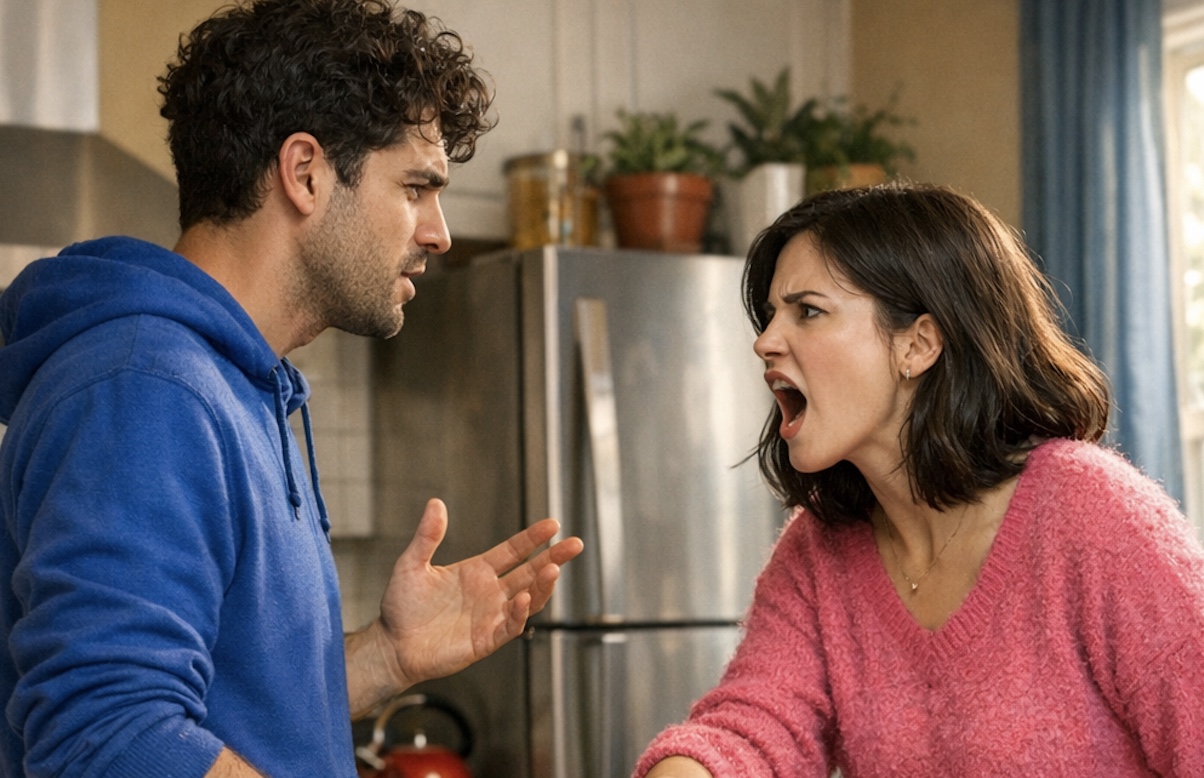
“Lena, have you completely lost it?!” Dmitry shouted. “You made my mother look like some helpless pauper! She’s over there sobbing like she’s in a soap opera, and you’re standing here stirring porridge!”
He stormed into the entryway without even untying his boots, stamping so hard on the mat that sand spilled off his soles like grains in an hourglass. His jacket hung open, his hat was shoved back on his head, and his eyes were blazing. I was at the stove, a small pot simmering on one burner, the kettle whistling on the other, while Kiryusha sat on a stool swinging his legs and pretending he was inside a little fort.
“Take your shoes off first, hero,” I said calmly. “This isn’t a train station.”
“I don’t care about the shoes! Do you even realize what you’ve done? Mom has been waiting for this trip for six months!”
“And I’ve been waiting six months for our refrigerator to stop dying every other week,” I replied, switching off the kettle. “Well, surprise — it finally died. Completely. No saving it. So yes, I bought a new one.”
Dmitry stepped closer, as if he thought he could win by glaring harder.
“You could have bought a cheaper one!”
“I could have chosen a cheaper husband too,” I shot back, and immediately heard Kiryusha snort softly into his fist. “But I already picked you, and sadly there’s no returning you with a receipt.”
“Lena…”
“Don’t start, Dima. I spent my bonus. Mine. Not on ‘nails and coffee shops,’ the way your mother loves to describe it. I spent it on an appliance that keeps food from spoiling — food that you, by the way, also eat.”
“Mom…” he faltered, then blurted, “Mom was counting on that ticket! I promised her!”
I turned and looked at him the way you look at someone who’s just confessed they went out for bread and came home with a speedboat.
“You promised her. When exactly did you promise me anything? That you’d pay for kindergarten? That you’d cover the utilities? That you’d at least stop saying ‘I’m figuring things out’ like you’re some kind of explorer?”
“You don’t have to do this…”
“Oh yes, I do.”
Kiryusha went very quiet, put on a serious face, and began scraping the edge of the table with his spoon. He understood: now the grown-up part of the evening was beginning.
Dmitry exhaled and tried to switch into that “reasonable tone” he always used when he felt himself losing.
“Lena, come on, it’s my mother. She’s not a stranger. She wanted to visit her sister. It’s hard for her being alone…”
“She’s not suffering from loneliness. She’s suffering from a lack of drama,” I said, moving the saucepan aside. “And she’s not the only one. You struggle without it too. The two of you belong on the same stage.”
“You’re going too far!”
“Am I?” I let out a dry laugh. “Dima, our food has been sitting on the balcony for a week. Outside it’s freezing one day and thawing the next. Milk is basically a gamble. Yogurt is a casino. And you’re standing here lecturing me about a ticket.”
He pressed his lips together.
“Mom already told everyone she was going. She packed her suitcase. She…”
“She called you, cried on cue, and you ran over here to yell at me. Do I have that right?”
“She was upset!”
“And I’m supposed to clap happily and say, ‘Hooray, Valentina Ivanovna is upset, let’s all pull money out of thin air’?”
Dmitry jerked like I’d slapped him.
“Lena, you’re mocking this!”
“No. I’m surviving it,” I said evenly. “And do you know what’s really sad? You’ve been ‘finding yourself’ for four months, and the only thing you’ve managed to find is new ways to make me the villain.”
He opened his mouth, then shut it again. Like a fish in an aquarium that had just realized no one was feeding it.
“I am looking for work!”
“Really?” I narrowed my eyes. “Then show me something. Anything. A message thread, an interview invitation, an application, a rejection — I’ll take any proof at all besides your eternal ‘I was browsing job listings.’”
“You don’t believe me?”
“I believe you about as much as I believed our fridge was keeping anything cold during the last two weeks.”
Kiryusha looked up.
“Daddy, why is Grandma crying?”
Dmitry flinched as though he’d been shocked.
“Because… because…” he stammered.
I sighed and bent toward my son.
“Grandma is crying because her feelings were hurt. But being upset is not a reason to start yelling. Understand?”
“Understand,” Kiryusha said solemnly. “But Daddy is yelling.”
“Daddy is about to stop,” Dmitry said quickly, glaring at me from under his brows. “Lena, let’s just talk normally. Let’s figure this out.”
“Fine,” I nodded. “Very simple: you do not promise people things that will be paid for with my money.”
“It’s not your money, it’s… it’s family money!”
I laughed under my breath.
“Family money is when two people contribute. Right now I’m the one contributing. You’re contributing crossed arms and hurt feelings.”
He turned around and went into the other room as if he were withdrawing behind the walls of some fortress. He didn’t slam the door — but I heard the absence of that slam louder than any bang.
I fed Kiryusha, wiped his mouth, brushed the crumbs off the table. One thought kept pounding in my head: He’ll go running to complain again. Of course he will. Like a little boy who got offended outside and ran home crying.
The phone rang exactly an hour later. Naturally.
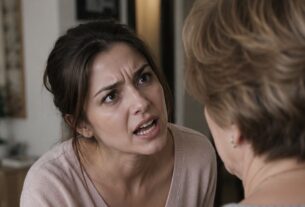
“Elena,” Valentina Ivanovna said in a syrupy voice with sand mixed into it, “I would like to understand what exactly you think you’re doing.”
“Good evening, Valentina Ivanovna,” I replied as politely as possible. “Everything is fine here. What are you calling about?”
“What am I calling about?” she snorted. “You ruined my trip. Dima promised me you would buy the ticket. I already told everyone. I already…”
“Stop,” I cut in. “Dima promised you. He never asked me. That’s number one.”
“And number two?”
“Number two is that our refrigerator broke, and I bought a new one. That’s called a priority.”
“Priority…” she dragged the word out as if it tasted sour. “You’re always like this. First your machines, then people.”
“Valentina Ivanovna, a refrigerator is not just a ‘machine.’ It’s food. A child. A home.”
“And what am I? Not a person?”
“You are a person. But you are an adult person. A very capable one. Unlike your son, who seems capable only of making promises he can’t keep.”
There was a pause on the line. Then her voice sharpened.
“Don’t push it. Dima is my son. And I can see how you’re crushing him.”
“I’m not crushing him. I’m feeding him,” I said, surprising even myself with how calm I sounded.
“There! There it is! You say that as if he owes you something!”
“He does owe me at least one thing: not making me the bad guy for his own mess.”
“He told me you spent your bonus… your bonus on yourself!”
I almost laughed.
“On myself? On the refrigerator that’s standing in our kitchen storing our food? Yes, incredibly selfish.”
“Elena,” she drew in a breath, “in a normal family, a woman does not make decisions alone.”
“In a normal family, a man works — or at least genuinely looks for work,” I answered. “He doesn’t play at ‘I’m in transition’ and run to his mother for sympathy.”
“You’re rude,” she exhaled.
“Possibly. But at least the refrigerator doesn’t leak anymore.”
“I’m coming over tomorrow,” she said suddenly. “We need to talk. Face to face.”
“Valentina Ivanovna, tomorrow is a workday. I have a job.”
“Then in the evening. I’ll come. And Dima will be home.”
“You can come,” I said. “But I’m warning you now: if anyone starts shouting, I’m ending the conversation.”
“You’re setting conditions for me?!”
“I’m setting conditions for what happens in my kitchen,” I replied, and hung up.
Dmitry walked out of the room as if he’d been waiting for that exact moment.
“You spoke to her like that?”
“How exactly should I have spoken? On my knees?” I lifted an eyebrow. “Dima, she announced her visit like an inspection. Did you promise her that too?”
He looked away.
“She decided it herself…”
“Of course she did. She ‘decides it herself,’ and you ‘just happen to be standing nearby.’ Convenient arrangement.”
Dmitry sat down on the edge of a stool.
“Lena, this hurts me. She’s my mother.”
“And I’m your wife. We have a child. And when you choose ‘Mom is upset,’ what you’re really saying to me is: ‘Your exhaustion doesn’t matter.’”
“I never said that!”
“You didn’t say it. You showed it,” I cut in.
He fell silent. And in that silence there was more confession than in any words.
The next evening Valentina Ivanovna did come. Like an auditor arriving for an inspection. Her ring at the door was short and sure, as if she wasn’t visiting but entering somewhere she believed she had every right to control.
I opened the door. She stood there in her coat with her handbag and an expression that said plainly: I’m here to restore order. Her eyes swept over the hallway instantly — shoes, coats, Kiryusha’s toy car abandoned in the middle of the floor like a little trap.
“Everything’s exactly the same as always here,” she said instead of hello.
“And good evening to you too,” I replied. “Come in, since you’re already here.”
Dmitry came out from the room and offered a guilty smile.
“Mom…”
“Don’t ‘Mom’ me,” she snapped. “I didn’t come for tenderness.”
We sat down in the kitchen. I poured tea. She pointedly didn’t touch hers.
“Well then, Elena,” she began, “explain something to me. Why did you decide the money belongs only to you?”
“Because it’s my salary going onto that card,” I said. “And because I’m the one covering our expenses.”
“And Dima? What is he, then? Air?”
“At the moment? A ‘journey of self-discovery,’” I said. “And somehow this journey never pays for kindergarten, groceries, or bills.”
Valentina Ivanovna turned to her son.
“Dima, do you hear her? She’s humiliating you.”
Dmitry shifted in his seat as if he wanted the floor to swallow him.
“Mom, Lena just…”
“Just what?” I looked at him. “Just stating facts?”
My mother-in-law slapped her palm down on the table. The kettle jumped.
“You are allowing yourself far too much! This is not how people speak in a family!”
“And this is not how people live in a family,” I replied. “Where one person works herself into the ground and the other promises his mother vacations.”
Valentina Ivanovna narrowed her eyes.
“So now I’m the guilty one. Naturally. I’m the manipulator. The controller.”
“I didn’t say that,” I answered, though it was exactly what I was thinking. “What I’m saying is that you don’t get to decide how our money is spent.”
“I’m not deciding! I’m asking!”
“You’re not asking. You’re applying pressure. Those are not the same thing.”
She turned to Dmitry again.
“Dima, say something to her. Tell her you’re a man. Tell her you’re the head of the family. Tell her you…”
I finally snapped.
“Oh, here we go. ‘The head of the family.’ Dima, when was the last time you were the head of anything financial? In anything at all besides slamming doors dramatically?”
“Lena!” Dmitry jerked. “Enough…”
“No, not enough. Because otherwise this circus will keep going forever.”
Valentina Ivanovna leaned forward.
“You are holding him down! Because of you, he’s not himself anymore!”
“And who exactly was his ‘real self’?” I asked. “The version who worked and made decisions? That version would be more than welcome. I’d love to see him. But right now he isn’t making decisions. He’s dumping them on me — and on you.”
My mother-in-law’s mouth twisted into the kind of smile people wear when they think they’re about to play their winning card.
“And do you know something else, Elena? Dima told me he already has a job. That he’ll be starting soon.”
I felt something go cold inside me — as if the new refrigerator had suddenly opened inside my chest.
“What?” I turned to Dmitry. “Dima?”
He went pale.
“Well… I… Mom, I just…”
“So you told her you already had a job,” I said slowly, “but somehow forgot to mention that to me?”
“I wanted to be sure first…”
“Being sure means you have a contract,” I said. “Or at least a confirmed start date. Not a fantasy you plan to backfill later.”
Valentina Ivanovna practically glowed with triumph.
“There! You see? He’s afraid to tell you anything! Because you’ve crushed him!”
I stood up so abruptly my chair scraped.
“No. He isn’t afraid. He’s lying. To me and to you.”
Dmitry stood too.
“Lena, don’t…”
“Then how should I say it, Dima?” My voice rose. “For four months you’ve been saying ‘I’m working on it.’ Meanwhile you’ve been feeding your mother fairy tales about your job. Why?”
He swallowed.
“I… I didn’t want her to worry.”
“So I’m the one who gets to worry?” I laughed harshly. “What a perfect arrangement. Mom gets a fantasy. Wife gets reality — and the bills.”
Valentina Ivanovna jumped to her feet, swinging her handbag against the chair.
“Dima, do you see this? She’s hysterical! That’s exactly why you told me it’s impossible to live in this house!”
I looked straight at Dmitry.
“You told your mother it’s impossible to live here?”
He didn’t answer. And that silence thundered louder than any yes.
“Understood,” I said. “Then listen carefully, both of you. I am not going to keep playing the villain in your family drama. If you want a performance, stage it without me.”
“You’re threatening us?” my mother-in-law almost choked.
“I’m not threatening anyone. I’m warning you,” I said. “One more time: no more promises made at my expense. And no more discussing me behind my back. If you want to talk about me, do it in front of me.”
Dmitry rubbed his face nervously.
“Lena, can we not…”
“Can we not what?” I leaned toward him. “Not tell the truth? Not take responsibility? Not admit that things don’t just ‘somehow happen’?”
At that exact moment Kiryusha ran out of the room like a tiny firefighter responding to an alarm.
“Mom, why are you yelling?” He looked from me to Grandma to Dad. “Is Daddy in trouble again?”
“Kiryusha, sweetheart, go back to your room,” I said quietly. “The adults are talking.”
“I’m an adult too,” he declared importantly. “I put my pants on by myself now.”
I couldn’t help it — I snorted. Because in that proud little I do it myself now there was honestly more independence than in some of the actual adults standing in that kitchen.
Dmitry lowered his head.
“Mom,” he said at last, quietly. “Lena is right.”
Valentina Ivanovna froze.
“What?”
“She’s right,” he repeated, louder this time. “I promised you the ticket. Without asking her. I thought… I thought it would somehow work out. But it didn’t.”
My mother-in-law went pale.
“So that means… you chose her?”
“I chose my family,” Dmitry said. Then, looking at me, added, “And yes. I lied. To you too.”
“Well, that’s a twist,” I said tiredly. “Anything else you’d like to confess?”
Dmitry took a shaky breath.
“It’s not just about the job. I also… borrowed some money.”
“From whom?”
He darted a glance at his mother.
“From Mom.”
Valentina Ivanovna jolted.
“I gave it to him because he told me you had both agreed!”
Very slowly, I sat back down. Inside my head, something clicked into place. There it was. The lie stripped bare.
“How much?” I asked.
“Twenty-five,” he muttered. “I thought I’d cover things… just for now… until I found work.”
“And where did it go?” My voice was so calm I almost didn’t recognize it as my own.
He swallowed again.
“Some little things. Internet, some stuff… and…”
“And what else?” I raised an eyebrow.
He said it almost in a whisper.
“I bought myself a phone.”
At first I didn’t even process it. Then the meaning landed — and I laughed. Not because it was funny. Because the alternative was screaming obscenities.
“You bought yourself a phone,” I repeated. “With money you borrowed from your mother after telling her we had decided on it. Meanwhile I’m paying for kindergarten and groceries.”
“It was on sale,” he squeaked, and the sheer pathetic smallness of it was enough to make even Valentina Ivanovna freeze for a second.
“On sale,” I nodded. “Naturally. And were your brains on sale too? Or were they simply out of stock altogether?”
Valentina Ivanovna clutched at her heart — in that theatrical, practiced way people do when they want the scene to revolve around them.
“Dima! What have you done?!”
“There,” I said, pointing into the air. “There is your reality. Not ‘Lena is greedy.’ Not ‘Lena is controlling.’ The truth is: Dima wants to play grown-up and keeps losing.”
Dmitry stood there like a schoolboy called to the front of the class.
“Lena, I… I’ll fix it.”
“How?” I asked.
He looked around helplessly.
“I’ll… I’ll find work.”
“Will you ‘find work,’ or will you actually get up tomorrow and go somewhere?” I narrowed my eyes. “Because if this turns back into ‘I’m in the process,’ I’m telling you now — I cannot carry all of this alone. And I won’t.”
Unexpectedly, my mother-in-law sat back down and said quietly:
“He told me you controlled everything… that you hid money from him.”
I looked at her.
“Valentina Ivanovna, do you really think I’m ‘hiding money’ when the linoleum in our kitchen is bubbling and the faucet drips nonstop?”
She looked away.
“I… I don’t know.”
“Then find out,” I said sharply. “Not from Dima’s stories. From facts. Here are the facts: I work. I pay. I bought the refrigerator. Your son bought himself a phone ‘on sale.’”
Dmitry lifted his head and said softly,
“I’ll pay it back.”
“To whom?” I asked.
“To Mom. And to you… I mean…” He faltered. “I’ll put it back into the family.”
I let out a tired laugh.
“Try putting yourself back into reality first.”
The next few days felt strange. It was as if Dmitry was seeing our home for the first time not as “the place where everything somehow gets taken care of,” but as a place where things had to actually be done, every single day.
On the third day, he said on his own:
“Lena, I’ll stay with Kiryusha. Go do your side job.”
I almost stared at him.
“You’re sure?”
“I’m sure,” he nodded. “I need to understand.”
“All right,” I said. “But call me if anything happens. And don’t try to play hero. We’ve had enough heroics already — especially the kind that come with promises.”
He gave me a crooked smile.
That evening, when I came back, the stairwell smelled like fried onions from the neighbor’s apartment and wet dogs. The elevator, as usual, wasn’t working. I climbed to the fifth floor, opened the door, and heard Dmitry’s voice from the kitchen:
“Kiryusha, tell me honestly — who invented the idea that children need to eat three times a day? This feels like sabotage.”
“I’m not sabotage,” Kiryusha replied through a full mouth. “I’m growing.”
“Then I guess I’m shrinking,” Dmitry sighed. “Because I’m running out of strength. How does your mother do this?”
I walked in. The scene: crumbs everywhere on the table, Dmitry in a T-shirt stained with porridge, something burnt on the stove, Kiryusha looking as pleased as a cat who had just found a bowl of cream.
“Hi,” I said.
Dmitry turned around.
“Lena…” He exhaled like I’d arrived carrying a life raft. “This is hell. Just… without the special effects.”
“Yep,” I nodded. “Welcome.”
He came closer and lowered his voice.
“I understand now how tired you get.”
“You understood that in three days?” I smirked. “Impressive. Usually it takes people ten years and at least three scandals.”
“Lena, I’m serious.” He looked me in the eyes. “I was here, but I wasn’t really in it. Now I’m in it. And I’m ashamed.”
I took off my coat and hung it on the hook.
“Shame can be useful,” I said. “As long as it doesn’t turn into ‘feel sorry for me.’”
“It won’t. Tomorrow I’m going. For real.” He rubbed the bridge of his nose. “There’s a warehouse position. Nothing glamorous. But it’s money.”
“Good,” I said. “And that phone you bought ‘on sale’? You’re returning it.”
He nodded immediately, without arguing.
“Yes.”
“And you’re telling your mother the truth,” I added.
“Already did,” he exhaled. “She was… stunned. Can you imagine? She also thought you were ‘hiding money.’”
I gave a dry laugh.
“I can imagine. It fits her version of the story better.”
Dmitry was quiet for a moment, then asked carefully,
“How did you manage not to explode all this time?”
“I was exploding,” I said. “Just quietly. On the inside. Honestly, that’s worse.”
He nodded, then said cautiously:
“I want to fix this. But… do you believe me?”
I looked at him for a long moment.
“I don’t believe words anymore. I believe actions. Show me something real, and then I’ll believe you.”
He nodded as if signing a contract.
A week later, Dmitry started the job. Not a dream job. Not a calling. Just work. Early mornings, crowded minibuses, long shifts, tired feet, and a paycheck that wouldn’t make him rich but would let us breathe again.
Valentina Ivanovna called on Saturday. Her voice sounded different this time — without the usual pressure in it. As though, for the first time, she wasn’t speaking to “the daughter-in-law,” but to an actual person.
“Lena,” she said, “may I… say something?”
“You may,” I answered, and the thought almost amused me — as if I were now granting permission for a normal human conversation.
“I went too far.” She paused for a long time. “I listened to Dima and thought you were the one controlling everything. But it turns out… he was trying to command his own life without even having a map.”
I smiled faintly.
“That’s actually a very accurate description.”
“And about the money…” she sighed. “I really did think you were hiding it. And then Dima told me about the phone. I said everything I had to say. He was holding the phone away from his ear by the end of it.”
“I can picture that,” I said. “Loud emotional outbursts seem to run in your family.”
“Don’t be sarcastic,” she said unexpectedly gently. “I… I understand now that this has been hard for you. And I’m ashamed that I kept interfering.”
I was silent for a couple of seconds. Not to punish her. Just out of caution.
“Thank you for saying that,” I replied. “It matters to me.”
“And one more thing…” she hesitated. “About the trip. I really did want to go. But I don’t want screaming and fights over it anymore.”
“There won’t be,” I said. “Not if everyone acts like people.”
“Like people…” she repeated, as if trying the words out. “Lena, you’re not greedy. I was just… angry. At the whole situation. But I took it out on you.”
“That happens,” I said. “Just let’s keep the theatrics out of it.”
She gave a quiet little chuckle.
“Agreed. And Dima… is he really trying?”
“He is,” I answered honestly. “But I’m watching him now. Not like he’s a child — like he’s an adult learning how to be one.”
“All right,” she said. “Then I’ll wait. If next month works, I’ll go. If it doesn’t, then it doesn’t. The world won’t collapse.”
“The world won’t collapse,” I agreed. “Our elevator’s been broken for three weeks and somehow we’re all still alive.”
She laughed. Genuinely this time, without bitterness.
At the end of the month, we really did buy her ticket. Calmly. No “you owe me,” no “I’m the mother,” no tears and no emotional blackmail.
That evening Dmitry came home, put the receipt on the table, and said,
“Here. I handled it myself. And I told Mom right away: ‘We decided together.’ Not ‘I promised,’ but ‘we decided.’”
I looked at him.
“Good.”
“You said that like I just memorized the multiplication table in first grade,” he smirked.
“Dima, that’s basically where you are right now,” I replied with a small smile. “Just a very late first grader. The curriculum is life.”
He came over and wrapped his arms around me.
“Lena,” he said quietly, “I’m not going back to how I was. I really did understand.”
“We’ll see,” I said. “I don’t believe ‘I understood.’ I believe ‘I did it.’”
Kiryusha wandered out of the room rubbing his eyes.
“So Grandma isn’t crying anymore?”
“Grandma talks now,” Dmitry said.
“That’s better,” Kiryusha announced seriously. “When people cry, I can’t hear my cartoons over them.”
The three of us laughed. Even me. And there was something new in that laughter: not the relief of thank goodness this disaster passed, but the feeling that maybe, finally, we were no longer living inside other people’s tantrums.
Later, after Kiryusha had fallen asleep, we sat in the kitchen. The new refrigerator hummed softly like a satisfied cat. Outside, courtyard lights blinked on and off, someone on a bench was arguing about parking, and a television murmured from the apartment next door.
Dmitry poured me some tea and said,
“I realized something else too. Mom pushes. And I used to… hide behind you. Like, ‘Lena decides.’ So I didn’t have to be the bad one.”
“Of course,” I nodded. “Very convenient. You stay the good guy, I become the villain.”
“I don’t want that anymore,” he said. “I want to be an adult. Not Valentina Ivanovna’s son first. A husband. A father.”
I looked at him, and for the first time in a long while I didn’t feel the urge to jab, to joke, or to put up armor. I just wanted to tell the truth.
“It’s going to be hard. You’re used to being rescued. Your mother rescues you with tears. I rescued you with my paycheck. From now on, you’ll have to rescue yourself.”
He nodded.
“I know. But I’m ready.”
I smirked.
“Say that again after you clean the bathtub on Sunday.”
“I already cleaned it once,” he huffed. “That tub is not a bathtub. It’s a marriage stress test.”
“Well then, congratulations,” I said. “You passed.”
He smiled, then turned serious again.
“Lena… I’m sorry for putting you in that position. And for lying.”
“I forgive you,” I said. “But remember this: I’m not watching season two of that show.”
“Deal,” he said.
And for the first time in a very long while, it felt like we weren’t merely holding on, enduring, or surviving. We were simply living. With ordinary problems, with tiredness, with sarcasm — but without that constant feeling that I had been appointed the guilty one by default.
And it turned out, that alone was already a great deal.
The End.