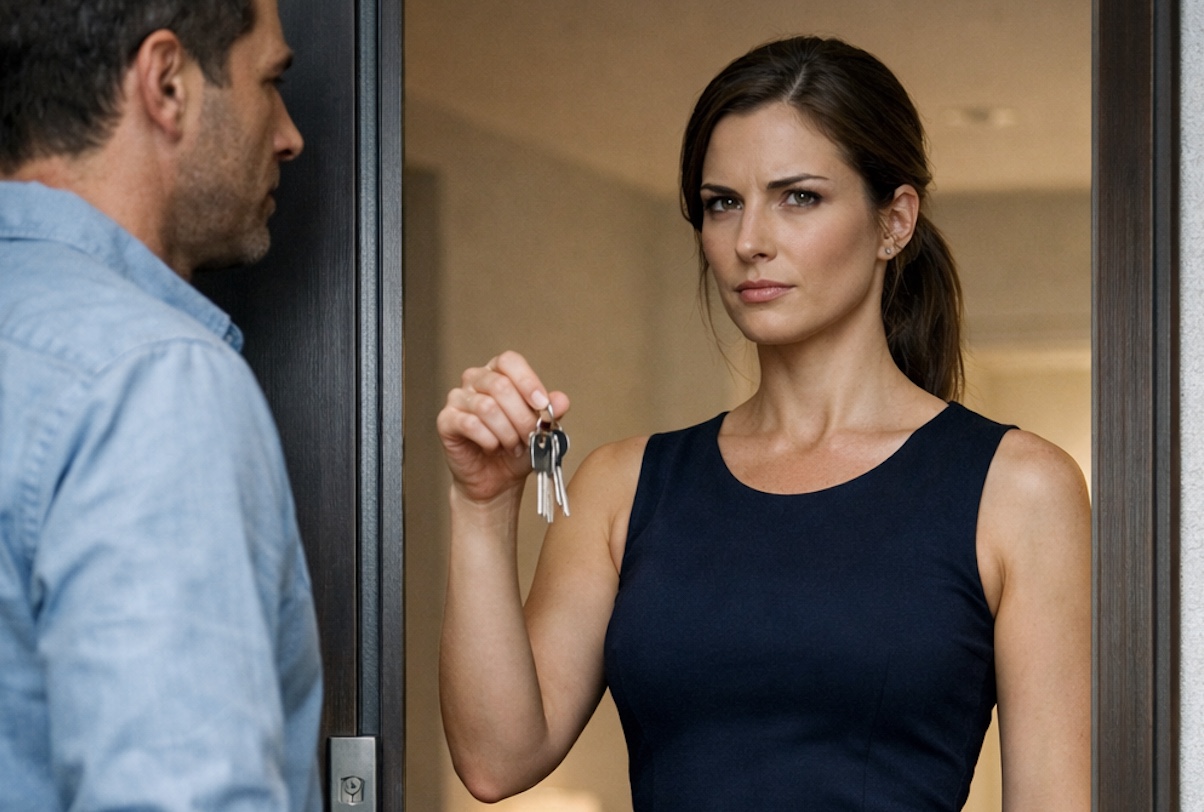
“Pasha, I’m asking you one more time: don’t give anyone the keys to my apartment,” Oksana said without raising her voice. “I don’t want to come home and wonder who’s been here during the day.”
Pavel didn’t even look up from his phone. He just smirked slightly, as if she were making a fuss over some minor inconvenience that didn’t deserve attention.
“Here you go again. They’re not strangers. It’s my mother, Lena, and the kids. What, are they supposed to stand outside if they get here early?”
Oksana sat at the table, gripping the edge of her mug. Not because of the mug itself. She simply needed something to hold onto so she wouldn’t end up shouting. She looked at her husband longer than usual, as if hoping that this time he might hear not just her words, but what they meant.
The apartment really was hers. Not “their family place,” not “their shared nest,” not “our temporary home.” It was a one-bedroom, but a good one: bright, with a long hallway, a separate kitchen, and a large alcove in the main room where a wardrobe had once fit perfectly. Oksana had inherited it from her grandmother. All the paperwork had been completed long before the marriage. Pavel had moved in with her afterward. At first cautiously, bringing a small bag for weekends. Then he stayed for good. Back then, it had seemed to her like the definition of normal adult life: your own home, your own person, your own rules. Only somehow the rules were more and more often being set not by the one whose name was on the deed, but by the one who treated every comfort as communal property.
Pavel was not a loud man. Not openly rude in the usual sense. He didn’t slam doors, throw things around, or make dramatic scenes. He had a different way of getting his way: acting as if everything had already been decided, and as if anyone else’s disagreement simply wasn’t important enough to discuss. Especially when it involved his relatives.
His mother, Tamara Sergeyevna, lived in the suburbs. His sister Lena lived in the next district, but after her divorce she was always running around with her two children and loved using the city as though it owed her convenience. Clinics, extracurricular classes, the market, the notary, art lessons for the older child, the dentist for the younger one—somehow all of it kept ending at Oksana’s apartment. If Oksana was home, she was simply informed after the fact. If she wasn’t, they came without her.
At first it all seemed almost harmless. One day Tamara Sergeyevna had “just stopped by to warm up” while waiting for the bus. Then Lena had “fed the kids” there because it was inconvenient to sit in the car. Later, Pavel casually admitted that he had made a duplicate key for his mother.
“Just in case,” he’d said. “You never know. What if a pipe bursts, what if you’re not home, what if I need to pick something up?”
Oksana hadn’t even found words right away. She had stood in the hallway with a grocery bag in her hand, staring at him as though she couldn’t decide whether he was joking.
“You made a duplicate without asking me?”
“So what?”
“The fact that this is my apartment, Pasha. Things like that are discussed.”
He rolled his eyes with that same expression that infuriated her most: as if he weren’t talking to his wife, but to someone throwing a tantrum over nonsense.
“Oh, here we go. It’s not like I gave it to the neighbors. It’s my mother.”
“I don’t care who exactly. No one should be coming in here without me.”
“You’re exaggerating.”
That word—“exaggerating”—came up many more times afterward. When Oksana found a child’s spoon with a cartoon pattern in the sink, one she had never owned. When she noticed someone else’s towel hanging on the drying rack. When she opened the fridge and found a container labeled in marker, “For Lyosha after practice.” When Lena’s car keys showed up on the hallway table and little muddy footprints appeared on the floor. Every time the explanation was the same: “They just stopped by for half an hour,” “They didn’t want to bother you,” “What’s the big deal?” “You’re making a mountain out of a molehill again.”
She had said it plainly more than once. No hints. No polite domestic games. She did not like the idea of other people living out their habits in her apartment while she was away. Someone opening cupboards, moving towels around, looking for a bag, slicing bread, turning on the kettle, leaving children’s mittens on the windowsill and then forgetting them. She hated coming home and feeling as though someone had passed through her space with total entitlement.
The worst part wasn’t even the mugs or the slippers left out of place. The worst part was the little things that were impossible to prove, but impossible not to notice. The throw blanket on the back of the sofa had been folded differently. A jar of grain had been shifted. The towel in the bathroom was hanging in a different way than she had left it that morning. Once she found one of Lena’s hair clips on top of the washing machine. Another time there was a printout of Tamara Sergeyevna’s medical test results neatly tucked under the sugar bowl. As though the apartment had quietly turned into some kind of transit station where everyone had the right to drop in, sit down, rummage around, wait something out, and the owner’s only duty was not to be so sensitive.
Every time, Pavel was annoyed not by the situation itself, but by her reaction to it.
“What, are you that stingy?”
“It’s not about stinginess. It makes me uncomfortable.”
“Why? Nobody stole anything.”
“That’s not the point.”
“Then what is the point?”
He asked that sincerely. And somehow that made it even worse.
Oksana tried to explain. That home is the place where a person should feel calm. That she didn’t want to return home and inspect her own kitchen like an investigator. That this wasn’t about a kettle, a stool, a mug, or even the visits themselves. It was about the right to decide who gets to cross her doorway. But Pavel heard only stubbornness.
It became especially unbearable after one Sunday incident. A meeting of hers was canceled, so she came home earlier than expected. She got to her floor, took out her key—and found the door unlocked from the inside. Not wide open, just latched on the chain. Behind it she could hear children’s voices, Lena laughing, and Tamara Sergeyevna telling someone where the bags were kept. Oksana didn’t step inside right away. She just froze for a few seconds outside her own door, keys in hand, as though she had somehow walked into the wrong building. It took her a moment before she finally pushed the door open and saw what looked like a full family gathering in her kitchen.
Lena was sitting at the table, the older nephew eating cottage cheese, the younger one swinging his legs from a stool. Tamara Sergeyevna stood by the stove, reheating cutlets that Oksana had left for dinner for herself and Pavel. The moment they saw her, everyone fell silent. Even the children.
“Oh, you’re home already?” her mother-in-law said first, recovering quickly. “Pasha said you’d be late.”
The way she said, “you’re home already,” made it sound as though Oksana had shown up too early not to her own apartment, but to someone else’s house.
She took off her shoes in silence. Walked into the kitchen, placed her keys on the table, and looked first at her husband, who emerged from the room with the expression of someone ready to smooth everything over, then at her mother-in-law, then at Lena.
“Why is the door open?”
“We’re not staying long,” Lena answered quickly. “The kids were tired after the hospital, and I didn’t want to drag them all over the city.”
“I asked why the door is open.”
Pavel stepped closer and spoke in that tone people use when they’re trying to calm someone down without realizing that that very tone is what pushes them over the edge.
“Oksana, don’t start. Mom is here. What could possibly happen?”
She turned toward him so sharply that he stopped mid-sentence.
“Anything could happen. But that’s not even the point. Nobody warned me. People are helping themselves in my fridge. They’re eating in my kitchen while I’m gone. And once again you’re acting like that’s perfectly normal.”
Tamara Sergeyevna let out an exaggerated sigh.
“Of course. We come to see my son and suddenly it’s like we’ve committed a crime. Apparently we’re unwanted here.”
Oksana said nothing. She simply took a plastic bag from the cupboard and started putting containers into it to clear a shelf. The sharper the cellophane crackled in her hands, the clearer it was that one more push and this conversation would end in something other than words.
After that Sunday, she told Pavel bluntly: if it happened again, he would be dealing with the consequences, not another discussion. At first he brushed her off. Then he sulked. For several days he acted like he was the one who had been insulted. And after that, everything drifted right back to the same pattern.
Oksana began to notice something: the calmer she asked, the easier it was for everyone to ignore her. As if her politeness wasn’t taken as self-control, but as weakness. She even started to feel that in this whole story, everyone had already been assigned a role. Tamara Sergeyevna was the offended mother. Lena was the woman “having a hard time on her own.” Pavel was the son and brother trying to keep the peace. And Oksana, in that version of events, always ended up being the difficult one—the overly rigid, fussy homeowner making everyone’s life miserable over something as petty as a door and a set of keys.
The decisive day began like any other. Nothing dramatic. No warning signs. In the morning she left to run errands, and before leaving she glanced over the kitchen automatically: mug on the drying rack, clean countertop, jar of coffee by the kettle, two plates back in the cupboard from the night before. Everything in place. She locked the door and drove across town, expecting to return in the evening.
But her errands ended sooner than expected. Even in the stairwell she felt that familiar, unpleasant sensation. Not really a thought—more like the feeling you get when you approach a window and somehow know it’s open even though you remember closing it. The hallway smelled wrong. Not her shower gel, not the floor cleaner. A faint sugary smell of children’s juice and fried dough drifted from the kitchen.
Oksana stepped inside, set her bag down on the hallway table, and froze.
Two unfamiliar mugs stood on the table. One with a faded kitten print. The other a large red one with the words “Best Mom.” Oksana didn’t own either of them. They definitely hadn’t been there that morning. Beside them was an open pack of cookies, crumbs trailing toward the windowsill. A child’s sweater with one twisted sleeve hung over the back of a chair. In the room, near the sofa, stood Lena’s sports bag—the same one with the zippered side pocket. A corner of pajamas stuck out of it, along with a toy doctor kit.
Oksana’s face didn’t even twitch right away. She simply closed the front door slowly and walked through the room again, as though hoping she had somehow made a mistake. But no. A throw blanket lay on the armchair, folded by someone else’s hands. A bottle of children’s syrup stood on the dresser. And in the bathroom, a small towel with little cars on it hung from the hook.
She placed her palm on the doorframe and stared at one spot for several seconds. Then she let out a breath as if she had been holding it in for too long. Her phone was in her pocket. Her first instinct was to call Pavel and finally have the conversation that had been building for months. But in the next instant she realized: that conversation had already happened. More than once. Everything had already been said. Explained. Repeated. There was no point explaining anymore.
She didn’t start clearing away other people’s things. She didn’t photograph the mugs. She didn’t hunt for more proof. She no longer needed proof. When a boundary is crossed again after a direct warning, it is no longer a misunderstanding. It is simply a habit of taking advantage of someone else’s tolerance.
Oksana sat down on the edge of the sofa, took out her phone, and opened her contacts. She still had the locksmith’s number from the previous year, when the bottom mechanism in the door had jammed. She called immediately.
The man answered quickly. Businesslike voice. No unnecessary questions.
“Can you come today?”
“If it’s within the hour, yes.”
“Come. I need the entire front-door lock changed.”
“Do you have the apartment documents with you?”
“Yes.”
She hung up, looked toward the room where Lena’s bag had been left, and for the first time in a long while she felt not confusion, but clarity. Cold, simple, without drama. As though something inside her had clicked into place, and out of all possible actions only one remained truly right.
Before the locksmith arrived, Oksana gathered the other people’s belongings into two bags. Neatly, without anger, without any theatrical gestures. The bathroom towel, the syrup, the sweater, the toys, the sports bag, the phone charger, someone’s child’s sock from under the sofa. She took the mugs from the kitchen and added those too. Then she placed everything in the hallway next to the shoe cabinet. After that she opened the drawer where Pavel usually kept his spare key ring, selected the right key, and set it aside on a shelf. The second one—the copy he still had on him—would soon be useless anyway.
The locksmith arrived on time. A short man with a toolbox and the habit of speaking only when necessary. Oksana showed him her passport and the property documents, then opened the door wide. While he worked, she stood nearby listening to the dry metallic knocks, the clicks, the brief rasp of the screwdriver. For some reason the sounds soothed her. Not because she took pleasure in the conflict. But because each turn of the tool gave her back a sense of a boundary that had been steadily erased under the excuse of family closeness.
“All done,” the locksmith said half an hour later. “Try it.”
Oksana turned the new key. The lock closed smoothly, firmly. It opened just as cleanly.
“It’s fine.”
“Everything’s here. I’ll take the old cylinder.”
“Take it.”
When the door closed behind the locksmith, the apartment fell silent. Completely silent. No чужие footsteps in her head, no lingering feeling that someone might let themselves in with their own key at any moment. Oksana walked through the rooms slowly, putting things back in order. She put the mugs away. Wiped down the table. Opened the kitchen window to air the place out. She checked the cupboard to make sure her documents were where they belonged. Not because she feared anything had gone missing—she simply wanted to finish the day properly, completely, through action.
She didn’t call Pavel.
And she didn’t text him.
By evening, the sky outside had darkened, the courtyard filled with ordinary sounds—car doors slamming, someone calling a child from the playground, a chair scraping in the apartment above. Oksana boiled herself some pasta, sliced a bit of cheese, ate in silence, and was almost surprised by how peaceful her own kitchen could sound. Not sterile. Not museum-like. Just peaceful. Like a place where you don’t have to wonder who was drinking from your mug a few hours earlier.
The first ring of the doorbell came at 7:45. Sharp, quick, then another. A key scraped in the lock—once, twice, three times. The exact sound she had been expecting all evening. Not with fear. More with a sense of readiness.
Her phone vibrated almost immediately.
Pavel.
Oksana looked at the screen, let it ring out, and only then walked to the door. On the other side she could already hear annoyed muttering, keys rattling, restless movement. Her phone started vibrating again.
This time she answered.
“Where are you?” Pavel’s voice was angry and confused at once. “Why doesn’t the key work?”
“At home.”
“Then open the door. What is this nonsense?”
Oksana ended the call without explaining. She walked to the door and looked through the peephole. Pavel stood alone, a grocery bag in one hand, frowning, sweaty from climbing the stairs, irritated. She didn’t open immediately. She waited just long enough for him to understand that this time things would not go the way they usually did.
Then she opened the door.
Pavel stepped onto the threshold and stopped at once. His eyes flicked from her to the inside edge of the door, to the new polished cylinder, then back again.
“What is going on?”
Oksana stood straight, not folding her arms, not hiding behind the door. There was no theatrics in her face, no nervousness. Only the calm determination he had never expected from her.
“I changed the lock because there will be no more guests without an invitation,” his wife said sharply.
For a few seconds Pavel simply stared at her. As though waiting for her to soften, explain, slip into the familiar kind of argument where he could interrupt, persuade, pressure her through guilt, mention his mother, the children, unfortunate timing, emergencies. But Oksana had no intention of making this easier for him.
He stepped inside, set the bag down on the floor, and ran a hand roughly over his chin.
“You’re serious?”
“Completely.”
“Maybe change the lock in your head first before you start messing with the door,” he snapped, his voice rising now. “What kind of circus is this? I can’t even get into my own home!”
“You got in. You’ll have keys. But not so everyone else can come and go whenever they want.”
She nodded toward the shelf in the hallway, where a new set lay waiting—meant for him alone.
Pavel noticed the bags of his relatives’ things and frowned even harder.
“You packed all that too?”
“Yes.”
“Lena was here today?”
“She didn’t just stop by. She settled in.”
“She had the kids after a doctor’s appointment. They had nowhere else to wait!”
Oksana didn’t even blink.
“Then someone should have called me. Or they could have gone home. But they were not supposed to open my door with their own key.”
“There you go again—my door, my apartment.”
“It’s not starting again. It’s ending.”
He fell silent. Probably not because he agreed, but because he heard something new in her voice. Not hurt. Not an emotional outburst. Not another plea to be understood. But a boundary drawn without any hope left that he would understand it.
Pavel walked into the room, then came back out. Made a slow circle through the hallway like a man used to believing that in the end his irritation would still be the final word.
“You could have warned me.”
“I did. Many times. Today wasn’t words anymore. It was action.”
“You’re acting like my mother and sister are intruders.”
“I’m not acting like anything. I’m closing the door to my apartment to people who don’t belong here without my permission.”
“They are not outsiders!”
Oksana tilted her head slightly and looked at him in a way that made him lose momentum.
“For you, maybe not. But in an apartment where nobody asks me who is coming in—they are.”
Pavel opened his mouth to say something else, already drawing breath, but couldn’t find the right words. His usual arguments no longer worked. He couldn’t wear her down with exhaustion, accuse her of being cold-hearted, or reduce everything to female hysteria. She wasn’t arguing. Wasn’t defending herself. Wasn’t going in circles. She had simply stated the rule and made sure it could no longer be bypassed with a copied key.
He stood there in silence, not expecting her to go this far.
Oksana said nothing more.
The situation had become perfectly clear without further explanation.
And in that moment, one thing became obvious: no one would be dropping by out of habit ever again.