That February had been a strange one—thaw one day, hard frost the next, as if the weather itself could not decide what it wanted. Katya stood by the window, watching the janitor downstairs chip ice off the sidewalk, and thought she understood him perfectly: sometimes the only thing left to do is pick up a tool and strike at what should have melted away on its own long ago.
Her phone was lying on the kitchen table. The message had come early in the morning; she had read it still wearing her robe, a cup of coffee in hand, and after that the coffee had tasted wrong.
Nina Arkadyevna, her mother-in-law, had sent a file. The document had a short, businesslike title: Menu for the Eighth. Katya opened it and found three dense pages of text—a list of dishes with detailed instructions, recipe links, and even little notes in parentheses: Dima doesn’t like too much garlic, be sure to add a spoonful of vinegar to the dough so it rises properly, Olivier salad must be made only with doctor’s sausage, not any other kind.
She put down her cup. Sat down. Read it again.
Then she texted Dima: Your mother sent a menu.
A few minutes later he replied: Yes, she mentioned it. Don’t pay attention to it, she just wants to help.
Help. Katya locked the phone and stared at the wall for a long time.
They had met about five years earlier at someone’s birthday party—at the apartment of mutual friends, crowded and noisy, with everyone talking over one another and the music just a little too loud. Back then Dima had seemed steady and dependable, like a solid house. Broad-shouldered, quiet, the kind of man who knew how to listen. They dated for nearly two years, and in that time Katya fell not only for him, but for the whole idea of their future together: a small apartment they would arrange side by side, shared breakfasts, shared decisions, a shared life.
Of course, she had known about Nina Arkadyevna. Dima had warned her—said his mother was a woman with a strong personality, used to keeping everything under control. She doesn’t mean any harm, he would always say whenever one of his mother’s actions needed explaining. That’s just how she shows love. She worries.
At first Katya tried to accept that. She really was younger than Dima—he had already lived on his own, worked, built a life, while she had only just flown the nest, and the difference in experience was obvious. Nina Arkadyevna sensed that and, apparently, considered it her duty to pass all her experience on to Katya immediately, completely, and without being asked.
The first menu had appeared on New Year’s. That time her mother-in-law had called personally, dictated a list of dishes, and spent a long time explaining why it had to be exactly those dishes—because Dima had loved this and that since childhood, because without a certain salad it was not really a holiday, because Katya was still young and might not know the right way to do things.
Katya had said nothing then. She wrote everything down. She cooked it all.
At Easter came the first email—a written list this time, so she would not forget.
On Dima’s birthday—a two-column table: what to cook and exactly how to cook it.
And now here was March 8th, and once again, three pages.
Dima’s sister, Olya, never stayed on the sidelines either. Olya was a few years older than Dima, married, with children, and carried herself as someone unquestionably experienced. She sent Katya housekeeping advice in messenger chats, forwarded articles about how to store food properly, and once, while visiting, opened the kitchen cabinet and rearranged all the pots “the right way”—by size, the way they were arranged at her mother’s house.
After they left, Katya silently put everything back where it had been.
But that had been a small victory, invisible to anyone else. The big one kept being postponed.
A few days before the holiday, Katya asked Dima one evening while they were sitting in the kitchen and he was scrolling through something on his phone.
“Dima.”
“Mhm.”
“I’m not going to cook from your mother’s list.”
He lifted his head. Looked at her. Waited.
“March 8th is my holiday too,” she said. “I’m going to put on the table what I think belongs there, not whatever your family orders from me. Clear?”
Dima was silent for a moment. Katya could see him weighing something inside himself—his lifelong habit of keeping the peace against something else that, she hoped, also lived in him.
“Mom will be upset,” he said at last.
“Possibly.”
“Olya will start—”
“I know exactly what Olya will start,” Katya cut in. Not harshly, but firmly. “Dima, for three years I’ve been cooking from their lists. Three years. Not once have I put on the table what I actually like. Not once have I cooked a dish because I wanted to. March 8th is Women’s Day. Do you understand the irony?”
He did. It showed on his face. Dima sighed—not heavily, not offended, just like a man who had made a decision and was already a little tired that the decision had been necessary at all.
“All right,” he said. “Cook whatever you want.”
“Thank you.”
“But I’m not going to explain it to Mom.”
“I will,” Katya said.
She spent all of the day before the holiday and the whole morning of the eighth in the kitchen. But this time it felt completely different—not anxious, not like an exam where you constantly check someone else’s list and are afraid to get it wrong. This time it was hers.
Katya turned on her favorite music. Opened the small kitchen window, and cold March air rushed into the apartment, smelling of snow and something sharp, almost springlike. She chopped, mixed, tasted, adjusted—and for the first time in a very long time she felt she was cooking not for approval, but simply because she knew how and because she loved it.
The table did not look anything like Nina Arkadyevna’s list. There was no Olivier salad with doctor’s sausage—instead there was a bowl of warm roasted vegetable salad with herbs and goat cheese, which Katya adored. There was no aspic fish made from her mother-in-law’s family recipe—but there were baked salmon rolls filled with cream cheese and dill. There was no jellied meat, which Nina Arkadyevna insisted “a real hostess simply must know how to make”—but there was a large plate of marinated mushrooms bought at the market from a vendor Katya knew, and a platter of homemade pickles she had canned in the fall using her own mother’s recipe.
In the center of the table she placed a roasted chicken—rubbed with mustard, honey, and garlic, with a crust so beautiful that when Dima peeked into the kitchen at the last moment, he made a sound that could not be mistaken for anything else.
“You made all this yourself?” he asked.
“Who else would have?” she smiled.
“It smells incredible.”
“I know.”
Nina Arkadyevna and Olya arrived together. Olya brought her husband and children—two boys around seven and ten, who immediately ran into the living room toward the television. Her mother-in-law was holding a box of chocolates wrapped in decorative paper and looked at Katya with that blend of warmth and caution Katya had learned to read flawlessly over the past three years.
“So, how are things here?” Nina Arkadyevna said, kissing her on the cheek. “Did you manage everything?”
“I did,” Katya answered.
“I sent you the list…”
“I saw it, thank you.”
They went into the room. Sat down. Dima poured the wine. Katya brought out the first dishes.
Nina Arkadyevna looked at the table. Then looked again. Then slowly let her gaze travel over everything on it, and Katya could see her expectations dimming one by one.
“And where’s the Olivier?” Olya asked.
“I didn’t make it,” Katya replied calmly.
“Dima likes Olivier.”
“Dima has tried this salad,” Katya said, nodding toward the roasted vegetables, “and he liked it. Didn’t you, Dima?”
“I did,” Dima said. His voice was careful, like a man walking across thin ice, but firm.
Nina Arkadyevna pressed her lips together.
“And there’s no aspic fish either?” she asked.
“No. But there are these rolls. Try them—they really are delicious.”
“I had sent you the recipe… I did send it.”
“I saw the recipe, Nina Arkadyevna.”
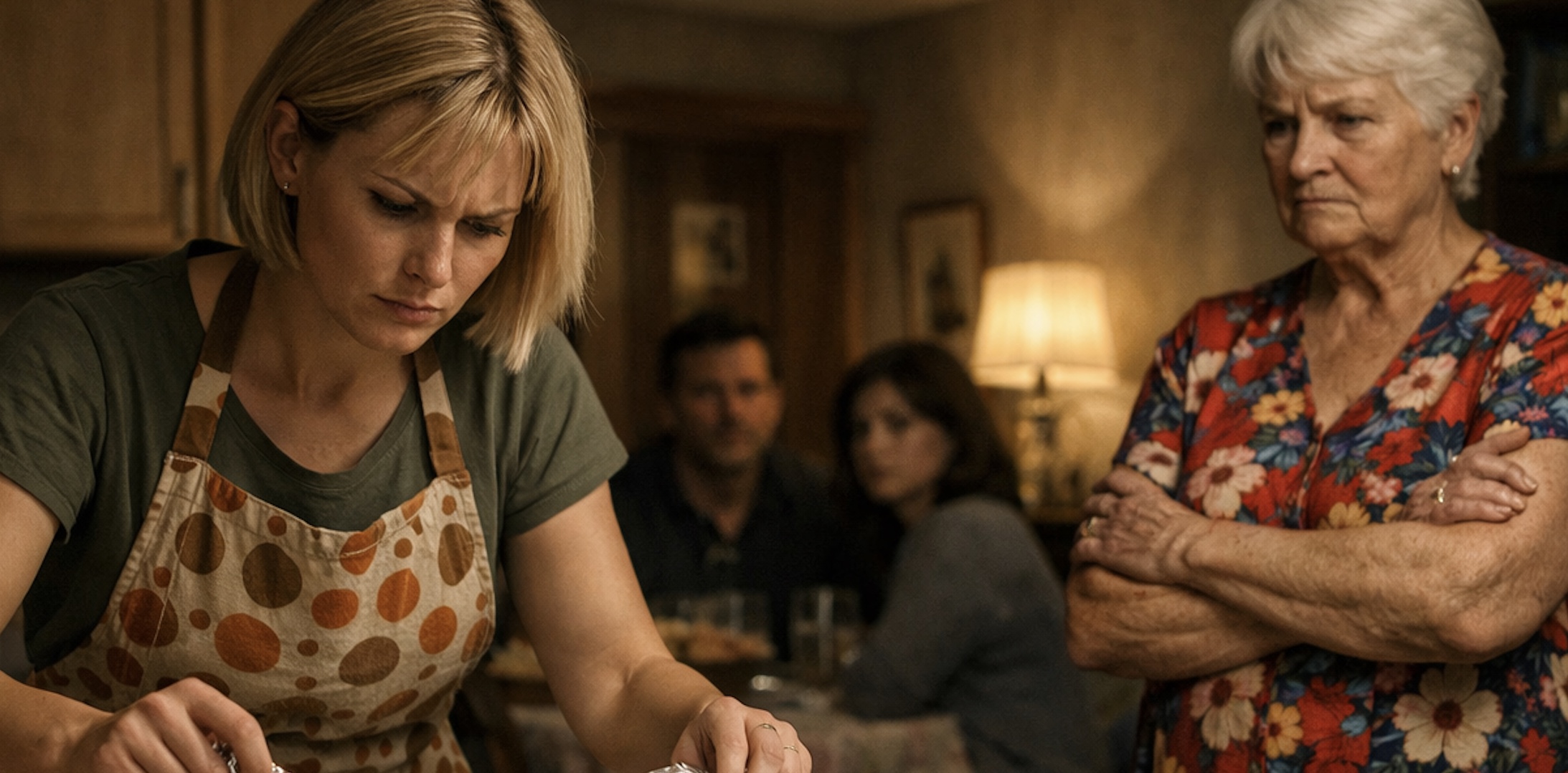
A pause settled over the room. Olya exchanged a glance with her mother. Katya did not look away—not defiantly, not challengingly, just steadily, the way people do when they have made up their minds beforehand and have no intention of changing them.
“Katya, we don’t do this out of spite,” Olya finally said. Her tone was conciliatory, but beneath it was that familiar condescension, which had always been worse than direct criticism. “It’s just that we have traditions. Dima’s been used to certain dishes since childhood. And the holiday is really first and foremost for him…”
“Olya,” Katya interrupted, gently and without anger. “March 8th is Women’s Day. It’s my holiday too. And this is my home. I’m glad you came, I really am. But what’s on this table is what I chose. This is my kitchen, my food, my rules.”
“Well now that’s just—” Nina Arkadyevna began.
“Mom,” Dima said.
Just one word, but something in the way he said it made her stop.
Silence again. The children burst into laughter in the other room. Outside, a group of people carrying flowers passed down the street.
Nina Arkadyevna picked up her fork. Nudged one of the rolls. Took a small bite and began chewing with the expression of someone determined not to approve—but the taste, apparently, did not give her much room for complaint. She chewed in silence, then took another bite.
Olya reached for the mushrooms.
“Where did you get these?” she asked reluctantly.
“At the market. There’s a stall there. From Vasilych.”
“Vasilych has good mushrooms,” Olya admitted, almost against her will.
It was not a victory in the classic sense—no one threw up their hands, no one apologized, no one delivered a speech about how Katya had been right. Nina Arkadyevna circled back to the subject of jellied meat several times before the evening was over—“next time at least make the jellied meat”—and frowned when the children asked for seconds of the chicken. Olya pursed her lips whenever anyone praised the salad.
But they ate. They sat at a table not laid according to their list, eating dishes they had not chosen, and the evening still moved forward—alive, noisy, with toasts, children laughing in the other room, and the roasted chicken reduced, in the end, to nothing but bones.
When they had left and Dima was washing dishes while Katya cleared the table, he said:
“You did great.”
“I just made dinner.”
“You know that’s not what I mean.”
Katya did know. She stacked the empty plates and paused for a second by the window. The city below glittered with lights, somewhere in the distance people were walking with armfuls of tulips, and at last March was beginning to feel like March—with that cautious, still uncertain warmth that pushes through even the hardest frost.
“Next time,” she said, “I’m making rabbit in cream sauce. I’ve wanted to try that recipe for ages.”
“Mom won’t like it,” Dima called from the kitchen.
“I know.”
She smiled at her reflection in the dark glass. A quiet, peaceful smile—the smile of someone who had finally come home, to a place where she belonged not as a guest, but as the one in charge.
“It’s fine,” she said. “She’ll get used to it.”