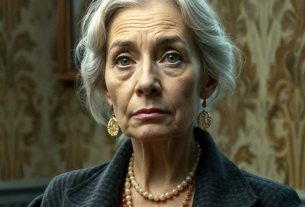
I had been standing at the stove since ten in the morning. The turkey had to come out with skin the color of honey and meat soaked through with rosemary. It was the third time in two years I had cooked it, and every single time Galina Ivanovna found something wrong. Too salty. Not salty enough. Too dry. Too greasy. Today I had decided it would be flawless. Every ten minutes I checked the oven, shifted the trays, and basted the bird with its juices.
By two o’clock the table was set. My tablecloth—the one my mother brought from Prague long before I got married. Crystal glasses I had polished with special cleaner so not a single streak would remain. Napkins folded into fans. Everything exactly the way my mother-in-law liked it, though she had never once appreciated any of it. To her, my effort was as ordinary and invisible as radiators working in winter.
The guests took their seats. Three of Galina Ivanovna’s friends—women with tightly smoothed hair and expensive but tasteless jewelry. They looked over my place settings with that faint contempt people reserve for servants trying too hard to please. I knew that look. After seven years, I could recognize it instantly.
Igor sat at the head of the table, worrying the edge of his napkin and glancing at his mother. He always did that—waited for her approval like a little boy bringing home a good grade. He was forty-two, but in Galina Ivanovna’s presence he turned into a teenager.
I brought out the soup. Mushroom soup, made with porcini I had cleaned until midnight. I set the pot on the table and straightened the ladle.
“Oh? And what is this?” my mother-in-law asked in a tone that suggested I had served poison. “I specifically asked for no mushrooms.”
“Galina Ivanovna,” I said evenly, “yesterday you said you wanted mushroom soup. I asked you again to make sure.”
“Me?” She arched her eyebrows in exaggerated innocence. “Igor, did I ask for mushroom soup?”
Igor shrank at once.
“Mom, I think you did say—”
“I said chicken!” she snapped. “Anya, you always twist everything. Honestly, what can anyone do with you?”
I said nothing. Just drew in a breath. Her friends exchanged knowing looks: poor Galina Ivanovna, stuck with this hopeless daughter-in-law.
“I’ll fix it,” I said. “I already have broth on the stove. I made it this morning.”
“Oh, never mind,” she said with a dismissive flick of her hand. “Serve this one. We’ll survive on what we’ve got.”
She pulled her bowl closer and took an ostentatiously tiny spoonful.
“Too salty,” she declared.
I stood by the stove gripping the ladle until my knuckles turned white. I wanted to throw it at the wall. Or at her. But I held myself back. I always held myself back.
Then came the turkey. I took it from the oven at exactly fourteen hundred, just as planned. The smell rolled through the apartment; even the hallway filled with rosemary and garlic. I transferred the bird onto a large oval platter and decorated it with rosemary sprigs and orange slices, just as the chef from my cooking course had taught me.
I carried it into the living room with both hands.
“Well, finally!” Galina Ivanovna cried from her chair, leaning back as though I were three hours late. “We’re starving here. Move it, you lazy lady!”
She laughed—loudly, theatrically, for her audience. Her friends joined in at once, like a pack scenting blood. Even Igor forced out a smile, though there was misery in his eyes.
“Galya, you are strict,” one of the women said, the red-haired one.
“What choice do I have?” my mother-in-law said, lifting her wineglass. “You can always spot the uncultured ones. She has none of that… what is it called… efficiency. Everything with her is a mess.”
I set the platter on the table. My hands were steady. I was calm in the way people are calm right before stepping into freezing water. I already knew what I was going to do. The decision had not arrived in that second. It had been ripening inside me for seven years, and now, in this moment, it was finally ready.
“Galina Ivanovna,” I said softly, “please repeat what you just said.”
She didn’t understand.
“What? I said move it, you lazy lady. What, you don’t like it? Truth hurts?”
Slowly, I untied my apron and hung it on the hook. Then I picked up my phone from the counter, turned on the camera, and pointed it at her.
“Say it again. For my lawyer.”
The room went silent. Even her friends stopped chewing. Igor froze with a knife in his hand.
“Are you filming me?” Galina Ivanovna’s voice lost its mockery and rose into a shrill whine. “Have you lost your mind? Put that away!”
“No,” I said, feeling something huge and long-crushed expand inside me. “I should have done this a long time ago.”
I walked around the table without lowering the phone. Galina Ivanovna tried to stand, but I placed a hand on her shoulder and pressed her back down. Harder than I meant to. She gasped.
“Have you gone insane?” she hissed. “Igor, do you see this? She’s laying hands on your mo—”
“Igor,” I said, without looking at my husband, “if you take her side now, you leave with her. Choose.”
I went to the front door and threw it open. The hallway outside was cool; a draft ran across the floor, stirring the edge of the rug.
“Out, Galina Ivanovna,” I said. “Take your things and go.”
“What?!” She sprang up so abruptly that she knocked over her wineglass. Red wine spread across the white cloth like blood. “You’re throwing me out? From my son’s apartment?”
“This is not your son’s apartment,” I said, meeting her stare. “This is my apartment. My parents bought it for me when I was still in college. Ten years before I married your son. The deed is in my name. The title is in my name. Igor is only registered here. So are you, as a matter of fact.”
She turned to look at Igor. He sat there with his head lowered, unmoving.
“Igor!” she screamed. “Why are you quiet? Tell her!”
“Mom,” he said weakly, “well… legally… the apartment is hers.”
“Quiet!” she cut him off and stepped toward me. “You think paperwork decides everything? I’ve lived here seven years! Seven years I cleaned up after you! I fed you, you parasite! I kept you alive!”
I laughed. Truly laughed, full and loud. She recoiled.
“You fed me?” I repeated. “Galya, whose money bought the groceries? Mine. Your son hands half his paycheck to you, and I paid the utilities, the food, the renovations, your medicine. I worked two jobs while your son fiddled with bolts in a garage. And you call me a parasite?”
I went to the hallway wardrobe and pulled open the door. Her coats were hanging there, along with her house robes and the fur coat she had bought two years earlier with my bonus.
“Let me help you pack,” I said, and began sweeping clothes off their hangers. They hit the floor in a rustle of lining and sleeves.
“Don’t touch that!” she screeched. “That’s mine!”
“If it’s yours, take it with you.” I nodded toward the open door. “I’ve already called a taxi. It’s downstairs.”
She stopped dead and stared at me. For the first time in seven years, I saw fear in her eyes.
“You… you’re serious?” she asked, more quietly.
“Completely,” I said. “You have ten minutes, Galya. If you’re not out by then, I’ll call the district officer. He can explain the difference between ownership and residency registration.”
I turned to the guests. They sat pale and rigid, afraid to move.
“Ladies,” I said politely, “you should leave as well. The celebration is over.”
They sprang into motion, rustling with handbags and coats, hurrying toward the door and stepping over the robes and slippers scattered in the hall. No one said goodbye. No one said a word.
My mother-in-law remained standing in the center of the entryway, staring at the things strewn across the floor.
“Igor,” she called. “My son.”
Igor stood up from the table, went to her, and took her by the elbow.
“Come on, Mom,” he said dully. “I’ll take you. You can stay with me tonight, and tomorrow…”
“Where exactly are you taking her?” I asked. “Are you leaving too?”
He turned back toward me. There was confusion in his eyes, and something else. Pity? Guilt? I couldn’t tell.
“Anya,” he said, “I can’t just leave her alone.”
“Yes, you can,” I replied. “She’s a grown woman. She has her own apartment—the one she rents out. She has somewhere to go.”
“But she’s my mother…”
“She’s your mother, Igor.” I picked up the folder I had brought from the bedroom and held it out to him. “Look. Ownership certificate. Gift deed. Extract from the state register. It says in black and white: owner—Anna Sergeyevna Volkova. Volkova, by the way, is my maiden name. So tell me, what am I to you? Not a wife. A maid? A provider? A housekeeper you sleep with?”
“Anya, stop,” he said, wincing.
“I am stopping,” I said. “Right now. Either you stay here with me and we start a new life without your mother, or you leave with her and never come back. Choose.”
My mother-in-law grabbed his hand.
“Igor, let’s go. She’s not worth it. Did you hear how she spoke to me? To your own mother? What kind of wife is she? Come on, my boy.”
He stood there shifting from foot to foot. I looked at him and knew: he was going to leave. I had known it even before he opened his mouth.
“Anya,” he said, “I’ll call you.”
Then he stepped into the hallway, picked up two of his mother’s bags, tucked her fur coat under his arm. Galina Ivanovna shot me one last look filled with such hatred that I could almost feel it physically.
“You’ll regret this,” she hissed. “No one will ever need you. You’ll end up alone.”
“Go, Galya,” I said. “The door is closing.”
They stepped into the corridor. I took hold of the door handle.
“Igor,” I called.
He turned.
“Your keys,” I said.
He looked down at the keyring in his hand. Hesitated. Then he removed the apartment key and tossed it to the floor. Metal rang against tile.
I closed the door. Turned the lock. Rested my forehead against the cold panel and closed my eyes.
The apartment was silent. Only the clock in the kitchen ticked, and a draft stirred the balcony curtains. The turkey was cooling on the table; wine kept spreading across the cloth; half-eaten salads sat abandoned.
I opened my eyes and looked at the few things they had left behind in the hall—some robes, slippers, an umbrella. I gathered them up, stepped onto the landing, and set them neatly by the elevator. She could collect them if she wanted.
Then I went back inside. Locked the door with every lock. Walked into the living room, turned off the light, sat down on the floor in the middle of the room, and cried.
Tears ran down my cheeks while I kept staring at the door. With every breath, it felt as if something heavy and foreign was leaving me—something that had been lodged beneath my ribs for years. I was not crying from pain. I was crying from relief.
And from fear of what came next. But this fear was mine now. Mine. Not hers.
I must have sat on the floor for an hour. Maybe longer. Time had no shape anymore. I kept staring at the door through which Igor and Galina Ivanovna had disappeared, trying to believe what had just happened. Seven years. Seven years I had endured, kept silent, swallowed every insult, pretended nothing serious was going on. And now I had thrown her out. Done the very thing I had been afraid even to imagine.
Eventually I got up, went to the kitchen window, and opened it. Cold air rushed into the room; it smelled of snow and gasoline from the cars below. I looked down. The taxi was gone. Neither Igor nor my mother-in-law was anywhere in sight. They had left. For good.
I shut the window, went into the bedroom, lay down on the bed without even undressing, and stared at the ceiling. My body felt heavy, wrung dry. My eyes burned from crying. I lay there until evening, until darkness pooled outside the windows. Then I got up, went into the kitchen, and threw the cold turkey into the trash. I pulled the tablecloth, stained dark red with wine, off the table and soaked it in a basin. I didn’t wash the dishes. I had no strength left.
That night I didn’t sleep. I lay staring at the ceiling while scenes from the past flashed before my eyes, as if someone were changing channels in my head.
It had all begun seven years earlier.
I met Igor at a mutual friend’s birthday party. He seemed quiet, dependable, a little shy. Not like the men who had chased after me before. He didn’t play the macho man, didn’t show up with giant bouquets, but he was attentive. He remembered how I took my coffee, what my cat’s name was, when my birthday fell. Back then I was working as a sales manager in a small company, renting a room in a communal apartment, saving up for a place of my own. My parents helped when they could, but most of my money was going toward the mortgage.
We dated for six months before he proposed. I said yes. I thought I had found happiness.
We had a modest wedding in a café. Galina Ivanovna wore black, as if she were attending a funeral instead of a wedding. All evening she sat with a stone face, and whenever someone raised a toast to the newlyweds, she looked deliberately out the window. At the time I thought perhaps she was tired or anxious about her son. Foolish me.
The first months we lived at her place. Igor said it would be easier that way: we could save for our own home, and his mother could help around the house. I agreed. We didn’t want to waste money on rent, and my room was too cramped for two.
From the first day, Galina Ivanovna made it clear who ruled the house.
“Anna, that towel is not for hands, it’s for feet. Can’t you see the difference?”
“Anna, that’s not how you peel potatoes. Didn’t anyone teach you anything?”
“Anna, don’t you dare turn on the washing machine after eight in the evening. The noise gives me a headache.”
I tried to please her. Peeled the potatoes again. Rehung the towels. Did the laundry only during the day. She watched all my effort with cold contempt, as if observing a trained dog performing tricks. Igor never interfered. Whenever I tried to complain, he just shrugged.
“Anya, she’s my mom. She’s old. Just do what she asks, and that’s it.”
Old? Galina Ivanovna was fifty-two then. Full of energy, strength, and an overwhelming desire to command.
After six months of that life, I told Igor I couldn’t do it anymore. Either we moved out, or I did. He panicked, promised he would find us a place. But one month passed, then another, then a third. He kept postponing, saying the money was needed elsewhere, that his mother would be upset, that we needed to wait.
I didn’t wait. I found us an apartment myself. Tiny, in a concrete block building, with a miniature kitchen and peeling wallpaper. But it was ours—or rather, rented for us. We moved in.
Galina Ivanovna staged a full scandal. She yelled that I was stealing her son from his own family, that I was selfish, that I couldn’t cook or run a household, that Igor would be ruined with me. Igor stood in the hallway among the bags, silent. I carried boxes to the car.
When we moved into the new apartment, I exhaled. I thought things would finally get better. Just the two of us. No mother-in-law. A fresh start.
But Galina Ivanovna had no intention of letting her son go.
She called ten times a day. In the morning to wake him. In the afternoon to ask what he had eaten. In the evening to check whether he was already in bed. Igor answered like an obedient schoolboy. If he didn’t pick up, she called me.
“Anna, why isn’t Igor answering? What happened over there?”
“Nothing happened, Galina Ivanovna. He’s in the shower.”
“In the shower? What is he doing in the shower at this hour? Are you wasting water?”
I would close my eyes and count to ten.
Two months after we moved, she arrived unannounced with two suitcases.
“My apartment is being renovated,” she announced from the doorway. “I’ll stay with you for a week.”
I looked at Igor. He stood there looking guilty.
“Mom, you could have at least warned us…”
“Warn you about what? I’m your mother, not a stranger. I’m not going to live here forever. You can manage a week.”
That week stretched into three years.
At first she slept in the living room on a folding cot; then Igor dragged in an old sofa for her. Then she started rearranging things in the wardrobe because “normal people do not store things like this.” Then she threw out my books. Then she began telling me what to wear.
“Anna, in that dress you look like a peasant. Igor, tell her.”
Igor either stayed silent or muttered, “Mom, leave her alone.”
But Galina Ivanovna never left me alone.
I remember the first time she called me a “lazy lady.” It was at breakfast. I hadn’t managed to fry her eggs because I got home late from work. She sat in the kitchen tapping her spoon against the table and complaining.
“How long am I supposed to wait? I’m sitting here starving while she wanders around somewhere. Move it, you lazy lady!”
I had been stunned. The word she used sounded like mockery. I was no pampered lady. I was an ordinary woman carrying the weight of the house, the work, the husband, and his mother. But from her mouth the phrase meant: you are nobody, a pretender, someone who does not belong here.
I said nothing. Because Igor was sitting right there, staring into his plate.
And then she moved in for good. She said she had rented out her own apartment so she could help us with the mortgage. But she had no intention of helping. She kept all the rental income for herself. What we got instead were higher utility bills and food costs. In return, she claimed authority. Now she could say, “I gave up my apartment for you people, and this is how you repay me…”
I worked two jobs. During the day I was a manager; in the evenings I worked remotely in customer support. Igor was an auto mechanic, earning little and giving half his salary to his mother. I paid for everything else.
Galina Ivanovna didn’t work. She stayed home, watched television, visited her friends, and monitored me.
“Anna, why did you come home at eleven yesterday? Where were you?”
“I was working.”
“Working? Who is forcing you to work? Igor supports you, for heaven’s sake.”
“Galina Ivanovna, I pay for this apartment.”
“This apartment belongs to Igor!” she would bark. “This is his home!”
It was not his home. I had moved into that apartment a year before the wedding. My parents, may they rest in peace, helped me with the down payment, and I paid off the rest myself. The ownership documents were in my name. When Igor and I married, he registered his address there, but the owner remained me.
Galina Ivanovna knew that perfectly well, but behaved as if it were irrelevant.
“What do papers matter?” she would say. “A family is not paperwork. A wife is supposed to obey her husband.”
And I endured it. Because I loved Igor. Because I believed that one day he would stand up for me. Because I was afraid of being alone.
I endured it when she threw away my things. When she called my mother a market woman with contempt because she sold goods at the market. When she told guests in front of me that I was a useless housekeeper, all thumbs, lazy.
I endured it because every time I was ready to say “enough,” Igor would look at me with such guilt and pleading in his eyes that I gave in. He promised to talk to his mother, but never did. He promised she would move out, but never made her leave.
I endured it until the thing happened that erased everything.
My mother brought me jam. She was already ill then—her heart had started troubling her—but every summer she still went to the village to visit her sister and made preserves. Strawberry, my favorite. She brought me three jars, set them on the kitchen shelf, and said:
“These are for you, sweetheart. Made with love. Have tea and think of me.”
I placed the jars on the most visible shelf. I told Igor: this is my mother’s, don’t touch it. He nodded.
The next day I came home from work. The jars were gone. In their place stood three identical store-bought jars with printed labels.
“Galya, where’s the jam?” I asked, though I already knew the answer.
My mother-in-law sat at the kitchen table, drinking tea and smiling.
“Oh, that? I threw it out. It had mold. I bought proper jam at the store. You need to watch what food you keep around, Anna, instead of dragging in village junk.”
“There was no mold,” I said. “My mother just made it.”
“Well then she sealed it badly. I know better. And what are you making such a fuss over anyway? Jam is jam.”
I looked at Igor. He was sitting there spreading store-bought jam onto bread and staring out the window.
“Igor,” I said. “Did you know?”
He shrugged.
“Mom said it had gone bad. Why did you need that much anyway? You never would have eaten it all.”
I left the kitchen. Went into the bathroom, shut the door, and sat on the edge of the tub. I must have sat there for an hour, staring at the tiles, feeling something inside me tear loose.
My mother had made that jam for me. She had stood over a stove in her little village kitchen, wiping sweat from her forehead, worrying it might burn. She had thought about me while sealing those jars. She had carried them halfway across the country just to make her daughter happy.
And some чужая woman—a stranger who had taken over my apartment, my life, my husband—had simply thrown it into the trash. And my husband hadn’t defended me.
That night I didn’t sleep. I lay there thinking. How much longer would I endure it? What would happen when I was finally gone—when I broke and turned into a shadow, a servant, a “lazy lady”? How much of myself had I already lost?
The next morning I took the day off and went to see a lawyer.
That was two weeks ago.
The lawyer, an older calm man, listened to me, reviewed the documents, and said:
“Anna Sergeyevna, you are the owner. The woman living with you has no rights to that property. If she behaves aggressively, insults you, you may remove her within twenty-four hours. File a report with the local police officer, collect evidence—recordings of conversations, witness testimony. Everything is on your side.”
I asked, “And what if my husband objects?”
“Your husband,” the lawyer said, adjusting his glasses, “is not the owner. His consent is not required. This is your apartment. Yours.”
I walked out of his office feeling as if I could breathe fully for the first time.
From that day on, I began preparing. I bought a voice recorder. I recorded every conversation with Galina Ivanovna, especially when she began shouting. I gathered all the papers into one folder. I checked when she would have guests over. I wanted witnesses. I wanted it impossible for her to lie later and claim I had thrown her out for no reason.
I waited for the right moment. And it came today. The moment she called me a “lazy lady” yet again in front of everyone, her friends cackling while Igor dropped his eyes. I knew then: now or never.
And I did it.
Now, lying in the dark and listening to the silence, I understood there was no going back. Igor was gone. My mother-in-law was out. I was alone in the apartment I had paid for with my own hands, my own nerves, my own life.
I was afraid. But mixed into that fear was something else. Something close to hope.
I closed my eyes and tried to imagine what tomorrow morning would look like. No shouting. No orders. No robe hanging on the bathroom door. No smell of her perfume soaked into the hallway.
Tomorrow I would begin a new life. At that moment I had nothing except this apartment and the cat curled at my feet. But it was mine. Mine. And that was what mattered.
I turned onto my side, hugged the cat, and fell into a heavy, dreamless sleep.
I woke to someone meowing directly into my face. Kuzya, my ginger cat, sat on the pillow staring at me with his yellow eyes, demanding breakfast. I reached out and stroked him, and only then did everything come back. Yesterday. My mother-in-law. Igor. The locked door.
I sat up in bed and looked around. The bedroom felt unfamiliar. Her robe was not draped over the chair back like it always was—Galina Ivanovna used to leave it there so she wouldn’t have to walk to the bathroom “in nothing.” Her face cream was gone from the nightstand. The air was free of her heavy, cloying perfume, the one that always gave me a headache.
It was quiet. So quiet I could hear tires hissing on the street outside and a door slamming somewhere in the stairwell.
I got up, put on my robe, and went into the hallway. Only my own coat hung on the rack. The spots where her fur coat and jackets had hung yesterday stood empty. The floor, where I had stacked the things she left behind, was clear too. Someone must have taken them during the night or early morning. I hadn’t heard. Probably Igor, while I slept. He still had the building entry key, though not the apartment key. So he must have simply picked the bags up from the landing and gone.
I went into the kitchen. Yesterday’s dishes were still piled in the sink. The tablecloth with the cherry-red wine stain was soaking in a basin. The turkey was in the trash bin—I had never taken it out. I opened the window to air the room, poured food into Kuzya’s bowl, and set the kettle on for tea.
I stood by the window looking at the gray morning sky, trying to understand what I felt. Freedom? Emptiness? Relief? Probably all of it at once. And fear too. But not that old sticky, familiar fear I felt every time I heard her voice. This was different. Fear of the unknown. What would happen now? How do you live alone? What do I tell the neighbors when Igor stops coming around?
The kettle boiled. I made tea, took my mug, and sat down at the table. In the place where Galina Ivanovna always sat, a dark blotch from yesterday’s spilled wine still stained the cloth. I looked at it and suddenly felt anger. At her, at Igor, at myself for enduring it for so long.
I finished my tea, rolled up my sleeves, and started cleaning. I washed the dishes, wiped down the table, carried out the trash. From the hallway closet I removed everything that reminded me of Galina Ivanovna: the old slippers she had left behind, a bag of medicine, her umbrella that hadn’t fit into her suitcase. I packed all of it into a sack and left it on the landing. Let them take it. Or not. I didn’t care.
I was wiping the floor in the hallway when my phone rang. I looked at the screen. Igor.
I didn’t answer. He called again. Then again. On the fifth call, I picked up.
“Yes.”
“Anya, hi,” he said. His voice sounded guilty, but calm—as if nothing exceptional had happened. “How are you?”
“Fine,” I said. “And you?”
“Anya, can we meet? We need to talk.”
“Talk on the phone.”
“Not on the phone. Anya, seriously. What you did yesterday… it was too much. Mom nearly had a heart attack.”
I gave a dry laugh.
“Igor, your mother claims she’s having a heart attack every time someone refuses to hand her a third slice of cake. She’s as healthy as a horse. You know that.”
“Anya, don’t say that. She’s old.”
“She’s fifty-seven. She goes to fitness classes and gets her hair dyed in a salon every two weeks. Don’t start with the age.”
He was silent for a moment.
“Fine. But we still need to talk. I’ll come by in an hour, okay?”
“Come by,” I said, and hung up.
I didn’t bother dressing up. I stayed in jeans and a T-shirt, pulled my hair back into a ponytail. Let him see me as I was. No effort. No performance. No trying to please him anymore.
He arrived exactly one hour later. I opened the door, and for several seconds we simply looked at each other. Igor looked terrible. Unshaven. Unwashed. Dark circles under his eyes. He was probably running on no sleep. In his hand he carried the bag with the things I had left on the landing.
“Take this,” he said, nodding toward it. “And the umbrella. It belongs to your mother.”
“Anya…” He set the bag on the floor and stepped into the hallway. He glanced around. “You’ve already cleaned.”
“Yes.”
He walked into the kitchen and sat at the table. I remained standing by the doorway.
“Sit down,” he said.
“I’ll stand.”
“Anya, what’s the point of this? We’re human beings. We need to talk.”
“Then talk.”
He sighed and rubbed his face.
“Why did you do that to Mom yesterday? In front of people. She’s humiliated now in front of her friends.”
“So I’m supposed to feel sorry for her humiliation?” I asked. “What about the fact that for seven years she humiliated me in front of anyone she could? Calling me a lazy lady, a freeloader, useless with my hands? Throwing out my mother’s jam? Insulting my mother? You weren’t ashamed then?”
“Anya, she didn’t mean it like that. She just…”
“She didn’t mean it?” I raised my voice, then forced myself to lower it again. I didn’t want to shout. “Igor, I waited seven years for you to tell her to stop. Seven years. I thought you loved me. I thought we were a family. But for you, family meant you and your mother. I was just an accessory. A housekeeper who also happened to bring in money.”
“That’s not true,” he said quietly.
“It is true. You walked out with her yesterday. You chose her. Not me.”
He lifted his eyes to mine. There was something like despair in them.
“What was I supposed to do?” he asked. “Leave my mother alone? She’d fall apart without me.”
“She won’t fall apart. She has her own apartment, tenants, pension, health, friends. I was the one falling apart, Igor. I had already started disappearing. I forgot who I was. I became a shadow. A servant. Didn’t you see that? Or did you just not want to?”
He said nothing.
I went to the table and sat down across from him.
“I filed for divorce,” I said. “The papers are already with the court. I saw the lawyer yesterday after you left.”
He went pale.
“You… what?”
“Divorce, Igor. I can’t live like this anymore.”
“Anya, what are you doing?” His voice trembled. “We can fix this. I’ll talk to Mom. She’ll apologize. We…”
“She will never apologize. And you will never talk to her. You always promise, and you never do it. I don’t want to stand between the two of you anymore. Choose, Igor. You already did. Yesterday.”
He sat hunched over, staring at his hands. I could see him searching for words.
“And the apartment?” he finally asked. “I’m registered here.”
“You’re registered, but you are not the owner. The lawyer said that doesn’t give you the right to live here if I object. Still, I’m not forcing you into the street. You can collect your things any time you want. Just let me know in advance.”
“So you are throwing me out?” he asked, hurt.
“I’m not throwing you out. I’m saying we’re not living together anymore. You left yesterday. On your own. With your mother. That was your choice.”
He opened his mouth to answer, but the doorbell rang.
We both froze. It rang again—insistent, demanding.
I stood and went to open the door. On the landing stood the district police officer I had seen the day before—a young lieutenant with a tired face. Behind him stood Galina Ivanovna in her best fur coat, hair perfectly arranged, lips pressed into a thin line. Next to her shifted an unfamiliar man in a black jacket.
“Anna Sergeyevna?” the officer asked.
“Yes,” I said. “Come in.”
They stepped into the hallway. The moment Galina Ivanovna saw Igor emerging from the kitchen, she cried out:
“Igoryok! You’re here! Thank God! You see what she’s doing? She threw my things onto the landing! I got an official record from the officer! She’s going to answer for this!”
“Galina Ivanovna,” the officer said, lifting a hand, “let’s stay calm.”
I stood with my arms crossed and watched the performance. This was her element. She loved to complain, loved to be the victim, loved to be surrounded by fuss and sympathy.
“Anna Sergeyevna,” the officer said, turning to me, “a complaint has been made against you. The citizen claims you unlawfully evicted her from the residence, threw out her belongings, and threatened physical harm.”
I let out a short laugh.
“Threatened her with what? The turkey spoon?”
“Don’t you laugh!” Galina Ivanovna shrieked. “I have witnesses! People saw how she grabbed me!”
“Galina Ivanovna,” I turned toward her, “I did not grab you. I put my hand on your shoulder when you tried to stand up. Three of your friends saw it. If necessary, I will invite them to court. They will confirm that I used no force.”
The officer took out a notebook.
“Anna Sergeyevna, please explain on what grounds you removed the woman.”
I nodded, walked to the bedroom, and brought back the folder I had prepared two weeks before. I laid it open on the hall table.
“Here,” I said, indicating the papers. “Ownership certificate. Gift deed. Extract from the registry. The apartment belongs to me. Galina Ivanovna is not registered here. She was staying temporarily. I asked her to leave. She refused. I placed her belongings in the hallway, but I did not destroy or discard them. Everything is intact.”
Then I looked at the officer.
“I also have recordings of her insulting me, threatening me, demanding money. I had planned to file a complaint for defamation and disorderly conduct, but first I tried simply asking her to leave. She refused. So I acted more firmly.”
The officer looked through the documents and then handed them back.
“That is correct,” he said. “Owner: Anna Sergeyevna. Ma’am, were you living here without registration?”
“What do you mean without registration?” Galina Ivanovna threw up her hands. “I lived here! Seven years! My son registered me!”
“Are you registered here?” the officer asked Igor.
“Well…” Igor faltered. “She’s registered in another apartment. Her own. She was just living here.”
“Then there has been no legal violation on the part of the owner,” the officer said. “Ma’am, if you believe your rights were violated, you may file in court. But as it stands, the owner is fully entitled to control access to her property.”
“And what about my things?” Galina Ivanovna screamed. “She threw out my things!”
“Your things are in the hallway,” I said calmly. “Here they are, in the bag. I didn’t throw them away; I moved them outside so they wouldn’t clutter the apartment. Igor brought them back in. He can carry them out again when he leaves.”
I turned to the officer.
“You can make a note that I am not preventing her from taking her belongings. And while you’re at it, please record that there was no unlawful eviction.”
The officer nodded and made notes.
Galina Ivanovna stood there breathing heavily, fists clenched. She was not used to losing. Her face, just like yesterday, flushed in blotches.
“You’ll regret this!” she hissed at me. “I’ll drag you through court. I’ll make you pay.”
“Galya,” I said, looking directly at her, “you have no grounds for any lawsuit. I have documents, recordings, witnesses. All you have is the urge to dominate someone else’s house. If you come here again without my invitation, I will call the police and file a harassment complaint.”
She opened her mouth, but the officer interrupted:
“Ma’am, please don’t make this worse. If the owner asks you to leave the premises, you must do so. It is lawful.”
Galina Ivanovna seized Igor’s sleeve.
“Igor, why are you silent? Are you a man or not? Say something!”
Igor shifted his gaze from his mother to me. His face was gray.
“Mom,” he said quietly, “let’s go. We’ll sort it out later.”
“We are not sorting out anything!” she shouted. “You tell her right now that the apartment is shared! That you have rights!”
“He does not,” the officer said evenly. “Once again: ownership belongs solely to Anna Sergeyevna. The citizen may be registered here, but that does not give him authority over the property.”
Galina Ivanovna looked at the officer, then at me, then at her son. And in her eyes there was something very close to fear. Not fear of the law. Fear that she had lost. That the power she had held for seven years had collapsed in one moment.
“Come on,” Igor said, taking her by the elbow. “Mom, let’s go.”
She jerked away.
“My things!” she shouted. “I’m taking my things!”
“They’re in the hallway,” I reminded her. “Take them.”
She rushed out onto the landing, grabbed the bag, pulled out her robe, and clutched it to her chest. Then she turned to Igor.
“Are you coming with me?”
Igor stood in the doorway looking at me. In his eyes was something I had never seen before. Regret, perhaps. Or the realization of what he had lost.
“Igor,” I said quietly, “come get your things whenever you want. I won’t stop you.”
“Anya…” he began.
“Igor!” Galina Ivanovna barked from the stairs. “Move!”
He exhaled, bent down, picked up the bag with her things, and left. The officer lingered one moment longer.
“Anna Sergeyevna,” he said, sliding the notebook away, “you did the right thing. If there are any more problems, contact us.”
“Thank you,” I said.
He left. I locked the door and leaned back against the frame, closing my eyes.
My heart was pounding in my throat. My hands were shaking. I stood like that for a minute or two. Then I opened my eyes and looked around the hallway. Empty. Clean. Mine.
Kuzya meowed from the kitchen, so I went to pour him some water. As I passed the table, I saw the folder with the documents still lying open. I picked it up and put it away in the dresser drawer in the bedroom.
Then I went to the window and looked down. Igor was standing outside by the entrance with the bag, and beside him Galina Ivanovna was waving her arms, talking furiously. He nodded, hunched over like a beaten dog.
Then they got into a taxi and drove away.
I stepped back from the window and sat down on the bed. Kuzya jumped into my lap and began to purr. I stroked him and stared at the wall where our wedding photograph had once hung. I had taken it down the evening before after they left and put it in the closet facing inward.
I did not know what would come next. I did not know how I would survive the loneliness, how I would explain to the neighbors why Igor never came anymore, whether I would have the strength not to call him when things became especially hard.
But I knew one thing: I had done it. I had thrown her out of my apartment. Out of my life. And now I was free.
I lay back on the bed, hugged the cat, and closed my eyes. In my head thoughts started to move through me: change the locks, call someone to rehang the wallpaper in the living room, buy a new tablecloth. Small things. Ordinary things. The kind nobody would criticize, rearrange, or throw away.
And for the first time in a very long while, I let myself smile.
After the door had closed behind Igor and Galina Ivanovna, I stood by the window for a long time. The taxi pulled away, and the courtyard became empty again. Kuzya jumped down from the bed, ate from his bowl, and returned to his favorite spot on the windowsill. I stared at the gray sky and could hardly believe that all of it had actually happened.
The day crawled by. I washed every dish, wiped every cupboard, threw away the old sponges and cloths Galina Ivanovna had used. I bought new ones. I also picked up a lock—nothing fancy, but sturdy, with two keys. The locksmith arrived within the hour and changed it. I placed the old keys into an envelope, just in case. Igor would not be able to come in now, even if he wanted to.
That evening I sat in the kitchen drinking tea and eating biscuits, feeling an odd lightness. As if someone had lifted a heavy backpack from my shoulders—the one I had been carrying for years. But along with the lightness came something else: unease. I knew Galina Ivanovna. She would not let this go. She would want revenge.
I was not wrong.
The next morning, Igor’s sister, Svetlana, called. She lived in another city with her husband and children and had never involved herself in our family drama. We had met only a few times, and she had always kept carefully neutral. I answered, though I could easily have ignored her.
“Anna, hi,” she said tensely. “How are you?”
“I’m all right, Sveta. You?”
“Listen, I spoke to Mom. She’s hysterical. Says you threw her out, tossed her belongings, called the police.”
“She came with the district officer herself,” I said. “I did not call anyone. And I did not throw out her things.”
“I understand,” Svetlana said after a pause. “Anna, I don’t want to get involved. But Mom is living in Igor’s garage right now. Can you imagine? He turned it into a room, but there isn’t even a shower.”
“She has her own apartment, Svetlana. She rents it out.”
“She says it’s in bad shape and needs repairs.”
“That’s her problem. She rented it out for seven years and saved the money. I’m not obligated to let her move into my place just because she doesn’t feel like renovating her own.”
Svetlana sighed.
“I’m not defending her, Anna. I know what she’s like. But Igor… he called me crying. He says you’ve filed for divorce.”
“Yes,” I said. “I have.”
“Are you sure? Maybe you two can still make peace? He says everything will be different.”
“Svetlana, he promised that for seven years. Nothing ever changed. I’m tired.”
“I see,” she said. “I only wanted to know how you are. I’m staying out of it. I don’t want to be caught in the middle.”
“Thank you, Sveta. I appreciate that.”
We hung up. I stared at the phone, feeling something inside me tighten. Igor had cried. I felt sorry for him, but the feeling was distant, almost impersonal, as if I were pitying a stranger. The man I had loved no longer seemed to exist.
An hour later one of Galina Ivanovna’s friends—the red-haired one—called me. I had no idea where she got my number, though I suspected Igor had given it to her. I didn’t answer. She called again. Then she sent a text: “Anna, Galya is in the hospital. Heart. Happy now?”
I didn’t respond. I knew that tactic. During the seven years I had known her, Galina Ivanovna had been “hospitalized with heart trouble” several times after arguments. Every time the doctors found nothing serious, and every time she managed to turn it into an excuse for sympathy and attention. I was not falling for it now.
Instead I called the lawyer I had visited two weeks earlier. Dmitry Petrovich answered immediately.
“Anna Sergeyevna, I’m listening.”
“Dmitry Petrovich, I need your help. My former mother-in-law and my husband are pressuring me. People are calling, making threats, spreading stories. What should I do?”
He was silent for a moment.
“Pressure is serious. Do you have recordings?”
“Yes. I collected them over the course of a year. Mostly it’s my mother-in-law insulting me.”
“That’s good. If they keep calling or sending messages, save everything. Don’t answer provocations, don’t get drawn into arguments. Gather evidence. And if you feel truly threatened, go straight to the police.”
“And the divorce?”
“I have already filed the petition. The hearing is in two weeks. Your husband has no property claim, since the apartment is your separate property. It should be straightforward. But if he starts threatening to challenge your ownership, do not be afraid. He has no legal basis.”
“Thank you, Dmitry Petrovich.”
“And one more thing, Anna Sergeyevna. Don’t meet with them alone. If a meeting is necessary, let it be with a lawyer present or at least in front of witnesses. Take care of yourself.”
I hung up and felt something inside me grow heavier but firmer. Not anger. Determination.
That afternoon I went to my mother’s place. She lived in a small one-room apartment in a neighboring district, the one we bought together when I first started working. She already knew what had happened—I had called her the night before. She didn’t pity me, didn’t say “I told you so.” She simply said, “Come over, sweetheart. I’ll bake a pie.”
I sat in her kitchen eating hot cabbage pie and listening as she talked about neighbors, the weather, and a cat from the next building who had started sneaking onto her balcony. Simple, peaceful things. Those ordinary conversations brought me back to life, to something real that had nothing to do with Galina Ivanovna, with shouting, with humiliation.
“Mom,” I asked, “aren’t you angry with me for putting up with it for so long?”
She looked at me, and there was such pain in her eyes that I regretted asking.
“Sweetheart, I was angry. But not with you. With myself, for not stepping in sooner. I was afraid you would be offended. I kept thinking you’d sort it out yourself. And that woman…” My mother shook her head. “How could she throw away my jam? I made it for you. For you.”
“I know, Mom. I’m sorry.”
“Don’t apologize. You were brave to do what you did. Now start living for yourself.”
I hugged her and stayed like that for a long while, feeling the warmth of her hands. For the first time in years, I didn’t have to hurry anywhere, cook for anyone, or please anyone. I was simply a daughter who had come to her mother for shelter.
By the time I returned home, it was already evening. The landing was empty. I unlocked the door with the new key, went in, and switched on the light. Kuzya met me at the threshold, rubbing against my legs. The apartment smelled of cleanliness and quiet.
I went into the kitchen, sat down at the table, and took out my phone. There were several missed calls from unknown numbers. I didn’t call back. Instead I opened the folder where I had stored the recordings and started listening.
Galina Ivanovna’s voice rang out, harsh and metallic.
“Anna, where are you wandering? Is dinner ready? My son is hungry!”
“What kind of housewife are you? All you do is waste money. Better get a proper job instead of running around God knows where.”
“Your mother is a market woman, and you’re just the same. No manners. No shame.”
I listened and wondered how I had endured it. How I had heard these things every day and somehow not shattered. Maybe I had been stronger than I knew. Or maybe I simply hadn’t noticed how slowly I was being ruined.
I turned the recordings off and sent Igor a short message, without any emotion: “You can pick up your things on Saturday between 10 and 12. I will be home. Do not come with your mother.”
He replied a minute later: “Okay. Anya, can we talk?”
“We can talk about your things. Everything else goes through court.”
“Are you serious? Completely serious?”
“Absolutely.”
He didn’t write again.
I put the phone away, went into the bathroom, and stood under the hot shower for a long time, washing the day off me. Then I got into bed and opened a book I had wanted to read for months but had never found time for. Galina Ivanovna always said reading was a waste of time. “You’d be better off scrubbing the floors,” she used to say.
I read until midnight. No one rushed me. No one shouted from another room. No one demanded I turn off the light. I could read as long as I wanted. It was astonishing—to do something simply because I wanted to.
Before bed I went to the window. It was drizzling outside, and the streetlamps reflected on the wet asphalt. The courtyard was empty. No one stood under the windows waiting to start another fight. I closed the curtains, lay down, stroked Kuzya, and shut my eyes.
In the darkness I remembered again the day Galina Ivanovna had thrown away my mother’s jam. Back then it had felt like the end of the world. Now I understood it had not been the end. It had been the beginning.
The next morning I woke early, at seven. Habit. Years of rising before dawn to make breakfast before my mother-in-law left her room. But today there was no one to get up for. I lay there for a while, then got up, made coffee, sat out on the balcony with my cup, and watched the city wake up.
At ten, the downstairs neighbor, Lyudmila Petrovna—the same one who had brought over pie—called me.
“Anna, good morning,” she said. “I wanted to ask if everything is all right over there. I heard some noise yesterday, and then the district officer came.”
“Everything is fine, Lyudmila Petrovna. Thank you for asking.”
“Anna, I don’t mean to interfere, but… did you throw your mother-in-law out?”
“Yes.”
“I thought so.” She hesitated. “You know, I wanted to say something to you many times, but I was afraid. She’s so… loud. We heard everything, the way she shouted at you. My husband wanted to call the police more than once—we thought someone was being murdered up there.”
I smiled, not happily exactly, but genuinely.
“Thank you. Yes, it was difficult. But it’s over now.”
“God willing, Anna. God willing. If you need anything, we’re here.”
We said goodbye, and I put my cup down on the table. It was a strange feeling—to know that the people around me had seen how I was treated and kept silent. But I wasn’t angry with them. They had been afraid too. Afraid of getting involved with Galina Ivanovna.
I called the locksmith who had changed my lock and asked him to install a wide-angle peephole so I could see who was outside before opening the door. I needed that. I had no idea what Igor might try on Saturday when he came for his things. I wanted no surprises.
On Wednesday I received the court notice. The hearing was set for Monday. I read the paper several times, then put it into the folder. My insides tightened, but I forced myself to stay calm. Dmitry Petrovich had said it would be simple. Igor had no claim to the apartment. We had no children. It should go smoothly.
On Thursday evening an unknown number called. I answered because I was expecting a call from a repairman.
“Anna?” a rough male voice said. “Galya asked me to tell you something. You’d better settle this nicely, or there will be problems.”
“Who is this?” I asked calmly.
“Doesn’t matter. Just know this: you had no right to kick her out. She’s in the hospital with her heart. If anything happens to her, you’ll answer for it.”
“Tell Galina Ivanovna,” I said, “that I have recorded this call. If anything like it happens again, I will file a complaint for threats and extortion. That’s all.”
Then I hung up and blocked the number. My hands were shaking, but I made myself breathe. I knew Igor had probably asked one of his friends to do it. He wouldn’t have dared himself. And Galina Ivanovna always found someone willing to act on her behalf.
I made tea, sat in the kitchen, and stared out the window for a long time. Then I took out my phone, found the district officer’s number, and sent him a message: “Hello. I received a threatening call. I blocked the number, but the call is saved. If it happens again, I will file a complaint. Thank you.”
He replied half an hour later: “Understood. Noted. Contact me if needed.”
I let out a breath. I was doing everything right. One step at a time.
On Friday evening I packed Igor’s things. Clothes, shoes, books, the tools he kept in the utility closet. I boxed everything neatly, without anger. Simply because those things were no longer mine to keep. I wanted him to come, take them, and leave. No drama. No tears. No pleading.
I lined the boxes up in the hallway by the door. Then I went to bed, but sleep wouldn’t come. My mind kept circling back to the next day. What would he say? What would he do? Would he bring his mother? I decided that if Galina Ivanovna showed up, I would not open the door. I would call the police. Everything by the book.
The wind rattled outside, and Kuzya curled against my side. I closed my eyes and tried to imagine the life ahead of me. Alone. In my own apartment. With my cat. With my freedom.
It was frightening. But it was mine.
Saturday morning began early. I woke at six-thirty, though I hadn’t set an alarm. The sun had not fully risen yet; outside it was gray and still. Kuzya slept on his cushion in a tight little ball. I lay there staring at the ceiling and running through my plan for the day.
Igor had said he would come between ten and noon. I knew him well enough to know he would arrive at exactly ten, not a minute later. He had always been punctual when unpleasant conversations were involved, as if he wanted to get them over with as fast as possible.
I got up, showered, put on jeans and a plain T-shirt. I tied my hair back. No makeup. Let him see me as I was—the woman who would never again dress up to win his approval.
In the kitchen I made coffee and drank it slowly by the window. Then I checked the boxes in the hallway. Everything was in order. I had packed his things carefully, even the clothes he hadn’t worn in years. I had placed his old scarf on top—the one he used to love. Not out of tenderness. Just so he wouldn’t go looking for it later.
I walked through the apartment one last time, checking that everything was in place. On the kitchen table lay the folder with the divorce papers. I decided I would show him a copy, so he wouldn’t entertain fantasies. Not to hurt him. Just to avoid useless discussion.
At half past nine the intercom buzzed. I went to the door and looked through the peephole I had installed the day before. Igor stood on the landing. Alone. No mother. I exhaled, though I did not relax. Then I opened the door.
“Come in,” I said.
He stepped inside and stopped in the hallway. He looked awful. Dark circles, stubble, wrinkled clothes. He was wearing the same jacket he had had on the evening he left. It seemed he had not truly gone home in days.
“Hi,” he said quietly.
“Hi. Your things are in the hall. Four boxes and a bag. Check them and make sure nothing is missing.”
He looked at the boxes, then at me.
“Anya, maybe we could have tea? Talk?”
“Talk if you want. But I’m not offering tea.”
He sighed and leaned against the wall.
“You don’t feel sorry for me at all, do you?”
“I felt sorry for you for seven years, Igor. That’s enough.”
He was silent for a moment, then nodded toward the boxes.
“You packed everything?”
“Yes. Tools in the big box. Clothes in two. Books and papers in the small one. Shoes in the bag.”
“Papers?” he asked warily.
“Your personal documents. I found your passport, license, employment book in the drawer. They’re all there.”
“And our photographs?” he asked, and there was such pain in his voice that I felt a flicker inside me.
“I kept the photographs,” I said. “If you want them, I can give them to you.”
“No, keep them. Maybe someday…” He didn’t finish.
“Don’t, Igor. Don’t say ‘someday.’ We’re getting divorced. The hearing is Monday. Here.” I held out a copy of the filing. “Read it.”
He took the paper and skimmed it. I saw his knuckles go white.
“You’re not asking for support?” he asked.
“What support? We have no children. I’m not asking you for anything. We’re simply ending this.”
“And the apartment?”
“The apartment is mine. You know that.”
“I’m registered here.”
“Registration does not equal ownership. You can stay registered if you want. I don’t care. But you will not be living here.”
He looked up at me then, and in his eyes there was a kind of understanding I had never seen before. Perhaps the realization that he had lost me forever.
“Anya, I want to come back,” he said suddenly. “I understand now. I’ll talk to Mom. She’ll move out. I’ll even rent her a place if I have to. Just give me one chance.”
“Igor,” I said wearily, “how many times have you promised me that? Every time I said I couldn’t go on, you promised. And nothing changed.”
“This time is different.”
“How?”
“Because I lost you. I finally understood I can’t live without you.”
“You can. You’ve spent a week without me already, and you’re still here.”
“I’m living in a garage, Anya. With my mother. Do you even understand what that’s like?”
“I do,” I said. “I lived with her for seven years.”
He fell silent. I looked at him and felt something tighten inside me. A part of me—the part that once loved him—wanted to say, Stay. But another part, stronger now, knew the truth. He was weak. He would always choose his mother.
“Igor,” I said more gently, “we are not going to live together again. This decision is final. Please take your things and go.”
He stood motionless. Then suddenly he stepped toward me and seized my hands.
“Anya, I love you. I’m an idiot, I know. But I love you. Don’t push me away.”
I pulled my hands free.
“Don’t. You don’t get to do this.”
“Don’t get to?” His voice rose. “And you get to throw me out of my own home?”
“This is not your home!” I said, feeling anger ignite inside me. “This is my apartment! Mine! I bought it, I paid for it, I lived in it while you sat in a garage with your mother! And yes, I have every right to remove anyone who makes my life unbearable!”
“I made your life unbearable?” he asked, hurt.
“You and your mother did. But you more than her, because you never protected me. You watched her humiliate me and said nothing. You let her throw away my things, insult my mother, rule my home. You are a coward, Igor.”
He went pale.
“Don’t call me that.”
“What else should I call you? You abandoned me that night. You walked out with her. You chose her. That is fact. And now you stand here telling me you love me? Don’t insult me.”
He clenched his fists. I tensed, but I did not step back.
“You’ve always been a bitch,” he said quietly. “I just didn’t see it before.”
“Maybe,” I said with a nod. “If so, your mother made me one. So thank her.”
He opened his mouth to answer, but just then the doorbell rang. Loud. Insistent.
I looked through the peephole. Galina Ivanovna stood outside with the same man in the black jacket who had come with the officer before. I turned toward Igor.
“You brought your mother?”
“No,” he said, genuinely startled. “I didn’t know.”
“She’s here. With some man.”
I opened the door but stayed in the doorway, blocking the entrance.
“Galya, you were not invited.”
“I don’t need your invitation!” she screamed. “Igor! Are you in there? Come out!”
“Igor is collecting his things and leaving,” I said calmly. “And you’re leaving too. Back onto the landing.”
“Don’t you dare tell me what to do!” She tried to push past me, but I did not move.
“Galya, I am calling the police. You have five seconds to leave.”
“Call them!” she shrieked. “I’m going to inspect this apartment. Who knows what you’ve hidden in there!”
“Mom,” Igor stepped into the hall behind me, “go. I’ll handle it myself.”
“You’re on her side?” she glared at him with such fury that he took a step back. “You’re against your own mother?”
“Mom, I’m not against you. Just go. I’ll take the things and come down.”
“I’m not going anywhere! I want to see what she’s done!”
I took out my phone and dialed emergency services.
“Hello. At this address… a woman is trying to force her way into my apartment. Please send officers.”
Galina Ivanovna went pale. The man in the black jacket, who had been hanging back all this time, tugged at her sleeve.
“Galya, come on. Let it go.”
“Don’t touch me!” she snapped, yanking free. Then she turned to me. “You will pay for this. I’ll come after you. Through the courts, through the prosecutor. I’ll prove you threw me out illegally.”
“You have no grounds, Galya. My lawyer explained everything. You are not registered here, not the owner. You were a guest. Guests can be told to leave at any time.”
“I lived here seven years!”
“That does not give you rights. Get out.”
She stood there breathing heavily, fists clenched. I could see the battle in her—the urge to grab me by the hair, and the fear of the police. The man pulled at her shoulder again.
“Galya, come on. There’ll be time later.”
She looked at Igor, then at me, turned sharply, and marched toward the elevator, her heels striking the floor like blows. The man followed.
I closed the door and turned to Igor. He stood with his head lowered.
“You see?” I said. “She hasn’t changed. She never will.”
“I didn’t know she’d come,” he whispered.
“But she did. And you still didn’t stop her.”
“I…”
“Take your things and go. Please.”
Without a word he bent down, picked up the two heaviest boxes, and walked toward the door. He paused.
“Anya,” he said without turning around, “I’m sorry it ended like this.”
“So am I,” I answered.
He left. I locked the door behind him. A minute later the intercom rang—the police had arrived. I explained that the conflict was over and they could stand down. The responding officer said he would file a report, but if Galina Ivanovna came again, I should call at once.
I thanked him and went back inside.
The boxes were gone from the hallway now. Just empty floor where they had stood. I ran my hand along the wall and then went into the kitchen and sat down at the table.
My hands were trembling. I clenched them into fists until they steadied. It was over. Igor had left. He had taken his things. Galina Ivanovna had not forced her way in.
On Monday, there was court.
I arrived ten minutes early. The room was nearly empty—only the judge, the secretary, and Dmitry Petrovich were there. Igor came alone. No lawyer. No mother. He sat on the bench opposite me without meeting my eyes.
The process was brief. The judge read the petition and asked whether there were objections. Igor said he had no objection to the divorce.
“No property claims?” the judge asked.
“No,” Igor answered quietly.
“The apartment was acquired before the marriage and is the plaintiff’s separate property,” Dmitry Petrovich added.
The judge nodded and made a note.
“The marriage will be dissolved. The ruling takes effect in one month.”
I nodded. That was it.
We exited the courtroom at the same time. Igor stopped by the door.
“Anya,” he said. “Maybe we could have lunch? Like old acquaintances.”
“No, Igor.”
“At least coffee.”
“No.”
I headed for the exit. He called after me.
“Anya! Are you… are you really okay?”
I turned around.
“Yes,” I said. “I really am. For the first time in a long time, I actually feel okay.”
He nodded, as if he understood. I stepped outside and drew in the cold air. The sky was clear, the sun bright but without warmth. I decided to walk instead of taking a taxi. I needed the motion, the distance, the time.
I thought about how, seven years earlier, I had stood in that same building filing marriage papers. Back then I had been happy, naive, full of belief in love. Now I was walking out of court a free woman. No husband. No mother-in-law. No illusions.
At home, Kuzya was waiting for me. He sat on the windowsill staring outside, then jumped down and ran over the moment I entered. I picked him up and held him close.
“Well, my boy,” I said, “it’s just us now.”
He purred.
I went into the bedroom, took the wedding photo out of the closet, and looked at it. Two young people smiling, embracing. I barely recognized myself. That girl had believed she was loved. I shoved the photograph back toward the closet, then changed my mind, carried it to the kitchen, and dropped it into the trash. Right on top of the cold turkey I had never finished.
I didn’t want to preserve the memory of something that no longer existed.
That evening I called my mother.
“It’s done, Mom. I’m divorced.”
“And good for you, sweetheart,” she said. “Come this weekend. I’ll bake pies.”
“I will.”
I hung up, sat on the balcony wrapped in a blanket, with Kuzya on my lap. The first stars were appearing overhead, and somewhere below the city hummed. I sat there thinking that now I could do anything I wanted. I could skip cooking when I felt like it. I could sleep until noon on weekends. I could buy new curtains without asking anyone’s opinion. I could simply sit on a balcony looking at the stars, and nobody would tell me I was lazy.
I smiled.
Freedom. It was frightening, cold, and empty. But it was mine.
A month passed. A whole month of living alone.
It was a strange period. For the first two weeks I woke every morning at six because my body still expected Galina Ivanovna’s breakfast hour. I would lie there, staring at the ceiling, waiting for the realization to arrive: no one needed feeding, no one needed placating, no one would be demanding explanations. The realization came slowly. Sometimes I caught myself looking at the clock and thinking, in an hour she’ll be up and barking orders. Then I would remember she was gone, and another invisible weight would drop away.
I took two weeks’ leave from work and devoted that time to myself and to the apartment. I decided the space had to become wholly mine. Not just legally. Emotionally. Physically. Free from any trace of the person who had dictated the rules there for seven years.
I began with the entryway. I removed the hooks where her robes had hung. Filled in the holes. Painted the wall a warm pale shade. Then I bought a new full-length mirror, the one I had wanted for years. When it was mounted, I stood in front of it and looked at myself for a long time. A woman with tired eyes, yes—but a straight back. No longer the woman who lowered her gaze when someone shouted.
In the bedroom I changed the bed linens. I threw away the burgundy floral set Galina Ivanovna had chosen because she called it “noble.” I bought new pale blue linen sheets. On the nightstand I put a photograph of my mother and my favorite book. Igor used to say that reading in bed was bad for my eyes. Now I read every night for as long as I pleased.
The kitchen got the biggest transformation. I rearranged the pots and pans in the way that suited me. I threw out the frying pan only Galina Ivanovna had used—old, chipped, with a damaged handle, but she had refused to replace it because “my hand is used to it.” I bought a new light nonstick pan. I arranged the spice jars in alphabetical order simply because I could. No one could tell me that was wrong.
On the shelf where my mother’s jam had once stood, I placed three new jars. My mother had brought them the previous weekend, when I went to visit her in the village. She already knew everything and asked nothing. She simply hugged me, set a plate of pies in front of me, and said:
“Eat, sweetheart. Rest.”
I ate while watching her move around the kitchen. She had grown thinner over the past year, but she held herself together well. When I asked if she needed help, she waved the idea away.
“I’ll manage. You think about yourself.”
That evening we sat on the porch for a long time, drinking mint tea and looking at the stars. My mother talked about the neighbors, the garden, the cat next door who had developed a habit of stealing sour cream from her kitchen. Ordinary, peaceful things. Those simple conversations brought me back to life—to a reality untouched by city noise, arguments, and courtrooms.
“Mom,” I asked, “do you regret that I never had children?”
She was quiet for a moment, then took my hand.
“Sweetheart, grandchildren are wonderful. But they should never be punishment. First, find yourself. The rest will come if it’s meant to.”
I nodded. She was right.
When I returned to the city, the apartment felt different. Not just cleaner or prettier. It felt mine. Every object in it now answered only to me. I could invite guests over or not. I could play music loud or sit in complete silence. I could skip dinner if I wanted and eat straight from the pot at the refrigerator door. And no one would say, “How disrespectful,” or “Where is my portion?” or “You’ve become so lazy.”
I began to love the silence. But sometimes it frightened me, especially in the evenings when darkness thickened outside and the apartment felt especially empty. I would catch myself listening for footsteps in the stairwell, waiting for the sound of a key in the lock, for Igor to walk in. But he had no keys anymore. And I had no intention of giving him new ones.
One evening as I sat on the balcony with tea, my phone rang. An unfamiliar number. I answered.
“Anna Sergeyevna?” a pleasant female voice asked.
“Yes.”
“My name is Elena. I’m a lawyer. My client, Galina Ivanovna, asked me to contact you regarding—”
“Excuse me,” I interrupted. “If Galina Ivanovna has something to say to me, she may do so through official court channels. I’m not discussing anything with her representative by phone.”
“But perhaps we could settle this peacefully—”
“It is too late for peaceful. Goodbye.”
I hung up and blocked the number. My hands trembled, but I forced myself to calm down. Dmitry Petrovich had warned me that Galina Ivanovna might attempt some kind of claim—for money spent on repairs, food, anything she could invent. But he had also said she had no chance. Everything she had ever spent was voluntary. There were no contracts, no agreements, nothing.
The next day I called Dmitry Petrovich and told him about the call. He chuckled.
“Don’t worry, Anna Sergeyevna. That’s just pressure. If any official documents arrive, I’ll handle them. Until then, ignore it.”
I exhaled. I had to learn not to be afraid. Every call, every message from an unknown number made my heart jump. But I was not going to surrender.
Two weeks after the divorce hearing, I ran into Igor in a supermarket. I was choosing yogurt when he appeared from the aisle with the grains, and we nearly collided head-on.
He had changed. Lost weight. Hollow cheeks. Dark shadows under his eyes. His clothes hung on him carelessly, as if he no longer bothered. We looked at one another for a few seconds, and I saw him hesitate—walk away or speak.
“Hi,” he said at last.
“Hello.”
“How are you?”
“I’m fine. And you?”
“Fine,” he repeated. Then added, “Actually, not really. Mom… well, you know. She still won’t stop. She wants to sue you.”
“I know. Her lawyer already called me.”
“Lawyer?” He looked startled. “She hired a lawyer?”
“Yes. Apparently she thinks she’ll get something.”
“Anya, I don’t want any of this. I tried to stop her.”
“Did it work?”
He lowered his eyes.
“You know my mother. Once she decides…”
“That,” I said, “is exactly why we divorced, Igor.”
He sighed and ran a hand across his face.
“Anya, I miss you. Not the apartment. You.”
I looked at him. Something moved inside me, but it was not love. It was pity. Pity for a man who had never really grown up.
“Igor,” I said softly, “you don’t miss me. You miss what you had. A home. Comfort. A normal life. But that isn’t coming back. Not because I’m cruel. Because you were never prepared to protect it.”
He opened his mouth as if to answer, but I shook my head.
“Don’t. Really. Go live your life. And try to become happy. Without me.”
Then I turned and walked to the checkout. My back was straight, my steps firm. I did not look back.
At home I sat in the kitchen for a long time, watching the sunset and thinking. About what had been. About what might have been. But I did not regret my decision. Not for a single second.
The next day I enrolled in Spanish classes. I had wanted to learn the language for years, but Galina Ivanovna used to dismiss it as nonsense and say I’d be better off learning to cook properly. Now I could study anything I wanted.
In the evenings I began going to the swimming pool. The water calmed me, washed unnecessary thoughts out of my head. There I met a woman named Lena who also swam in the evenings. We started talking and discovered she lived in the neighboring building and worked as an interior designer.
“You know,” she said one day as we sat in a café after the pool, “you look like someone who’s just dropped a hundred kilos. What happened?”
I told her. Not every detail, of course, but enough. Lena listened without interrupting, then said:
“I went through something similar. My mother-in-law didn’t live with us, but she controlled everything from a distance. My husband and I divorced three years ago. And honestly? It was the best decision of my life.”
“You don’t regret it?”
“Not even a little. At first it’s terrifying. But then you get used to it. And you realize being alone is better than being with someone who doesn’t value you.”
I nodded. She was right.
We exchanged numbers, and for the first time in a long while I felt I might be gaining a real friend. Not just an acquaintance. Someone who understood.
That Saturday I went to my mother’s. She baked apple pie and made more jam—strawberry, raspberry, currant. I helped her in the kitchen, and we chatted like we used to.
“Sweetheart,” she said as we sat down for tea, “you look so calm. I haven’t seen you like this in a long time.”
“I haven’t seen myself like this in a long time either, Mom.”
She smiled and stroked my hand.
“Everything is going to be all right. You’ll see.”
And I believed her.
On Sunday evening I returned home. The apartment was quiet and smelled of cleanliness and flowers—I had put a pot of geranium on the windowsill, something I had always wanted but Galina Ivanovna said flowers were just extra dirt.
Kuzya met me at the door, winding around my legs, demanding attention. I fed him, sat down on the sofa, turned on the television, but kept the volume low. I liked the silence. There were no orders in it. No shouting. No accusations. Just me and my thoughts.
I thought about the future. About how now I could shape it the way I wanted. I could travel, change jobs, repaint the walls any color I liked. I could stop asking permission, stop reporting in, stop justifying myself.
I took out my phone, opened the language app, and began practicing vocabulary. “La libertad”—freedom. A good word.
Before bed I went to the window. The courtyard lamps glowed below, a dog barked somewhere in the distance, the wind whistled between the buildings. An ordinary city evening. But for me it was special. Because it was my evening. My home. My life.
I closed the curtains, got into bed, hugged Kuzya, and closed my eyes. Tomorrow would be a new day. And it would belong only to me.
Half a year passed.
I rarely thought about that story anymore. Sometimes if I walked past the courthouse or saw a man in a shop who resembled Igor, something inside me would twitch. But it passed quickly.
I finished Spanish and began studying Italian. At work I got promoted and started managing a department. Lena became a close friend—we took walks, went to the cinema, talked about books. I even went on vacation to Spain by myself. And it was a marvelous trip.
My mother was happy. She said I had finally bloomed. And I felt that too.
One evening, returning from work, I saw Igor standing by the building entrance smoking. I hadn’t even known he smoked. He never had before.
“Anna,” he said when he saw me. “Can we talk?”
“About what?”
“Just talk. Don’t worry, I’m not here for anything. I just wanted to… apologize.”
I stopped and looked at him. He looked older than he had six months before. There was a kind of resignation in his face.
“For what?”
“For everything. For not protecting you. For being a coward. For never saying no to Mom when I should have. You were right. I was a coward.”
I said nothing.
“Mom filed the lawsuit against you,” he continued. “I found out by accident. I went to her and told her to stop. We had a terrible fight. She said she was disowning me. That I was a traitor.”
“And how are you?”
He gave a tired shrug.
“I don’t know. I should have done it years ago. I was just too late.”
“It’s not too late, Igor. You finally chose yourself.”
He nodded.
“I rented a room. Small, but mine. I’m working. It’s… okay, I guess.”
“I’m glad,” I said.
“Anya…” He looked me in the eyes. “I’m not asking you to come back. I just want you to know that I understand now. Everything. And I’m sorry.”
I stood there for a moment, then nodded.
“Thank you. I should go.”
I walked past him and opened the building door. At the threshold I turned back once.
“Igor,” I said, “I hope you find happiness. Really.”
He smiled faintly.
“You too, Anna.”
I went inside, rode the elevator up, and unlocked my door with my own key. The apartment was warm and smelled of pies—I had baked them that morning using my mother’s recipe.
Kuzya was asleep on the couch, curled into a tight ball. I stroked him, then went into the kitchen and poured myself tea. Outside, the sky was darkening and the first lights were appearing in neighboring windows.
I sat there in the kitchen looking at those small squares of light and feeling a calm, even peace. Everything that had happened was part of my life. A heavy part, yes. But an important one. It had taught me how to value myself, how to defend my boundaries, how not to be afraid of being alone.
Because loneliness is not being by yourself. Loneliness is being with someone who does not see you. And now I knew how to be alone. And how to be with myself.
I finished my tea, set the cup in the sink, and switched off the kitchen light. As I passed the mirror in the hallway, I stopped and looked at my reflection. A woman with clear eyes, a calm smile, and straight shoulders. A woman who was no longer afraid to say no. A woman who knew her own worth.
I smiled at myself.
“Well then,” I said to my reflection, “lazy lady? Time to go on living.”
And I went to bed. In my home. In my life. The one that was only just beginning.
If you want, I can also turn this into smoother literary English with a more novel-like tone while keeping the meaning intact.