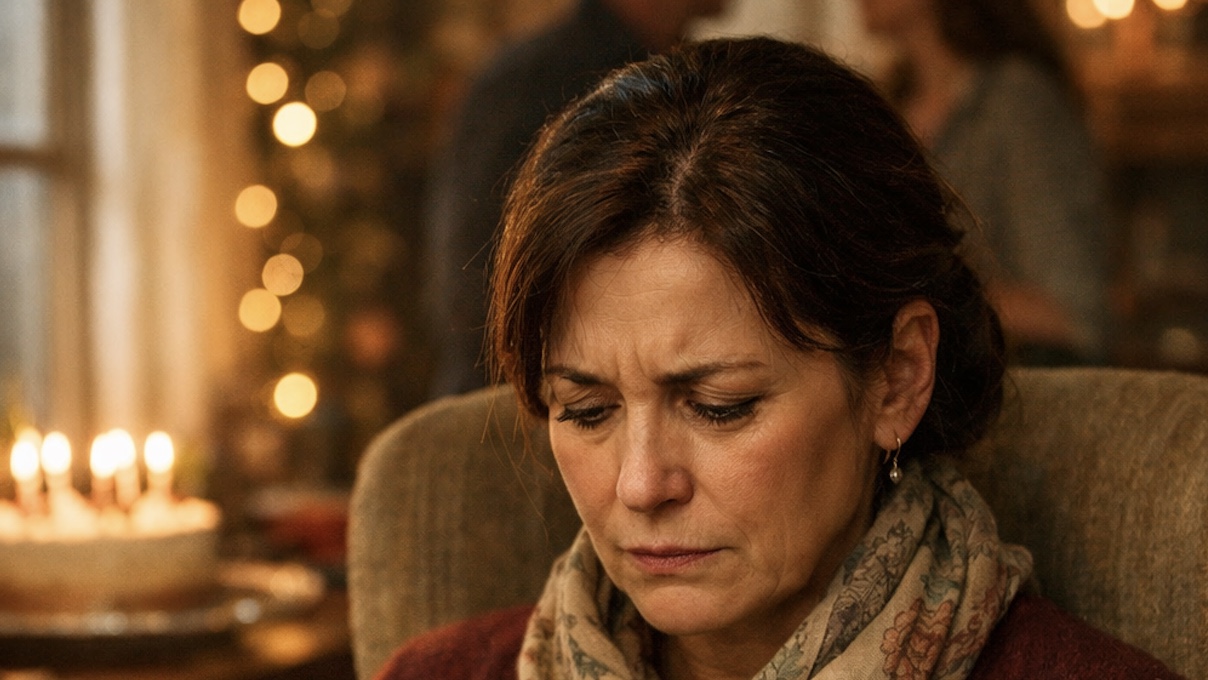
I opened the box—and understood. Instantly, in that very second.
The guests had not left yet. On the table stood the birthday cake with three candles still in it—two had already burned down and bent into wax, the third was still holding on. In one corner of the living room, Anton was talking with Kostya, the neighbor, laughing about something. From the kitchen came the smell of fresh coffee—Sveta had brewed it right before dessert, wanting everything to feel special. Everything was going as usual. Fifty-four years old, loved ones all around, a birthday like any other.
And I was sitting in an armchair with a small velvet box on my lap, unable to move.
“Well?” Sveta rose a little from the sofa. “Open it already, Natasha, I’m dying of suspense here!”
The guests laughed. Someone shouted, “Come on, come on!” Anton turned around—he was smiling, waiting.
I opened it.
Oval garnets in delicate silver settings. The stones were darker than ruby, almost brown, with a warm light inside them. The left earring—I looked at the left one first—had the tiniest dent on the side of the frame, where the metal had spread just a little.
I knew that dent. I had made it myself—after wearing the earrings for a year, brushing them with my little finger every night when I took them off before bed. Small, nearly invisible. But I knew it.
“Natasha?” Sveta’s voice softened. “You don’t like them?”
“I do,” I said. “Very much. Thank you, Svetochka.”
And I smiled. I am very good at smiling when I need to. It is a skill polished over years—first at work, then at home, then at work again. By fifty-four, it barely takes effort anymore.
Sveta lit up.
“I bought them from Mefodyich—you don’t know him, he has a stall at the market, and he always has interesting things! I saw them and immediately thought: these are so Natasha, absolutely her!”
“Absolutely mine,” I agreed.
Anton brought in the cake, everyone sang “Happy Birthday” in Russian—off-key, laughing—and the evening moved on as if nothing had happened. I drank coffee, answered questions, laughed in all the right places.
And the box lay beside me on the windowsill. I tried not to look at it.
Four years earlier, in another March just like this one, Viktor had brought me a blue box.
Not velvet—a firm cardboard box tied with a silver ribbon. He set it down on the kitchen table without a word while I was frying potatoes, then stepped aside. I turned, and he was standing by the window, looking out into the yard. As if nothing at all had happened.
I asked, “What is it?”
He said, “Open it.”
Inside were the earrings. I lifted them from the backing and held them up to the lamp. Dark garnets, thin silver, careful workmanship—not some trinket from a mall.
“Viktor,” I said. “Where did these come from?”
“From the jewelry store on Lesnaya,” he answered, still looking out the window. “Remember, you stopped at the display last March? We were walking home from the bus.”
I didn’t remember. Honestly, I remembered nothing about it. It had been an ordinary evening, an unremarkable walk home, and I had probably paused for a second, glanced at the window, and kept going. There are a thousand store windows in the world.
But he remembered.
“You remember everything I do at store windows?” I asked.
“No,” he said. “Only when you stop for more than three seconds.”
For my fiftieth birthday I wore them to a restaurant—we went alone, just the two of us, exactly how I wanted it. Viktor pretended not to notice how long I stood in front of the mirror before we left. At the door he only said, “Come on, we’ll be late.” And smiled.
Two years later, he was gone.
A heart attack, on a Friday evening, sudden and fast. He was walking home from work—the same route, the same road past that jewelry store on Lesnaya. Anton arrived half an hour later. I don’t remember that evening clearly—not because so much time has passed, but because memory protects what we do not have the strength to hold.
I put the earrings away in the dresser drawer. The same drawer where I kept his watch, his notebook—he always carried a paper one, never trusted phones—and a few photographs from our first trip to St. Petersburg. I would go a long time without opening that drawer. Sometimes—very rarely—I would open it. Just to look.
And then the earrings disappeared.
I noticed they were gone in May, about a month after Kristina had come over to help me sort through some of Viktor’s things—I had kept putting it off, and she offered. It had seemed like a kind idea. We sorted his books, his jackets, his tools in the storage closet. I spent a lot of time going back and forth to the kitchen—making coffee, finding bags for the things we decided to give away. Kristina stayed in the room. I did not.
When I opened the drawer in May, the earrings were gone.
I tore the apartment apart. Checked every drawer, every shelf. Pulled out my winter boots, summer hats, boxes of documents. I called the building manager—he promised to ask the cleaning woman, then stopped answering my calls. Nothing.
Two weeks passed. Then a month. I told myself: they’re somewhere here. I just haven’t looked properly. Viktor would have disapproved of such chaos in my head—he would have searched calmly and found them in five minutes.
But there was another thought. A quiet one, somewhere in the back of my mind. I never let it step into the light. If I am honest, I was afraid of it.
The guests left around ten.
Anton stayed behind. He washed the dishes on purpose—he knew I hated leaving them overnight. I stood beside him, putting the cups back into the cabinet. We talked about nothing—about Kostya from next door, about how long winter seemed to be dragging into spring, about some film he said I should watch. A normal conversation. An ordinary one.
“Mom,” he said suddenly. “How are you?”
“Fine,” I answered. “It was a warm evening.”
“The earrings are beautiful.”
“Yes,” I said. “They are.”
He looked at me for a second—Anton has always been observant, ever since he was little—but he did not ask anything. He kissed my cheek, said, “Happy birthday, Mom,” and left. Kristina was waiting for him at home.
I closed the door and walked back into the living room.
The box was still on the windowsill where I had left it. I picked it up and opened it again. Looked at it for a long time.
Who had brought the earrings to Mefodyich? That was the only question now. Sveta—dear, noisy Sveta with the red scarf she wears over every coat she owns—she had simply bought something at the market because she liked it. She knew nothing. But whoever had brought them there—that was a different matter.
I closed the box.
I did not want to know. That is the truth; I am not inventing it. I sat there in the silence of my apartment—fifty-four years old, alone, the earrings in my hand—and I truly did not want the answer. Because that quiet thought in the back of my mind had long ago begun whispering a name. And I did not want that whisper to turn out to be right.
But I also knew I could not leave it unanswered.
The next morning I called Sveta.
“Sveta,” I said, “remember that man you mentioned? Mefodyich? What market is he at?”
“At the Bird Market, Sundays only. Why? Did something happen?” she asked at once, alert.
“Nothing happened. I just want to see what else he has. Do you have his number?”
“Of course! He’s about sixty-five, looks strict, but he’s actually kind. Tell him I sent you.”
I wrote down the number and called immediately. Mefodyich was brief—“Sunday, ten o’clock, north gate”—and hung up. The conversation lasted less than a minute.
It was Tuesday. Sunday was five days away.
I don’t know how to describe those five days. I got up in the mornings, made coffee, looked out the window. The days moved forward as they always do. But beneath all of it sat one question, and there was still no answer.
Several times I thought: maybe I shouldn’t go. Maybe I should leave it alone. The earrings came back—that should be enough. What you do not know cannot hurt you; that is true too.
But no. I know myself. If I did not find out, I would think about it for the rest of my life. I would look at the people around me and trust no one. And that would be worse.
I do not know how I would have gotten through those days if I had not picked up my phone on Wednesday. I was simply scrolling through photographs—you do that when your hands need something to do—and came across pictures of the earrings. Two of them: one taken right after Viktor gave them to me, the earrings lying on the sofa fabric in warm lamplight. The second on my mirrored vanity table before a trip to visit a friend.
I looked at them and thought: what if.
I typed into Avito: “garnet earrings silver oval.” There were many. I kept scrolling. On the third page, I stopped.
It was my photograph. Mine exactly—the same angle of the vanity, the same shadow from the mirror frame. The listing had been deleted, but the page had been cached. I copied the link and saved it in my notes.
Then I waited for Sunday.
On Wednesday evening Anton called. He asked how I was feeling—he always calls after my birthday; it is our tradition. I said I was fine, thank you. He said Kristina’s father was finally doing well—he had recovered from heart surgery, it had taken a long time, but now he was all right. Thank God, he added. It had been a serious operation.
I said, “Thank God.” And asked how Kristina was.
“Okay,” he said. “She can finally breathe again.”
“That’s good,” I said. “Take care of her.”
We said goodbye. I sat with the phone in my hand for several minutes after that.
Heart surgery is expensive. Very expensive. I know because when Viktor first started having heart problems—back when he was fifty-five, not the final thing, but the first scare—we looked into the costs. Insurance would never have covered everything.
The quiet voice in the back of my head grew louder.
On Saturday I barely slept. Not because I was afraid—just because I lay there thinking. Thinking: if I am right, then what? What do I do with being right? A scandal? Police? A break with Anton?
And at the same time I thought of something else: Viktor had chosen those earrings. He had stood at that display window, thought about them, remembered. Brought them home, set them down on the table, stepped aside to the window—and waited. He always did that when he gave me something important: let me open it myself, looked away, gave me time.
Those earrings were not merely jewelry. They were the last thing he had chosen for me.
I could not leave that unanswered. Even if the answer was hard.
On Sunday I got up at eight-thirty, got dressed, and went to the Bird Market.
I found Mefodyich by the north gate—a short man in a dark quilted jacket, a wool scarf wrapped nearly up to his nose. His folding table was small: several trays of jewelry, a pair of figurines, a stack of old pins.
“Are you Mefodyich?” I asked. “Sveta Kharchenko gave me your number.”
“I remember Sveta,” he said. “What are you looking for?”
I took out my phone with the saved link.
“You sold some earrings. These ones. I want to know who brought them to you.”
He looked at the screen without surprise. Resellers have seen everything.
“Why do you need to know?”
“They were mine,” I said.
He was silent for a moment. Then he pulled one phone from his pocket—an old one with buttons, though he used it only for calls—and then a second one, a smartphone. He scrolled through it.
“Is the Avito account still active?” he asked.
“No, the listing is gone. But the cached page still exists.”
He nodded. Found the correspondence—he kept everything, a proper businessman.
“A young woman,” he said. “Wrote: family jewelry, urgent. I bought them for three thousand rubles.” He turned the phone toward me. “Here’s the profile.”
I looked at the screen.
The page was almost empty. No photo—just the default avatar. Name and surname: Kristina Vyazemskaya.
Her maiden name. She never changed it officially and did not make a point of using it, but I knew it—she had once mentioned that her passport still carried it.
I did not look away from the screen right away. I simply kept staring.
“Thank you,” I said to Mefodyich.
“Are you going to call the police?” he asked. Not curiously, just matter-of-factly.
“No,” I said.
He nodded and put the phone away.
I walked away from his stall, found a bench near the gate, and sat down. It was cold—the kind of March air that still has not decided whether it belongs to winter—but I did not feel the cold. I sat there looking at the gray trees beyond the fence.
So. Kristina.
I had expected anything—anger, tears, relief that I had finally found the answer. But what came was something else. Quiet and heavy. The feeling you get when you understand something essential about a person and take no joy in it.
She had come in April to help. She had sorted through his books. She had seen the drawer open—I remembered clearly that it had been open—and she had seen the earrings. Then I had gone into the kitchen.
Kristina is not a cruel person. I knew that for certain. She is complicated, closed-off, proud to the point of stubbornness—but not cruel. So something must have driven her to it.
Her father’s surgery. Three thousand rubles from Mefodyich would have been nothing, of course, far too little. Which meant she must have been gathering money from everywhere—her brother, a friend, anyone she could.
I stood up and walked toward the metro.
I called her the next day—Monday afternoon.
“Kristina,” I said. “I need to talk to you. Can you come by today?”
Her voice was steady. She knew nothing, suspected nothing.
“Of course, Natalya Sergeyevna. Are you unwell?”
“No. I just want to talk.”
“In about two hours?”
“All right.”
I hung up and spent two hours cleaning the apartment. It helps—when you do not know where to put your anxiety, you pick up a cloth and wipe down shelves. By the time Kristina arrived, the apartment was clean and my mind was calmer.
She rang the bell exactly two hours later. That was like her—always on time.
I opened the door. She stood there in a dark coat, her hair thrown over one shoulder, her face composed. But I looked at her and could see that composure was only the top layer. Beneath it was something else. She felt that something was wrong. She just did not yet know what.
“Come in,” I said. “Will you have tea?”
“Yes, thank you.”
We sat in the kitchen. I poured the tea silently, without rushing. Kristina held her cup in both hands and looked at the table.
“Kristina,” I said, “a year ago my earrings disappeared. The ones Viktor Mikhailovich gave me.”
She looked up.
“I know you took them.”
Silence.
I waited. I waited for her to say, that’s not true, or where did you get that from, or what do you mean. But she said none of those things. She only sat there, staring at her cup. For a long time.
“Kristina.”
“Yes,” she said.
Just one word. Quiet, but firm.
“Why?”
She moved her hair over her shoulder—automatically, without noticing—and finally looked at me.
“My father needed surgery,” she said. “In spring. Urgently. My brother Artyom and I couldn’t manage the cost alone. He gave what he could, I added my savings. It still wasn’t enough.”
“And you didn’t ask me?” I said.
She was silent.
“Kristina.”
“I couldn’t,” she said. Her voice changed slightly—softer now. “Viktor Mikhailovich had been gone for two years. You were barely holding yourself together as it was. I couldn’t come to you asking for money.”
“You could have,” I said.
“I couldn’t,” she repeated. “I know it was wrong. I understand that. But I couldn’t.”
I stood and walked to the window. Outside was a gray March sky, with drops running down the glass—rain or snow, impossible to tell.
So that was where it came from. She had been there in April, sorting books, alone in the room for several minutes. She had seen the dresser drawer open. The earrings had been lying on top—I had taken them out to look at and never put them away properly, just left them there.
One moment. One impulse.
“She took them to sell,” I said aloud. Not to her—to myself. Just to make the words real.
“I took them,” Kristina said. “Not to keep for myself. I know that doesn’t excuse it.” She faltered. “I sold them for three thousand. Of course it wasn’t enough, I had to borrow more from a friend. My father lived.”
Three thousand rubles. Less than what Sveta had paid Mefodyich.
I turned to her.
“Kristina,” I said. “Do you understand these weren’t just earrings? Do you understand what exactly you took?”
“Yes,” she said. “I knew. I knew when I took them. And afterward I thought about it every day.”
“And you said nothing.”
“And I said nothing.”
I looked at her. Sharp cheekbones, straight back, hands resting on her knees. She was not crying—not out of indifference, but because she knows how to keep herself together. Just as I do.
That was when I understood something important. In that, she and I are alike: both of us endure, both of us do not ask, both of us carry our burdens alone. The difference is that in fifty years I have learned to recognize when you are not supposed to carry something by yourself. She has not learned that yet.
“How is your father now?” I asked.
Kristina flinched slightly. I think she had been expecting a different question.
“He’s well,” she said. “The doctors say it all went well.”
“Thank God,” I said.
We sat in silence. The tea in our cups had gone cold.
“Natalya Sergeyevna,” she began.
“Wait,” I said. “I’m not finished.”
She fell quiet.
“What you did was wrong,” I said. “That is true. You took something that did not belong to you. Something that mattered to me. You knew that—and you took it anyway. There is no other name for that.”
She looked at me.
“And at the same time,” I said, “I understand why you did it. That is true too. Both truths exist side by side, and I am not going to pretend one of them cancels out the other. You did something wrong—and I understand what led you to it.”
“That doesn’t excuse it,” she said quietly.
“No,” I agreed. “It explains it. There is no excuse for something like this. But explanation is a different thing.”
She looked down at her hands.
“I wanted to pay the money back,” she said. “I’ve already started putting some aside. Every month.”
“Kristina,” I said. “The money is not the issue. Money is not what I’m talking about.”
She looked up.
“You have to tell Anton,” I said.
The silence changed again.
“He’ll be upset.”
“Probably,” I said. “Maybe angry. That is his right. But he has to know what happened in this family. Because it is his family too.”
She did not answer immediately. Then, quietly:
“Will you tell him yourself?”
“No,” I said. “You will. Today.”
She nodded. Slowly, but she nodded.
I stood up, put the kettle on again, and poured us both fresh tea. We sat there another half hour—not saying anything important, only drinking tea. I told her about the birthday. She answered. Not everything between us was resolved—I understood that. Things like this are not resolved in one conversation. But something shifted. Something important.
As she was leaving, she stopped in the hallway.
“Natalya Sergeyevna,” she said. “I don’t know how to say this.”
“Not now,” I said. “Go home. Talk to Anton. That’s what matters.”
She left.
I closed the door and stood in the hallway for a while. I heard the elevator go down. Then silence.
So that was it. I had learned what I wanted to know. I wished I had been wrong—but I wasn’t.
And now?
Now—nothing. Now I wait and see what happens next. That is all that was in my power.
Anton called at half past ten.
“Mom,” he said.
From that one word, I understood everything. He knew.
“I’m here,” I said.
“I just found out. Kristina told me.” He paused. “Mom, I didn’t know.”
“I know you didn’t.”
“She shouldn’t have done that.”
“No,” I said. “She shouldn’t have.”
“How are you?”
“Fine.” I thought for a moment. “Actually—fine. I wasn’t certain before. Anton, there is one thing I need you to understand.”
“What?”
“She did something wrong. She knows she did. And she has to live with that. That is enough.”
“Mom, she took something that belonged to Viktor Mikhailovich.”
“Yes,” I said. “I know. I know that better than you do.” I paused. “But I do not want you and her to fall apart because of me. Do you hear me? No breaking up, no not speaking for a month—none of that. That is my request.”
“You’re defending her?”
“No. I am asking you to keep your family intact. Those are not the same thing.”
He was quiet for a long time. I could hear him breathing into the phone.
“She’s crying,” he said at last.
“I know,” I said. “Anton. Stay with her. That matters more right now than trying to sort everything out. You can talk later. When you have both calmed down.”
“Are you sure you’re okay?”
“I’m sure,” I said. “Go to her.”
We said goodbye.
I set the phone down on the table. I got up and walked through the apartment—to the kitchen, back to the living room. It was quiet. The familiar kind of quiet I knew by heart—the creak of the floorboards near the threshold, the hum of the refrigerator, a car passing somewhere beyond the window.
Then I went into the bedroom.
The velvet box was on the nightstand, where I had placed it on the evening of my birthday. I picked it up and opened it.
Warm lamp light fell over the dark stones. The garnets looked almost coppery in the yellow glow—they always do.
I stood before the mirror.
I looked at myself. Chestnut hair, forehead uncovered—I always pin it back in a bun, habit from childhood. Small hands with neatly trimmed nails. A face no longer young. An honest face, I thought.
I picked up the left earring. The same tiny dent in the silver setting—so small that no one would notice unless they already knew it was there. But I knew.
I put it on. Adjusted it with my finger—as always, as I had done hundreds of times before. It clicked into place.
Then the right one.
Viktor had bought them from the jewelry shop on Lesnaya. He remembered that I had paused at the window. He said nothing then—he simply remembered, came back alone, chose them. Brought them home, set them on the table, stepped aside to the window.
The earrings had vanished a year ago. They had passed through чужие руки—through Kristina’s desperation, through Mefodyich’s stall, through Sveta’s red scarf and her love for old beautiful things. And they came back. On my birthday, just as they once had before.
I looked at myself in the mirror.
I do not know whether there is meaning in things returning. Probably there is none. Probably it is only coincidence, a chain of accidents: Mefodyich could have sold them sooner, Sveta might never have gone to that market, everything could have turned out differently.
But it happened this way.
They were mine again.
I switched off the lamp and went to bed.
I had not fallen asleep so peacefully in a very long time—not because everything was all right. Simply because now everything was known. It turns out that matters more than whether things are good or bad.