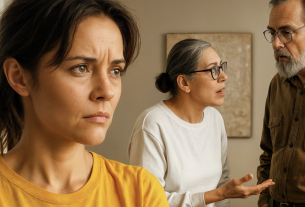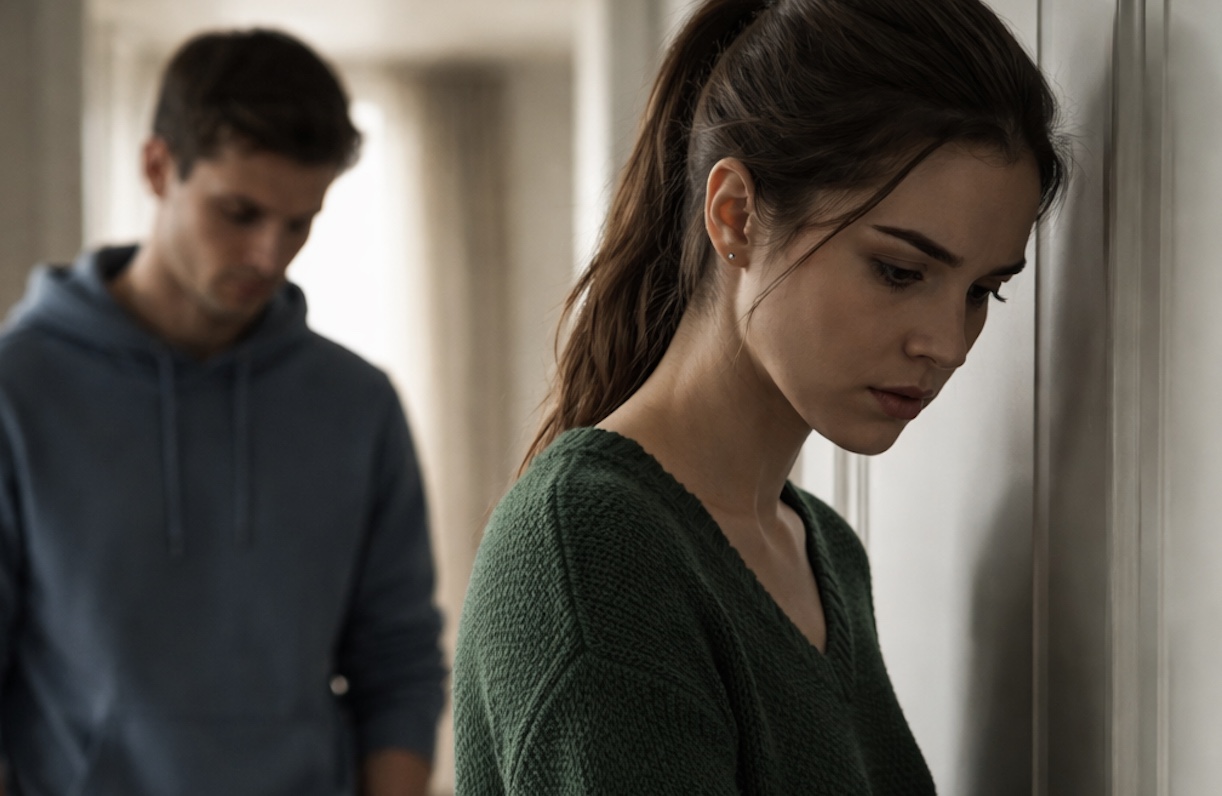
“This is my apartment. No, not ‘our family place.’ And no, I am not required to feed your sisters and their children,” Tanya said so sharply that she surprised herself with how calm she sounded.
Sergey froze in the hallway, a towel draped around his neck, like a man caught trespassing at someone else’s summer house with a barbecue in his hands. His mother, Valentina Ivanovna, did not flinch. She only lifted her chin a fraction, as if she had heard some irritating noise outside the window. Nearby hovered Aunt Galina, her hands still wet, wearing that guilty-but-busy smile of someone pretending everything is perfectly normal. And all around them, her two boys tore through the room like overheated balls of energy, crashing into furniture and shrieking with laughter.
Tanya stood in the doorway of her own kitchen and felt something click inside her head: enough with being polite. That switch usually flipped when someone stepped on a sore nerve. Today they had not just stepped on it. They were trying to drag it away with them.
She had come home late, angry and drained. Shopping bags in her hands, a mental list of unfinished tasks in her head, and only one desire in her chest: silence. When she opened the door, for a second she thought she had walked onto the wrong floor. Strange shoes were lined up in the entryway. Worn men’s boots, teenage sneakers, children’s glittery winter boots, all of them gleaming like a mockery. From the kitchen came the smell of stewed cabbage and some cheap meat dish, the kind of food that announced itself with absolute confidence. From the living room came squeals and stomping so loud that the neighbors were probably watching plaster fall from their ceiling.
All she had done then was exhale and mutter, “God, please not this,” before following the noise.
Valentina Ivanovna was there, standing over the stove with her sleeves rolled up, wearing the expression of a woman who had come not to tidy a house but to reorganize someone else’s life. And she was doing it with her usual certainty: I’m allowed. I’m the mother.
“Tanechka, finally!” she called out loudly, without even turning away from the pot. “We were beginning to think you’d decided to sleep at work.”
“And what… exactly is going on?” Tanya asked evenly, though anger was already stirring in her voice like a mouse beneath the floorboards.
“Oh, nothing special,” Galina replied, lifting something sizzling off the frying pan. “The kids and I are staying for a couple of days. We’re having repairs done at home. Dust, noise, chaos. And here at your place… well, it’s roomier.”
Roomier.
Tanya looked around at their idea of “roomy”: a two-room apartment where she and Sergey already lived as if they were forever rationing space. One shared wardrobe. One kitchen. One sofa that turned into a battleground for the remote every weekend. And in that instant, for the first time in her life, she had the crystal-clear feeling that they were about to push her out of her own home, while somehow making her feel guilty for resisting.
“Roomier…” she repeated, hearing a tone enter her own voice that usually made people start looking for the nearest exit. “It’s a two-bedroom apartment. It’s obviously not meant for all of us.”
“Family aren’t strangers,” her mother-in-law cut in, using that voice reserved for foolish young women who just don’t understand life yet. “We’ll all be happier together. It’ll even be good for you. A home should feel alive.”
Home. Her home. Paid for with her mortgage. Decorated with her renovation. With wallpaper she had spent two evenings choosing. Tanya noticed sunflower seed shells scattered across the coffee table, crumbs on the carpet, someone’s jacket dumped on her couch. And then there was a greasy little handprint on the cabinet door. Tiny things, all of them. But tiny things are like sand. At first they’re merely unpleasant. Then they start grinding between your teeth until you want to spit.
“Where’s Sergey?” she asked, clinging to the possibility that this was some misunderstanding he would walk in and fix.
“In the shower,” Valentina Ivanovna said with a dismissive wave. “You know your Seryozhenka. He gets shy when there’s too much noise.”
And Sergey really did come out a moment later, hair still damp, dressed in sweatpants, wearing the face not of a husband, but of a little boy sent forward by his mother to smooth things over.
“Hey,” he said. “Mom and Galya… well… just for a little while.”
“For a little while?” Tanya looked at him as if he had just admitted to selling her laptop. “And you couldn’t warn me first?”
Sergey scratched the back of his head, a gesture Tanya had already come to hate.
“I wanted to… but… you’re always tired. I thought why upset you more than necessary?”
“So instead you decided not to upset me by presenting me with a fait accompli?” Tanya actually smiled then, but the smile was ice cold. “Brilliant plan, Seryozh.”
Valentina Ivanovna jumped in at once.
“That’s modern women for you. Nothing is ever good enough for them. Then they complain about being lonely. You should learn to be simpler.”
Tanya swallowed that remark. Not because she agreed, but because she was too exhausted to start a war right then. She took off her coat, walked into the living room, and saw that the children had already found her laptop and were hammering at the keyboard. She restrained herself, snatched the computer away, and told Sergey, “Do something. At least one thing.”
Sergey mumbled, “Come on, they’re just kids…”
And Tanya understood that if she stayed, she would explode in a way that would leave only her ashamed afterward.
So she left for the gym. At least no one there cooked on top of her nerves.
And now she was back, only to find that her absence had loosened everyone’s restraint even further. Sneakers were sprawled across the hallway floor, a meat patty was stuck to the rug, the bathroom door hung open, wet towels lay on the floor as if there had been a flood. In the kitchen, Valentina Ivanovna was once again directing operations, Galina was doing dishes, the children were playing tag, and one of them had left a greasy forehead print on the refrigerator.
Tanya slammed the kitchen door hard enough that everyone froze.
“Oh, the hostess has returned,” her mother-in-law said sarcastically, without raising her voice, making it sound as though Tanya were the rude guest here. “Now I suppose we’re about to get a lecture.”
“You are,” Tanya replied. “Because it feels like I’m living in a train station.”
“We’re trying to be careful,” Galina offered timidly, though she made no move whatsoever to pull her boys away from the furniture.
Sergey came out of the bedroom. His face looked tired, the way people look when they have spent an entire day solving nothing and still somehow feel exhausted by everyone else’s decisions.
“Seryozh,” Tanya said, stepping closer. “No more ‘just for a little while.’ Either you stop this, or I will.”
“What, you’re going to throw my mother out?” he asked quietly, as though afraid his mother might hear, even though she heard everything that happened anywhere on Earth.
“And why shouldn’t I?” Tanya turned to Valentina Ivanovna. “Do you even understand that this apartment is legally mine?”
“Oh, here we go,” her mother-in-law drawled, rolling her eyes. “Your generation measures everything with papers. Mine, mine, mine. What about respect for your family? What about heart?”
“I have a heart,” Tanya said, keeping her voice low, which only made her words land harder. “But having a heart doesn’t mean living in chaos and listening to lectures about how I’m ‘wrong’ because I don’t want my home turned into a hostel.”
“Tanya!” Sergey tried to interrupt, but there was more panic than conviction in his voice.
“No, Seryozh. Enough.” She turned fully toward him. “I work, I come home, and I want peace. Instead I find other people’s things, other people’s rules, and somehow I’m the bad one for not liking it.”
Valentina Ivanovna let out a heavy, theatrical sigh, the sigh of a woman cruelly burdened with ungrateful people.
“So I spent my whole life raising my son, working myself to death at night, and now I’m afraid to enter my own son’s home.”
“Your own?” Tanya slammed her palm on the table. “Whose? Mine. You came in here without warning. And now I’m telling you: either you gather your things, or I call the district officer. I don’t care what the neighbors think.”
Galina jerked in alarm.
“Tanya, come on… the police… that’s a bit…”
“It’s called accountability,” Tanya cut in. “Because otherwise you’ll keep showing up whenever you like and every time explaining to me how I should be ‘easier.’”
Her mother-in-law narrowed her eyes and stepped closer until they were nearly face to face.
“You really think that because the apartment is in your name, you’re the one in charge here? You’re mistaken. Family always has more rights than a piece of paper.”
And that was when Tanya said the line that had started all of this. She repeated it now, looking straight into her mother-in-law’s eyes without blinking.
“This is my apartment. And I am not obligated to feed your sisters and their children. If you want to call yourselves family, learn to respect someone else’s home. My home.”
Something crashed in the hallway. One of the children had knocked something over. There was a second of crying, then laughter again, as if nothing had happened. Tanya did not even turn around. By then the noise itself no longer bothered her. What made her sick was the feeling that everyone here saw her as part of the furniture: if it stands there, it can be moved.
Sergey stood there like a man caught between two walls. And suddenly Tanya saw the truth. This was not some poor torn man trapped between two women. He had built himself a comfortable spot where no one would be angry at him, let the women destroy each other, and afterward sigh, “I only wanted what was best.”
“Seryozh,” Tanya said quietly. “Right now you are either a husband or a son. Don’t pretend you get to be both in the same moment.”
Valentina Ivanovna threw up her head.
“Oh, now it’s blackmail. Wonderful. Son, do you hear her? She’s forcing you to choose!”
Sergey swallowed. Tanya saw the muscle jump in his cheek, a tiny movement like someone making the first decision of his life not to stay convenient.
“Mom,” he said finally. His voice was not loud, but it was different. “This is Tanya’s home. And mine. But legally it’s hers. And… we should have asked her. I should have asked her.”
Tanya went still. Not from joy. From surprise. Sergey almost never said the words I should have to his mother. Usually he said, “Mom, please, don’t start.”
Valentina Ivanovna went pale for a moment, then gathered herself immediately.
“Well. I see. So you choose her. Some girl. And your mother gets thrown out into the street.”
“Nobody is throwing you into the street,” Tanya said, picking up the keys from the table and spinning the ring around her finger. “But you are leaving. Today. And you no longer have keys to this apartment. Visits from now on happen only after a phone call. And only if we agree.”
“Oh, so that’s how it is!” her mother-in-law cried, throwing up her hands. “Fine then, live with your pride. We’ll see how long that lasts.”
Galina was already gathering the children, muttering, “All right, let’s go, let’s go, this is awkward.” The boys grumbled, but obediently began pulling on their coats. Valentina Ivanovna lingered one last second, as if waiting for Sergey to change his mind, ask her to stay, kiss her hand. He did none of those things.
She stormed out, stomping heavily. The front door slammed so hard the light fixture in the entryway trembled.
And then silence fell like a stone.
Tanya stood there breathing hard, as if she had actually been in a fistfight. Sergey silently picked up a child’s mitten from the floor, set it on the shoe cabinet, and said quietly,
“I’m sorry. I… I really thought it would be easier this way.”
“Easier for whom?” Tanya looked at him. “For you. So you could stay good for everyone, while I stayed patient. Convenient.”
Sergey lowered his eyes.
Tanya sat down on the couch. And suddenly she started crying. Not from self-pity, but because the tension had finally found a way out. She was shaking as if she had just walked away from a car crash, the kind where you survive, then realize how much worse it could have been.
She wiped her face with her palm and said almost in a whisper,
“Seryozh, if you don’t put a full stop to this now, we will go on living as a threesome forever. No matter how many rooms we have.”
Sergey nodded as if he had swallowed something bitter.
“I’ll talk to Mom. For real this time. And I’ll take back the spare keys.”
Tanya lifted her head.
“What spare keys?”
Sergey froze. And in that silence, he said more than any explanation could have.
“Sergey…” Tanya said his name slowly, like a warning. “Your mother has keys to my apartment?”
“Well… yes,” he forced out. “She’s had them for a long time. Just in case. In case something happened.”
Tanya laughed, and the sound frightened even her.
“Just in case,” she repeated. “So she could come in here whenever we weren’t home?”
“She… didn’t come in,” Sergey said weakly. Then added too quickly, “Well, I mean, I don’t think so.”
Tanya got to her feet. Inside her, the switch flipped again, only now it was no longer enough being enough. Now it was time to count the losses.
She went to the cabinet, opened the drawer with the documents, checked the envelope of cash she kept for major expenses. It was still there, but lying differently, slightly crooked. A chill ran down her spine.
“You’re going to tell me the truth right now,” she said without turning around. “Has your mother ever been here while we were away?”
“I… don’t know,” Sergey admitted, no longer even trying to sound convincing. “She said she stopped by a couple of times to water the plants. I thought you knew.”
Plants. Tanya had two cacti that survived more out of spite than care.
“All right then,” she said levelly. “We change the locks. Today. You are not arguing. And then you go to your mother, take those keys back, and explain that she does not enter this apartment again unless we are here.”
Sergey nodded. But in his eyes Tanya saw the thing that finally made her furious beyond words: fear. Not fear for their marriage. Fear of his mother.
And at that exact moment, the doorbell rang. Short. Confident. The ring of someone who knew perfectly well the door would be opened.
Tanya and Sergey looked at each other.
“Don’t tell me…” Tanya began.
The bell rang again. And then Valentina Ivanovna’s voice came through the door, sweet as poison.
“Seryozhenka, open up. I forgot something important. And don’t pretend you’re not in there. I can hear you whispering.”
Tanya exhaled slowly, looked at Sergey, and said softly,
“Well then, husband. Let’s find out who actually runs this house.”
Sergey stood by the door and did not move. Tanya saw the tension in his back, not like a grown man, but like a schoolboy about to be called to the front of the class. The bell rang again, more insistently this time, with that particular rhythm Valentina Ivanovna always used when she believed something belonged to her by right.
“Seryozhenka, enough of this circus,” came her voice again. “I forgot my keys. And besides, we need to talk.”
Tanya walked over, not toward the door, but toward Sergey. She stood beside him. Not behind him. Beside him. So he would feel it: they were standing in one line now, not on opposite sides.
“Don’t open it,” she said quietly. Not as an order. As a fact.
“Mom…” Sergey started, then stopped. He took a deep breath like a man about to dive underwater. “Mom, we’re not opening the door right now.”
A pause followed. Then a small laugh. That same condescending laugh.
“Oh, come on. Tanya’s standing next to you, isn’t she?” Valentina Ivanovna did not even bother to hide the contempt in her voice. “Tell her I’ll only be a minute. I’m not a stranger.”
Tanya felt something rise inside her, not hysteria, not rage. A cold, heavy determination. The kind that comes when you finally understand that if you give in now, everything after this only gets worse.
“You are not coming in,” she said loudly and clearly, facing the door. “We settled this yesterday. You took your things. The conversation is over.”
“Oh, really?” Her voice on the other side turned hard. “So now I’m not even allowed to speak to my own son?”
“You are,” Tanya replied. “Just not inside my home. And not in that tone.”
“Seryozha!” Valentina Ivanovna raised her voice. “Do you hear her? She’s silencing you!”
Sergey swallowed. Tanya felt it almost physically. Then he said,
“Mom, this is my decision. Ours. You do not come here anymore unless you are invited.”
Silence. Real silence. For a second Tanya thought she had gone. Then came a slow, dull knock, not so much against the door as against their shared past.
“I see,” Valentina Ivanovna said at last. “So this is how my life ends. My son against me. For a woman who won’t even feed her own family.”
“I am not required to feed anyone,” Tanya answered. “And if you keep going, I will call the police. That is not a threat. It is a warning.”
A scoff came through the door.
“Call them. Let’s see how you explain why you threw your husband’s mother out.”
“I’m not explaining anything,” Tanya said tiredly, closing her eyes for a second. “I’m simply living in my own apartment.”
Footsteps. Slow. Receding. Then the elevator. Silence again.
Sergey sank down onto the little bench in the hallway and stared at the floor as if the instructions for how to live the rest of his life might be written there.
“I…” he started, then stopped.
“Wait,” Tanya said, lifting a hand. “No excuses right now. They’ll only come out crooked anyway.”
She went into the kitchen, sat down, and poured herself a glass of water. Her hands trembled slightly. Not from fear. From adrenaline after too many hours of holding herself together.
Sergey came in after her and sat across the table.
“I really didn’t think it would go this far,” he said quietly. “To me it was… normal. She’s always been like that.”
“Exactly,” Tanya said, looking at him carefully. “To you, it’s normal. To me, it isn’t. And we never really said that out loud all these years. I stayed silent. You pretended everything was fine.”
“I was afraid,” he admitted. And that was perhaps the most honest thing he had said all evening. “Afraid of fighting with her. She knows how to make you feel like the worst person alive.”
“I know,” Tanya nodded. “I’ve felt it too. But I’m not your mother. And I’m not here to be convenient.”
He rubbed a hand over his face.
“We’ll change the lock tomorrow morning.”
“Today,” Tanya corrected him. “I won’t sleep knowing someone else has keys.”
He nodded without arguing. And that nod meant more than all his previous let’s do it later.
The locksmith arrived an hour later. Young, indifferent, carrying a toolbox. He changed the cylinder quickly and without unnecessary conversation. Tanya stood beside him and, for the first time in a long while, felt something strange and almost forgotten: safety.
When the door closed with its new click, the apartment felt different. Not outwardly. Inwardly. As if something heavy and invisible that had sat in the middle of the room for years had finally been carried out.
That night Tanya barely slept. She lay awake thinking, not even about her mother-in-law, but about herself. About how many years she had lived by saying, Fine, I’ll put up with it. And how that phrase had slowly eaten away at everything else.
Sergey left early the next morning. He said he was going to his mother’s place. To get the keys. To talk.
“Are you sure?” Tanya asked, not lifting her eyes from her coffee cup.
“No,” he said honestly. “But I have to do it.”
He came back that evening quieter than when he had left. Sat down on the couch. Stared at one point for a long time.
“Well?” Tanya asked.
“I got the keys,” he said. “More accurately, I took them. She screamed. Then cried. Then said I wasn’t her son anymore.”
Tanya nodded. No triumph. No pity.
“And you?”
“And I told her I am her son. But I’m an adult. And if she wants a relationship with me, it will be without invasions and without scenes.”
He looked at Tanya as if waiting for a verdict.
“I don’t know what happens next.”
“Neither do I,” Tanya replied. “But I know what will not happen anymore. And that’s enough.”
A few weeks passed. Valentina Ivanovna did not appear. Sometimes she called Sergey, briefly, coldly. She never mentioned Tanya, as if Tanya had ceased to exist.
The apartment became quiet. Truly quiet. Tanya caught herself realizing that for the first time she no longer tensed when opening the front door. She no longer scanned the floor for чужие shoes or counted unfamiliar pairs with one glance.
One evening Sergey said,
“You know… I’ve only just realized that we weren’t living as two people before. We were living under surveillance.”
Tanya gave a short smile.
“Welcome to adulthood.”
He smiled back, tired but genuine.
And in that moment Tanya understood: yes, there would still be hard conversations ahead, difficulties, maybe new attempts at pressure. But the most important thing had already happened. She had stopped surrendering her place.
And she never intended to give it up again.
The apartment was just an apartment again. Not a battlefield. Not an argument. Simply a home.
And that turned out to be enough.
The End