Victoria held the key in her hand. It was small and metallic, yet it carried the weight of an entire life. It did not feel like a key so much as a medal for surviving some cruel event called five years without joy. The cold, sharp metal burned against her fingers, not from the February chill, but from everything it stood for: every morning she skipped takeaway coffee, every winter she wore the same worn-out boots, every time she denied herself simple things like a movie ticket or a sweet roll from the station after a night shift. All of it for those forty and a half square meters on the edge of the city—with mold in the bathroom and a view of an endless line of cars. But it was hers. Belonging to no one else.
“Vika!” Olga called, shifting impatiently by the door. A cake was balanced in one hand, pure excitement in the other. Her eyes were lit with that unmistakable spark women get at weddings or in the middle of a sale. “Why are you standing there like you’re about to get married? Come on, open it already!”
They had known each other since the days when they made doll dresses out of old socks, and when a first kiss had less to do with feelings than with curiosity and a chemistry lesson. Their bodies had changed, their taste in men had only gotten worse, but their friendship—though at times it felt like dragging a suitcase without wheels—kept moving forward anyway. Some things you do not throw away.
“Coming,” Victoria said, drawing in a deep breath like someone about to jump into freezing water. The key clicked in the lock, and the door reluctantly opened.
Inside there were bare walls, linoleum the color of burnt fish, and stains on the ceiling that made it look as though rain had been falling right there in the hallway. But Victoria smiled so widely it reached the very edges of her soul.
“Happy housewarming, my friend!” Olga burst in like a storm and immediately started inspecting the place. “Well… there is definitely work to be done.”
“But at least it will all be my way,” Victoria said, taking off her coat as though she were shedding the past. “And no mother-in-law is ever going to tell me where to put a vase.”
They began the renovation in high spirits, armed with ridiculous jokes and buckets of paint, just like in their student years. Olga, dropping the roller every few minutes, painted the bedroom walls while Victoria fought with the kitchen tiles. Music blasted through the rooms—somewhere between Zemfira and Nautilus—and the apartment smelled of fresh paint, dumplings, and hope.
“Can you imagine what the housewarming party will be like?” Victoria asked dreamily, stirring the paint like a potion.
“With cake and beautiful dishes!” Olga shouted back from the ladder. “And a dinner set for special occasions. Which means every day, because every day is special.”
They bought furniture as though they were curating an exhibition: a solid wood table, a handwoven rug, a lotus-shaped lamp. Olga even brought in a giant mirror without asking.
“So you will remember you are beautiful,” she said. “Even with a hangover.”
Three months later, the renovation was finished. Tired, dressed in old T-shirts, but glowing with the feeling that they had built something truly important, they celebrated. That was the evening Victoria met Andrei. Tall, with a polished advertising smile and a voice that sounded like late-night radio. He asked where the outlet was and poured her a glass of wine. Two months later, they were together. A year and a half after that, he proposed.
The wedding was quiet and elegant. No ridiculous games, no embarrassing contests—just live music and a cake made by Olga.
“Well, now you’re a wife,” Olga whispered in the ladies’ room as she adjusted Victoria’s veil. “All that’s left is for you to learn how to say ‘darling’ without grinding your teeth.”
“I’m happy,” Victoria answered. “And Andrei respects my independence.”
The first few months felt like a dream. Andrei moved in, adjusted himself to her habits, even lined up his slippers in the corner exactly the way she liked. But before long, Larisa Pavlovna—Andrei’s mother—entered their life. A woman with a flawless smile and a gaze sharp as a blade.
At first she brought pastries. Then advice. And then came remarks like:
“Your little apartment is quite nice… for one person. Or maybe two. But surely you’re thinking about the future, aren’t you?”
Victoria, raised never to argue with older people, answered gently:
“We’re not planning on children yet, Larisa Pavlovna.”
But the older woman heard only one word: yet. And that, to her, meant hope.
And so it began.
Every Sunday became more than lunch—it turned into a small battle, with not only food laid out on the table, but plans, suggestions, and hints that slowly stopped being hints at all.
“Why not sell this little place?” Larisa Pavlovna would suggest with a sweet smile, as if merely chatting. “And with Andrei’s contribution, you could get a house outside the city.”
She built whole castles in the air, and in those castles there barely seemed to be a place for Victoria at all.
“Andrei,” Vika whispered one evening as they sat on the sofa. “Have you noticed that your mother is getting far too involved?”
“She just cares, Vika. Don’t take it so much to heart.”
But the heart does what it wants. It raced, froze, trembled at every cutting remark. Especially when she overheard them “discussing” the only thing she truly owned.
The real blow was still just ahead.
That morning was quiet, except for the dull crash in the kitchen. A cup slipped from Andrei’s hand, shattered on the floor, and coffee spread into a dark stain—symbolic in a way neither of them could ignore. He silently took a rag and began wiping it up. Vika watched him as though he had not broken porcelain, but something inside her.
“Did you talk to your mother?” she asked evenly, almost softly.
Andrei froze, wringing out the cloth.
“I can’t talk to her like that… she’s my mother.”
“And who am I? A public hallway? A doorbell button you can choose not to answer?”
She moved toward him slowly, like a surgeon approaching an open wound.
“You’re discussing the sale of my apartment behind my back. You’ve already chosen a house. You’ve already decided where my money will go. All of that—without me.”
“I thought you’d understand eventually. It’s for us…” he muttered.
“No, Andryusha. It’s for you. And for her. In those conversations I’m like an organ donor. A walking wallet. Convenient.”
Anger flashed in his eyes.
“You’re acting hysterical. It was just a discussion.”
“Without me? Without my consent? That’s what you call ‘just a discussion’? Was our wedding also ‘just a discussion’?”
He clenched his fists.
“Don’t dramatize it. Nobody was planning to rob you. Mom just…”
“Mom just wanted my kitchen, my walls, my floor. And you just let her talk about it. You know she doesn’t like me. She never did.”
“She’s just different. She has her own views…”
“She sees me as temporary!” Vika stepped back sharply. “A temporary accessory. Today it’s me, tomorrow it’ll be someone more convenient—with a bigger kitchen and a mother included.”
“You twist everything!” Andrei was nearly shouting now. “She wants to help!”
“Help? Is that what you call it when she says, ‘Are you a man or not? Or are you going to spend your whole life in the little box your wife gave you?’”
At that moment, the door flew open.
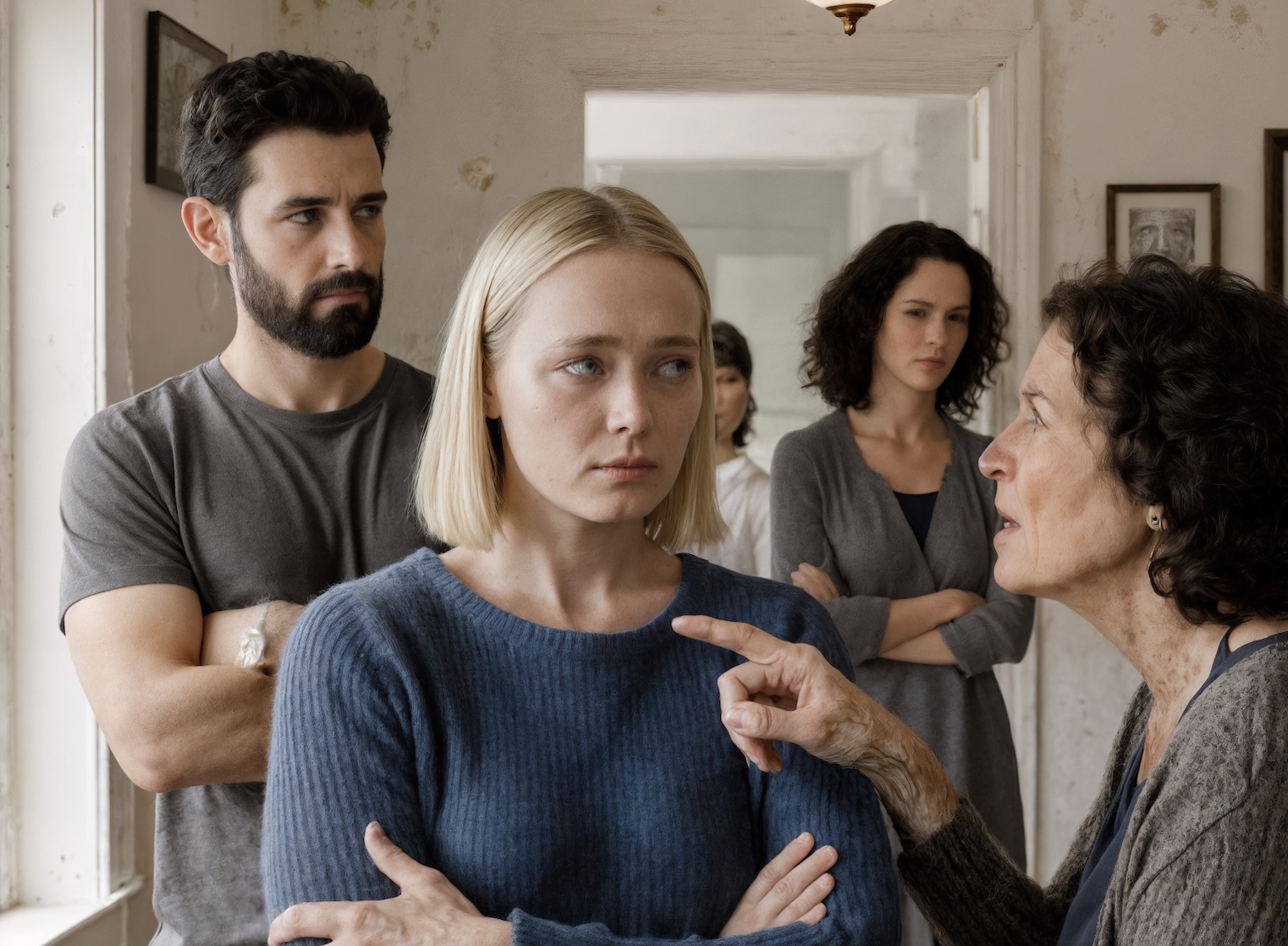
“What now, fighting again?” Larisa Pavlovna stood in the doorway in her usual cap, wearing the expression of a nosy village neighbor staring at an uncut yard.
“We’re talking, Mom,” Andrei answered tiredly.
“Talking? She’s yelling, and you’re standing there like a rag. Where is your backbone, son?”
“It’s in the same place as my kitchen,” Victoria replied calmly. “But you want to break it.”
“There is one thing I don’t understand,” her mother-in-law said, lowering herself into a chair and pursing her lips. “Why are you so attached to this tiny apartment? So your grandchildren will have to stand in line for the bathroom?”
“I’m perfectly fine having something that is mine,” Victoria replied. “And yes, the toilet is mine too.”
“That’s greed,” Larisa Pavlovna said. “You want everything to belong to you. That’s not how families work.”
Vika calmly took a sip of water.
“In a family, many things can exist, Larisa Pavlovna. Love. Respect. Trust. But there should never be a war over territory.”
Her mother-in-law narrowed her eyes.
“So clever all of a sudden. I suppose you and that little friend of yours sit around writing scripts together. Let me tell you something: there’s nothing sacred in you. No children, no patience, no understanding of what it means to be a woman.”
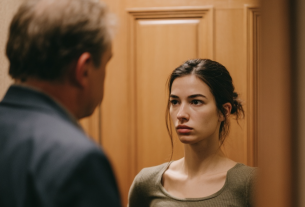
Victoria stood and walked to the table. She brought her palm down on the wood—not hard, but loud enough for the crack to ring in the room.
“I am a woman,” she said calmly, as though stating the obvious. “And do you know what a woman does when people keep pressing on her? First she endures. Then she stays silent. And then she starts to act.”
“Is that a threat?” Larisa Pavlovna raised an eyebrow.
“It’s a warning.”
And then Andrei snapped, as though he had been waiting for the moment to unleash everything he had been holding in.
“Enough!” he shouted. “Both of you are driving me crazy! Two witches! One orders me around, the other plays the victim! I’m sick of it! I don’t even understand why I got married in the first place!”
Silence fell, thick and heavy.
“Well, it’s a good thing you don’t understand,” Victoria said slowly. “At least that means I didn’t waste two years for nothing.”
“You…” he stepped toward her, angry as a bull about to charge.
Vika did not move.
“Try it,” she said quietly. “And you won’t hit me. You’ll hit yourself.”
Her mother-in-law could not resist adding more poison.
“Your tongue is longer than your skirt. A cold, arrogant woman with delusions of grandeur!”
“And you,” Victoria replied without hesitation, “are a rude woman obsessed with ownership. The difference between us is that I know how to leave. You don’t. You cling to everything: your son, square footage, your need to be right. Want to win? Do it without me.”
She was already turning toward the door when Larisa Pavlovna lunged—whether to grab her arm or her hair, it was hard to tell. But Olga was already standing in the hallway.
“Don’t move,” she said with icy calm. “Or I’ll slam you into the wall. Sorry, but today is not the day.”
The confrontation ended quickly. Olga did not hit anyone, but she firmly turned the mother-in-law around and escorted her out like a nurse dealing with a violent patient.
Andrei stood frozen. His face was empty, his eyes lifeless.
“We could still…” he began.
“No, we couldn’t,” Victoria cut in. “Because you are you. And your mother is your mother. And I am separate from both of you.”
The door closed. The click sounded like a seal, like the end of an entire chapter.
At first there was silence. Not the cozy kind with a kettle and rustling curtains, but the kind that rings in your ears after a car crash, when you are still alive but not sure if you are whole.
Victoria sat on the floor in an old tracksuit and wool socks. Her tea cooled beside her. Her head felt empty, except for the dull pounding of her pulse in her temples.
I threw them out. I didn’t run away. I didn’t leave in hurt. I threw them out. So I can do this.
The next morning she woke early. No anxiety. No instinctive glance toward the bedroom to see whether Andrei was awake, no fear that someone from his family might appear without warning. The space was hers again, truly hers. Like her own skin. Like breathing.
The kitchen was quiet. The refrigerator was almost empty. But those were her shelves, her jars. No one had rearranged them, criticized them, or left notes about how meat ought to be stored.
She texted Olga:
“I’m ready. We can do it.”
Olga arrived quickly—with documents, coffee, and her rough, throaty laugh.
“So, rebel, ready to be mistress of the house again?”
“I never stopped being one,” Victoria said with a crooked smile. “Someone just decided I was a prize in a lottery.”
The deed of gift, prepared a week earlier just in case, was in Olga’s bag.
“We’ll transfer it back as soon as this is over. On paper, it’s insurance. In real life, it’s protection,” her friend said.
“That kind of protection would have been useful yesterday,” Victoria sighed.
A few days later, she filed for divorce. No drama. Just her passport and a thermos of tea. The registry office smelled of paper and the exhaustion of people who had come there to untie what had once been tied.
Andrei did not call. He did not write. He disappeared as easily as he had existed in her life. Maybe he hoped she would change her mind, remember how “comfortable” it had all been. But Vika knew the truth: she did not need a partner for whom love could be measured in square meters and other people’s advice.
Two weeks later, she was once again the sole owner of her apartment. Olga handed over the documents and said:
“Now you’re really free. And the apartment is safe.”
“The apartment part matters,” Victoria nodded. “Everything else can be survived. But spending nights in some shelter for abandoned wives? No thank you.”
They laughed. This time lightly, without bitterness.
Then the changes began.
A new curtain in the kitchen. A new mug, just because she liked it. Wallpaper redone in the hallway without anyone’s approval.
Then came books, plans, walks alone. Not because of loneliness, but because being with herself had finally become peaceful.
And one day, looking into the large mirror Olga had once bought for her, Victoria no longer saw an abandoned woman or a victim. She saw a woman who had walked through a storm and remained standing.
She had not broken.
She had not surrendered.
She had not sold herself away.
She had simply survived.
And at last, she had begun to breathe again.