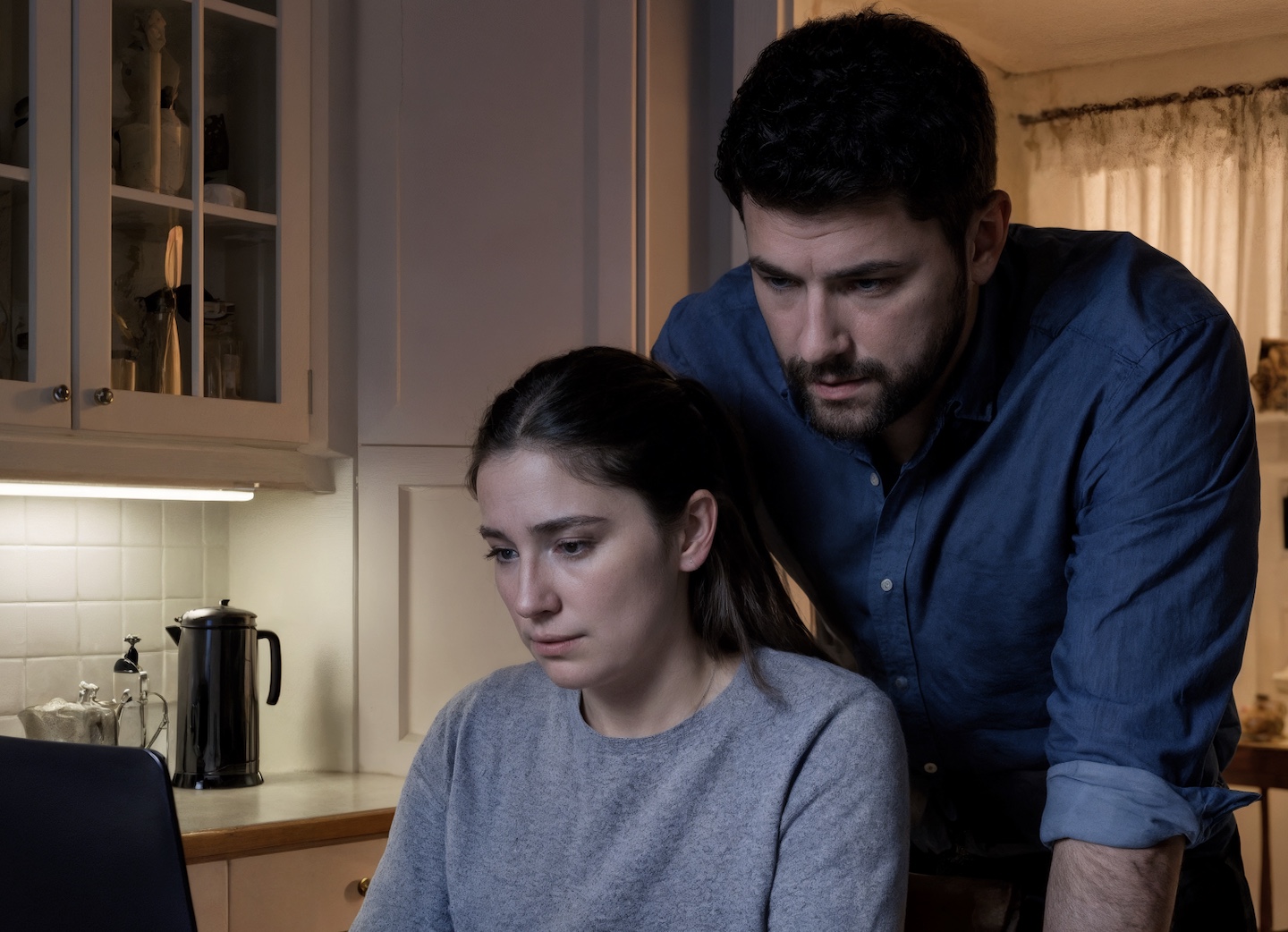
The evening had been quiet and worn-out. Outside, October darkness was chewing through the last crumbs of daylight, and in the kitchen of their concrete-panel apartment building only the little light beneath the extractor hood was on, throwing harsh shadows against the cabinets. Olga sat at the table, eyes locked on her laptop. In front of her lay a stack of bills, a calculator, and her blue faux-leather notebook—the chronicle of their family budget she’d been keeping for seven years, ever since she’d married.
The air still held the smell of mashed potatoes and cutlets they’d barely touched at dinner. Andrey stared out the window in silence, slowly stirring tea that had already gone cold. Their son Artyom, catching the tense stillness between his parents, had escaped to his room half an hour earlier under the pretense of homework.
“Your bonus is definitely coming this week, right?” Olga asked without lifting her head. Her voice was calm and efficient—the tone she always slipped into whenever money was on the table.
“They’re supposed to transfer it by Friday,” Andrey replied. “Why?”
“I’m doing the numbers. Utilities, kindergarten, the car loan you still didn’t pay off early… Artyom needs a winter jacket; he’s outgrown the last one. And this weekend we’re going to your mom’s—we can’t show up empty-handed.”
Her fingers tapped the keyboard, brows drawn tight. The figures wouldn’t line up. Olga cleared the spreadsheet and started again, typing in the password for the mobile banking app. Her finger stopped in midair.
“Andrey.”
He turned. Just the way she said his name—tight as a spring—made it clear something was wrong.
“What happened?”
“From the card… where did you send fifty thousand?”
The kitchen went so quiet the refrigerator’s hum seemed loud. Andrey dropped his gaze to his cup.
“I told you… Sveta needed it. They were having trouble with the electricity. It could’ve been shut off. And with a child…”
“Fifty thousand?” Olga repeated the amount slowly, as if she didn’t trust her own hearing. “For electricity? Are you serious? That was all our money, Andrey! Everything we’ve been putting aside for half a year! For a vacation! For the sea trip for Artyom!”
She pushed back her chair; it scraped hard across the floor.
“When? When did you do this?”
“Three days ago…” he said. “She called, she was crying. Said they’d be out in the cold, the baby would get sick…”
“So you just took everything we had and gave it away without saying a word to me?” Her voice started shaking—not with tears, but with powerless rage. “That’s our shared card! My salary is on it too! I’ve been saving on everything—food, myself—just to put that money away! So we could buy discounted tickets in February! And you… you just handed it to your eternally whining sister!”
Andrey got up as well, his face twisting with guilt and irritation.
“Don’t shout. She’s not ‘whining,’ she’s in a hard situation! She’s alone with a child! We’ll manage somehow, but they—”
“Who is ‘they’?” Olga cut him off, stepping closer. “They’re your sister who changes men like gloves but can’t keep a steady job? The sister who’s ‘borrowed’ money how many times and never paid back a kopeck? And who are we, then? Me, you, and our son? Or are we just your emergency fund for Sveta and her endless disasters?”
“Don’t talk about her like that! She’s my blood!”
“And what am I?” Olga’s voice dropped to a whisper, and that made it even sharper. “What am I to you, Andrey? A stranger? You live with me, you sleep in the same bed, we have a child—and the moment it’s about your family, I become an outsider. Convenient enough that you can empty our home behind my back.”
She saw him lower his eyes—and that was the worst confession.
“You weren’t even going to tell me, were you? You were just hoping I wouldn’t notice until you built the amount back up? Or until Sveta needed the next ‘last time’ rescue?”
“Ol, calm down,” he tried, reaching for her hand, but she jerked away as if he’d touched a flame. “I’ll pay it back. I’ll get the bonus, I’ll take overtime…”
“Pay it back?” She gave a bitter laugh. “Andrey, that money is gone. Do you understand? It’s not there. It’s been swallowed by debts that will come back again in a month. And right now we have three thousand in the wallet to last a whole week until payday. Can you even picture that?”
She yanked open the refrigerator door.
“Look! Empty! I was going to do a full grocery run today—I thought we had money. Milk, bread, eggs, fruit for Artyom… With what? Three thousand? So what—no dinner tonight? Or tomorrow? Or all week on pasta?”
Andrey said nothing. Every word landed dead center. He saw the empty shelves, saw the notebook with neat columns of expenses, saw her face—beautiful, familiar down to every line—now twisted with pain and contempt.
“That’s it,” Olga said quietly. She closed the laptop and gathered her papers. “That’s it, Andrey. I’m done. I’m done being last on your list of priorities. After Sveta. After your mother, who always covers for her. After anyone who holds out a hand and calls you family.”
She looked him straight in the eye. There was no warmth left there—only ice-cold resolve.
“Here’s your ultimatum. Either ‘we’ is you, me, and Artyom—and your sister and her problems stay outside this door. Forever. Or… you keep being an ATM with a brother’s title. But alone. Do you understand?”
He wanted to say something, to find an excuse, but at that moment his phone rang—sharp and insistent—in the silence of the kitchen. It lay on the table, and the screen blazed with one word: “Mom.”
Andrey stared at it, then looked at Olga. She was staring at the phone too, and the corners of her mouth twitched in a dry, exhausted half-smile.
“Well,” she whispered. “Answer it. It’s probably ‘urgent’ again. Something’s probably happened—again.”
Andrey picked up.
From the speaker came his mother’s agitated, shrill voice—so loud it carried even from half a meter away.
“Andryusha, my son, you finally picked up! I’ve been worried sick! Listen, it’s bad—Sveta needs help again. This time it’s a real disaster…”
His mother’s call hung in the air like something heavy and sticky. Andrey didn’t look at Olga. He pressed the phone to his ear and stepped into the narrow hallway, as if he could physically shield himself from her frozen gaze.
“Mom, I’m listening. Just… keep your voice down, please.”
But his mother never could keep her voice down. It burst through the receiver, filling the space around him—sharp, dramatic, trembling with practiced panic.
“Andryusha, it’s a catastrophe! They didn’t just shut off Sveta’s power! She told me everything just now… She hid it so I wouldn’t worry. She’s behind on her apartment payments, bailiffs brought papers, and her little Vanya—you know he’s asthmatic—needs an expensive inhaler, and she can’t buy it… She’s completely broken, the poor thing, sobbing… Fifty thousand is a drop in the ocean! You have to help!”
Andrey rested his forehead against the cool wall. His eyes closed. In his head the words kept pounding: a drop in the ocean, a drop in the ocean. The money he’d taken in secret, the money he’d lied about with silence—the sea of hope for Olga and Artyom—was being called “a drop.”
A sense of being trapped—tight, airless, inescapable—wrapped around his throat.
“Mom, I don’t have that kind of money right now. None. I gave everything.”
“What do you mean you don’t have it?” Her voice flipped instantly from pleading to demanding. “You’re an engineer! You’ve got a good job! Borrow from the bank, from colleagues! Are you really going to abandon your sister in trouble? She’s alone, light as a feather… And you’ve got a full family, you’re stable. How can you be so cruel?”
In the kitchen a chair scraped. Andrey instinctively turned. The hallway door was ajar. He saw Olga—expressionless—placing her cup in the sink, washing it, drying it, putting it away. Every movement was crisp and economical, as if she were following a routine. She was pretending she couldn’t hear, and somehow that made it worse. This wasn’t a show of hurt. It was the process of stepping away.
“Mom, I can’t. I have obligations. A family.”
“What family?” his mother snapped, genuinely offended. “Your real family is us—your blood! I raised you, I didn’t sleep nights! And that Olga… she’s been pulling you away from us. The minute you married her, you stopped calling, stopped visiting. Now she wants you to throw your own sister out on the street!”
A chill ran down Andrey’s spine. He lowered his voice to a whisper.
“Mom, stop. No one is throwing her out. And don’t drag Olga into it. I made my own decision.”
“Well then fix it!” his mother barreled on, no longer hiding the hysteria. “You’re a man, the head of the household! You decide who you support and who you help! If not you, then who will save my girl? I’m on a pension, pennies… Do you want me, an old woman, to take out a loan? To run to court with a sick heart? I won’t survive the shame! Do you want to hurry me into my grave?”
Manipulation sharpened by years hit its target perfectly. Andrey saw his mother’s face in his mind—worn, lined with worry. He remembered Sveta as a little girl in a shabby dress, holding his hand. Duty—thick as tar—coated his thoughts and muted whatever was left of reason.
“I… I’ll think,” he forced out. “Give me time.”
“Think faster—her deadlines are burning! Call her, support her! You’re her brother!” His mother softened at once, sensing weakness. “I know you’re kind. You won’t leave her. Forgive me for yelling… I’m just worried about my children. My heart feels like ice…”
She talked another ten minutes, cataloguing Svetlana’s misfortunes and weaving in stories of what a golden boy Andrey had been, how he’d always protected his little sister. He listened, nodding into the empty hallway, murmuring “mm-hm” and “I understand.” When the call finally ended, his ears rang with silence.
He didn’t dare go back into the kitchen right away. It was quiet behind the door. When he peeked in, the room was empty. The living room light was off too. Only a thin strip of light slipped from beneath Artyom’s door, and he heard Olga’s muted voice. She was reading their son a bedtime story—calm, gentle, as though nothing had happened.
Andrey went to the bedroom. On the wide bed lay only one pillow and his blanket. Next to it, on Olga’s pillow, her night robe had been folded into a neat square. She hadn’t taken her things. She’d simply shown him that his place was here now—and hers was there, with their child.
He sat on the edge of the bed, dropping his head into his hands. His thoughts tangled, snagging on fragments from years of the same pattern.
Five years earlier. They’d just bought the apartment, drowning in a massive mortgage. Sveta called.
“Andryokh, save me! My jerk boyfriend sank my phone! He bought himself a new iPhone, and I’m stuck with this cracked old thing! How am I supposed to live without a phone?”
“Sveta, every ruble is counted right now. Mortgage…”
“Just buy me a basic one! Ten thousand! You’re my brother! I’ll pay you back, I swear!”
He bought it. “Pay you back” never came.
Three years earlier. Artyom’s birth. Olga still in the maternity ward. Sveta visiting, spinning a rattle in her hands.
“Oh, cute! By the way, Andrey, I’m in trouble with Vanya’s kindergarten. They need a contribution, urgently—his place could go to someone else. Thirty thousand. Help me out? I’ll return it when I get paid.”
He was a new father, dizzy with happiness, not yet understanding how heavy their new expenses would be. He said yes. Sveta’s “payday” vanished into the fog of her constant emergencies.
A year earlier. Their anniversary. He wanted to surprise Olga with a weekend in St. Petersburg. Sveta called in tears—her “very promising” guy had left for another city, and she needed money for a ticket to “sort things out and bring it back.” The amount matched the cost of the trip. When Olga found out, she didn’t make a scene. She just canceled the hotel booking and stared out the window all evening. Then she said something he’d brushed off at the time: “One day your kindness is going to leave us with nothing.”
Every time there was an excuse. Every time—tears, pleading, promises it was temporary. Every time Olga protested more quietly, and her eyes grew colder. And he kept telling himself: We’re stable, she’s alone, she has it hard. He wasn’t just a brother. He was an anchor, a lifebuoy, an ATM that dispensed sympathy, justification, and cash on command. And somewhere deep down, he liked it. It made him feel needed, strong, important. The provider—not only for his own small family, but for an entire clan.
But now that anchor was dragging him down. And dragging his real family with him.
He lifted his head and flinched.
Olga stood silently in the doorway. She’d changed into her robe; her hair was tied back. Her face looked tired and hollow.
“Everything sorted?” she asked without emotion.
“Ol…” He tried to stand, but his legs wouldn’t cooperate.
“I’m not here to talk,” she said. “I’m warning you. Tomorrow after work I’m taking Artyom and going to my parents for the weekend. You need to decide—before we come back.”
“You’re… leaving?”
“Yes. So I don’t get in the way while you ‘think.’ And make your proper, manly decisions.” A sharp, poisonous note slipped into her voice—the same note he’d heard in his mother’s words—and he realized she’d heard enough of the call.
She turned to go.
“Wait!” he shouted, and his voice cracked with raw, animal panic. “Don’t go. Let’s talk!”
Olga stopped without turning around.
“Talking is over, Andrey. It’s been five years of talking. Today I saw the result: an empty plate, an empty fridge, and the empty eyes of a man who’s afraid to tell anyone ‘no’—except me. I have nothing left to say. Only one thing left to ask. And I’ve already asked it.”
She walked out, closing the door softly behind her. The click sounded like a verdict.
Andrey was left alone in the dark. His phone vibrated again in his pocket. He pulled it out. The screen flashed: “Sveta.”
He stared at the name, at the pulsing call icon that seemed to drain the last air out of the room.
His finger moved toward the red button. Trembled. Stopped.
And pressed the green.
“Hello,” he said—and his own voice sounded foreign.
“Bro!” Sveta’s voice spilled through the speaker, sweet and bright. “Mom said you were so kind today—just golden! Thank you! You saved me! I’ll be grateful to you all my life!”
Saturday morning, the apartment rang with silence. Andrey woke up on the living-room couch, where he’d moved in the middle of the night; sleeping in their empty marital bed had been unbearable. Cold autumn sunlight stabbed his eyes. He lay there staring at the ceiling as the last few days rolled through his head like heavy gears.
Olga had left the evening before. She packed quietly and methodically, putting her things and Artyom’s into a bag. Their seven-year-old son watched his father with wide, questioning eyes but didn’t ask anything. Only at the door did he turn back and whisper, “Dad… don’t leave us, okay?” The words cut sharper than any scream.
Andrey got up and went to the kitchen. The empty refrigerator droned in the stillness. Olga’s blue notebook still lay on the table. He opened it without thinking. The last line, written in her crisp handwriting, read: “Vacation — 50,000. February fund.” Beneath it, a bold line—then nothing.
He flung the notebook away; it slapped the floor.
The phone beside it had been vibrating all morning. First his mother: “Andryusha, did you talk to Sveta? She won’t pick up, I’m worried!” Then a coworker: “Man, you know the project’s frozen? Looks like no bonuses this month…” And now, for the third time, Svetlana herself.
Andrey answered. His sister’s voice wasn’t sweet like yesterday—it was tight with panic.
“Andrey, where are you? I need to see you. Now.”
“I’m home. What is it?”
“You’re home? Great. I’ll be there in twenty minutes. Don’t go anywhere.” She hung up before he could respond.
His stomach clenched. He drank a glass of water, trying to steady his thoughts, and waited.
Exactly twenty minutes later, the doorbell rang—loud, impatient. Andrey opened the door.
Sveta stood there—not just standing, but practically barging in. She dragged a huge, battered wheeled bag and held her five-year-old son Vanya by the hand. The boy was pale, frightened, glued to his mother’s leg.
Sveta looked like she hadn’t slept in days. Mascara smudged under her eyes, hair in a messy knot with strands falling loose. She wore an old tracksuit.
“Come in,” Andrey said hoarsely, stepping aside.
She rolled the bag into the hallway, blocking half the passage, and hurried into the living room without removing her jacket. Vanya followed, staring around.
“Sveta, what happened? Why do you have things?”
Sveta collapsed on the couch—the same couch he’d just slept on—and covered her face with her hands. Her shoulders began to shake.
“It’s over, Andrey. Everything’s finished. They’re throwing me out.”
“Who? Out of where?”
“Out of the apartment!” she burst out, dropping her hands. Tears glinted in her eyes, but Andrey noticed with a sick jolt that there was no true confusion there—only a theatrical, practiced despair. “The bailiffs came this morning. The court decision’s final. For the mortgage debts. Three years I didn’t pay, do you hear me? Three years! And that witch—my ex-mother-in-law—she was a guarantor, so she’s on my back too! I have nowhere to go!”
Andrey sank into the chair opposite. One word hammered in his head: mortgage. He remembered helping her with paperwork years ago, celebrating with her, listening to her swear she’d handle it. And he remembered her endless requests: for repairs, for Vanya’s health, for a “one-time urgent payment”—something was always more important than paying the bank.
“Three years, Sveta. Why didn’t you tell me? I would’ve helped… somehow…”
“Helped?” She wiped her cheek hard. “You already helped plenty! How could I come to you with numbers like that? You’re not a charity! I thought I’d manage… find a better job, or a man with money would come along… But it all collapsed. And now—” she gestured toward the hallway where the bag sat—“I have one day to leave. One day, Andrey! Where do I go with a child? The station? A shelter?”
Hearing her mother’s raised voice, Vanya whimpered. Andrey looked at the boy. He was dressed too lightly for the weather, in a thin sweatshirt. Andrey’s heart tightened.
“Does Mom know?”
“No! And don’t you tell her!” Sveta shot up. “Her blood pressure! She’ll lose her mind, she’ll have a stroke! Do you want to put her in the grave? You know how she worries about me!”
There it was again—the same weapon his mother had used the day before. Nausea rose in Andrey’s throat. The trap was shutting, all exits sealed.
“What do you want me to do?” he asked, exhausted.
Sveta drew a breath. The tears vanished instantly; her gaze sharpened.
“I have nowhere to live. Only you, Andryokh. I’ll stay here until I get back on my feet. Just a month—two max. I’ll sleep on the couch. We’ll put a mattress on the floor for Vanya in your office. We won’t be in the way. Olga…” She flicked her eyes around, as if searching for her sister-in-law. “She’s not against it, is she? You’re family.”
Andrey didn’t answer. He couldn’t bring himself to say Olga was gone—and that Sveta had helped push her out.
Sveta mistook his silence for agreement.
“I knew it! I knew you wouldn’t leave me!” She threw her arms around his neck, smelling of cheap perfume and cigarette smoke. “I’ll make it up to you! I’ll get a job—waitress, anything! I’ll be fast, you won’t even notice us!”
Andrey stood there without returning the hug. He looked over her shoulder at frightened Vanya, at the huge bag in the hallway, at the silent apartment that had been his home just yesterday. He pictured Olga coming back. What would he say? How would he explain that his sister and nephew were living here now?
“Until I get back on my feet.” The phrase sounded like a cruel joke. Sveta hadn’t been “getting back on her feet” since university. There was always someone—husbands, boyfriends, him, their mother.
His phone rang in his pocket. He expected his mother.
Instead the screen showed: “Olga.”
His stomach dropped. He looked at Sveta, who had already started unpacking in the hallway, pulling out children’s clothes and crumpled shirts.
“I need to answer,” he muttered and stepped onto the balcony, shutting the glass door behind him.
Cold air burned his lungs. He lifted the phone.
“Hello, Ol.”
“Are you home?” Her voice was calm, ordinary.
“Yes.”
“Artyom wants his dinosaur encyclopedia—the blue one. He forgot it. It’s on the bottom shelf in his room. If it’s not too much trouble, can you find it?”
“Sure. I’ll look.”
“Okay.”
A pause. He could hear her breathing. He desperately wanted to blurt everything out—Sveta’s here, with bags, she’s being evicted, I don’t know what to do—but the words stuck in his throat.
“Are you alright?” Olga asked, and for half a second there was something like concern in her voice.
Andrey looked through the glass into the apartment. Sveta was opening cupboards in the kitchen. Vanya sat on the living-room floor watching cartoons on a tablet at full volume. The sound leaked even onto the balcony.
“Everything’s… fine,” he lied. “How are you two?”
“So far, fine. I have to go. Bye.”
She hung up.
Andrey lowered the phone and stared at the grey apartment blocks across the courtyard. His hands were shaking, and it wasn’t from the cold.
He went back inside. Cartoons blared. Sveta, already without her jacket, poured herself water and drank in big gulps by the sink.
“Who was that?” she asked carelessly.
“Olga.”
“Oh…” Curiosity flashed in her eyes. “And?”
“Nothing. She asked about Artyom’s book.”
“Is she coming here?” Sveta pretended to adjust a towel on the hook.
“I don’t know,” Andrey answered honestly.
“Well, if she does, I’ll explain!” Sveta suddenly brightened. “Women understand women. I’ll tell her my situation. She’s not heartless.”
Andrey didn’t reply. He thought of Olga’s frozen calm, her last look. He thought that tomorrow—maybe the day after—she would come back. And she would see this: his sister settling in on the couch, a strange child in his office, belongings everywhere.
“Until I get back on my feet,” echoed in his skull.
Sveta gave him an encouraging smile—but there was no warmth in it. Only confidence that her brother’s couch had become her new territory. For a month. Or two. Or however long it took.
All Sunday night Andrey didn’t sleep. He lay on the narrow fold-out chair in what used to be his office and listened to the sounds of someone else’s life taking over his home. Behind the thin wall, Sveta tossed on his couch. Through the open door he heard Vanya’s breathing as he slept on a mattress by the desk. Sometimes the boy whimpered, and Sveta muttered drowsily, “Hush, Vanya. Sleep.”
But it wasn’t just the sounds. It was the smells. The apartment filled with Sveta’s sweet, cheap perfume, mixed with the scent of her face cream. The smell of someone else’s crumbs on the kitchen table. The smell of children’s clothes dumped in the hallway. His space was being occupied—fast, completely, irreversibly.
In the morning, when he came into the kitchen, his heart contracted at what he saw. Sveta, wearing his old robe—taken without asking—stood at the stove frying something. On the table lay open packages of his cereal and pasta; his coffee jar was almost empty. In the sink a pile of dirty dishes had formed—her cup, Vanya’s plate, the frying pan.
“Morning!” she called cheerfully over her shoulder. “I made eggs. Sit down—I’ll fry you some too.”
“Sveta,” Andrey’s voice broke. “What are you doing? Did you even ask if you could use any of this?”
She turned, holding a greasy spatula. Her face froze into pure, offended confusion.
“What do you mean ‘ask’? We’re not in a hotel—we’re at my brother’s! You’ve got plenty. I fed the kid. What, you’re going to be stingy over a couple eggs?”
Andrey couldn’t find words. Her simple, cynical logic paralyzed him. Any attempt to set boundaries crashed into the same wall: “But we’re family.”
He silently poured a glass of water and went to wash up.
Monday at work was torture. He couldn’t concentrate, constantly thinking about what was happening at home. After lunch, an official email arrived: the project was frozen; bonuses for the quarter were canceled. His last hope of quickly rebuilding their financial cushion collapsed.
When he came home that evening, he stopped in the doorway.
On the living-room couch sat a stranger—a girl with neon-pink hair. Loud music blasted from her phone speaker. On the coffee table were two cans of energy drink and a bag of chips, crumbs scattered into the carpet. Vanya ran around the table with a toy pistol, shrieking, “You’re dead! You’re dead!”
Sveta saw her brother and waved lazily.
“Oh, hey! This is Lena, my friend. She popped by to chat. You don’t mind, do you?”
Lena looked Andrey up and down and smirked.
“I thought you’d be older. Nice to meet you.”
Andrey went to the kitchen without a word. It was no better there—dirty dishes again, candy wrappers on the table. He opened the fridge. The butter he’d bought was gone. The milk carton sat open, nearly empty.
He couldn’t take it anymore.
He went back to the living room. The music thumped.
“Sveta. Turn it off. And… ask your friend to leave. I’m exhausted.”
Sveta widened her eyes as if he’d insulted her.
“What? Andrey, we’re just talking! You want me sitting here alone like I’m in prison? I have a life too!”
“You can have a life somewhere else. And not this loud. And clean the kitchen.”
Silence snapped into place. Lena watched with entertainment. Sveta rose slowly, and on her face appeared the expression Andrey remembered from childhood—wounded and superior at the same time.
“Fine. I get it. We’re in your way. We—your own people—when we’re in trouble, we’re in your way. I thought I had a brother, and it turns out you’re just… possessive. Whatever. Lena, let’s go. Vanya, get dressed.”
She began packing Vanya’s things with exaggerated anger. Vanya started crying. Andrey felt like the worst human being alive. The manipulation worked flawlessly.
“Enough with the performance,” he said, drained. “Stay. Just lower the music and clean up.”
Sveta instantly “softened.”
“See? That’s better. I’m not an animal, I’ll clean up!” She turned to Lena. “We’ll just listen with headphones, okay?”
Andrey shut himself in the office. He sat in the dark, listening to muffled laughter through the wall, and thought of Olga. She was supposed to return tomorrow. The dread was physical.
The next morning, to his surprise, Sveta really did tidy the kitchen—washed the dishes, wiped crumbs. She was unnaturally lively, helpful.
“Andryusha, I was thinking… I need to look for work. Can I borrow your laptop for a couple hours? Update my resume, check sites?”
Relieved to see even a hint of movement, he barely hesitated. He left for work, gave her the laptop—and even handed her some money for “small expenses.”
He came home with a heavy premonition. Olga had called once, brief, saying she’d arrive that evening. He still hadn’t said a word about Sveta. He couldn’t.
When he opened the door, the apartment was quiet. Sveta sat in the living room watching a series on his laptop and eating yogurt. Vanya was asleep.
“How’d the job search go?” Andrey asked, taking off his jacket.
“Huh?” She glanced up. “I looked around. Everything’s either far away or pays pennies. I’ll keep looking.”
He nodded and went into the bedroom to change.
Passing Olga’s dresser, he accidentally brushed her jewelry box. It stood slightly out of place, nudged toward the edge. Olga always kept it perfectly straight. He opened the lid.
His heart stopped—then hammered so hard his ears filled with sound.
On the black velvet lay a pair of stud earrings, a couple of chains. But the most important piece was missing—the family silver earrings with small sapphires. Olga’s grandmother had given them to her before the wedding. Olga almost never wore them; she kept them like a relic, sometimes taking them out just to hold them. They weren’t just jewelry. They were memory.
Andrey ran back into the living room.
“Sveta!” His voice came out raw. “Did you touch Olga’s jewelry box?”
Sveta slowly looked up from the laptop. First confusion—then irritation.
“What? What jewelry box?”
“The one on the dresser! In the bedroom! Olga’s earrings—her grandmother’s—are missing!”
“Oh my God, why are you yelling?” she snapped. “I was looking for cotton swabs. I peeked. Maybe she moved them herself.”
“She wouldn’t! Never!” Andrey stepped closer, shaking. “Sveta, give them back. That’s not ‘just’ jewelry. Give them back right now.”
His sister’s face twisted. She stood, bracing for a fight.
“So now you’re coming at me? What, you think I’m a thief?” She sneered. “Maybe you should look at your saintly wife! Maybe she pawned them while you were gone and now she’s pinning it on me!”
The lie was so bold, so filthy, it finally snapped something in him.
“Shut up!” Andrey shouted so sharply that sleeping Vanya jolted on the mattress. “You’ve lived here two days! You’ve gone through our things, eaten our food, dragged strangers into our home! And now Olga’s things start disappearing. Give them back!”
Sveta clasped her hands dramatically. Her eyes filled with real, furious tears.
“Oh, so I’m a thief! I’m a freeloader! I told Mom you’re whipped, I knew it! That Olga brainwashed you! She ruined your family, and you’re snarling at your own sister! Fine—then I’m leaving! Vanya, get your things!”
She launched into another packing hysteric, but this time it didn’t work. Andrey watched as she shoved clothes into the bag with trembling hands. A cold rage spread through him.
And then—the sound of a key turning in the lock. A click. The door opening.
Both froze.
Olga stepped into the hallway with a bag in her hand. She stopped when she saw them—Andrey pale and disheveled, Sveta crying with frightened Vanya at her side. Olga’s gaze swept over the suitcase in the corridor, the dirty dishes at the edge of the kitchen table, the чужие вещи in the living room.
Still not understanding, she walked into the bedroom to drop her bag. A minute later she returned. Her face was completely expressionless, like a mask. In her hands she held the open jewelry box.
“Where are they?” she asked softly. The question hung in the air—aimed at no one and everyone.
Sniffling, Sveta wiped her nose.
“Olenka, I didn’t take them, I swear! He attacked me right away! I only went in for swabs…”
Olga turned her head toward Andrey. In her eyes he didn’t see a question. He saw a sentence.
“She’s living here?” Olga asked, very clearly, very quietly.
Andrey nodded, unable to speak.
“Since Saturday?”
He nodded again.
“And you didn’t tell me. Yesterday you didn’t tell me.”
Olga set the jewelry box down on the dresser. Then she faced Sveta. There was no aggression in her posture, no hysteria—only a cold, almost inhuman restraint.
“Svetlana, you and your son need to leave. Now.”
“Where am I supposed to go?” Sveta shrieked. “I was evicted! I have a child!”
“That’s not my problem,” Olga cut in. “That’s your problem—and your brother’s. But you are not living in my home anymore. You take your things and you go. If the earrings don’t show up within an hour, I call the police. I will file a theft report. You have a witness.” She nodded toward Andrey.
“You… you can’t!” Sveta screamed. “My brother is registered here! It’s his apartment too!”
“Under marital property laws—yes,” Olga said evenly. “But under theft laws—no. Choose. Either you leave quietly, or you leave with the police. I’m not bluffing.”
Andrey saw Sveta go pale. He barely recognized his own wife. This calm, merciless decisiveness was more terrifying than any screaming match.
Sveta muttered something, yanked Vanya by the hand, grabbed the bag, and fled into the hallway without looking at anyone. The door slammed like a gunshot.
Silence flooded the apartment. Olga stood with her back to Andrey, staring at the empty living room, the wrinkled couch, the crumbs on the carpet.
“Ol…” he began.
“Don’t,” she said, without anger—only endless exhaustion. “Just don’t.”
She turned to him. There were no tears. Only emptiness—deep and final.
“In my own apartment I became a stranger, Andrey. A stranger with no rights. I can’t do this anymore. I don’t want a life where my home can be taken over at any moment, my things can be rifled through, and my husband stays silent and helps cover it. I’m filing for divorce.”
She wasn’t shouting. She was stating a fact. And that was a thousand times worse.
She walked past him, took her bag from the bedroom, and left without looking back.
Andrey remained in the chaos he had created with his own hands. His world—so solid a week earlier—crumbled to dust. And the silence after Olga’s exit was louder than any scandal.
He sat in the empty apartment until dusk without moving. He couldn’t think, couldn’t feel. Olga’s words—“I’m filing for divorce”—hung in the air like a heavy weight, pushing everything else out. He stared at the battered couch, at Vanya’s toy pistol under the table, at a dirty cup in the sink. Every detail screamed failure.
The doorbell made him jolt. His heart slammed—maybe Olga had returned? Maybe she’d changed her mind? He nearly ran to the hallway and flung the door open.
His mother and Sveta stood there.
His mother, Lyudmila Stepanovna, was pale, lips pressed tight, eyes burning with a cold, righteous fury. Behind her, Sveta performed silent suffering, clutching Vanya, who whimpered again.
“Mom… what are you doing here?” Andrey asked dully, stepping aside.
Lyudmila Stepanovna entered without a word, shot her son a crushing look, and walked into the living room. She scanned the room like she was inspecting a battlefield.
“So it’s true,” she said at last, turning back to him. “You threw your own sister and a child onto the street. Nine o’clock at night.”
“Mom, it wasn’t like—” Andrey started, but she cut him off with a sharp wave of her hand.
“I know everything!” she snapped. “Sveta told me! She stayed here two nights and your wife came back and made a scene! Accused her of stealing! How dare she? My daughter—a decent person—and she dares slander her!”
“Olga didn’t slander her,” Andrey tried, feeling himself weaken under the pressure. “Her earrings disappeared. Her grandmother’s. Valuable.”
“Valuable!” his mother scoffed. “What valuables can she have? You provide for her, you gave her everything—this apartment, the car! And instead of gratitude she destroys the family! And you, Andrey—where were you? You didn’t even speak up for your sister? You let that… that snake humiliate your blood?”
Hearing the support, Sveta immediately perked up.
“Mom, he didn’t say a word! He just stood there! She told him ‘Don’t talk’ and he shut up. She’s got complete power over him!”
Lyudmila Stepanovna stepped right up to her son. He could see every line on her face, the familiar expression—disappointment fused with command.
“That’s enough. I won’t listen to your marital squabbles. Sveta and the child stay here until her housing situation is solved. This is your home. You are the man here. You protect your own, not outsiders.”
“Mom, you don’t understand… Olga… she isn’t an outsider. She’s my wife. And she said she’s filing for divorce.” Andrey’s voice cracked.
Something flashed in his mother’s eyes—cold, almost triumphant.
“Let her file! Let her go! You should be grateful she left on her own, otherwise you’d have to throw her out yourself! Do you think I haven’t seen how she put you under her heel? How she pulled you away from us? You used to visit every two weeks; now only on major holidays! She’s always stood between us. Good riddance. You’ll find another. But you only have one sister. One mother. This is your real family.”
Andrey listened and felt the floor disappear under him. Her logic was twisted but iron: clan over marriage, blood over choice. He had been raised inside it. Olga’s divorce threat sounded like a death sentence, and his mother offered him a pardon—come back to the “real” family. Even if it meant betrayal.
“But… how can I just throw her away?” he managed weakly. “We were together ten years…”
“Ten years she made your life hell!” Sveta cried. “I knew it from the start! She turned you—kind you—into a bitter monster! Without her you’ll go back to normal!”
“Sveta’s right,” his mother nodded. “She’s been pushing you to this for a long time. Those earrings? She probably hid them herself so you’d turn against your sister. Cunning little thing.”
Andrey wanted to shout that it wasn’t true—that he had seen Olga hold those earrings like a relic. But his throat wouldn’t form the words. Years of obedience to his mother, the reflex to be the rescuer for his “weaker” sister, froze him in place. He stood with his head bowed like a scolded schoolboy.
“Decided,” Lyudmila Stepanovna announced, reading his silence. “Sveta stays. And you—act like a man. Like the head of the household. Don’t let outsiders tell you who belongs under your roof.”
She straightened Sveta’s collar.
“You settle in. I’m going home—it’s late. Andrey, walk me out.”
He nodded like a machine. In his coat, he followed her into the stairwell. The elevator descended in silence. On the ground floor she stopped and placed a hand on his shoulder.
“My son, I know it hurts. But this has to be endured. You must show backbone. Show who runs the house. Sveta is your flesh and blood; she’ll never betray you. Outsiders come and go. You’ll thank me later.”
She kissed his cheek and went outside.
Andrey returned to the apartment. Sveta had already begun unpacking again, flinging things around. She planted Vanya in front of the TV and went to the kitchen, pulling out the last remaining food with the ease of a rightful owner.
“Mom’s right,” she said, not looking at him. “You were too soft with her. Should’ve put her in her place from the start. Don’t worry—we’ll fix everything now. We’ll live great.”
Andrey didn’t answer. He walked into the office, sat at the desk, and stared into the darkness beyond the window. A civil war raged inside him: duty and shame and habit fought against the understanding that he had done something monstrous to Olga, against love for her and for Artyom, against the knowledge that he was making a mistake he couldn’t undo.
An hour later his phone rang again. Olga. He squeezed the phone in his hand, staring at her name glowing on the screen. In the doorway, Sveta appeared, watching him.
“Well? Answer,” she whispered. “Tell her how it is. You’re the master of the house.”
Andrey drew breath, forcing himself to gather whatever was left of courage, and pressed the green button.
“Hello, Ol.”
“Andrey,” Olga’s voice was official, flat. “Tomorrow morning I’m coming for the rest of my things. Mine and Artyom’s. Please be there. And I’m warning you formally: today I filed for division of marital property. My lawyer has already sent you notice by email.”
“Ol, wait… let’s talk,” he choked out.
“There’s nothing to talk about. Your choice is obvious. You chose them. So our marriage meant nothing to you. From now on we communicate only through lawyers. And one more thing…” For the first time her steel wavered. “Tell your sister that if those earrings don’t appear by tomorrow, a theft report will be filed along with the divorce paperwork. I’m not bluffing.”
She hung up.
Andrey lowered his hand slowly. When he looked up, Sveta stood there with her arms crossed, a triumph she could barely hide on her face.
“Well, brother?” she said softly. “She cut your leash? Now you see what she is?”
Andrey looked at her—at the smugness, at her scattered things in his home—and for the first time in years something rose in him that wasn’t anger.
It was clarity.
He didn’t answer. He walked past her, went into the bedroom, and shut the door. Not to cry—he sat at the laptop and opened his email. Among the spam sat a message from an unknown address titled: “Notice of initiation of division of jointly acquired property.”
This wasn’t a scene. It wasn’t hysteria.
It was paper.
A legal fact.
The end.
And through the thin door he heard Sveta turn the TV up full blast and laugh at something. She had won this round—she’d reclaimed her brother-ATM and a roof over her head.
But lying alone on the cold bed, Andrey wasn’t thinking about her victory. He was thinking about the empty refrigerator shelves he’d have to fill alone now. About Olga’s notebook on the floor. About Artyom’s question: “Dad, don’t leave us?”
He hadn’t saved his family. He’d betrayed it. And the apartment’s silence—broken only by someone else’s laughter—became both judge and sentence.
For the next three days Andrey lived in a state that felt like sleepwalking. Wake up. Go to work. Come home. Lie down. The apartment’s life flowed around him, but he barely took part. Sveta settled in completely. Her toiletries spread in the bathroom; her makeup stood on the shelf; Vanya raced through the hallway, yelling and banging toys.
Andrey watched without speaking. He saw his sister buy groceries with his money—expensive yogurts and treats. Saw her spend whole days on the couch scrolling her phone or chatting with friends. The word “job” disappeared from her vocabulary.
He didn’t argue. He didn’t set rules. Inside him was emptiness. His mother’s talk of “real family” rang false, like poison in his ears. This “family” he was meant to protect was draining him dry and offering nothing in return except guilt and tired obligation.
On the fourth day, coming home from work, he found his mother there. Lyudmila Stepanovna was cooking borscht in the kitchen and talking to Sveta. The smell of onions and bay leaf—usually comforting—made Andrey feel sick.
“Oh, my son, you’re home!” his mother smiled. “Sit down, we’ll eat. I made you homemade borscht—you look exhausted.”
“I’m not hungry,” Andrey said softly, trying to pass into the office.
“What do you mean, not hungry?” she protested. “You’ve worked all day! Go wash your hands. We’ll sit together like before.”
Her tone carried absolute certainty that everything was returning to “normal”—that his quiet compliance meant he’d finally come to his senses.
“Mom, I need to work,” he repeated, but there was no strength in it.
“Work can wait. Sit.”
He sat.
Dinner went on under their voices—his mother and Sveta chatting about neighbors, health problems, and—casually—Sveta’s new debts.
“By the way, Andrey,” Sveta said, pouring herself more compote, “tomorrow I need to go see someone about a job. Do you have money for transportation?”
“I don’t have cash,” he answered automatically.
“Then take it off the card. Transfer it. Five thousand. Just in case I need to buy coffee, make a good impression.”
His mother nodded approvingly.
“Right. You invest in the future. Help her, Andrey.”
Andrey looked down at the borscht, the smear of sour cream. A lump rose in his throat.
“I don’t have five thousand,” he said clearly, staring at the table. “Payday is the day after tomorrow, and it’ll go straight to the mortgage and… to Vanya’s daycare, which I gather is on me now too. We need food. The fridge is empty.”
A short pause.
“It’s temporary,” Sveta waved a hand. “Once I get a job, I’ll pay it back.”
“When?” Andrey lifted his eyes. “When will you get a job, Sveta? You’ve been ‘looking’ for three weeks. Or you lie on the couch all day. I haven’t even seen you open a job site.”
Heavy silence dropped. Sveta’s face twisted with rage and offense.
“What, now you want a report? I’m under stress! I was evicted! I can’t just take any job!”
“And I can?” Andrey’s voice stayed quiet, but steel finally sounded in it. “I’m supposed to just go to work so I can feed my family, your kid, and you? Where is my family? My wife and my son? They left. Because of you. And because of me. But first of all—because of you.”
Lyudmila Stepanovna shot up; her chair crashed.
“Andrey! How dare you speak to your sister like that! It’s not her fault your wife is a selfish shrew!”
“Olga is not a shrew!” Andrey raised his voice for the first time in days. “She defended our home! And I… I handed it over. Without a fight. I let you take over my life with your problems, your debts, your… brazen calm.”
He stood too. His hands trembled, but something had cracked, and the words he’d swallowed for years began pouring out.
“You, Mom, talk about family. But your family is you, me, and Sveta. Olga and Artyom are just an add-on. Their feelings, their happiness—don’t count. As long as Sveta doesn’t cry. But Olga cried. Quietly. And now she’s gone. And she took my son. And I don’t want this. I never wanted this.”
His mother went pale. She stepped right up to him, ice burning in her eyes.
“Then listen. If you throw your sister out today, you’re no son of mine. Don’t come to my doorstep. Don’t call. You’ll be dead to me.”
The words—hissed, low, like grinding metal—hung in the air like a guillotine blade. Sveta stared at him with animal fear—not for him, but for her source of survival.
Andrey looked at his mother. Not love. Not pain. Only a will that demanded obedience. In that moment the last thread tying him to childhood, to dutiful guilt, to being the “good son,” snapped.
“Then I’ll be dead,” he said simply. “Because I can’t live the way you want anymore. Sveta—you have twenty-four hours. Pack and leave. Anywhere. I won’t give you another ruble. And you won’t live in my home.”
He turned and walked out of the kitchen, leaving them in stunned silence.
That night the apartment was frozen quiet. His mother left, slamming the door. Sveta locked herself in the living room. Andrey sat in the office listening to his own heartbeat. He felt an enormous emptiness—and something new, painful but clean: determination.
In the morning, before work, he saw that Sveta and Vanya were still sleeping. He shut the door quietly and left.
At work he received an email from Olga’s lawyer with a copy of the property division claim. Dry lines about the apartment, the car, bank accounts. He printed it and placed it in his briefcase.
When he came home that evening, Sveta was gone. Along with her things. The couch was empty. On the kitchen table lay a folded note. He opened it.
“Andrey, I get it now. You’ve changed. You’re angry. I won’t be in your way. I’m going to stay with a friend. Forgive me for everything. Don’t look for me. Sveta.”
At first he felt relief. Silence. Space. His home was his again.
But it didn’t last. Along with the relief came the realization of absolute loneliness—and fear of what was next: court, division, life alone inside a too-big apartment.
He sat down at the computer to check accounts, pay what he could. And then a thought hit him—heavy as lead.
He went to a major credit-history bureau site. He still had an old login. Using Sveta’s details—her full name, date of birth, passport information he knew by heart—he requested a report.
It arrived within half an hour.
Andrey opened the file and couldn’t make sense of what he was seeing. It wasn’t a credit history—it was a financial apocalypse. Microloans, overdue credit cards, unpaid installment plans. Each debt was small on its own, but together they formed a monstrous number. And most were overdue for months—some for years. Collection agencies. Court rulings.
Then his eyes caught one line.
A consumer loan taken just three months earlier from a small, unfamiliar microfinance outfit. Amount: 300,000 rubles. Status: “Transferred to enforcement. Security provided.”
His heart dropped. Three months ago—right when Olga and he had started having their first serious money arguments about Sveta.
He opened the loan details. Under “Security,” it read: “No property collateral required. Security—personal guarantor.”
And beneath that were the guarantor’s details.
His name.
His passport data.
His signature.
Andrey stared at the scanned contract. The guarantor’s signature was crooked, uneven—but frighteningly similar to his own. The kind he used on official documents.
Only he had never signed anything like this.
Never.
And then it clicked.
Sveta’s “couple of hours” with his laptop. The folder of documents in his desk drawer. A copy of his passport, tax number, insurance card—everything was there.
A surge of cold, white fury rushed through him so hard his vision swam. This wasn’t just shamelessness.
It was a crime.
Forgery.
Fraud.
At that moment, the doorbell rang—sharp, forceful. Not the intercom. The actual door.
Andrey rose slowly and opened it.
Two men stood outside. One was large, broad-shouldered, in a sports jacket with a close-cropped haircut. The other was thinner, wearing glasses, holding a leather folder.
“Andrey Viktorovich?” the man in glasses asked politely, without a smile.
“Yes.”
“Hello. We’re from a debt-recovery agency. Regarding your obligations under the guarantor agreement for borrower Svetlana Viktorovna K. May we come in?”
They stepped inside without waiting for permission. The larger man scanned the hallway with a measuring look.
“You have one week,” the man in glasses said, opening his folder and handing Andrey a copy of the same loan contract, “to pay the borrower’s debt in the amount of 327,840 rubles including penalties. Otherwise we will file in court to collect from you as guarantor. And we will begin the process of seizing your property. First—your car.”
Andrey took the paper. His hand didn’t shake. Fury gave way to cold, crystalline clarity. He looked at the signature. His—and not his.
“That isn’t my signature,” he said quietly.
The man in glasses smirked.
“Everyone says that. But it’s in the contract. Your data, too. You’ll have to pay. Or prove in court it wasn’t you. That’s long and expensive—and the debt keeps growing.”
The bulky collector stepped closer.
“Let’s skip the sentiment. We’ll be back in a week. With the money. Understood?”
Andrey didn’t answer. He looked at the document, and in his mind a plan assembled—clean, technical, like a blueprint.
When they left, he didn’t call anyone. He didn’t tear his hair out. He sat at the computer and typed into search: handwriting analysis, fraud report, criminal code article on fraud.
He found an independent forensic bureau. Found a template for a police report. He worked methodically, like he did at his job when something complex had to be fixed under pressure.
Before he began writing, he opened his desk drawer. Inside was his folder of documents. He pulled out the copy of his passport. In the corner was a small coffee-ring stain—brown, familiar. He always set his coffee cup on that folder. On the scanned passport copy attached to the loan contract, there was no stain.
Meaning Sveta had scanned a clean copy—and later, after the stain appeared, she’d edited the scan. Sloppy work.
He smiled for the first time in weeks. It wasn’t a happy smile. It was hard.
Then he picked up his phone and dialed Olga.
She didn’t answer immediately.
“Hello.”
“Ol, it’s me. I’m not going to interrupt your life and I’m not asking forgiveness. Just listen. Sveta committed fraud. She took out a loan in my name. Collectors came today. I’m filing a police report and doing a signature analysis. It’ll be ugly and it’ll take time. But I’m doing it. I wanted you to know—so Artyom… so he doesn’t think his dad is completely spineless.”
There was a long silence on the other end.
Then he heard her exhale.
“Alright, Andrey. I understand. Do what you have to do.”
“Thank you,” he said, and hung up.
He started writing the report. The word “sister” no longer hurt. Now it was just a legal term: suspect.
And his home—quiet and empty—finally became a fortress again. One he was going to defend not with pleading, but with the law.
The next two weeks were strangely focused and clear. Andrey moved like a machine, following his plan step by step. The storm of emotion that had been tearing him apart sank somewhere deep and turned into cold fuel.
The day after the collectors’ visit, he delivered everything to a private forensic bureau. The expert—a dry, meticulous man around fifty—studied Andrey’s passport, several samples of his real signature from work, and the printed loan contract.
“You can see it with the naked eye,” the expert said, shaking his head and pointing at the monitor where the signature was magnified. “Look here: your usual stroke is confident, with steady pressure, one continuous line. Here you can see micro-tremors, breaks—like someone traced it. Classic imitation. And the presence of the coffee stain on your passport copy and its absence on the scan in the contract is a strong indicator. I’ll prepare an official conclusion. It will carry weight.”
After paying, Andrey went to the local police station. The duty sergeant listened with skepticism—until Andrey placed the printout of Sveta’s credit history, the contract copy, and the expert’s preliminary opinion on the desk. The sergeant’s face hardened. He registered the complaint and directed Andrey to an investigator.
The investigator, Captain Igor Vasilyevich Morozov, turned out to be a practical man. Older, with tired but sharp eyes, he didn’t turn it into a “family conflict.”
“It’s a dirty situation,” Morozov said, flipping through the pages. “But legally it’s straightforward. If the expert confirms forgery—and I almost don’t doubt it looking at this ‘signature’—there’s an offense under fraud statutes. Are you prepared to take it to court, even if the suspect is your sister?”
Andrey nodded.
“Yes. I am.”
“Good.” Morozov made a note. “We’ll send a formal request for an official forensic examination, request records from the microfinance company, and locate your sister. Understand: once we start looking for her officially, your mother will likely find out. There will be pressure.”
“I’m ready,” Andrey repeated.
Leaving the station, he breathed the icy air in fully. The first step was done. Now he couldn’t back down.
The next day, just as Morozov predicted, his mother called. But it wasn’t screaming—not at first. Her voice was strangled, trembling with real fear.
“Andrey… what have you done? They came to you? From the police?”
“Hello, Mom,” he said evenly.
“Don’t ‘hello’ me! Sveta just called—she’s hysterical! She says you filed a report that she robbed you! How could you? That’s prison! You want your sister in prison?”
“I didn’t file a robbery report. I filed a fraud report. She forged my signature on a loan contract for three hundred thousand rubles. Collectors are demanding the money from me.”
“What collectors? What signature? She couldn’t—she’s like a child! She got confused!”
“She’s thirty-five. She’s not a child. And she could. The signature analysis is already underway. And if you’re still in contact with her, tell her: it’s better for her to come in and confess. It will help her case.”
A muffled groan on the line. Then a whisper full of hatred and despair.
“I don’t recognize you. You’ve become a monster. Over money? Over stupid money you’re ready to destroy your own sister?”
“Not over money,” Andrey said quietly, clearly. “Over truth. She didn’t steal my money—she stole my name. She tried to steal my life by dumping her debt on me. And before that, she stole my family. That’s enough.”
He heard his mother slam the call shut. The conversation was over.
A day later the official forensic conclusion arrived: the “Andrey Viktorovich K.” signature on the loan contract had not been made by Andrey Viktorovich; it was executed by another person imitating his handwriting. Probability: 98.7%.
Andrey scanned the report and, after a moment, emailed it to Olga. No message. Just evidence.
That evening Olga called.
“I got your file,” she said. Her voice was restrained—but no longer icy.
“I thought you should see it. As proof.”
“Yes… it’s proof. What happens now?”
“Police are looking for her. If they find her and she denies it, she could be detained. If she confesses and cooperates, she may get a suspended sentence and a restitution plan.”
Olga was silent a moment.
“And you? How are you?” There was cautious concern in her voice.
“I’m… holding up. Working. Walking through an empty apartment and knowing I did the right thing. But I don’t feel like I won. I’m just… surviving.”
“I understand,” she said softly. “Artyom asks about you.”
His throat tightened.
“What do you tell him?”
“I tell him his dad loves him more than anything. That adults sometimes make mistakes that cost a long time to fix. That his dad is fixing his mistakes now. And that it’s not Artyom’s fault. Not even a little.”
“Thank you,” Andrey whispered. “Those words… mean more than any courtroom victory.”
“I’m not saying it for you. I’m saying it for him. So he doesn’t break.”
Silence again, filled with city noise through the phone.
“Why did you come to this?” Andrey asked carefully. “Not just to talk about the court.”
Olga exhaled and removed her coat, setting it aside. The simple gesture—like she intended to stay a little—made his heart twitch.
“I came because I’m tired of carrying a stone inside me. Hatred, anger, resentment. It’s heavy. It keeps me from living. Me—and him. And I can see… I can see you did everything to chip that stone down. You re-mortgaged, you paid my share, you took your sister to court, you stayed alone in these walls. You paid the full price.”
She looked at him. No tenderness—yet no ice, either. Just exhausted clarity.
“I can’t forgive what happened. Not now. Maybe I never will completely. Betrayal leaves scars. But I see the debt is paid. You don’t owe anything anymore. Not to me. Not to them. You’re free.”
Andrey listened without breathing. It was more than he could hope for—and still less than he’d dreamed of on the darkest nights.
“What does that mean?” he asked softly.
“It means we can start a new account. From zero. If you want. If I can.” She paused, choosing her words. “Not as husband and wife. Too much has been broken. But as Artyom’s parents. As people who once loved each other and maybe can learn—not to love again, but at least to respect. And to trust. One small piece at a time.”
She stood and walked to the window. With her back to him, looking at the grey roofs, she said what mattered most:
“He wants to see you. Not once a month by court schedule—more. On weekends. Go to the park, the movies, just talk. I don’t have the right to deny him that. And… I don’t want to. You’re his father. You earned the right to be in his life, despite everything. But this is your chance to be a father for real. Without your mother’s pressure, without your sister’s debts. Just you and him.”
Andrey stood and stepped closer, but not too close—leaving a single step between them, space for a possible future.
“I want that. More than anything. I gave up everything to stay with you… with you both. Even if ‘staying’ only means being nearby. I’ll learn. I’ve learned to say no. Now I’ll learn to be a dad. A good dad.”
Olga turned back. The corners of her mouth shifted—not a smile, but the faintest hint of relief.
“Then we’ll do this. This Saturday, after his art class, you take him for a day. You’ll spend time, talk. Then we’ll see.”
“Okay. I… I’ll buy his favorite fruit. And new paints. For his art.”
“He already has paints,” she said. “Just be with him. Talk. Listen. That’s what matters.”
She put on her coat and headed for the door. At the hallway she stopped again.
“And, Andrey… don’t try to buy his love with gifts. And don’t punish yourself in front of him. The past is our pain—the adults’. Don’t dump it on him.”
“I understand.”
She nodded and left.
The door closed. Andrey was alone, but the silence in the apartment felt different now. Not empty—filled with possibility. Fragile, hard, but real.
He went to the window and watched Olga cross the courtyard without looking back. He remembered her words: the account is cleared. We start a new one.
A new account. A clean page—without debts, manipulations, blind duty. Two wounded, tired adults, and a boy who needed both of them. Step by step, word by word, maybe they could build something new. Not perfect, but real. Not based on obligation, but on choice. Not on guilt, but responsibility. Not on fear of losing, but respect for each other’s boundaries.
He picked up a notebook—not Olga’s blue one, but a plain black one. Opened the first page. At the top he wrote: “New account.”
And underneath, his first entry:
“Saturday. Artyom. Just be there.”
It was a beginning. Not a fairy tale. Not guaranteed. But the only one that made sense.
And for the first time in months, in his empty home, it wasn’t hopelessness that moved in—but a quiet, cautious hope.