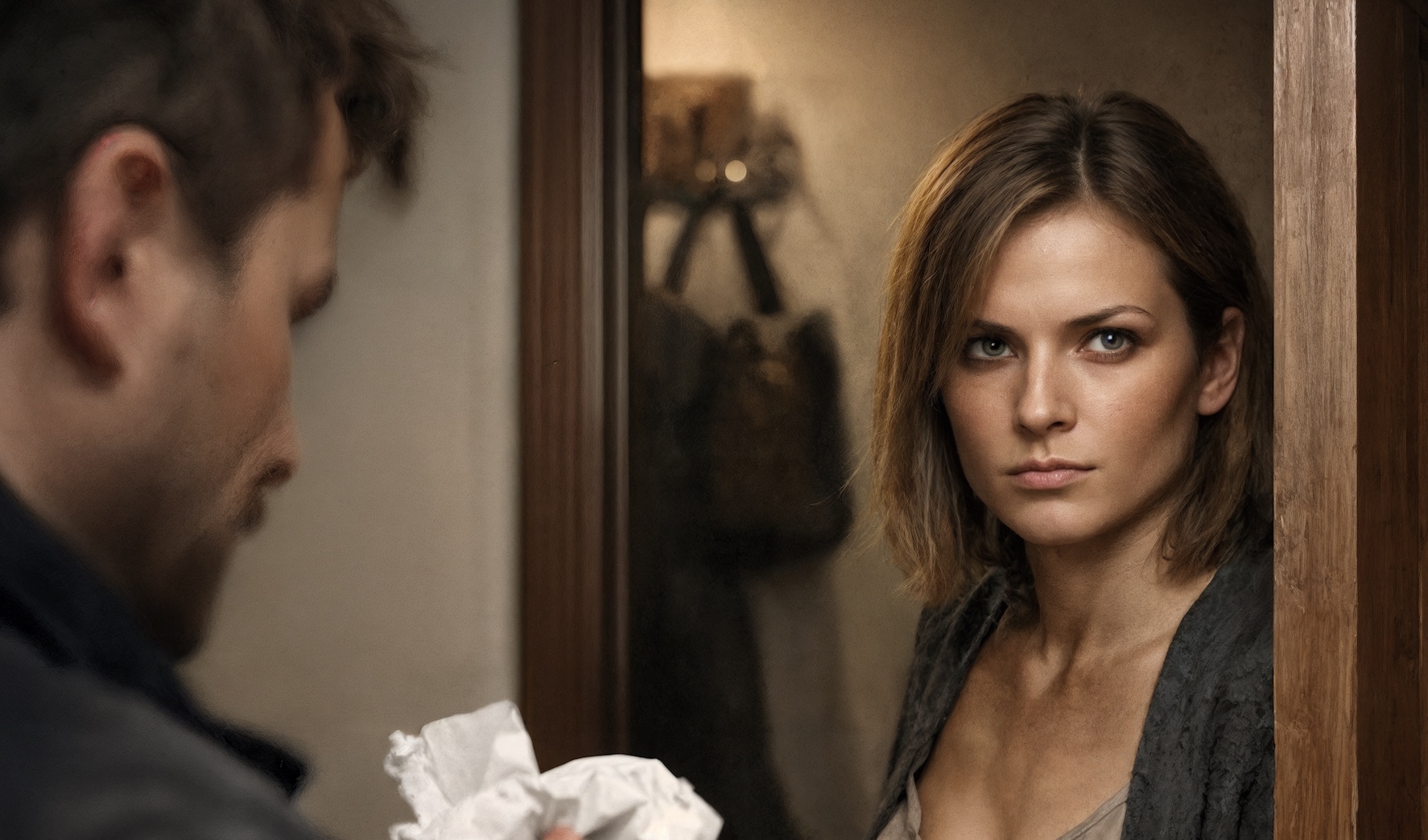
Polina received the apartment from Aunt Vera three years earlier, when Vera’s heart finally started failing badly. Vera insisted on putting everything in writing ahead of time so there wouldn’t be any ugly fights later—so no “distant relatives” would suddenly materialize right after the funeral, hungry for a share.
Polina tried to refuse. She said it was too early, that Vera would get better. But Vera only shook her head and signed the notary papers with a trembling hand.
Six months later, Vera was gone—and Polina was left with a three-bedroom place in an old building: high ceilings, creaky parquet floors, that familiar hush of solid walls that had seen other lives. The apartment was registered solely in Polina’s name, clean and unambiguous, with no add-ons or conditions. That detail mattered more than she understood at the time.
A year later Polina met Maksim, and from the very beginning she made her position crystal clear. They were sitting in a café on their first date when the conversation naturally drifted to housing. Maksim talked about renting a tiny one-bedroom on the edge of town, complained about the neighbors, grumbled about the rent.
“And you—where do you live?” he asked, finishing his coffee.
“In my own apartment,” Polina said. “It was my aunt’s. A three-bedroom downtown.”
“Lucky,” he smiled. “Must be great having your own place.”
“It is,” she agreed, meeting his eyes. “And it will stay mine. Always. I want you to understand that right now.”
Maksim nodded like it was obvious—lightly, without hesitation, without questions. Polina remembered that nod. Back then, she truly believed he’d understood.
They dated another six months before Maksim moved in. Polina repeated her terms: the apartment was hers; no “shared investments,” no illusions about dividing it one day. He nodded again, agreed again, even joked that he was happy not to pay rent anymore. Polina didn’t laugh. For her, it wasn’t funny.
The first months living together were quiet and manageable. Maksim worked for a construction company, came home late and exhausted, ate in silence, and fell asleep in front of the television. Polina didn’t complain—she valued peace and the absence of pressure.
But little by little, something shifted.
Maksim started visiting his mother more often. At first once a week, then twice, then almost every other day. And each time he returned with a tense face, like he’d been loaded with someone else’s thoughts and was now expected to carry them around.
Polina didn’t ask what they talked about. She only knew her mother-in-law, Lyudmila Petrovna, from rare holiday gatherings. The woman was cold, with a thin layer of permanent dissatisfaction—like Polina was a temporary inconvenience in her son’s life. For Maksim’s birthday, Lyudmila Petrovna gave him a book on family law. Polina said nothing—but she remembered.
One evening, as they sat in the kitchen, Maksim suddenly asked:
“Have you ever thought about putting the apartment in both our names?”
Polina looked up from her phone.
“Why?”
“Well, we’re a family,” he shrugged. “Mom says it’s normal. That’s what people do when they’re serious about marriage.”
“Your mother says a lot of things,” Polina said, setting her mug down. “But the apartment stays mine. I told you that before we even started dating.”
“I remember,” he said, looking away. “I just thought… maybe with time you’d change your mind.”
“I won’t,” Polina answered, firm.
He didn’t argue. But after that, he started disappearing to his mother’s even more. Polina noticed the way he came back—lips pressed tight, tired, almost offended. She understood perfectly that he was being coached. But she wasn’t going to fight for his convictions. If he couldn’t hold his ground with his mother, then he didn’t really have ground to stand on.
Then one Friday evening, Maksim came home earlier than usual.
Polina was cooking when she heard the front door slam. He walked into the kitchen in unusually high spirits, almost triumphant—and that immediately made her wary.
“Hey,” he said, taking off his jacket. “We need to talk.”
“About what?” Polina asked without turning around.
“About the apartment.”
She turned off the stove and faced him. Maksim pulled a folded envelope from the inside pocket of his jacket and placed it on the table. Polina looked at the envelope, then at her husband.
“What is that?”
“A gift deed,” he said with a confidence she’d never heard in him before. “Mom handled it. It’s in my name now. Officially, the apartment is mine.”
For a moment, Polina didn’t even process what she’d heard. The words came slowly, like they had to push through thick fog: gift deed… handled… mine.
She opened the envelope and slid out several pages. The document looked official—letterhead, stamps, signatures. Across the top, in bold print: “Deed of Gift for Real Property.” Below, it stated that Polina Sergeyevna Kravtsova supposedly transferred the apartment at a given address to Maksim Andreyevich Sokolov as a gift.
Polina read it once. Then again.
Maksim stood beside her with his arms folded, watching with barely disguised expectation. He had already pictured himself the owner. He expected her to panic, to stammer, to justify herself—maybe even cry.
But Polina didn’t cry.
She immediately registered several details.
First, the signature at the bottom wasn’t hers—crooked, uncertain, nothing like the one she’d used for years.
Second, the date was from last year—back when they weren’t even officially married yet.
Third, the notary stamp looked suspiciously blurry, as if it had been scanned from some other paper and pasted here.
Polina lifted her gaze to Maksim. There was no confusion in her eyes—no hesitation. Only cool, steady calm.
“Did you honestly think this would work?” she asked quietly.
“What do you mean?” Maksim frowned. “It’s an official document. Mom found a notary who agreed to backdate it. He said it can be done.”
“It can,” Polina gave a short, dry laugh. “If I’d actually signed it. But I didn’t, Maksim. This is forged.”
“It’s not forged!” he snapped, raising his voice. “Everything is legal! There’s a stamp, a signature—everything!”
“The signature isn’t mine,” Polina said, placing the papers back on the table. “The date is falsified. The stamp is smeared so badly you can’t even read the number. Any lawyer will prove in five minutes this is fake.”
Maksim went quiet. His face showed it plainly—he hadn’t expected this reaction. He’d counted on a scene, on tears, on fear—something he could leverage into a “compromise.”
But Polina wasn’t afraid.
She stood, walked to the front door, and turned the key in the lock. Then she returned to the kitchen, picked up the envelope, and held it out to him.
“You can wipe yourself with that deed and go back to your mother,” Polina said calmly—and opened the door.
Maksim froze. For several seconds he just stared at her, like he couldn’t believe the conversation was truly over. Then he took the envelope, crushing it in his fist.
“You can’t just throw me out,” he muttered. “I live here.”
“You lived here,” Polina corrected. “Now pack.”
“Polina, listen—”
“No,” she cut him off, still not raising her voice. “I’m not listening. You came into my home with a fake document and tried to take my apartment from me. The only thing I owe you right now is an open door. Everything else—take with you.”
He stood there gripping the envelope while anger, resentment, and something like shame battled in his eyes. Polina felt no pity. This wasn’t a sudden impulse—too much had been planned, too carefully arranged, to excuse it as a moment of stupidity.
“I’ll call tomorrow,” he tried again. “We’ll talk calmly.”
“Don’t,” Polina said, standing straight in the doorway with her arms crossed. “There’s nothing to discuss.”
Maksim nodded slowly, turned, and walked into the hallway. Polina heard him open the closet, pull out a bag, and shove clothes inside. He packed for ten minutes—maybe fifteen—while she stood by the kitchen doorway without moving.
When he finally came out with two overstuffed bags, he stopped and looked at her one last time.
“Mom said you were like this,” he said quietly. “Cold. Calculating.”
“Your mother is right,” Polina answered, emotionless. “I am. And it saved my home.”
He didn’t reply. He just turned and left. The door shut behind him with a dull thud, and Polina stood alone in the hallway. She exhaled slowly, like she’d finally set down a heavy load she’d been carrying far too long.
She went back to the kitchen, poured herself a glass of water, and sat at the table. Her hands were trembling—not from fear, but from the tension finally releasing. She thought about how easily she could’ve believed it, how easily she could’ve panicked, started explaining herself, apologizing. If she’d been softer, less attentive, less stubborn, the ending might have been different.
That same evening, Polina called a locksmith she knew and asked him to come the next morning to change the locks. He arrived at nine, installed new, stronger ones, and handed her two sets of keys. Polina tested the lock, paid him, and closed the door. Now Maksim had neither a right nor a way back in.
Three days later, he called. Polina didn’t answer. He called again and again. He sent messages—first apologizing, then accusing her, then threatening to take her to court.
Polina didn’t respond.
She knew the court wouldn’t give him anything. The apartment was registered to her before the marriage, there were no shared investments, and the attempted forgery would only make his situation worse.
On the fourth day, a message came from her mother-in-law. Lyudmila Petrovna wrote that Polina had been cruel, that she’d destroyed a family over “some apartment,” that a real wife should share with her husband.
Polina read it, smirked, and blocked the number.
That evening she sat on the sofa with a cup of tea and looked around the now-empty apartment. It was quiet. Maksim wasn’t blasting the TV, wasn’t slamming the closet door, wasn’t leaving his things scattered everywhere. Polina didn’t feel lonely. She didn’t feel regret. She felt relief.
She thought of Aunt Vera, who had left her this home. She remembered how stubbornly Vera had insisted on the paperwork—as if she’d known someone would eventually try to take it from Polina. Maybe Vera understood something Polina was only learning now: in this world, you hold onto what’s yours with both hands, and you don’t trust pretty promises.
Polina finished her tea, set the cup down, and smiled. For the first time in a long while, she felt genuinely free. The home was still hers. Her life was still hers. And the person who’d tried to steal it no longer had anything to do with her.
And that was exactly how it should be.
A week later, Polina received a letter from Maksim’s attorney. It demanded a division of property and “compensation” for the time they’d lived together. Polina took the letter to her own lawyer. He read it and gave a small, amused snort.
“They don’t have a chance,” he said, setting the paper aside. “The apartment is in your name from before the marriage. There was no prenuptial agreement, no evidence of joint вложения—no shared investment. Even if they try to claim something, we’ll knock it down easily. And the fake gift deed only works against them.”
“Good,” Polina nodded. “So we just wait?”
“Yes. Most likely they’ll drop it once they realize it’s a dead end. And if they don’t—we’ll win.”
Polina left the lawyer’s office feeling light. She knew there could still be unpleasantness ahead—court hearings, pressure, toxic conversations, more attempts from Maksim and his mother.
But she was ready.
She was protecting what was hers, and that gave her strength.
That evening she came home, brewed her favorite tea, and sat by the window. Streetlights glowed outside; a few pedestrians hurried along with their own errands and lives. Somewhere out there, Maksim was probably at his mother’s again, plotting “next steps.”
But it wasn’t Polina’s problem anymore.
She understood the main thing: sometimes the only way to keep your life is to close the door in time on the people who are trying to take it from you. Without excuses. Without explanations. Without guilt.
Just close it—and keep walking.
And Polina did.
No looking back. No сожаления—no regret. With her keys in her pocket and the calm certainty that no one would ever dare try to take what was rightfully hers again.