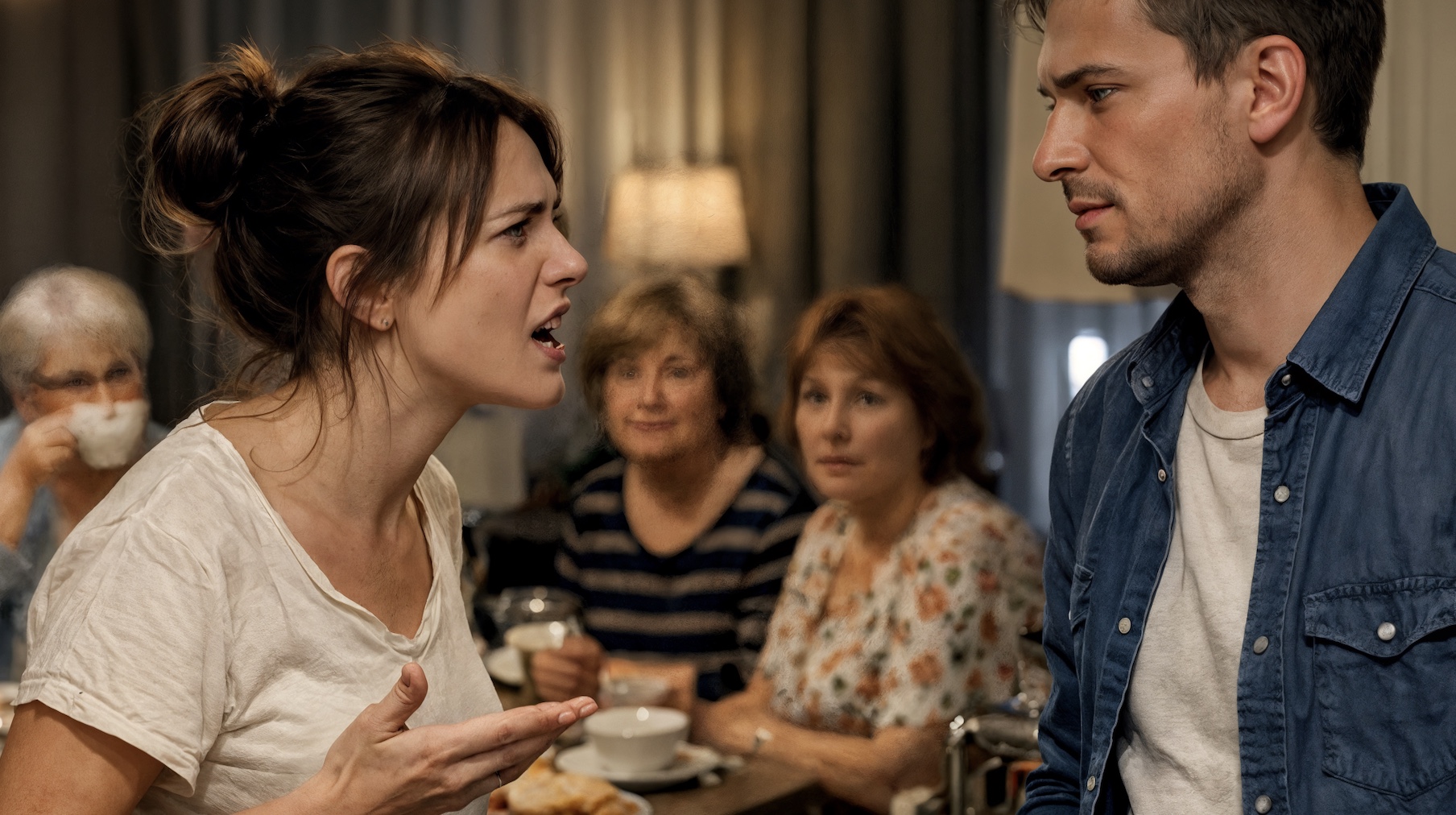
Victoria stepped over the threshold and kicked off her heavy winter boots.
“You forgot to turn off the hallway light again,” she said.
No answer.
From the other room came only the steady tapping of a keyboard and the muffled bursts of an online shooter. Vika let out a heavy sigh and rested her back against the front door. This year’s quarterly report was grinding her into dust: the tax office was on the attack, the numbers refused to line up, and outstanding payments sat there like a concrete block chained to her ankle. For the last four hours in that airless office, she’d been clinging to one simple dream—silence, a hot shower, and a cutlet with mashed potatoes she’d wisely cooked on Sunday.
But instead of the scent of cleanliness and comfort, her nose was assaulted by a thick, sickly cloud of cheap “Red Moscow” perfume mixed with the smell of something fried and already cold. That smell was familiar enough to hurt. It meant one thing, and one thing only:
Someone had invaded her apartment again.
Victoria walked down the hallway, her eyes snagging on details that made a cold fury rise inside her. On the pale laminate she’d scrubbed on her knees all weekend, dirty street-shoe prints stood out like evidence. Black, greasy streaks ran from the front door straight to the kitchen. Whoever had walked in hadn’t even bothered to wipe their feet on the mat.
On the coat rack, tossed carelessly right over her own coat, hung someone’s knitted scarf in an acid-bright color. Vika pinched it with two fingers like it was contaminated and flung it onto the shoe cabinet.
Then she entered the kitchen—and froze.
It looked like a battlefield after a locust swarm had won decisively. The table was littered with crumbs and sticky droplets and buried under a heap of dishes: mugs with half-drunk coffee, saucers smeared with cream, candy wrappers from the chocolates Vika bought for herself and hid in the back of the cupboard. Their expensive coffee machine—the pride of the kitchen—blinked a furious red warning light: the used-grounds bin was overflowing and the water tank was bone-dry. Coffee beans, the pricey kind, were scattered all around it and crunched under her feet.
“Roma!” she shouted without moving.
The game noises died. A minute later Roman appeared in the doorway. He was wearing stretched-out sweatpants and a T-shirt that said BOSS, a gift from his mother for February 23rd. He looked relaxed and satisfied—like a cat that had just polished off a bowl of sour cream.
“Oh, Viku, hi. Why so late? I thought you’d be home by seven.”
He leaned in to kiss her cheek, but she pulled away. Her eyes were locked on an empty, filthy frying pan sitting прямо on the table—no trivet, no protection, nothing.
“What happened here?” she asked, gesturing at the wreckage.
Roman shrugged, shoved his hands into his pockets, and leaned against the doorframe.
“Nothing major. Mom stopped by. Aunt Galya was with her, and Lidiya Petrovna. They were walking in the park, got cold, decided to come in and warm up. I couldn’t exactly leave my own mother on the doorstep. You know she has blood pressure issues—she needs to rest.”
“Warm up?” Vika stepped closer to the sink where plates were piled high. Fatty sauce had dried on the rims in strange patterns. “They warmed up by eating my food and trashing my dishes? Roma, that wasn’t tea. That was a banquet.”
“They were hungry,” Roman said, frowning, a sharp edge sliding into his voice. “Vik, why are you starting? They’re elderly. They were admiring our renovation, your taste. Aunt Galya said our place is like a museum. What—are you really that stingy?”
Victoria spun toward him. Her exhaustion snapped into a hard, prickly rage. She remembered spending the entire Sunday at the stove, sacrificing her only day off so she wouldn’t have to cook during the week. Three kilos of minced meat rolled and seasoned. Cutlets fried in batches. A huge bowl of salad. A plan laid out neatly through Friday.
She yanked open the refrigerator.
Empty.
Three big containers sat in the sink, “washed”—or not washed, really, just licked clean.
“Stingy?” she repeated quietly, closing the fridge so hard the magnets rattled. “It’s not that I’m stingy, Roma. It’s that it hurts. I’m a chief accountant. My head is full of numbers all day. I come home to collapse. And instead I walk into a pigsty.”
“Don’t call my mom and her friends pigs,” Roman scowled. “That’s disrespectful.”
“And it’s respectful to eat everything I cooked for the week and leave me a mountain of dirty dishes?” Vika’s voice rose, though she still forced herself to stay in control. “Do you even realize they ate our dinner? Tomorrow’s breakfast? Lunch for tomorrow?”
“I’ll order pizza,” Roman waved it off like a minor inconvenience. “God, you’re making a tragedy out of nothing. Cutlets… it’s just food. What matters is being human. Mom was praising your coffee. Says no café makes it that good.”
“Of course not!” Vika snapped. “Because at a café you have to pay for it! Here it’s some ‘unbelievable generosity’ attraction—on my expense. Did you even lift a finger to clean up after them? Or did you just carry cups around and grin?”
Roman rolled his eyes like he was painfully tired of “women’s nonsense.”
“Vika, I was working. I had a call with a client at six. I couldn’t stand at the sink. They ate and left, and I went back to my project. I earn money, by the way, working from home—not just staring at the ceiling. You can clean this now, it’s five minutes. We have a dishwasher.”
Vika looked at her hands. The manicure she’d done two days ago already felt like something from another lifetime. She pictured herself scraping dried leftovers, loading the machine, wiping the sticky table, vacuuming the hallway… all while the TV muttered from the living room where her husband would be “resting” after his “call.”
“The dishwasher isn’t bottomless,” she said sharply. “And you can’t stuff someone else’s audacity into it.”
“Oh, come on—why are you clinging to this? They ate, so they ate. Next time they come—” He didn’t finish.
“I’m not cooking for your mother and her friends who decided our apartment is a free café!” Vika exploded. “Roman, I get home at eight, and our kitchen is again hosting a retirees’ club meeting that ate everything I cooked for the whole week!”
“You could’ve—”
“I didn’t sign up to be the catering staff for your relatives!” she cut him off.
“Lower your voice,” Roman hissed, glancing nervously at the ventilation grille. “The neighbors will hear. Why are you embarrassing me? ‘Free café’… listen to yourself. Mom just wants to be closer to us. She’s lonely.”
“She’s not lonely—she’s bored and hungry!” Vika marched to the table and dragged a finger through a greasy stain. “Why don’t they gather at her place? She has a three-bedroom apartment—plenty of space. Why not at Aunt Galya’s? Oh right, because Aunt Galya has an angry husband who’ll throw them out the second they start dropping crumbs on his sofa. But here Roma is ‘kind.’ Roma is a hero. Only Roma’s kindness runs on other people’s work.”
“You’re mercenary,” Roman threw at her, and the word landed like a sentence. “You begrudge cutlets for my mother. I thought you had a bigger heart.”
Victoria gave a tight little smile—not warmth, more like the bared teeth of an exhausted animal cornered for too long.
“I do have a big heart, Roma. But my wallet and my strength have limits. Do you even know what that beef cost—the kilo they demolished while chatting about the weather? No. You don’t even know where we keep dish soap.”
She took off her blazer and hung it on a chair. Something inside her clicked—like a worn-out mechanism finally snapping. Her patience had been grinding for months. Now it jammed for good.
“Here’s what’s going to happen,” she said evenly, her voice dry and flat. “You can order pizza for yourself. And I—”
She didn’t get to finish.
The balcony door creaked, and a ribbon of cigarette smoke drifted into the kitchen.
Out of the bluish haze stepped Nina Andreevna.
She stood in the doorway wrapped in a knitted cardigan Victoria recognized instantly—her cardigan, bought in Milan three years ago. Nina Andreevna held a thin cigarette in manicured fingers and flicked ash straight into the flowerpot where the ficus sat on the windowsill.
“Oh, Viku, you finally showed up,” she said instead of hello, exhaling smoke toward curtains that used to be clean. “Roma and I got talking. The girls just left, and I decided to get some air. By the way, your coffee machine is garbage. I wanted to make Galya an espresso, and it started buzzing, blinking, and poured nothing. You should clean it. It’s embarrassing in front of people.”
Victoria stared at her mother-in-law, and words lodged in her throat like dry crumbs. The fatigue hit so hard her knees trembled. Her eyes flicked from the ficus turned into an ashtray to her Milan cardigan, now soaked in cheap tobacco.
“Nina Andreevna,” Vika said, her voice dull as if it came from a deep well. “Why are you still here? It’s ten o’clock.”
“And?” Nina Andreevna looked honestly surprised as she walked in and shut the balcony door behind her. “I’m visiting my son. I have every right. Roma, tell her. She’s staring at me like I’m an enemy of the state.”
Roman, who’d been trying to melt into the doorframe, perked up.
“Vik, come on. Mom helped see the guests out, we got chatting. We’ll have some tea and I’ll call her a taxi.”
Victoria said nothing. She walked past them to the refrigerator. She needed to see it with her own eyes—just to understand the scale. She already knew what she’d find, but hope is stubborn and stupid; it was still twitching somewhere inside her.
She opened the fridge.
White light revealed spotless shelves. Where that morning a big enamel pot had stood—three kilos of homemade cutlets made from marbled beef—now there was only a sad chunk of dried cheese. Where a deep bowl of Olivier salad she’d chopped for an hour and a half had sat, there was a half-open jar of pickles. The sliced pork was gone. Even the expensive yogurts she bought for her breakfast had vanished.
Vika closed her eyes. A vein throbbed beneath her eyelids.
“Where are the cutlets?” she asked quietly.
“Oh, here we go,” Nina Andreevna said, dropping into a chair and crossing her legs. “We ate your cutlets. Tasty, I won’t lie—though a bit dry. I would’ve added more bread and onion. All that meat… you’re just wasting product.”
“Three kilos?” Vika turned to her. “The four of you ate three kilos of meat in one evening?”
“Well, the girls wanted to eat!” Nina Andreevna threw up her hands. “We didn’t come to sip tea and stare at air. Lidiya Petrovna was coming back from her garden plot, starving. Galya’s on a diet—she slipped. What was I supposed to do, sit guests at an empty table? Maybe in your family it’s normal to serve people tap water, but we’re old school—hospitality is in our blood. When people come, you put everything on the table.”
“Everything from what stove, Nina Andreevna?” Vika felt her face burn. “This isn’t a stove. This is my refrigerator. That was food for the week. For me and Roma. For the week—so I could come home and not stand over the stove like a prisoner!”
“Oh, stop playing the martyr!” Nina Andreevna waved her off. “‘Standing over the stove.’ You’re young, healthy—big strong mare, you’ll stand plenty more. Get up earlier, roll some patties—what’s the big deal? At your age I worked at a factory, raised three kids, and nobody starved. And you’ve got washing machines, multicookers… Lazy, that’s what you are, Vika.”
Roman wandered closer, picked up a dirty fork, and spun it in his fingers.
“Vik, honestly, why are you so fired up?” he started in his usual peacemaking tone. “They ate and they ate—good health to them. Food exists to be eaten. Mom didn’t throw them away. People enjoyed themselves, they complimented you.”
“Complimented me?” Vika let out a short, hysterical laugh. “They said they were dry—thank you, I’m honored. And the salad? The whole bowl of salad got ‘enjoyed’ too?”
“I packed the salad for Galya to take home,” Nina Andreevna said calmly, adjusting her hair. “Her husband is paralyzed; he deserves something tasty too. I found your plastic containers—nice ones, with lids—and made a little care package. You’re not greedy, are you?”
Victoria looked at her husband, waiting for him—just once—to say, “Mom, you went too far.” To be outraged that his food was being handed out to strangers’ husbands. But Roman only nodded, as if his mother’s decision was perfectly reasonable.
“See?” he said. “We did a good deed. Helped a sick person. And you’re ready to choke someone over salad. We’ll buy your peas and sausage, I’ll order a delivery tomorrow.”
“Tomorrow?” Vika repeated. “And what am I supposed to eat today? I didn’t have lunch. I came home dreaming about those damn cutlets.”
“Have an apple,” Nina Andreevna advised, pointing to the fruit bowl, where a single wrinkled apple lay like a sad joke. “Eating late is bad for you—ruins your figure. And you’ve already filled out in the hips; soon you won’t fit through the door. Roma needs a slim, pretty wife—not a wheezing accountant.”
Victoria exhaled slowly through her nose.
Inside her, something snapped. A thin thread—the one that held her to politeness, upbringing, respect for elders—broke with a loud, final twang. She looked at this woman sitting in her kitchen, wearing her clothes, handing out her food, dictating her life, and understood: this was the end. Talking would fix nothing here. Only surgery—clean, precise, irreversible.
“So you think this is normal?” she asked quietly, sweeping her gaze over the mountains of dishes, the smeared table, the smug faces. “To come into someone else’s home while the owners are out, throw a party, hand out their groceries to other people, trash everything, and then sit here and lecture me?”
“This is my son’s home!” Nina Andreevna shot up, slamming her palm onto the table. A cup of half-drunk tea bounced and tipped, splashing brown liquid across the tablecloth. “And I’m not a stranger here! But you, sweetheart, you’re acting like a street hag. I’ll call your mother and tell her what she raised. Miser! You begrudged your own family a piece of bread!”
“Bread?” Vika stepped close to the table. “You didn’t eat bread. You ate my time. My work. And my respect for you.”
She looked at Roman. He stood there frowning, his whole posture screaming disappointment—like she’d failed him.
“Vika, apologize to my mom,” he said firmly. “You’re crossing a line. She’s older, she’s a guest. You’re acting hysterical. Clean the table right now, pour tea, and calm down. I’m ashamed of you.”
“You’re ashamed?” Vika repeated, and a strange, unsettling smile appeared on her face. “Fine, Roma. I’ll clean. I’ll clean so well this place will be perfectly spotless.”
She marched to the cabinet under the sink where the trash bags were kept. She tore off a thick black bag—120 liters—snapped it open with a sharp motion, and shook it out.
“What are you doing?” Nina Andreevna asked, suddenly wary, scooting back from the table.
“Cleaning,” Vika said shortly. “A deep clean.”
She walked up to the table and started without even looking at the dishes.
The first plate hit the black maw of the trash bag with a dull, wet thud. It was from Victoria’s favorite set—fine bone china with a delicate rim, a housewarming gift from her father. Now it was smeared with dried ketchup and fish bones. Vika didn’t flinch. She swept it off the table like a dealer raking in losing chips.
“What are you doing, you lunatic?!” Nina Andreevna shrieked, springing up so fast she nearly toppled the stool. “That’s porcelain! Are you out of your mind?!”
Vika didn’t answer.
She moved like a machine whose empathy fuse had blown. Next went a saucer with a cigarette butt crushed into it. Then a cup with leftover coffee—straight in, liquid and all. Dark sludge splashed at the bottom of the bag, mixing with scraps.
“Roma!” his mother screamed, clutching her chest. “Do something! She’s having a fit! She’s smashing the dishes!”
Roman finally stepped away from the doorframe. His lazy comfort vanished, replaced by confusion and fear. He’d never seen his wife like this. Vika could cry, complain, shut down—but silent, methodical destruction? Never.
“Vika, stop!” he barked, taking a step toward her. “Put the bag down! Have you lost it? That costs money! We bought that set for twenty thousand rubles!”
Vika paused for a second.
In her hands was a heavy salad bowl, with mayonnaise remnants and soggy bread floating at the bottom. She slowly turned her head toward him. Her eyes were dry—no tears—just an icy emptiness.
“Money?” she said softly, and in the sudden silence her voice cracked like a gunshot. “You’re talking about money right now? Then what price tag do you put on me, Roma?”
She opened her fingers. The bowl dropped into the bag with a sharp, unmistakable chime of breaking glass.
“Who am I to you?” she continued, sweeping a handful of dirty forks and spoons from the table. “A free dishwasher? A cook-on-call? A cleaner you don’t even have to thank? You sit there in your Boss T-shirt and watch your mother turn our home into a sty and me into a servant—and you’re fine with it. You’re comfortable.”
“Don’t talk about my mom like that!” Roman tried to grab her wrist, but Vika jerked away, raising the filthy bag like a shield. A sour stench was already rising from the mixture inside.
“How else should I talk?” Vika threw greasy paper napkins into the bag. “I come home dreaming of hot food—and I find an ashtray in my ficus and an empty fridge. And instead of an apology I’m told I’m greedy, fat, and mercenary. You know what, Roma? I’m done. I’m exhausted—dead exhausted—of being convenient.”
Nina Andreevna, realizing there would be no physical attack, found her voice again. Hands on hips, still wearing someone else’s cardigan, she hissed:
“Hysterical! Psycho! Roma, I told you she’s not your match! Look at her! Wild eyes, shaking hands—smashing dishes! She’s dangerous! If I were you I’d call an ambulance—orderlies—someone!”
“Orderlies?” Vika gave a cold little laugh. “No, Nina Andreevna. We don’t need orderlies here. We need pest control.”
She moved to the sink where a frying pan sat, crusted with dried fat. Washing it would take time—soak, scrape, scour. Vika simply lifted it by the handle, flipped it over the bag, and shook the burnt oil residue out without caring about the nonstick coating. Then, after a beat, she shoved the pan itself into the bag. The handle stuck out stubbornly, but Vika pressed down hard until plastic and trash gave way.
“You’re sick…” Roman whispered, staring at the handle jutting out. “You’re actually sick. Do you realize we’re going to be eating off plastic plates now?”
“You can eat out of whatever you want,” Vika snapped. “Drink from the floor for all I care.”
She scanned the kitchen.
The table was bare now. Sticky, filthy—but bare. The entire “memory” of Nina Andreevna’s party was sealed in black polyethylene. The bag was heavy—five kilos at least: glass, metal, ceramic, food. Sharp fragments strained the plastic, threatening to tear through. A brownish liquid already began to seep from the bottom—coffee, sauce, oil.
Victoria hoisted the bag. It pulled at her arms. Warm, disgusting sludge oozed through a tiny split and smeared her fingers. But she didn’t feel disgust. Only a fierce need to return the “gift” to the sender.
“Where are you taking that?” Roman asked, tense now, as he realized she wasn’t heading for the small bin under the sink.
He was sitting on a chair, still trying to process what was happening, legs spread, hands on his knees.
A perfect target.
“This is yours, Roma,” Vika said, stepping close. “You’re so proud of your hospitality. You think your mother is sacred and the mess is ‘nothing.’ You think dirty dishes are a five-minute problem the wife should handle.”
“Vika… don’t,” he started to rise—too late.
With one hard swing, Vika slammed the heavy, sloshing, clinking bag straight down onto his lap.
It hit his gray sweatpants with a wet, brutal slap. A sharp shard of broken porcelain sliced the plastic open instantly. A greasy brown flood—coffee, oil, mayonnaise, pickle brine—poured over Roman’s thighs, his Boss shirt, and down onto his expensive gaming slippers.
“Mother of—!!!” Roman howled, springing up, trying to fling the stinking weight away.
The bag crashed to the floor, splattering its contents across the laminate. But it was done. Roman stood there with arms spread, dripping in slop, a chicken bone stuck to his stomach like a badge of shame.
“VIKA!!!” His face turned red with fury.
“Take it,” Victoria said calmly, wiping her hands with a wet wipe pulled from her pocket. “That’s your dinner, your service, and your ‘filial love.’ All in one package. And now—get out.”
Nina Andreevna clapped a hand over her mouth, staring at her son as sauce dripped off him.
“You… you monster!” she rasped. “You ruined his clothes!”
“I ruined them?” Vika stepped toward her, and Nina Andreevna backed into the wall. “No, dear mother. You ruined my life. But the banquet’s over. The bill is due. You’re paying with your exit.”
Victoria walked into the hallway where Roman’s keys lay on the little table and clenched them in her fist until the metal dug into her skin. The pain steadied her. The pain helped her draw the final line.
Roman stood in the middle of the kitchen like a scarecrow, dripping. A slice of pickle slid slowly down his pant leg, leaving a wet track. Coffee grounds mixed with cutlet grease dripped off his shirt. The stench around him was so strong it even pushed the stale cigarette smoke into the background. He stared at his wife with raw animal disbelief, as if she’d transformed into a fire-breathing dragon in front of him.
“Have you completely lost it?” he croaked, flicking a stuck napkin off his sleeve. “Do you even understand what you’ve done? These clothes are done for! No dry cleaner will touch this!”
“Dry cleaning won’t help you, Roma,” Vika said, her voice like ice. “Only a conscience transplant would help—and sadly, nobody performs that surgery.”
She walked to the coat rack, yanked his jacket down, and threw it into his face.
“Get dressed. A taxi won’t wait for you—and it won’t take you in that condition. You’ll walk. It’s not far.”
“I’m not going anywhere!” Roman shrieked, flinging the jacket aside. “I’m going to the shower! I’m sticky! You’ll pay for this, you hysterical witch! I’ll file for divorce!”
He moved toward the bathroom, leaving greasy footprints behind, but Victoria stepped in front of him. She was a head shorter, yet right now she felt like a wall.
“No, sweetheart. You’ll run water at your mother’s. You’ll wash your pants there too. You’re not stepping into my bathroom again.”
“Vika, come to your senses!” Nina Andreevna jumped in, seeing her son losing ground. She tried to sound commanding; it came out desperate. “It’s November outside! He’ll catch cold! He’s wet! Do you want my son to die?!”
“I want peace, Nina Andreevna,” Vika answered. “And cleanliness.”
Then she pointed at her shoulder.
“And I want my thing back. Take it off.”
“What?” Nina Andreevna blinked, clutching the cardigan tighter.
“Take the sweater off. That’s my cashmere, not a rag for balcony gossip. Take it off. Now.”
There was so much steel in Vika’s voice that Nina Andreevna muttered something about a “petty shrew” and began yanking it off in a fluster. She threw it on the floor—straight into the puddle that had dripped from Roman.
“Choke on your rags! I don’t need them! I have my own, better than that old junk!”
“Wonderful,” Vika said, not even looking at the ruined garment. “Now—out. Both of you. Time’s up.”
Roman, realizing he wouldn’t reach the shower, dragged his jacket on over the filthy shirt. He didn’t zip it—afraid to stain the lining. He looked pathetic and threatening at once, like a beaten dog still trying to bare its teeth.
“You’ll regret this, Vika,” he spat, pointing at her. “You’ll come crawling. You won’t manage alone. Who’ll want you—some divorced woman dragging a trailer of debt? I put up with your character, I ignored your coldness, but this… this is the end. I’m going to my mother’s. And I’m never stepping foot here again.”
“What a relief,” Vika said, swinging the front door wide. The stairwell’s cold air rushed in, carrying someone else’s fried cabbage smell. “For once, we agree. I’m keeping your keys. For your things, send a courier or movers. Don’t come yourself. I won’t open. I’m changing the locks tomorrow morning.”
“You have no right!” Nina Andreevna screeched, squeezing past her and trying not to brush against her filthy son. “That’s joint property! We’ll sue! I’ll make your life hell! The whole building will know what kind of creature you are!”
“The whole building already knows you have an opera voice, Nina Andreevna,” Vika shot back. “Look—your neighbor from 45 is already watching through the peephole. Wave to her.”
She nudged Roman forward. He stumbled onto the landing, turned, and spat:
“Idiot. You’re a sick idiot. Rot here alone in your pigsty.”
“Go to your mother’s,” Vika said, meeting his eyes. “And wash there—yourself, your dishes, and each other’s bones. Sleep there too. Forever.”
She slammed the door in his face.
The metal bang echoed down the stairwell, cutting off Nina Andreevna’s shrieks and Roman’s swearing. The bottom lock clicked. Then the top. Then the chain.
Victoria pressed her forehead to the cold door. Her heart hammered up in her throat, her hands trembling as the adrenaline that had held her upright began to drain away, leaving leaden weight behind.
Outside, the noises faded: shuffling steps, Nina Andreevna’s screeching, Roman’s dull bass grumbling. Then the building’s main door slammed, and silence finally arrived—the exact silence Victoria had dreamed about all day.
She slid down the door to the floor—and immediately forced herself back up. No. Sitting was dangerous. If she sat, she’d collapse.
She returned to the kitchen.
It looked like the aftermath of an apocalypse: puddles of slop on the floor, shards of her expensive dish set scattered everywhere, the ruined cardigan in the corner, an overflowing bin, an empty fridge. The stench was unbearable.
And yet—strangely—it was easier to breathe. The air felt cleaner despite the sour salad smell. The worst pollution had left: the suffocating, sticky presence of people who didn’t value her.
Victoria stepped over the trash and went to the window. She flung it open, letting in sharp, freezing night air. Down by the entrance, two figures—one heavy, one hunched—hurried toward the neighboring building. They argued, flailed their arms, stopped under a streetlamp to inspect stains on clothing.
“Good riddance,” Vika whispered.
She closed the window and faced the wreckage. She picked up a broom. Then a dustpan.
Tonight she would clean until morning. She would scrub every centimeter of the floor, dig into every corner, throw out anything that smelled like Nina Andreevna’s “hospitality.” She would go to bed hungry, exhausted to the bone, alone in an emptied apartment.
But tomorrow she would wake up as the owner of her own life again.
She would make coffee—instant, if she had to, until the machine was cleaned—and drink it in silence. No one would eat her breakfast. No one would stomp dirt into her hallway. No one would tell her she wasn’t good enough.
She swept the pieces of her favorite plate into the dustpan. The porcelain was a loss—it really had been beautiful. But freedom cost more than any dish set ever could.
Victoria straightened up. Instead of the familiar irritation, a calm, cold certainty spread through her chest.
Life was only beginning. And in her new life, she would be the one deciding the menu.