— Tanya, can you imagine what luck this is? It’s a total jackpot—I’m still stunned. Vika called me half an hour ago, shrieking into the phone like someone was killing her. I couldn’t even make out the words. At first I thought something awful happened, but then—this!
Sergey stormed into the kitchen without even taking off his street shoes, even though he normally slipped into slippers the moment he came home. His face shone with excitement; his eyes had that particular blaze people get when they believe they’re the ones deciding everyone’s fate. He tossed his keys onto the table—right on top of the petunia seed packets Tanya had laid out so neatly—and stood there with his hands on his hips, triumphant.
Tanya slowly lifted her gaze from the shopping list she’d been making for dacha season. She’d been savoring the calm of a Friday evening, thinking about what kind of soil she still needed to buy for her hydrangeas. Her husband’s loud entrance, plus the dirty shoes, shattered that fragile peace like a rock dropped into still water.
— What happened? she asked evenly, carefully sliding the keys off the packet decorated with a pale pink bloom. Did Vika win the lottery?
— Almost! Even better! Sergey snatched an apple and bit into it with a crunch, spraying juice. — She and Pasha found a last-minute Europe deal. Can you believe it? Someone canceled at the very last second—visas, hotels, flights, all included—and the discount is like seventy percent. Italy, France, Spain. A dream come true! They’ve barely traveled anywhere, just that same Turkey trip a hundred times. And now this chance! They fly out in a week.
Tanya nodded, forcing a polite look of interest, though nothing fluttered inside her. Vika—Sergey’s younger sister—and her husband Pasha were loud, chaotic people who always seemed to stumble into some new drama.
— I’m happy for them. Let them go, get away for once, Tanya said, returning to her list. — But what does that have to do with us? And why are you wearing shoes in the kitchen?
Sergey waved off the shoe comment like it was an annoying fly. He pulled out a chair, flipped it around, and straddled it, leaning over the table with a conspirator’s grin.
— Here’s the really good part. The problem was the kids. Where do you put three triplets? Pasha’s mom is going into the hospital for tests—scheduled, no way around it. And my mom—you know her blood pressure—she’s at Aunt’s dacha right now and can’t be chasing three boys. Vika was already crying, saying she’d have to cancel the trip and lose the tickets. So I told her, “Vika, stop panicking. Your brother will handle it.”
A cold, heavy knot formed in Tanya’s stomach. She knew that look on her husband’s face all too well. He’d worn it when he bought a car on credit without consulting her, or when he invited his friends to stay over and “forgot” to warn her. It was the face of a man who’d performed a “grand gesture” at someone else’s expense.
— And how exactly did the brother handle it? Tanya’s voice dropped, a metallic edge cutting through it, but Sergey—high on his own triumph—didn’t hear the warning.
— How? Easy! He flashed a wide grin, utterly convinced he’d come up with a brilliant solution. — The dacha is sitting empty—fresh air, nature. Your vacation starts Monday. So I told her: bring the whole bunch to us. You’ll be there anyway, digging in the beds, bored out of your mind alone. This way the kids have room to run, and Vika and Pasha can actually relax, have a second honeymoon.
He slapped the table in victory, making the seed packets bounce.
— I told them to drop them off Sunday evening. You’ll have time to buy groceries and get the rooms ready. Two bedrooms are free upstairs—you can spread them out. The boys aren’t picky. They just need to be outside and fed on time.
Tanya stared at him without blinking. The information landed in her mind slowly, like bricks stacked with no mortar. Triplets. Three five-year-old boys who, the last time they’d visited for Sergey’s birthday, had turned the apartment upside down in two hours, smashed the chandelier with a ball, and colored on the wallpaper with a marker they’d “found by accident.” Three uncontrollable bursts of energy that even Vika struggled to manage. And Sergey had just signed Tanya up, with one casual promise, to handle them around the clock.
— Wait. Tanya put down her pen. — Are you saying you invited three kids to live at my dacha? For my entire vacation?
— Not the entire thing, Sergey winced as if she’d said something stupid. — Just two months. They’ll be back mid-August. You’ll be there anyway! What’s the difference—drinking tea alone or keeping an eye on your nephews? You’re a woman, you’ve got instincts, all that. Besides, they’re family. Not strangers.
He said it lightly, like he was asking her to water a neighbor’s flowers twice a week. In his world, his wife’s vacation was empty time—something that needed to be filled. And he’d generously “found her a purpose.”
— Did you ask me? Tanya stared straight at the bridge of his nose. — Did you call and say, “Tanya, do you mind if your vacation becomes a maximum-security daycare branch?”
— Oh, here we go, Sergey rolled his eyes and took another bite of apple. — Why ask what’s obvious? You’re not some monster who’d refuse to help my sister. People get a once-in-a-lifetime chance to see Europe! And you’re going to make a scene over nothing? I already promised, Tanya. Vika’s already paying for the tickets. You won’t embarrass me in front of the whole family, will you? I told them my wife is pure gold—always comes through.
He got up, walked to the fridge, and started inspecting its contents, making it clear the discussion was over. For him, it was done: simple, logical, convenient. Convenient for everyone except the person he’d dumped the load onto.
Tanya exhaled slowly through her nose and looked out the window at the deepening dusk. She’d been dreaming about this summer since January—waking up in the quiet of the old wooden house, drinking coffee on the veranda, reading the books she never had time for, tending her garden. She wanted silence. Pure, ringing, healing silence. And instead, her husband had delivered chaos, noise, and nonstop cooking for a pack of children—wrapped up as “family duty.”
— So you already promised, she repeated, tasting the words. They were bitter.
— Yes, I promised. And don’t make that face like I sent you to hard labor. Fresh air is good for kids. And it’ll do you good to move instead of sitting around with a book. By the way, Vika asked—is the internet decent out there? The boys need cartoons before bed, otherwise they’ll tear the place apart.
Sergey pulled a pot of soup from the fridge, unaware that he was, right then, planting dynamite under the foundation of his marriage.
He spooned up borscht with appetite, not even noticing Tanya still hadn’t touched her dinner. He ate fast, matter-of-fact, like someone fueling up for a long trip, and at the same time pulled out his phone to open his chat with his sister. Tanya watched him with a frightening, unnatural calm. It was like she was watching a nature documentary: one insect explaining how to build an anthill to another, without any interest in what the second insect thought.
— Listen, there are some food details, Sergey said, dabbing his lips with a napkin. — I’ll forward the list, but I’ll tell you now so you remember. Tyoma is allergic to anything red—except apples. No strawberries, not even if he begs. Sasha can’t tolerate lactose, so his porridge has to be water or… what do they call it… plant milk. You’ll get it at the village store—they sell it everywhere now. And Dima is just picky—he digs boiled onion out of everything, so you’d better blend the soup into puree; then he’ll eat it.
Tanya blinked slowly. The demands didn’t sound like a desperate plea for help in an emergency. They sounded like instructions for hired staff at a five-star resort.
— You want me to cook three different menus? she asked quietly. — At the dacha? With our two-burner stove?
— Why three? Sergey looked genuinely baffled by her “lack of understanding.” — Just cook something light for everyone. It’ll be good for you too—you’re always complaining your stomach feels heavy. Light soups, steamed cutlets. Vika said they don’t eat store-bought frozen stuff, they’re used to home cooking. You don’t need to make dumplings, of course, but you’ll grind fresh mince. We still have that old Soviet meat grinder there, right? Great.
He spoke as if cranking out a whole basin of mince on a rusty hand grinder was the perfect way to relax after a year as chief accountant. Tanya felt her fingers clench into fists under the table; her nails dug into her palms, but the sting kept her clear-headed.
— And the groceries? Her voice was dry as fallen leaves. — Is your sister leaving money to feed three growing boys? Or is that part of the “all-inclusive package” too?
Sergey frowned and set down his spoon. He clearly didn’t like that “mercenary” tone.
— Tanya, why are you penny-pinching? They’re kids. How much can they eat? A bowl of soup and an apple. You’ve got a garden right there—carrots, zucchini, herbs. Everything’s yours, free. Vitamins! I’m not going to squeeze my own sister for spare change for food when they already spent money on the trip. Every euro counts for them right now—they need cash for travel. And you and I both work. We won’t go broke feeding the nephews for a couple of months. Consider it our contribution to their happiness.
Our contribution to their happiness, Tanya repeated to herself. So her garden—where she’d poured her strength every weekend, hauling buckets of water and weeding under the burning sun—was now a communal resource. A free supermarket for Vika’s family.
— And one more thing, Sergey added, burying his face in his phone again as he scrolled through a long message. — Vika’s worried they’ll forget their letters over the summer. They’re starting pre-school prep in the fall. And you’re the educated one, the smart one—could you do lessons with them for an hour a day? Reading, writing practice. They’ll bring books. They need routine, discipline. Vika spoils them, but you’re strict—kids won’t get away with anything with you.
He looked up at her, expecting approval for being so “thoughtful.” His eyes held an unshakable certainty that he was right. Sergey genuinely believed he’d arranged everything perfectly: found Tanya something to do, helped his sister, saved the extended family money—and came out looking like the devoted brother and caring husband.
— So, Tanya said at last, rising from the table without clearing the dishes—something she’d never allowed herself to do before—you promised Vika not just a place and childcare, but a chef, a dietitian, an entertainer, and a tutor? And all of it based at my dacha, paid for by me, using my personal vacation time?
— Don’t exaggerate everything, Sergey winced like he had a toothache. — “Services,” “paid for”… We’re family. Family helps family. When you needed to take Mom to the hospital, I drove her, didn’t I?
— You drove her once, Sergey. Once in three years. And then you complained for a week that you wasted gas and missed a football match, Tanya reminded him coldly.
— Don’t start, okay? He waved a hand and headed to the living room toward the TV. — I already decided everything. Vika will bring them Sunday at noon. Be ready. And yes, give them the big room—the one with the garden view. Better air. Move your things into the small one by the storage closet. You only need it to sleep anyway.
He walked past her without noticing how dangerously her pupils narrowed. He took her silence for agreement—obedience, the kind he’d grown used to over ten years of marriage. To him, Tanya was a convenient function, a failsafe mechanism that could be switched from “wife” to “nanny” with the push of a button.
Tanya stayed in the kitchen. The hum of the refrigerator sounded deafening. Somewhere under her ribs, a cold, poisonous fury began to boil. Staring at the empty chair where her husband had been sitting, she understood: this wasn’t really about the triplets, or even about Vika. It was about the fact that Tanya, as a person, no longer existed in this house. There was only staff—someone who’d just been handed a summer work order.
She walked into the living room and stopped directly in front of the TV, blocking Sergey’s view of the football match. Sergey, sprawled on the couch with the remote in one hand and his phone in the other, clicked his tongue in annoyance. He tried to lean to the side to see the score, but Tanya didn’t move an inch. She looked like she’d been poured from concrete.
— Tanya, move, will you? There’s a dangerous moment, he drawled lazily, not even looking up at her face. — Why are you standing there like a statue? Go get ready—the list is in your messages. Oh, and Vika asked if there are any old blankets at the dacha so the kids can sit on the grass.
— Look at me, Tanya said. Her voice was quiet, perfectly level, stripped of emotion. It wasn’t the familiar nagging Sergey usually ignored. It was the voice of someone who had just made a final decision.
Sergey finally tore his eyes from the screen and looked at her. There were no tears, no pleading, no hurt. Only a cold, studying curiosity—as if she were examining mold under a microscope on a piece of cheese she’d once loved.
— Fine. I’m looking. What is it? he hit pause, acting like he was doing her a huge favor.
— Tell me, Sergey, since when are you the owner of a home you have nothing to do with? she asked slowly. — You assign rooms, tell me where I should sleep—in a closet or a bedroom. You invite people to stay. You promise my labor. But let me remind you of one small detail: whose last name is on the property deed?
Sergey snorted and rolled his eyes. He’d heard this argument before and always dismissed it as petty “women’s nonsense.”
— Oh, here we go with that “grandma’s inheritance” song again. We’ve been married ten years, Tanya. Everything is shared. Your dacha is our dacha. My salary is our budget. Are we a family or LLC “Horns & Hooves”? What’s with dividing up square meters? It’s low, sweetheart. Especially when we’re talking about helping kids.
He tried to twist it so Tanya would feel like a greedy miser, hoarding corners of the house from her own nephews. But today, the trick didn’t work.
— Your salary goes to your car loans and your gadgets, Tanya cut in, and the fact hung in the air like a weight. — The land tax, the roof repairs, the electrical work, and the seeds all come out of my bonus. But this isn’t even about money. It’s about you deciding my time is your resource. You sold my vacation to your sister so you could look like a great brother.
— There you go again: “sold,” “resource”! Sergey started to boil. He sat up, tossing the remote onto the couch. Red blotches spread across his face. — I arranged entertainment for you! You’ll be howling from boredom after a week! What does one woman do out there—smell flowers? This way there’s fun, kids laughing, life buzzing! I’m taking care of you, idiot, so you don’t go feral out there in the wilderness!
— I dreamed of going feral, Tanya stepped closer, and Sergey instinctively pressed into the back of the couch. — I worked all year without taking sick leave, closed quarter after quarter, endured inspections. I waited for those two months so I could watch sunsets and not speak to anyone. And you decided my rest is nonsense. That if I’m not serving someone, I’m useless. To you I’m just a convenient function. A multicooker with voice control.
— You’re selfish, Tanya! he spat, switching to attack mode. — Cold, childless selfish woman! That’s why we don’t have kids—because all you care about is your comfort! God sees everything, that’s why He doesn’t give us any! And now you’ve been given a chance to clean up your karma, spend time with your nephews, and you turn your nose up!
Those words were meant to destroy her. Before, they would’ve cracked her defenses, made her cry and justify herself. Now they only confirmed what she’d understood in the kitchen half an hour earlier: this man didn’t just fail to love her. He despised her.
Tanya gave a bitter half-smile.
— Selfish, then. Fine. But do you know the best part about selfish people, Sergey? They do what they want—not what everyone else wants.
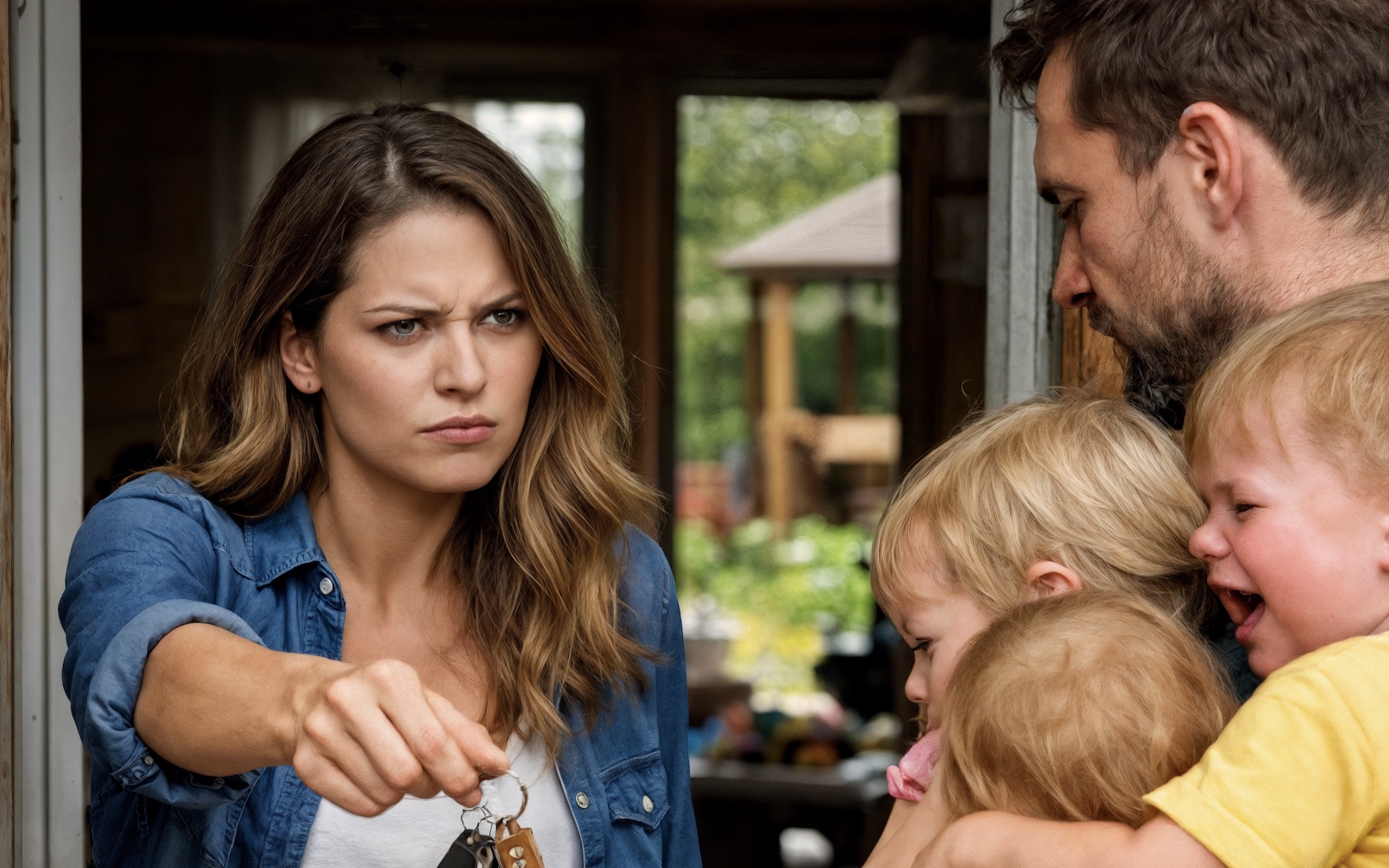
She slid her hand into the pocket of her lounge pants and closed her fingers around the cold metal of a keyring—keys to the city apartment, to the car, and most importantly, to the dacha gate with its heavy padlock.
— I am not going there with your nephews, she said clearly. — And they are not going there either.
— You won’t dare, Sergey jumped up, his face twisting with rage. — I already promised! Vika’s already packing! You want to disgrace me in front of everyone? Do you realize what kind of scandal this will be? Mom will never let me live it down!
— That’s your problem, Sergey. Only yours. You promised—you deliver. Want to be the heroic brother? Go ahead.
— You’re insane! he screamed, voice going shrill. — The dacha is shared! I have just as much right to be there! I’ll call Vika right now and tell them to come. And you won’t go anywhere—you’ll open the gate and smile, because you’re my wife!
— Not anymore, Tanya said calmly.
She went to the entryway cabinet where his little leather pouch lay, dumped it onto the floor, and among the coins and receipts his spare dacha key clinked—one she’d made him two years ago so he could go fishing. Tanya bent down, picked it up, and slipped it into her pocket.
Sergey stared, mouth open. He couldn’t believe what he was seeing. The mutiny had gone too far.
— What are you doing? Give that back! he lunged—but stopped when he met her eyes. There was so much icy contempt in them that his momentum died instantly.
— You promised your sister I’d babysit her triplets all summer for free at our dacha while she and her husband go to Europe? And you didn’t ask whether I wanted to be a daycare worker on my vacation? You decided you could manage my time and my home without me? No, darling. Hand over the keys. Babysit your nephews yourself—and don’t come back to me again.
— You’re crazy… Sergey whispered, finally grasping the scale of the disaster. — You do understand I’ll never forgive you for this?
— I’m counting on it, Tanya nodded. — Because there’s nothing to forgive. I’m just taking back what’s mine. You can keep your “shared.”
She turned and headed to the bedroom—not to sob into a pillow, but to pack. Only her things. Only what she needed for a quiet, solitary, happy summer.
The zipper of her duffel bag ripped through the bedroom silence like a starting pistol. Tanya moved quickly and efficiently: two pairs of jeans, warm sweaters, a waterproof jacket, a first-aid kit, and a stack of books that had been gathering dust on the nightstand since winter. Nothing extra. No “shared” items, no attempt to divide property. Only what would let her live independently.
Sergey stood in the doorway, leaning a shoulder on the frame. The pose was meant to look casually threatening, but his trembling fingers, worrying the hem of his T-shirt, gave away his panic. He was watching his comfortable, carefully arranged world collapse, and his mind was desperately searching for a lever to stop it.
— You’re bluffing, he finally forced out, his voice cracking. — You’ll get to the car, sit there five minutes, cry, and come back. Because you’ve got nowhere else to go, Tanya. We’re a family. You can’t just leave me with a done deal.
Tanya swung the bag over her shoulder. She didn’t even look at him. Once the decision was made, Sergey stopped being a loved one—he became an inconvenience, like a squeaky door or a puddle you step around.
— I’m not leaving you with a done deal, Sergey. I’m leaving you alone with your deal, she said calmly, walking past him.
He didn’t move, blocking the doorway with his body. His face flushed in angry patches, his eyes full of the trapped-animal fury of someone cornered.
— Stop right there! he barked, trying to turn on the “man of the house.” — Do you even understand what you’re doing? Vika called a minute ago! They’re already in a taxi—heading to the airport! The kids are coming tomorrow morning! Where am I supposed to put them? In this tiny apartment? Do you know what three boys will do to this place?
— Great question, Tanya stopped inches from him, and Sergey instinctively recoiled from the icy calm radiating off her. — But why are you asking me? You designed this plan. You’re the generous brother. So be generous. Sleep on the couch, feed them dumplings, keep them busy with cartoons. You said it was easy—“a bowl of soup and an apple,” remember?
At that moment Sergey’s phone started ringing in his pocket. The ringtone was cheerful—some pop song he’d set for his sister. In the current situation it sounded like a funeral march. Sergey jolted like he’d been shocked. He snatched the phone, saw “Vikusya” on the screen, and went pale.
He shoved the phone toward Tanya, nearly pushing the screen into her face.
— Here! Tell her! he screeched. — Tell her yourself you’re a monster! That you’re throwing your own nephews out onto the street! Go on—explain why their trip is ruined! I don’t have the guts—so you do it! You’re the “principled” one!
Tanya pulled his hand away as if it disgusted her.
— No, sweetheart. I didn’t promise anything. I wasn’t part of this scheme. That’s your phone, your sister, and your lie. You deal with it.
She walked around him like he was a lamp post and stepped into the entryway. Sergey froze for a second, stunned that she refused to be his lightning rod, and then rushed after her, still gripping the phone as it kept buzzing.
— You’re not leaving! he roared as Tanya started putting on her shoes. — I won’t let you take the car! It’s shared—we bought it during the marriage!
Tanya straightened up, already in her sneakers. She pulled the SUV keys from her pocket.
— The car is registered in my name, Sergey. And I paid that loan while you were “finding yourself” for two years. So legally, practically, and morally—the steering wheel is mine. I left you a metro pass. It’s on the cabinet, right next to your conscience, if you can find it there.
— If you walk out that door right now… he gasped, hunting for the most vicious words he could find. — If you leave, I’ll file for divorce! You hear me? I’ll dump you! Who will want you—an old maid with garden beds? I’ll find a normal woman who values family!
Tanya opened the front door. Cool air and freedom washed in from the stairwell. She turned back once. The man she’d shared a bed and a table with for years now looked pathetic—sweaty, frantic, and utterly foreign. The phone stopped ringing for a second, then started vibrating again—Vika wasn’t giving up.
— Sergey, Tanya said, and for the first time a hint of a smile flickered through her voice—tired and sad. — You’ve got it backwards. You’re not leaving me. I’m firing you—from the position of husband. For failing to meet basic requirements.
— What? he blinked stupidly.
— You wanted to be good for everyone at my expense. Didn’t work. Now you stay here—in this apartment—alone with your promise. And please don’t come to the dacha. The gates will be locked. I’ll ask the neighbors’ dog to watch the perimeter. If I see you at the fence, I’ll let her loose without warning.
— Tanya! he howled, stepping toward her—but the door swung shut in his face with a heavy, final thud.
The lock clicked. Once. Twice.
Sergey stood in the dark entryway. In the silence, his phone burst into that cheerful ringtone again. “Vikusya,” the screen announced, her photo glowing. He stared at it like a bomb technician who’d cut the wrong wire.
On the other side of the door came the sound of footsteps fading away, then the chirp of the intercom, then an engine turning over. Tanya was driving away into her summer. And the summer he’d so generously planned had just turned into his personal hell. Now he’d have to answer his sister and explain why the “free help” had been canceled—and why three children would arrive tomorrow morning not at a dacha with a garden and strawberries, but at a cramped apartment with an uncle who had no food, no patience… and no wife.
Sergey slid down the wall to the floor, clutching the phone as it kept ringing—demanding payment for words he’d tossed into the wind.