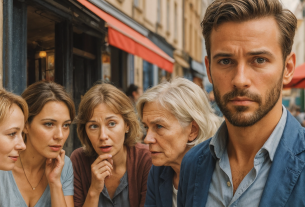
Below is a natural, human-sounding English translation, rewritten to be fully unique while preserving the plot, tone, and emotions.
“Andrey, I’ve said everything I’m going to say,” Yulia snapped. “And don’t even try to press on my pity. I inherited this apartment from my grandmother, and we’re not selling it—so don’t get your hopes up.”
She turned to the window and folded her arms across her chest. Outside, February snow drifted down in slow, lazy flakes, covering the playground like a white quilt.
“Yul, can we at least talk about it?” Andrey tried, forcing his voice to stay calm. “Look at what apartments cost in this area now. We could get a great one-bedroom in that new Parkovy complex—closer to the metro, modern infrastructure, everything right there.”
He stepped up behind her and placed his hands on her shoulders.
“Take your hands off me,” Yulia said quietly.
Andrey froze.
“I don’t want to discuss it,” she continued, still facing the glass. “Not today. Not in a month. Not ever. This apartment is the last thing I have from my grandmother.”
“Your grandmother would’ve wanted you to live better!” Andrey’s voice rose despite himself. “And we’re sitting here in this… this old place, when we can afford something decent!”
Yulia spun around so fast the air seemed to tighten.
“Decent?” she repeated, stung. “So the home where I grew up—the place where my grandmother read me stories every night, where I took my first steps—isn’t ‘decent’ now?” Her voice trembled with hurt. “Go back to your ‘decent’ office with your ‘decent’ coworkers and your ‘decent’ salary. I’ll stay right here, in my ‘indecent’ apartment!”
“Ohhh, here we go…” Andrey raked a hand through his hair, irritated. “That’s not what I meant. I’m just saying—I want a better life for us. A prestigious neighborhood, a place with a designer renovation…”
“A prestigious neighborhood?” Yulia let out a bitter laugh. “Three years ago, when we got married, you were fine with everything—this building, this street, this apartment. So what changed?”
“Everything changed!” Andrey flung his hands up. “I’ve grown professionally. All my coworkers live in normal—”
“Ah. There it is,” Yulia cut him off. “Your coworkers. So it’s about them? Because they live in expensive places?”
“What does that have to—”
“No,” she said sharply. “Let’s be honest for once. You’re ashamed of this apartment now. Ashamed of me. Maybe you don’t even like my ring anymore—the one my grandmother gave me. It didn’t come from some jewelry boutique, after all.”
Andrey fell silent.
In that hush, the sound of a piano floated up from the first floor—Margarita Stepanovna practicing, like she always did in the evenings. That music had followed Yulia through her whole life: homework, exams, and even the day she said goodbye to her grandmother.
Andrey went to the window and rested his forehead against the cold glass. From the fifth floor he could see the courtyard clearly—the playground with its peeling slide, the old swings that had finally stopped squeaking after Uncle Vitya from the third floor oiled them with engine grease.
“How do you not understand?” he said at last, still not turning. “I really do want what’s best for us. Yesterday at the meeting, Mikhail Sergeyevich announced a promotion. Do you know who got it? Vereshchagin. That smug upstart who’s barely been at the company for five minutes.”
“And you think it’s because of our apartment?” Yulia stepped closer, but didn’t touch him.
“Then what is it?” Andrey shot back. “Tell me why he gets invited to corporate events with his family and I don’t. Because he lives in Central Park, drives a brand-new Toyota, and his wife works at some big-name company. And me? Old building. Used car.”
“And a simple wife who freelances as a designer,” Yulia finished for him, her voice flat. “So that’s it. I don’t fit your shiny new life either.”
Andrey turned quickly, as if she’d slapped him.
“No—what are you saying? That’s not it,” he insisted. Then, softer: “It’s just… the world is changing. You have to match a certain level.”
“A level of what?” Yulia moved to the bookcase and ran her fingers over the spines—the same books she’d read with her grandmother in the evenings. “Do you know what she used to say? ‘The most important thing is to remain yourself. Because the moment you start bending to someone else’s standards, you lose who you are.’”
“She lived in different times,” Andrey muttered.
“No. Time has nothing to do with it.” Yulia’s eyes narrowed, remembering. “She once refused to move into a new apartment that was offered to her as an honored worker. She said every wall here remembered my dad as a little boy. And me as a little girl. All our joys. All our grief.”
She opened the cabinet and pulled out an old photo album with a worn cover.
“Look,” she said, flipping it open. “Here—I’m five, sitting right on this windowsill. Here’s my graduation—we took photos in this very room. And this…” Her throat tightened. “This was the last summer with Grandma. Remember? We’d just started dating. You came over, and she liked you immediately. Later she told me, ‘He’s a good boy. Reliable. Just make sure money doesn’t ruin him.’”
Andrey looked embarrassed.
“She really said that?”
“She did. And she also said, ‘If he loves you, he’ll accept you any way you are—with an apartment or without one.’ I didn’t understand why she said it back then. I thought it was just old-person wisdom.” Yulia swallowed. “But it’s like she knew.”
The doorbell rang.
On the doorstep stood Margarita Stepanovna holding a plate covered with a towel.
“Yulenka,” she said warmly, “I baked some pies—just the way your grandmother liked them. Today’s the anniversary, isn’t it? I remember. Here. Cabbage filling. Have them with tea. Remember her for me too.”
“Thank you for remembering,” Yulia said, taking the plate.
Margarita Stepanovna lowered her voice and added, almost conspiratorially, “And don’t sell the apartment, dear. I heard everything—forgive an old woman. These aren’t just walls. This place has a soul. New buildings… it’s all money and showing off, God forgive me.”
“Thank you,” Yulia said, hugging her with one arm. “Don’t worry. We’re not going anywhere.”
When the door closed, Andrey still stood by the window.
“So everyone knows already?” he asked hoarsely.
“In this building the walls are thin and the neighbors have excellent hearing,” Yulia replied without cruelty. “Here, everyone knows everyone’s business—and everyone cares. When I was sick last year, remember who brought broth? Margarita Stepanovna. When your car wouldn’t start in the мороз, who helped you? Uncle Vitya. Tell me—will people in your ‘prestigious’ complex do that for each other?”
Andrey didn’t answer. Through the cracked window, the distant sound of children laughing drifted in—kids still throwing snowballs even though it was late.
“Do you remember how we met?” Yulia asked suddenly. “You’d just gotten hired at your company, renting a room in a коммуналка. Back then you didn’t dream about a prestigious neighborhood. You dreamed about becoming good at what you do. Do you remember what you said the first time we talked?”
Andrey’s mouth twitched into a faint smile.
“I remember,” he said. “I told you I’d never met a girl who smiled so genuinely.”
“And?”
“And I said this apartment felt… unbelievably warm,” he admitted. “And that I wanted our kids to grow up in a home that felt like this.”
“Exactly.” Yulia walked up and took his hand. “And now you want to trade all of that for ‘prestige.’ Listen—your Vereshchagin will move out of Central Park in a year. He won’t be able to keep up with the mortgage. But we’ll still be here. And our children will grow up here. They won’t remember marble floors and a concierge with a stone face. They’ll remember the smell of a neighbor’s pies and piano music at night.”
Memory is built from small things—sounds, smells, casual conversations. And happiness isn’t measured in square meters or a flashy address. It lives in the moments that turn a building into a home.
Andrey stepped away from the window and sank heavily into his grandmother’s old armchair. His gaze drifted over the walls covered with photographs and stopped on a large portrait of Yulia’s grandmother.
“You know…” he began after a long silence, “I envy you. You have something real. A story. Roots. And me? I’ve got endless planning meetings, reports, and ties that cost fifteen thousand.”
Yulia perched on the armrest.
“You really think a tie will make you happier?”
“No,” he said honestly. “But at work, all anyone talks about is cars, apartments, watches. And I…” He rubbed his face. “I feel like a failure. I work as hard as everyone else, but it still feels like I’m behind.”
“And do you remember what you said three years ago?” Yulia asked gently. “When you proposed?”
Andrey smiled without meaning to.
“I said I was the happiest man alive because I’d found you.”
“And what else?”
“That I didn’t care about money, because the most important thing was…”
“The most important thing was being together,” Yulia finished. “Building our own life, not copying someone else’s. Where did that go, Andrey?”
The doorbell rang again.
This time it was Svetlana from the fourth floor, a young mother of two.
“Yulia, I’m sorry to come so late,” she said breathlessly. “Do you happen to have a little flour? The kids have a school fair tomorrow—I want to make pancakes, but the stores are closed.”
“Of course—come in,” Yulia said, heading to the kitchen. “Remember how last year we all celebrated Maslenitsa together? We set up tables in the courtyard. Every apartment cooked something…”
“How could I forget?” Svetlana laughed. “Your grandmother’s pancakes were incredible—she shared her recipe with everyone.” Then she lowered her voice. “By the way… I heard… about selling the apartment. Is that true?”
Andrey, who had been sitting quietly, stood up and came closer.
“No,” he said firmly. “It isn’t. That was me… being stupid. We’re not moving.”
Svetlana’s face brightened.
“Good,” she said with relief. “My kids were upset when they heard. Petya said, ‘Mom, who’s going to help me with math now?’ Yulia’s basically the whole building’s free tutor.”
After Svetlana left—with a bag of flour and a promise to bring pancakes tomorrow—Andrey pulled Yulia close.
“Forgive me,” he murmured. “I really did get lost in my own head. This morning Vereshchagin was bragging about his new apartment, showing photos—everything shiny, modern. And I thought…”
“That everything we have is old and not fashionable?” Yulia asked.
“Yes.” He exhaled. “Stupid, right?”
“Grandma used to say something when she was sick,” Yulia said, stepping away to the cabinet. “She said, ‘Chasing someone else’s happiness is the quickest way to lose your own. Don’t chase ghosts. Protect what you already have.’”
She opened the cabinet and took out an old wooden box.
“I never showed this to anyone,” she said. “Not even you. These are Grandma’s diaries. She started them when she moved into this apartment—back when my dad was five. Look.”
Yulia opened a notebook and read softly:
“‘Today we lit the stove in the new apartment for the first time. Little Sasha runs from room to room shouting that this is the best home in the world. Maybe he’s right. The walls still smell of paint, there’s dust in the corners, but something special is already here. A warmth—not from the stove, but from something bigger.’”
Andrey carefully took the notebook.
“Can I… read this?”
“Of course,” Yulia said. “I reread them often. Especially when I’m sad or life feels heavy. Everything is in here—joys, grief. Dad’s first day of school. When I was born. When my mother…” She trailed off. “You know. And there’s even something about you.”
“About me?” Andrey looked up.
“Yes.” Yulia flipped a page. “‘Today Yulenka brought her young man over. A good boy, kind eyes. And the most important thing—he looks at Yulia the way he should. Not at the apartment, not at the car, but at her. God grant that this modern chase for wealth doesn’t ruin him. That he manages to stay human.’”
Andrey closed the notebook and sat in silence for a long time.
“I’m going to disappoint your grandmother, aren’t I?” he asked at last, quietly. “She believed in me, and I…”
“You won’t disappoint her,” Yulia said, taking the notebook back and returning it to the box. “You just wandered off the road a little. It happens. The important thing is realizing it in time.”
Then Andrey straightened, suddenly resolute.
“And Vereshchagin can choke on his promotion,” he said firmly. “You know what I saw today? He was sitting alone in a café with a face like he’d swallowed a lemon. And we have…”
“We have life,” Yulia smiled. “Real life. With squeaky floors, old wiring, and neighbors who hear every sneeze.” Her smile widened. “But when you’re sick, they’ll bring you chicken broth. And when something good happens, they’ll celebrate with you.”
At that moment, loud voices spilled in from the stairwell. Yulia peeked into the hallway.
“Sounds like Nikolai Petrovich has guests.”
“At this hour?” Andrey asked.
“Of course. His son came—Dima. Remember him? He was at our wedding, dancing with my friend Lena all night.”
From behind the door came Nikolai Petrovich’s anxious voice:
“Son, what do you mean Moscow? What are you going to do there? You’ve got your own business here, clients…”
“And here comes another family drama,” Yulia sighed. “Dima’s been desperate to move to the capital for ages. Says there aren’t enough opportunities here, he needs to ‘grow.’”
Andrey gave Yulia a strange look.
“You know…” he said slowly, “I’ve thought about that too. They offered me a transfer to the Moscow office. I’d have to start at a lower position, but the prospects…”
“And you didn’t tell me?” Yulia stepped back, startled.
“I knew you wouldn’t want to leave,” Andrey admitted. “Because of the apartment, the memories… But now I understand—it’s not only about that.”
Behind the door the conversation continued:
“Dad, I can’t spend my whole life fixing computers in a small town!” Dima protested.
“What’s wrong with a small town?” his father replied calmly. “People know each other here. There’s memory. Roots.”
Yulia and Andrey exchanged a look.
“Funny, isn’t it?” Yulia said with a faint smirk. “Everyone’s running somewhere, searching for something. And happiness is right here.”
“You know what,” Andrey said, walking into the kitchen and switching on the kettle, “let’s really stay. For good. We’ll raise kids here, visit neighbors, celebrate New Year’s in the courtyard…”
“Are you serious?”
“Completely.” He nodded. “And remember last year when Uncle Vitya made a skating rink in the courtyard? Everyone helped—hoses, shovels…”
“You helped too,” Yulia smiled. “Three evenings after work, you poured water.”
“Exactly,” Andrey said, warming to the thought. “And in a ‘prestigious’ complex? Everyone stays behind closed doors. Polite smiles, and behind them—emptiness.”
The voices in the stairwell softened—apparently the father and son had reached some kind of agreement.
“Listen,” Andrey added suddenly, “what if we do a renovation? Not to sell—just for us. Make it modern and cozy. You’re a designer—you’ll come up with something.”
“Really?” Yulia lit up. “I have so many ideas! We can keep the old furniture but refresh it. Pick new wallpaper…”
“And insulate the balcony,” Andrey said. “I’ve wanted that forever.”
“And plant flowers out there!” Yulia laughed. “Like Grandma used to!”
The doorbell rang again.
Nikolai Petrovich stood there, slightly out of breath.
“Sorry to bother you so late, neighbors,” he said. “It’s just… Dima decided to stay. Says he’ll open a programming school for kids here. But do you happen to have a contact for a good real estate agent?”
Andrey and Yulia looked at each other again.
“We do,” Andrey said. “But not for selling an apartment—renting a small space for an office. If you want, I’ll send you the number tomorrow.”
“Oh, thank you!” the neighbor beamed. “I thought all young people only dream of leaving. It’s nice to know there are still people who ценят родное.”
After he left, Yulia wrapped her arms around Andrey.
“You know what I just thought?” she said. “Maybe we should start something of our own too. You’ve always wanted your own business, and I could help with design…”
“Here?” Andrey considered it. “In our neighborhood?”
“Why not?” Yulia said. “Look at how many new buildings they’re putting up—people will need renovations, interiors… I already have regular clients, and you understand sales.”
Andrey’s eyes shifted, thoughtful.
“And we could rent an office in the building next door,” he said slowly. “Walk to work. Eat lunch at home…”
“And if we have kids,” Yulia added, “they’ll always be surrounded by people who care. Neighbors will help.”
Outside, children laughed again—the courtyard gang refusing to go home.
“You know what I realized?” Andrey said, going back to the window. “Vereshchagin and his promotion… he’s probably miserable too. Running nonstop, trying to prove something. And me?” He turned to Yulia. “I already proved what matters—when you agreed to marry me.”
“So it’s decided?” she asked quietly. “We stay?”
“We stay.”
Yulia went to the cabinet and took out an old photograph—her grandmother standing by that same window, smiling. The kind of smile only wise people have, as if they know a secret about life.
“Thank you, Grandma,” Yulia whispered. “For the lesson. For the memories. For the home.”
A week later Andrey came home earlier than usual. He walked into the kitchen without a word and sat down at the table.
“You won’t believe it,” he said finally. “Vereshchagin quit.”
“What? How?” Yulia looked up from her laptop where she was working on another design project.
“He couldn’t keep up,” Andrey said. “Mortgage, car loan… They say he’s selling that Central Park apartment and moving somewhere outside town.”
“And what about his position?”
“They offered it to me,” Andrey said with a tired half-smile. “And… I turned it down.”
“Why?”
“Because I don’t want it,” Andrey said simply. “I don’t want to live like him—always cornered, always in debt, always wearing that ‘successful’ mask.” He inhaled. “I submitted my resignation.”
Yulia slowly closed her laptop.
“Are you sure?”
“More sure than I’ve ever been.” Andrey pulled out a notebook and slid it across the table. “Remember our conversation about starting our own thing? I sketched a business plan. Want to see?”
Outside, snow swirled low across the ground. Inside, the apartment smelled like coffee and fresh pastries—Margarita Stepanovna had brought pies again. Somewhere on the first floor, the piano played. But now the melody wasn’t the soundtrack to someone else’s life—it was music for their own story.
“I do,” Yulia said. “Very much.”
The next morning Andrey woke up unusually early. The apartment was quiet, but from the kitchen he heard soft movement—Yulia was already awake.
For the first time in a long while, he felt… free. Calm.
On the table lay the open notebook with the business plan notes, and beside it stood his grandmother’s old чашка with cold coffee.
“Why are you up so early?” he asked, walking in.
“Couldn’t sleep,” Yulia said, lifting her eyes from the laptop. “I spent the night thinking… I found a space in the building next door. Where the old tailoring shop used to be. They’re renting it cheap—first floor, separate entrance.”
“And?”
“Yesterday I talked to an agent,” Yulia said. “We can go see it today.”
A knock came at the door.
Dima—Nikolai Petrovich’s son—stood there.
“Hey, neighbors,” he said, grinning. “Listen… I heard you talking with my dad about renting a space for an office. What if we team up? I run the programming school, you do design… split the rent, share clients.”
Andrey opened his mouth to answer, but his phone rang.
The screen read: Mikhail Sergeyevich.
He picked up.
“Yes?”
“Andrey, what are you doing?” his boss sounded worn out. “What resignation? What quitting? Our project is on fire—Vereshchagin bailed—”
“Mikhail Sergeyevich,” Andrey said steadily, “I’ve made my decision.”
“I’ll give you a bonus. And the promotion—”
“No,” Andrey said, firm. “Thank you for everything, but… I’m leaving.”
He ended the call and turned to Dima.
“You know what? Not a bad idea,” Andrey said. “But let’s keep it without pretension. No fancy nonsense. Just a normal family business.”
“Deal!” Dima dropped onto a stool. “The main thing is to actually help people. Corporate life is a scam anyway. Like that joke— the prettier the sign outside, the more you pay for it.”
Yulia silently poured coffee for all three of them.
Through the window they could see the neighborhood kids gathering in the courtyard—soon they’d start flooding the rink again. An ordinary winter morning in an ordinary sleeping district… yet for some reason it felt exactly right.
“By the way,” Dima said suddenly, “we should name the business something simple. No ‘premium’ or ‘elite’ nonsense.”
Yulia wrapped her hands around her grandmother’s old cup.
“Home,” she said. “Just ‘Home.’ Because the most important thing is that a person has somewhere to live. Truly live. Not just exist.”
Outside, snow began falling again—big, unhurried flakes. Somewhere on the first floor Margarita Stepanovna started her morning music lesson. And inside the apartment, it smelled like coffee, fresh snow, and hope.
Yes—hope.
Hope that you can live differently. Without racing after someone else’s standards. Without chasing “prestige” like a mirage. Just live—here and now—among people who’ve known you since childhood. And build something of your own, not for show, but for the soul.
“So,” Andrey said, holding out his hand to Dima. “Do we рискнем?”
“We рискнем!” Dima laughed, clasping it.
And Yulia simply smiled—exactly the way her grandmother used to love photographing her. The smile of someone who knows, with full certainty, that she’s choosing the right path.