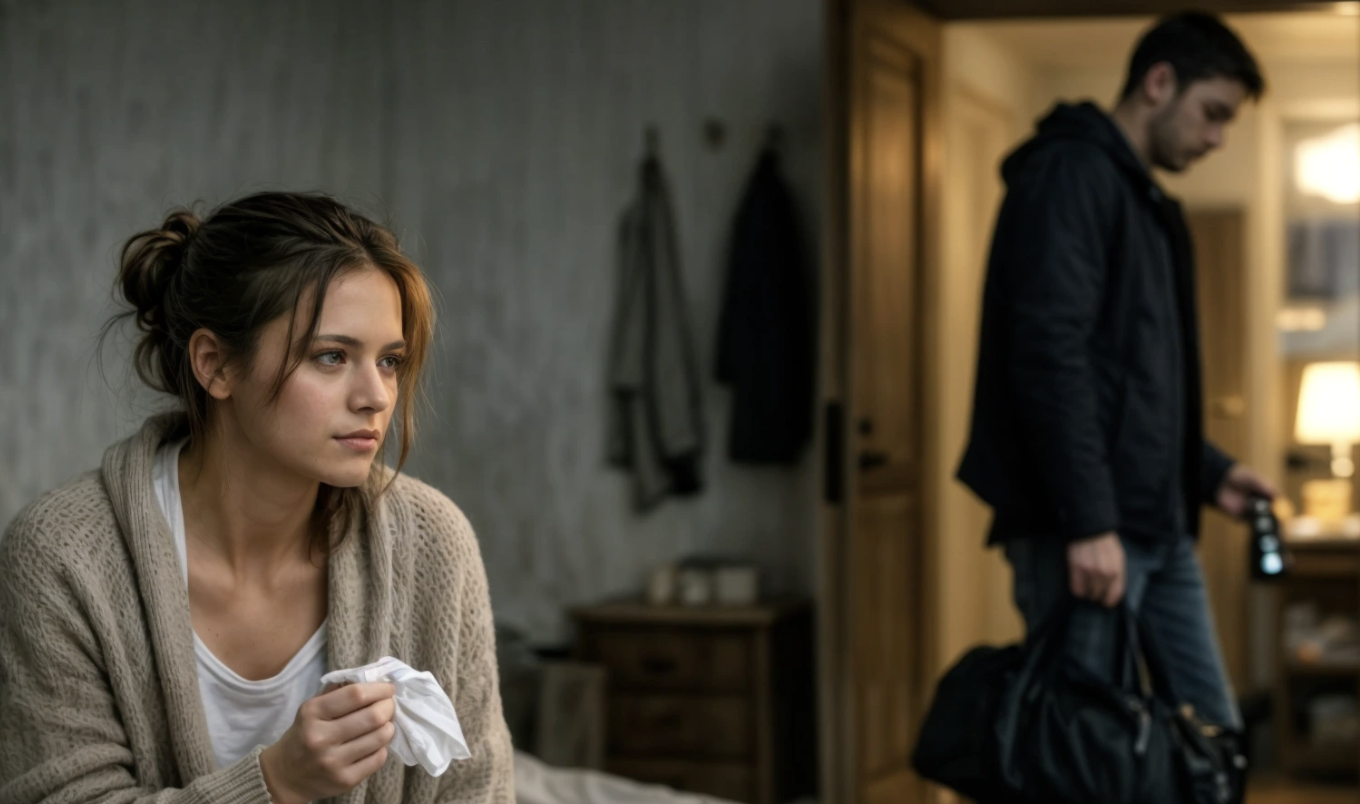
“Andrew, please bring me some water…” Marina’s voice sounded чужим—dry and brittle, like last year’s leaves. It barely pushed through the cottony blanket that had covered her completely.
Her body had turned into one solid, aching clot of pain. Everything throbbed—from her fingertips to the roots of her hair. Her skin burned, but underneath it a prickly, icy chill seemed to be running. The thermometer she’d barely managed to shake down half an hour earlier had shown 39.8°C. This was no longer just an illness—it was an altered state of consciousness, a half-delirium in which reality mixed with nightmares.
From the next room came an annoyed, muffled sound, as if someone had lifted their head off a pillow. Andrew didn’t appear in the bedroom doorway right away. First he pulled a medical mask over his face, carefully smoothing it across the bridge of his nose, and only then came in. He looked as though he were entering a chamber with biological weapons. He stopped a couple of meters from the bed, eyeing his wife warily.
“Marin, what is it now? I just brought you some,” he said with not a drop of sympathy—only a dull, almost childish irritation. “I’m going to catch it from you. I have work tomorrow. My project is on fire, you know that.”
“My mouth is so dry… please,” she rasped again, trying to push herself up on her elbows, but her head immediately spun and she collapsed back onto the pillow, wet with sweat.
He let out a heavy sigh, making it clear what an unbearable burden had fallen on him. He shuffled to the kitchen, loudly dragging his slippers on purpose. A minute later he returned with a cup only half full and set it on the very edge of the nightstand—so far away that, God forbid, it might touch the bed.
“Here. But do it yourself, okay? I don’t want to spread your germs around.”
Marina stared at him through the cloudy veil of fever—at that dissatisfied, disgusted face behind the stupid blue mask, at how carefully he kept his distance. This was her husband. The man she’d said “yes” to at the registry office three years ago. The man who had sworn to be there “in sickness and in health.” Apparently the flu with a high fever fell into some other category—one not included in the vows.
“Andrew… we need the pharmacy. The fever meds are gone. And buy lemons and ginger. I can’t even stand,” her request sounded pathetic, like a whimper.
“Oh God, the pharmacy again… It’ll be packed with sick people, a breeding ground for infection,” he grumbled, backing into the hallway. “I’ll see what’s going on with work. Maybe I’ll go later. If I have time.”
And he left. Just went into the other room and shut the door tightly behind him. Marina heard the lock click. He locked himself in. From her. As if she weren’t a sick loved one but a leper. A few minutes later, muffled gunshots and shouted commands came through the door—he’d sat down at the computer. Put on his headphones so he wouldn’t hear her. To wall himself off from her illness, her groans, her existence.
The hurt was sharp, physical—almost as strong as the headache. She lay staring at the ceiling, listening to those distant, unreal sounds of a computer war while her own body fought a real battle with a virus. She felt endlessly alone. Not just alone—abandoned. Left to die in her bed by the person who had chosen virtual battles over real help. Time stretched like melted cheese. It felt as if hours had passed. The water in the cup had long run out. The fever became unbearable, reality dissolved, and in her feverish delirium she saw Andrew’s face more and more clearly—alien, cold, behind the blue mask of indifference. She began to sink into a heavy, sticky sleep, and her last clear thought was: He hates me.
A sharp, nagging trill yanked Marina out of oblivion. The sound was insistent, demanding, and came from the part of the apartment where her husband was. At first she didn’t understand what it was. A phone call. Someone was calling Andrew. Through the cottony haze of illness she heard the gunfire in his room stop, and then his voice—surprisingly lively and clear. He’d taken off his headphones.
“Yeah, Mom, hi! Did something happen?” His tone was pure concern. No irritation, no fatigue.
Marina listened. She couldn’t hear her mother-in-law’s voice, of course, but from Andrew’s replies the picture began to form—and it was ugly.
“What do you mean ‘not good’? Blood pressure? What does the monitor say? One-forty over ninety? Well, that’s not critical, but it’s unpleasant, yeah… Dizzy? Badly?” Real anxiety crept into his voice—the very anxiety Marina had been waiting for all day. “Did you take your pills? Which ones? And you didn’t put anything under your tongue? Got it. Sit down, don’t do anything. I’m coming right now.”
I’m coming right now. Those two words hit Marina like a slap. She even pushed herself up in bed, forgetting her weakness. The room swayed, but she held on, gripping the headboard.
His door flew open. Andrew burst out like he’d been scalded. He’d already ripped off the mask and thrown it somewhere on the floor. His face was focused, worried. He darted around the apartment like a man whose house was on fire. He didn’t even glance in her direction.
He yanked open the fridge and started grabbing things, shoving them into a bag. Marina made out the oranges she’d bought yesterday for herself, a couple of yogurts, a pack of cottage cheese. Then he lunged at the wall-mounted first-aid kit in the hallway. He jerked the door so hard it nearly came off. His hands frantically sorted boxes and blister packs. He snatched an expensive heart medication they’d bought “just in case,” then something for blood pressure. And then his gaze landed on the last blister pack of fever reducers—the only one left in the house. The very one she’d begged him for.
“Andrew…” she whispered, but he didn’t hear her.
Without a moment’s hesitation he tossed those tablets into the bag with the rest of the medicine. He was going to take away the last thing that could bring her temperature down and ease her suffering.
Only then—already pulling on his shoes in the hallway—did he seem to remember she existed. He leaned into the bedroom, shrugging into his jacket as he spoke.
“Marin, I’m going to Mom’s. She’s really bad—seems like a pre-stroke situation.”
“She has one-forty blood pressure, Andrew,” Marina’s voice suddenly gained strength. “That’s not ‘pre-stroke.’ And I have forty fever. You took the last tablets.”
He grimaced as if she’d said something stupid that got in the way of his heroic rescue mission.
“Marin, don’t start. Mom’s fifty-eight, she has a heart condition. And you’re young—strong body. You’ll lie down and get through it. You’ll be fine. I can’t leave her alone like this. That’s it, I’m running.”
He didn’t listen to her answer. He just turned and rushed out, leaving the door open. She heard him thunder down the stairs, the entrance door slam. And that was it. Silence.
She stared at the open bedroom door, the mask tossed on the floor, the chaos by the medicine cabinet. He’d left. He’d raced across the city because his mother “felt dizzy.” And he’d left her here alone, burning with fever. Without medicine. Without food. Without a drop of water. And it wasn’t even about the pills. It was about the screaming, monstrous contrast: his disgusted indifference toward her—and his instant, panicked care for his mother. In that moment Marina understood her illness had been nothing but litmus paper. A test her husband had failed spectacularly. And the price of that failure was far higher than ruined relations.
Time lost its shape. It either collapsed into one endless second of pulsing pain in her temples or stretched into a murky eternity filled with scraps of nightmare dreams. Marina drifted under and surfaced again, not knowing whether it was day or night. In one of those moments of clarity she realized she couldn’t endure anymore. Her mouth tasted of dust and bitterness. Her tongue had swollen and stuck to her palate. The fever was so strong it felt as if her blood were about to boil. The glass on the nightstand—filled by Andrew an eternity ago—had long been empty.
Her gaze wandered aimlessly around the room. Empty. Andrew wasn’t there. At first she couldn’t even remember where he’d gone. Then her memory obligingly supplied the image: his worried face, his hurried packing, the bag with oranges and—most of all—the last blister pack of fever reducer disappearing into that bag. He’d gone to his mother. Leaving her. That thought no longer brought pain. It was simply a fact—cold and sharp as a shard of glass.
She had to get to the kitchen. To water. That idea became the only lighthouse in the fog of her mind. She threw off the damp, heavy blanket. Her body wouldn’t obey. Muscles twisted by illness refused to cooperate. Marina sat up, and the room immediately pitched like the deck of a sinking ship. She squeezed her eyes shut, clinging to the mattress, waiting out the wave of nausea and dizziness. There was no strength to stand. None.
So she slid off the bed onto the floor. Her knees struck the laminate, but the pain was far away, muted by the main torment—thirst. She crawled. On all fours, like a wounded animal, slowly moving hands and knees that felt чужими—like numb prosthetics. Every meter was torture. In the dim hallway, where the air was stale and motionless, her shoulder caught on the doorframe. Losing balance, she toppled onto her side and slammed her knee hard against the sharp corner of the tiled threshold that separated the hallway from the kitchen.
The pain was sharp, piercing, sobering. It tore through the fever fog like a bolt of lightning. Marina cried out, but it came out quiet and hoarse. She pulled her leg toward her. Through the thin fabric of her pajama pants a dark, quickly spreading stain appeared. Blood. She’d split her knee open. To the blood. In her own home. Because her husband had gone to save his mother from “dizziness.”
That moment became the point of no return. Sitting on the cold kitchen floor, pressing a hand to her bleeding knee, she looked at her apartment and saw it with completely different eyes. It wasn’t their cozy nest. It was the place of her humiliation. The place where she’d been left alone, helpless, like an unwanted thing. Fighting through the new, sharp pain, she crawled to the sink, somehow reached the faucet, turned on cold water, and drank greedily straight from the stream, choking and coughing. It was the best thing she’d felt in twenty-four hours.
Once she’d come to a little, she found the strength to stand, bracing herself on the countertop. Her legs trembled. Her phone lay on the kitchen table. The screen lit up: three missed calls from her mother. She didn’t call back—she didn’t want to scare her. Instead, with a trembling finger, she dialed Andrew.
The ringing went on for a long time. Finally he answered. His voice was lively, but edged with irritation, as if she’d pulled him away from something important.
“Yeah, Marin, is it urgent? I’m busy here with Mom.”
Something hummed behind him—maybe the TV. Busy, flashed through her mind.
Her own voice sounded unexpectedly steady and cold. No weakness, no pleading.
“Andrew, I fell. I crawled to the kitchen for water and I split my knee. There’s blood. I’m really unwell.”
For a second, silence hung in the line. She waited for some response—alarm, sympathy. But she heard only a heavy sigh.
“Marin, why are you acting like a child? Put antiseptic on it—brilliant green, whatever you’ve got. I can’t drop everything right now, do you understand? Mom’s having a serious crisis, she needs peace and attention. I can’t leave her. And you’re young—you’ll manage. I’ll call you back later.”
And something in her snapped. But it wasn’t hysterics. It was cold, concentrated rage poured into words she spoke clearly, enunciating every syllable:
“So while I was lying here with a forty-degree fever, you couldn’t even pour me tea, but the moment your mother sneezed you raced across the city with medicine? Fine—stay there treating your precious mommy, and don’t come back to me, traitor.”
She hung up without waiting for his reply and tossed the phone onto the table. That was it. Something inside broke—the last thread connecting her to this man. She looked at her split knee, at the drops of blood on the pale tile, and for the first time in days she felt nothing. No pain, no hurt, no heat. Only icy, absolute emptiness—and a decision as hard as granite.
Two days passed. The fever retreated, leaving a hollow weakness throughout her body and a strange, unfamiliar clarity in her head. The crisis had passed—both physical and emotional. On the second day Marina, barely moving around the apartment, called her neighbor, Aunt Valya, an elderly but lively woman from downstairs. Seeing Marina—pale, with huge bruised shadows under her eyes and dried blood on her bandaged leg—she gasped and immediately brought hot chicken broth and a first-aid kit. She treated the wound properly, grumbled about “men these days,” and left Marina her number, ordering her to call if anything happened.
That simple human care from someone almost a stranger became the final counterargument against Andrew. While the neighbor fussed in her kitchen, Marina acted. Her movements were slow, but methodical. First she found online the number of a service that opened and replaced locks. A technician arrived within an hour. A brief rasp of tools—and a new set of keys was in her hand. The old lock cylinder went into the trash. That was the first step.
Then she moved on to Andrew’s things. This wasn’t a hysterical flinging of clothes. It was methodical, almost ritual. She opened the wardrobe and began pulling out his shirts, suits, T-shirts. She packed them into large black construction trash bags. His shoes from the hallway went in too. His laptop from the desk, his gaming console, his disc collection, the headphones that mattered more to him than her moans. His shaving things from the bathroom, his favorite mug, even a half-used bottle of cologne. She was clearing the space, burning his presence out of the apartment. When three huge bags were filled, she forced herself, one by one, to drag them out to the stairwell and leave them by the trash chute.
Evening came unnoticed. Marina sat in the kitchen, drinking tea with lemon she’d brewed for herself. She felt nothing—no gloating, no regret. Only emptiness and exhaustion. And then, finally, she heard the familiar sound: Andrew’s steps on the staircase. Then the scrape of a key in the lock. Once. Twice. A quiet, bewildered curse.
Then a hesitant knock.
“Marin? Are you home? What’s wrong with the lock?”
Marina stayed silent, staring at one point.
The knocking grew louder, more insistent.
“Marina, open up! What kind of joke is this? My key doesn’t work!”
She kept silent. She savored the sound—his helplessness.
“Wh—what the hell is going on?!” Now he wasn’t knocking, he was pounding the door with his fist. “Marina! Open up right now!”
At that moment, through the peephole she saw the curious nose of their neighbor Uncle Vitya poke out from the next apartment. He looked at the bags by the trash chute, then at Andrew, and a sly grin spread across his face. He walked over to one of the bags, untied it, and with interest pulled out a nearly new branded hoodie. Tried it on. Fit perfectly.
“Hey! That’s mine! Put it back!” Andrew yelled when he saw it through the crack on the landing.
“Well, it’s been thrown out,” Uncle Vitya replied calmly, digging through the bag further. “Ownerless.”
Andrew howled with rage and hammered the door again.
“You—! Marina, I’ll break this door down! What are you doing?!”
And then she came to the door. Without opening it, she said loudly and clearly, so he and the neighbors—already gathering at the noise—could hear:
“Go away, Andrew. This isn’t your home anymore.”
“Have you lost your mind?! This is my apartment too! I’m calling the police!”
“Call them,” her voice was ice. “You’ll explain how you left your sick wife to die and ran to Mommy because she ‘felt dizzy.’ You’ll tell them how I crawled across the floor with a forty-degree fever and smashed my knees while you told me I’d ‘manage on my own.’ Go on—call. Let everyone hear.”
At that moment his phone rang in his pocket. He answered without stepping away from the door.
“Yeah, Mom… No, I can’t talk!.. What?! She won’t let me in, she changed the locks, she threw my stuff out!”
And then Marina heard Nina Petrovna’s shrill, screeching voice blaring from the speaker.
“What do you mean she won’t let you in?! Who does she think she is?! Andryusha, tell her to open immediately! She’s got no shame! I almost died here, and she’s putting on a show!”
Andrew pressed himself to the door again.
“You hear that?! Mom almost died because of you, because of your nerves! Open up!”
Marina smirked—coldly, silently.
“Tell your mother she now has a wonderful chance to take care of you around the clock. You can live with her. Treat her dizzy spells and bring her oranges. And don’t touch my things or my apartment again.”
“You’ll regret this!” he snarled. “You’ll dance for me!”
But his threats were already drowning in the general roar. The neighbors, emboldened, were dragging his things away. Someone grabbed the console, someone hauled off a bag of clothes. Uncle Vitya was already strutting in his jacket. It was the finale—loud, humiliating, public.
Andrew kept shouting, his mother kept shrieking into the phone, but Marina wasn’t listening anymore. She stepped away from the door and returned to the kitchen. Sat at the table. The noise outside gradually faded into retreating curses. He was leaving. Defeated. Left with nothing.
And she sat in the silence of her—now only her—apartment, slowly sipping cold tea. She felt no victory, no joy. Only emptiness—and a steel-hard certainty that she had done the right thing