“I’m ashamed to take you to the banquet,” Denis didn’t even look up from his phone. “There will be people there. Normal people.”
Nadezhda stood by the refrigerator with a carton of milk in her hand. Twelve years of marriage. Two kids. And now—ashamed.
“I’ll wear the black dress. The one you bought me.”
“It’s not about the dress,” he finally looked up. “It’s about you. You’ve let yourself go. Your hair, your face… the whole you is just… nothing. Vadim will be there with his wife. She’s a stylist. And you… you understand.”
“Then I won’t go.”
“Good girl. I’ll say you have a fever. No one will say a word.”
He went off to take a shower, and Nadezhda stayed standing in the middle of the kitchen. In the next room the children were asleep—Kirill, ten, and Svetlana, eight. Mortgage, bills, parent meetings. She had dissolved into this house, and her husband had started to be ashamed of her.
“Has he completely lost it?” Elena, her hairdresser friend, stared at Nadezhda as if she’d announced the end of the world.
“Ashamed to take his wife to a banquet? Who does he think he is?”
“Warehouse supervisor. Got promoted.”
“And now his wife isn’t good enough?” Elena poured boiling water into the kettle—sharp, angry movements. “Listen to me. Do you remember what you used to do before the kids?”
“I was a teacher.”
“Not work. You made jewelry. Beaded pieces. I still have that necklace with the blue stone. People ask me all the time where to buy something like it.”
Nadezhda remembered. Aventurine. She used to make jewelry in the evenings—back when Denis still looked at her with interest.
“That was a long time ago.”
“If you did it once, you can do it again,” Elena leaned closer. “When’s the banquet?”
“Saturday.”
“Perfect. Tomorrow you come to me. I’ll do your hair and makeup. We’ll call Olga—she has dresses. And you’ll get the jewelry yourself.”
“Elena, he said—”
“To hell with what he ‘said.’ You’re going to that banquet. And he’s going to wet himself.”
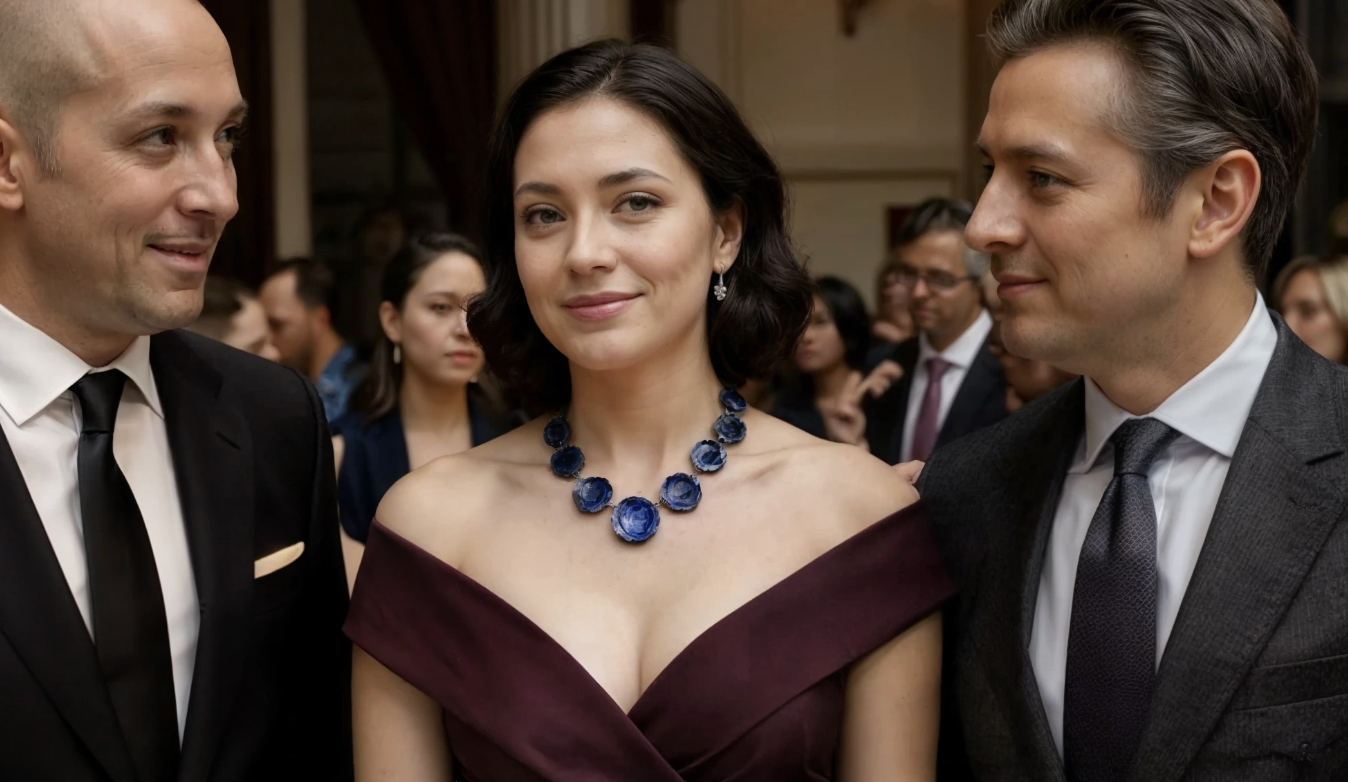
Olga brought a plum-colored dress—long, with bare shoulders. They tried it on for an hour, pinned it, adjusted it.
“With that color you need special jewelry,” Olga circled her. “Silver won’t work. Gold won’t either.”
Nadezhda opened an old jewelry box. At the bottom, wrapped in soft cloth, lay a set—a necklace and earrings. Blue aventurine, handmade. She’d made it eight years earlier, for a special occasion that never came.
“My God, this is a masterpiece,” Olga froze. “You made this?”
“I did.”
Elena styled her hair into a soft wave—nothing excessive. Makeup—restrained, but striking. Nadezhda put on the dress, fastened the jewelry. The stones settled on her neck—cold, weighty.
“Go look,” Olga nudged her toward the mirror.
Nadezhda stepped closer—and didn’t see the woman who’d spent twelve years mopping floors and cooking soups. She saw herself. The one she used to be.
A restaurant on the waterfront. The hall was full—tables, suits, evening dresses, music. Nadezhda arrived late, just as she’d planned. Conversations died down for a few seconds.
Denis stood at the bar, laughing at someone’s joke. He saw her—and his face went rigid. She walked past without looking, sat at a far table. Back straight, hands calm on her lap.
“Excuse me, is this seat taken?”
A man around forty-five, gray suit, intelligent eyes.
“It’s free.”
“Oleg. Vadim’s partner in another business. Bakeries. And you, if I may ask?”
“Nadezhda. The warehouse supervisor’s wife.”
He looked at her, then at the jewelry.
“Aventurine? Handmade—I can tell. My mother collected stones. You don’t see work like this often.”
“I made it myself.”
“Seriously?” Oleg leaned in, studying the weaving. “This is high level. Do you sell?”
“No. I’m… a housewife.”
“Strange. With hands like yours people usually don’t stay at home.”
All evening he stayed nearby. They talked about stones, about creativity, about how people forget themselves in everyday life. Oleg asked her to dance, brought sparkling wine, laughed. Nadezhda saw Denis watching from his table—his face darkening minute by minute.
When she left, Oleg walked her to the car.
“Nadezhda, if you decide to return to jewelry—call me,” he said, handing her a business card. “I know people who need this. Really need it.”
She took the card and nodded.
At home Denis didn’t last five minutes.
“What the hell was that?” he snapped. “The whole evening with that Oleg! Everyone was watching, you understand? Everyone saw my wife throwing herself at another man!”
“I wasn’t throwing myself at him. I was talking.”
“Talking! You danced with him three times! Three! Vadim asked what was going on. I was embarrassed!”
“You’re always embarrassed,” Nadezhda slipped off her shoes and set them by the door. “Embarrassed to take me, embarrassed when people look at me. Is there anything you aren’t ashamed of?”
“Shut up. You think you put on some rag and became someone? You’re nobody. A housewife. Sitting on my neck, spending my money, and now you’re playing princess.”
Before, she would have cried. Gone to the bedroom, faced the wall. But something inside her cracked—or clicked into place.
“Weak men are afraid of strong wives,” she said quietly, almost calmly. “You’re insecure, Denis. You’re terrified I’ll see how small you really are.”
“Get out.”
“I’m filing for divorce.”
He went silent. Stared at her—and for the first time there was not anger in his eyes, but confusion.
“Where will you go with two kids? You won’t live off your little beads.”
“I will.”
In the morning she took out the business card and dialed.
Oleg didn’t rush her. They met in cafés, talked things through. He told her about a woman he knew who ran a gallery of handmade pieces. That handcrafted work was in demand now, that people were tired of mass-produced junk.
“You’re talented, Nadezhda. It’s rare to have talent and taste at the same time.”
She started working at night. Aventurine, jasper, carnelian. Necklaces, bracelets, earrings. Oleg picked up the finished pieces and took them to the gallery. A week later he called—everything had sold. Orders grew.
“Does Denis know?”
“He doesn’t talk to me at all.”
“And the divorce?”
“I found a lawyer. We’re starting the paperwork.”
Oleg helped—without drama, without heroics. He gave contacts, helped her find a rental apartment. When Nadezhda packed her suitcases, Denis stood in the doorway and laughed.
“You’ll be back in a week. Crawling back.”
She closed the suitcase and left without answering.
Six months. A small two-bedroom on the outskirts, the kids, work. Orders kept pouring in. The gallery offered her an exhibition. Nadezhda started a social media page, posted photos. The followers grew.
Oleg visited, brought the kids books, called. He didn’t pressure her, didn’t intrude. He was simply there.
“Mom, do you like him?” Svetlana asked one day.
“I do.”
“And we like him too. He doesn’t yell.”
A year later Oleg proposed. No kneeling, no roses. Over dinner he just said:
“I want you to be with me. All three of you.”
Nadezhda was ready.
Two years later.
Denis was walking through a shopping mall. After being fired, he’d found a job as a loader—Vadim had learned from colleagues how Denis treated his wife and pushed him out after three months. A rented room, debts, loneliness.
He saw them near a jewelry store.
Nadezhda in a light coat, hair styled, that same aventurine on her neck. Oleg held her hand. Kirill and Svetlana were laughing, talking over each other.
Denis stopped at the display window and watched them get into the car. Watched Oleg open the door for Nadezhda. Watched her smile.
Then he looked at his own reflection in the glass—worn jacket, gray face, empty eyes.
He had lost a queen. And she had learned to live without him.
And that was his most terrible punishment—understanding too late what he’d had.