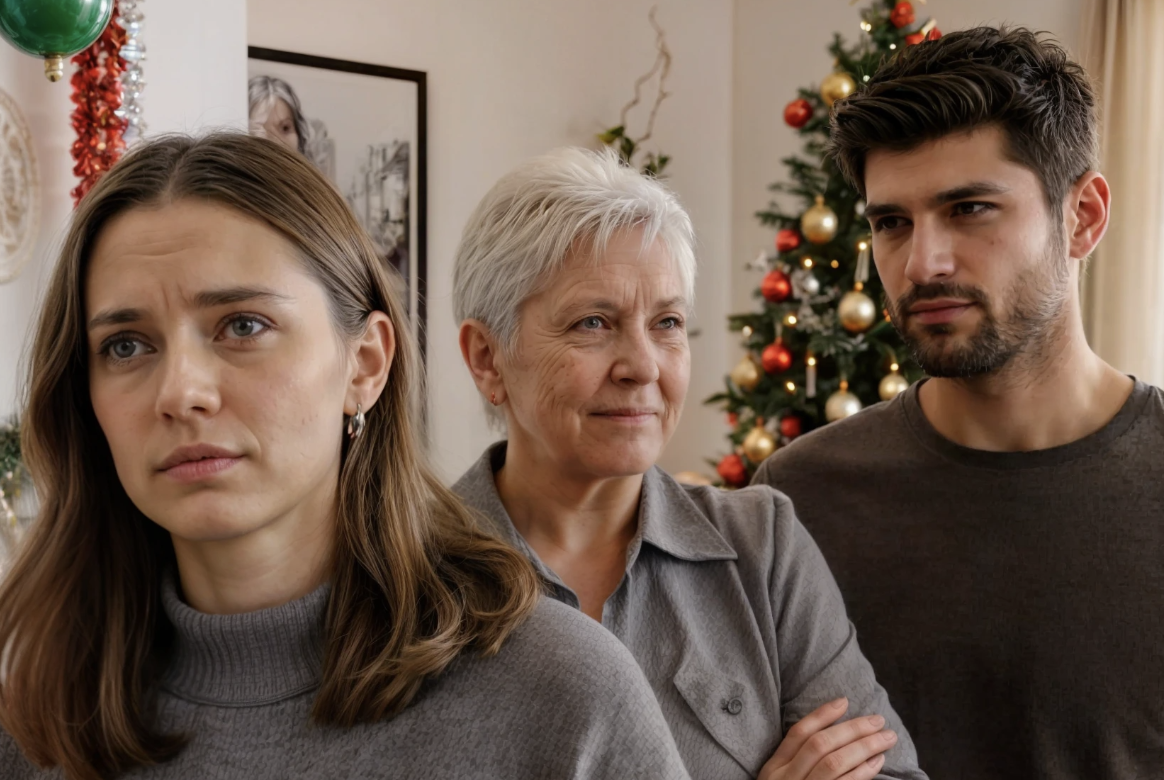
— “Varvara Nikitichna, I’ve got everything ready, really. You don’t need to bring anything.”
Vera pinned the phone between her shoulder and ear and kept slicing cucumbers for the salad. It was eleven in the morning; there were eight hours left until the guests arrived, and her mother-in-law had already called for the third time that morning.
“Verочка, what are you saying! How could it be ‘don’t need’? I always make my jellied meat for the holidays. Zhenya loves it so much. You remember—last year yours turned out a bit runny, the gelatin didn’t set properly.”
“I used a different recipe this year…”
“No, no, I’ve already decided. I’ll bring aspic too, and a fish pie. Your oven is small—you won’t manage.”
Vera closed her eyes and exhaled slowly. Seven years. Seven years of listening to these lectures, seven years of nodding and agreeing. But today was supposed to be different. For the first time in their marriage, they were celebrating New Year’s at their place, not at Varvara Nikitichna’s. Vera had spent three months preparing Zhenya for this conversation. Three months convincing him it was time to have their own traditions.
“Varvara Nikitichna, I really appreciate your care, but…”
“Perfect! Then I’ll be waiting for you at seven in the evening. Dress warmly—it’s minus fifteen outside.”
“Excuse me, what? We agreed it would be at our place today!”
A pause hung on the line. Then her mother-in-law laughed—strangely, tightly.
“Oh, Verочка, you’re so forgetful! We never agreed to anything like that. Zhenya himself told me last week you’d come. Right, Zhenya?”
Vera spun around. Zhenya was standing in the kitchen doorway in old jeans and a stretched-out T-shirt, holding a box of Christmas ornaments. His face looked guilty.
“Mom, I said this year we’re staying home…”
“What do you mean ‘staying’? I’ve already bought everything! I’m roasting a duck—your favorite! Kostya and Masha put presents under the tree, they drew pictures especially for Uncle Zhenya!”
“Mom…”
“And Oleg and Svetochka will come too. We’ll gather the whole family. Or are you refusing the family now?”
Vera watched Zhenya deflate before her eyes. Like always. Every time it came to standing up to his mother, he gave in—just dropped his hands and agreed.
“Varvara Nikitichna,” Vera gripped the phone tighter, “we’re staying home. If you want, come to us. I’ll be glad.”
“Are you mocking me? My table is already half set!”
“Then I’m sorry, but we won’t come.”
Vera ended the call. Her hands were shaking. The phone rang again immediately, but she declined. Then another call. And another.
“Why did you do that?” Zhenya asked quietly. “She’ll be upset.”
“And I won’t be?” Vera turned to him. “You promised me, Zhenya. Promised you’d talk to her. Explain.”
“I did talk! But she… you know her. She can’t do it differently.”
“She can’t—or you didn’t tell her?”
Zhenya put the box on the floor and ran a hand through his hair. Vera knew that gesture well—he always did it when he didn’t want to answer a direct question.
“I told her,” he repeated. “Just… maybe not clearly enough.”
“Not clearly enough,” Vera smirked. “Zhenya, you’re thirty-four. You’re married. We’ve lived together seven years. When will it finally be ‘clear enough’?”
“Ver, not now. Let’s just go to Mom’s, celebrate…”
“No.”
The word came out sharp, distinct. Vera surprised herself with her own resolve. Usually she gave in—because it was easier, because then Zhenya would spend three days gloomier than a storm cloud and call his mother every evening, apologizing for his wife. But today something clicked inside her. Like a switch.
“I told you back in September,” she went on. “We’re celebrating this New Year at home. I spent three days standing in lines buying groceries. Yesterday I made dough for pies until midnight. I want my own holiday. In my own home.”
“But Mom…”
“Your mom can come to us. As a guest. I’m inviting her.”
The phone rang again. This time Zhenya answered.
“Mom, enough… Yes, I understand… No, we’re not coming… Mom, please… Okay, then come to us… At seven… Yes… Deal.”
He hung up and looked at Vera.
“She’ll come to us. Oleg and his family too. But she’s furious.”
“I noticed.”
“She said she’s bringing her dishes anyway. She already cooked.”
Vera pressed her lips together. She wanted to argue, but she stayed silent. A small victory. Let it be that, at least.
By six in the evening, the apartment had transformed. A small two-room place on the fourth floor of an old five-story building gleamed with cleanliness. An artificial tree stood by the window, decorated with colorful baubles and a string of lights. In the living room, a white tablecloth Vera had begged from her mother, and a dinner set she and Zhenya had received at their wedding—still unopened until now.
Vera looked at her handiwork and felt a strange mix of pride and anxiety. The table really was pretty: Olivier in a big bowl, herring under a fur coat, sliced meats and cheeses, roast chicken with a golden crust. Not fancy, not a restaurant—but made with heart.
“Beautiful,” Zhenya said, hugging her from behind. “I’m sorry I… well, sorry.”
She leaned into him. She wanted to say it was fine, but she told the truth:
“I’m tired, Zhenya. Really tired. Every time it’s the same. Your mom decides, we obey.”
“I’ll try,” he promised. “Today I’ll try to be on your side.”
Vera wanted to believe him. She really did.
At half past six, the doorbell rang. Oleg and Svetlana arrived first. The kids immediately rushed to the tree; Svetlana swept the room with an appraising glance.
“Oh, what a small tree you have,” she said, taking off her coat. “Ours is two meters this year. We could barely get it into the room.”
“This one’s enough for us,” Vera replied, taking the gift bags from her.
“Well, sure, your apartment is small. We moved into a new build—three-meter ceilings. Gorgeous!”
Oleg slapped Zhenya on the shoulder.
“How’s it going, bro? Mom already called—warned me you’re rebelling.”
“What rebellion,” Zhenya forced a smile. “We just decided to stay home.”
“You’re a brave man,” Oleg whistled. “Mom doesn’t like that.”
At exactly seven, Varvara Nikitichna arrived. She stepped in with three huge plastic containers, her face unreadable, lips pressed into a thin line.
“Hello,” she said dryly.
“Hello, Varvara Nikitichna,” Vera tried to take the containers. “Let me help.”
“No. I’ll carry them myself.”
Her mother-in-law walked into the kitchen without taking off her coat. Vera followed, feeling her heart drop.
“Varvara Nikitichna, the coat rack is here…”
“I can see where the coat rack is.”
She set the containers straight on the kitchen table, then turned and surveyed the apartment again—like she was assessing flood damage.
“Where are we putting all this?” she finally asked, nodding toward her containers.
“Varvara Nikitichna, my table is already set…”
“Oh, Verочка. It’s no burden, it’s a joy. Zhenya!” she raised her voice. “Come here, help clear space on the table.”
Zhenya appeared in the doorway. Looked at Vera, then at his mother, then back at Vera.
“Mom, we’ve got everything ready…”
“I can see what’s ready. And what, you think I’m supposed to take my dishes back home? I stood at the stove all day!”
“But I stood at the stove too,” Vera said quietly.
“Wonderful! Now there will be more choice. Zhenya, take this,” she handed him a container of jellied meat, “and put it in the center of the table. And move the chicken somewhere to the edge.”
Zhenya took the container. Vera watched him carry it into the living room, watched him obediently push her chicken to the side, freeing the central place for his mother’s jellied meat. Everything inside her tightened into one hard knot.
Varvara Nikitichna followed into the room, finally took off her coat. Then sat at the head of the table—in the seat Vera had prepared for Zhenya.
“Svetа, how are you? How are the kids doing in school?”
“Thank you, Varvara Nikitichna, good. Kostya got an A in math last week.”
“Good boy! And Masha?”
“Masha draws beautifully—the teacher praises her.”
“She takes after me,” Varvara Nikitichna smiled. “I loved drawing as a child too. And you, Sveta, didn’t cook anything? I thought you’d bring something.”
“Well of course we did,” Svetlana pulled a container from the bag. “Here—crab stick salad. My signature.”
“Oh, perfect! Zhenya, put that on the table too.”
Vera stood in the doorway watching, as foreign dishes filled her table, on her tablecloth—watching her mother-in-law command her home like she was the hostess, and Zhenya silently comply.
“Vera, why are you standing there?” Varvara Nikitichna called. “Come sit with us. Or are you still busy?”
“No, I’m free.”
Vera sat down—farther from her mother-in-law, between Zhenya and Oleg. The kids made noise by the tree, inspecting presents. Kostya shook one of the wrapped boxes.
“Uncle Zhenya, what did you get us?”
“You’ll find out after the chimes,” Zhenya smiled.
“And we already know what Grandma got us!” Masha blurted happily. “A construction set!”
“Mashenka, that was supposed to be a surprise,” Varvara Nikitichna frowned, then immediately softened. “Oh well, the main thing is the kids are happy.”
Oleg poured champagne. Varvara Nikitichna pulled the salad closer and tasted it.
“Vera, did you add peas to the Olivier?”
“I did.”
“Strange. It turned out kind of pale.”
“The peas are green,” Vera replied evenly. “From a can.”
“I can see they’re from a can. But usually it’s brighter. And what sausage did you use?”
“Doktorskaya.”
“Yes? The taste isn’t right. I always buy only good doktorskaya—I don’t cut corners.”
“I didn’t cut corners either, Varvara Nikitichna.”
“Well, I don’t know. Maybe you got a different kind.”
Svetlana chimed in:
“Yes, Varvara Nikitichna, your Olivier is always special. I can’t figure out the secret.”
“No secret. You just have to cook with soul,” Varvara Nikitichna smiled condescendingly. “And choose the right products.”
Vera clenched her hands under the table. Zhenya tensed beside her but stayed silent. Oleg poured himself more champagne, clearly not wanting to get involved.
“And your herring is good,” her mother-in-law continued, serving herself. “I would only cut the beets differently. Too big.”
“I like it bigger,” Vera tried to keep her voice steady.
“Well, taste is taste. But small is more delicate. And you needed more mayonnaise. It’s a bit dry.”
“Mom, enough,” Zhenya finally snapped. “Everything’s tasty.”
“Am I scolding? I mean well! Criticism should be constructive.”
“Mom…”
“Zhenya, don’t defend her. Vera’s a smart girl, she’ll understand everything correctly. Right, Verочка?”
Vera looked at her mother-in-law. She was smiling, but her eyes were cold.
“Of course, Varvara Nikitichna.”
About forty minutes remained until the chimes. The kids ran around; Oleg told Zhenya some work story. Vera got up and went to the kitchen—she needed to take the sliced meats out of the fridge.
Svetlana was already there, rummaging in her bag.
“Ver, do you have napkins by any chance? I forgot.”
“In the cabinet on the left.”
Svetlana reached for napkins, then turned back.
“Listen, you’re a champ for standing your ground. I wouldn’t dare. Varvara Nikitichna is so domineering.”
“Today’s not the best day to discuss it.”
“Oh, I’m not saying anything like that! Just… I’m telling you. I have a good relationship with her. I always listen, take her advice. Maybe that’s why we don’t have conflicts.”
Vera looked at her more closely.
“So you’re saying the conflicts are because I don’t listen?”
“Not exactly… It’s just, she’s older, more experienced. She knows better.”
“Svetlana,” Vera said, taking the platter from the fridge, “in my home, I decide.”
“Of course, of course! I’m not arguing. Just… you understand, it’s his mother. Zhenya’s kids will be her grandkids. Maybe you should be softer?”
“Maybe,” Vera agreed. “Only I’ve been ‘softer’ for seven years. You can see the result.”
She returned to the living room. Varvara Nikitichna was telling the children about her youth:
“…and I worked as vice principal then. A very responsible position, by the way. The whole staff depended on me. The principal only knew how to sign papers.”
“Grandma, did you scold everyone?” Kostya asked.
“I didn’t scold—I guided them onto the right path. Many should thank me, by the way. Take your dad—he was such a mischief-maker as a child. And I made a person out of him.”
Oleg laughed awkwardly.
“Mom, not in front of the kids.”
“And what’s wrong with that? Truth is truth. I raised you and Zhenya alone—your father left when you were little. And I managed! I brought up two sons, got both of you on your feet.”
Vera sat down. Zhenya touched her hand under the table, but she didn’t respond.
Outside, the first bursts of fireworks sounded—someone was rushing to congratulate the city early.
“The chimes are soon,” Oleg said. “Let’s get closer to the TV.”
They gathered near the screen. Kids climbed onto the couch, adults stood with champagne. Varvara Nikitichna settled into the armchair like a queen on a throne.
The last seconds of the old year. The chimes. Cheers, clinking glasses, popping party crackers. Kids shouted “Hooray!” and threw confetti. Oleg hugged Svetlana, Zhenya kissed Vera.
“Happy New Year,” he whispered. “Forgive me for everything.”
Vera nodded but said nothing.
After midnight, the table gradually fell into disarray: empty bottles, used napkins, scraps of food. The kids got their presents and now fussed with new toys in the corner. Oleg told a joke; Svetlana giggled.
Vera stood to clear dirty plates. In the kitchen, she leaned against the wall and closed her eyes. Her head buzzed from tension, from fake smiles, from constant control. Her holiday. Her home. Yet she felt like an unwanted guest at someone else’s party.
“Vera!” Varvara Nikitichna called from the living room. “Where are the salads? Bring more—Olezhek wants seconds!”
Vera clenched her fists. Counted to ten. Then took the bowl of Olivier and carried it in.
“Here you go.”
“And bring the herring too. And my aspic. Zhenya loves it so much.”
Vera went back and forth: aspic, bread, mustard, something else—she didn’t even remember what anymore. Just walked like a waitress at her own holiday.
“Verочка, you should tidy up a bit,” Varvara Nikitichna said when Vera appeared in the doorway again. “Trash is piling up—doesn’t look nice.”
“Varvara Nikitichna, it’s a holiday…”
“Even more so! In my home there was never trash on the table. I always cleaned immediately.”
“Mom, enough already,” Zhenya tried again, but his voice was uncertain.
Vera silently grabbed the dirty plates and carried them to the kitchen. She set them in the sink, braced her hands on the counter. Breathing got hard; her vision swam.
Seven years. Seven years of remarks. Seven years of being not good enough: cooking wrong, cleaning wrong, dressing wrong, even speaking wrong. And on top of that, she wasn’t giving him children, imagine that.
Svetlana appeared in the doorway.
“Ver, you okay? Want help?”
“No.”
“Oh come on. Don’t take it to heart. Varvara Nikitichna is just like that—you have to get used to her.”
“I’ve been getting used to her for seven years.”
“Well, a little more,” Svetlana tried to joke. “They say after ten years you don’t care at all.”
Vera spun around sharply.
“Svet, I don’t want to wait ten years to stop caring about my own life!”
“Lower your voice! They’ll hear.”
“Let them!”
But Svetlana had already gone back. Vera stayed alone in the kitchen among dirty dishes and the remains of the celebration.
When she returned, they were talking about children. Varvara Nikitichna was explaining how to raise them:
“The main thing is strictness. Without strictness, nothing works. I raised my sons… Zhenya, remember when you brought home a failing grade in fifth grade? I kept you from going out for a month. And there were no more failing grades after that.”
“Mom, that was thirty years ago,” Zhenya said tiredly.
“So what? Good methods are always relevant. Kids today are spoiled—parents indulge every whim.”
“We try to find a balance,” Svetlana said carefully.
“What balance? Kids need a firm hand. When Vera has children, she’ll understand right away.”
An awkward pause. Oleg cleared his throat. Zhenya stared at his plate.
“Varvara Nikitichna,” Vera said, “let’s not discuss my plans.”
“What’s wrong with that? How old are you? Married seven years? It’s time already.”
“Mom, that’s our business,” Zhenya said more firmly.
“Your business, fine. Only Zhenya is thirty-four. A man at that age needs to have kids. Later it’ll be too late.”
“Enough,” Vera stood. “Excuse me, I’m going out to the balcony for some air.”
“In this frost? Are you out of your mind,” her mother-in-law snorted.
But Vera was already walking to the balcony door. She had to get out—immediately. Or she would snap and say something she couldn’t take back.
It was truly cold outside. Minus fifteen had turned into minus twenty. Vera hugged herself and stared at the night city. Somewhere in the distance fireworks still exploded.
The door opened behind her. Zhenya.
“Ver, come back in. You’ll freeze.”
“I don’t want to.”
“Just don’t pay attention. She’s like that with everyone.”
“Really?” Vera turned. “With everyone? Or only with me?”
“Well… yes, she’s stricter with you. But it’s because… she worries. She wants what’s best.”
“Seven years, Zhenya. Seven years your mother has treated me like a servant. I don’t cook well enough, clean well enough, look well enough, work well enough—and on top of that I’m not having your children, can you believe it?”
“That’s not what she meant…”
“Then what did she mean? What?”
Zhenya was silent. Vera waited.
“I don’t know,” he admitted at last. “I don’t know what she meant. But she’s my mother.”
“And who am I? A random fellow traveler?”
“Ver…”
“You’ve never once taken my side. Not once, Zhenya. Every time she starts, you stay quiet. Or agree. Or tell me ‘don’t pay attention.’”
“I don’t want to choose between you!”
“And I don’t want to be an outcast in my own home!” Vera raised her voice. “This is MY apartment! MY holiday! I prepared for three days! And she comes in and turns everything upside down, commands, criticizes—and you let her!”
“What am I supposed to do?! Throw my own mother out?!”
“No. You’re supposed to stop her. Tell her that in our home I’m the hostess. That we have our own rules. That she is a guest and should behave accordingly.”
“She won’t understand.”
“Try explaining.”
“I did talk…”
“Not clearly enough!” Vera waved her hand. “You always talk not clearly enough—because you’re afraid of upsetting her!”
“But you’re not afraid of upsetting me, are you?”
The question hung in the freezing air. Vera looked at her husband and suddenly understood—he really believed that. That she could be upset. That she’d endure it, understand, forgive. Because she always had.
“Let’s go back inside,” Zhenya said tiredly. “The guests are waiting.”
“Guests,” Vera gave a bitter little laugh. “Your mom isn’t a guest, Zhenya. She’s a conqueror.”
But she still went back in.
At the table, the talk shifted to work. Oleg spoke about a new construction site, Svetlana complained about grocery prices. Varvara Nikitichna listened halfheartedly, occasionally inserting her comments.
“Olezhek, you should buy a plot outside the city. Lots of people do. You can have a garden, and kids can be outdoors.”
“Mom, I don’t have money for a plot.”
“If you saved, you would. Zhenya’s a good boy, he saves. Right, Zhenya?”
Zhenya nodded without looking up.
“And you could get a better apartment,” she continued. “This one is so small. In new buildings they sell three-bedrooms cheap.”
“Varvara Nikitichna,” Vera set her fork down, “we’re fine with our apartment.”
“What do you mean, fine? It’s a tiny two-room! When children appear, there’ll be nowhere to put them.”
“If they appear, we’ll decide then.”
“What ‘if’? They have to! Zhenya, you want kids, don’t you?”
“Mom, not now.”
“And when? You’re both over thirty! I had Oleg at twenty-four!”
“Times were different,” Svetlana remarked.
“Times, times,” Varvara Nikitichna waved it off. “There are always excuses. Then they regret it. You’ll see.”
Vera stood up slowly, calmly. Took her plate and carried it to the kitchen. Behind her she heard:
“Offended again. So sensitive.”
“Mom, stop already,” Zhenya tried again.
“What do you mean, stop? I mean well!”
In the kitchen Vera paused by the window. Fireworks still popped somewhere below; people laughed. Someone was having a real holiday—bright and joyful. And hers was… this.
The kitchen door opened. Varvara Nikitichna came in.
“Vera, we need to talk.”
“About what?”
“About you. And about Zhenya.”
Vera turned. Her mother-in-law stood in the doorway with arms crossed—a victor’s posture.
“I’m listening.”
“You don’t like me. That’s clear. I don’t expect love. But you must show respect.”
“I respect you, Varvara Nikitichna.”
“No. If you respected me, you wouldn’t argue back. I’m older, wiser. I raised Zhenya. I know what he needs.”
“And I’m his wife. And I also know what he needs.”
“Wife,” her mother-in-law smirked. “Do you even iron his shirts? I saw he goes to work wrinkled.”
“Zhenya is an adult man. He can iron his own shirts.”
“And that’s exactly your problem! You don’t understand what it means to be a wife! At your age I worked, ran the house, raised kids—and my husband always had a hot dinner. And everyone’s clothes were ironed. And you? You’re at work all day, come home tired…”
“I’m a nurse. I help people.”
“And that’s wonderful! But family has to come first! Zhenya needs a real homemaker, not a…”
“Not what?” Vera stepped closer. “Finish it.”
“Not a careerist who thinks only of herself!”
“A careerist?” Vera laughed. “Varvara Nikitichna, I’m a nurse at a district clinic. What career?”
“Still! Your job matters more to you than family!”
“My job gives us extra income,” Vera said evenly. “Or do you think we can live on Zhenya’s salary alone?”
“You can, if you economize! I raised two sons on my own!”
“On your vice principal salary,” Vera replied calmly. “Which was twice a regular teacher’s. And you had an apartment the state gave you. We rented for five years, saved for the down payment. Different times, Varvara Nikitichna.”
“You’re making excuses!” her mother-in-law raised her voice. “Always excuses! And the facts are: Zhenya lives in a tiny apartment, goes to work in unwashed shirts, eats tasteless food!”
Something inside Vera snapped—finally. Like the last thin thread breaking.
“Varvara Nikitichna,” she said very quietly, each word clear, “get out of my kitchen.”
“What did you say?”
“I said—get out. This is my kitchen. In my apartment. The one Zhenya and I bought with our money.”
“How dare you speak to your elders like that?”
“The way people speak to someone who doesn’t respect other people’s boundaries. Seven years, Varvara Nikitichna. Seven years I’ve listened to your remarks—that I’m a bad homemaker, a bad wife, unworthy of your son.”
“I didn’t say that!”
“You did. Constantly. Every holiday. Every visit. Today I invited you as a guest. A GUEST. And you came in and started commanding. You brought your own food because you don’t like mine. You criticized everything you could reach—even my Olivier!”
“I wanted to help…”
“NO!” Vera raised her voice. “You wanted to show I’m worse than you. That without you we can’t cope. That you’re indispensable!”
Zhenya appeared in the doorway:
“What’s going on here?”
“Your wife is insulting me!” Varvara Nikitichna jabbed a finger at Vera. “She’s throwing me out!”
“I’m not insulting you,” Vera turned to her husband. “I’m just telling the truth. For the first time in seven years.”
“Ver, calm down…”
“NO! I won’t calm down! Zhenya, look around! This is our apartment! Our holiday! I prepared for three days! And your mother came and ruined everything—like always!”
“How can you…” Varvara Nikitichna whispered, turning pale. “I’m like family to you…”
“You’re NOT family to me!” Vera blurted. “Family respects each other! Rejoices in each other’s successes! And you only rejoice when I fail—when something doesn’t work for me—because it proves you were right!”
“You’ve lost your mind,” Varvara Nikitichna said, white-faced. “Zhenya, say something!”
Zhenya stood in the middle of the kitchen, confused, looking from his mother to his wife.
“Mom, you really do… go too far sometimes.”
“WHAT?”
“Well, the Olivier, for example. Why were you picking at it? It was fine.”
“I wasn’t picking at it! I was constructively—”
“Mom, you always do this. With every dish. Every little thing. Vera tried, and you…”
“Then both of you are against me!” Varvara Nikitichna clutched her chest. “She’s turned my own son against his mother!”
“Nobody turned anyone,” Vera said wearily. “You do it yourself.”
“I do it myself? I devoted my whole life to my children! Raised them alone! And now look—thanks!”
“Mom, stop with the ‘raised them alone,’” Oleg appeared behind Zhenya. “We’re adults now, stop playing that card.”
“You too?!” Varvara Nikitichna looked at both sons. “Both of you?!”
“Mom, you really do sometimes… overdo it,” Oleg said carefully. “Svetka was telling me the other day—”
“Svetka! So that’s what this is! You’ve all conspired!”
“Nobody conspired,” Vera stepped forward. “Varvara Nikitichna, I’m sorry, but I can’t anymore. I can’t keep enduring your remarks. Your control. Your constant dissatisfaction. I’m not perfect, but I try. And I have a right to respect—in my own home.”
“So what are you suggesting?” her mother-in-law threw up her hands. “That I never come to you again?”
“No. Come. But as a guest—who respects the hosts. You don’t like my holiday? The door is open. I’m not holding you.”
Silence fell. Somewhere in the living room the kids rustled softly. Outside, another firework burst.
“Zhenya,” Varvara Nikitichna turned to her son, “I’m leaving. Walk me out.”
“Mom…”
“I said—walk me out!”
Zhenya looked helplessly at Vera. She nodded.
“Go.”
They left. Varvara Nikitichna, Zhenya, Oleg with Svetlana and the children. The apartment emptied in five minutes. Oleg gave Vera a long look, as if he wanted to say something, but stayed silent. Svetlana hurriedly dressed the kids. Kostya asked:
“Why is Grandma crying?”
“Hush, sweetheart. I’ll explain later.”
The door closed. Vera was alone in the apartment, full of dirty dishes, leftovers, and a half-eaten holiday. She sat on the couch and just sat there. No tears. Just sat, staring at the tree lights.
Zhenya came back half an hour later. Quietly, sat next to her. Stayed silent for a long time.
“You went too far,” he finally said.
“I know.”
“Mom’s hysterical. Oleg barely calmed her down.”
“I’m sorry.”
“Are you?”
Vera turned to him.
“No. If I’m honest—no. I’m sorry it happened like that. On a holiday. In front of everyone. But I don’t regret what I said.”
“Ver…”
“Zhenya, I can’t do this anymore. Do you understand? Not at all. Every time your mom comes, I feel… small. Worthless. Everything I do is wrong, everything I say is stupid. I’m tired of proving I’m worthy of you.”
“You are worthy.”
“Then why didn’t you tell her that earlier? Why did I fight alone for seven years?”
Zhenya dragged a hand down his face.
“I was afraid. Afraid of hurting Mom. She’s been through a lot. Raised us alone…”
“I’ve heard that story a million times,” Vera said wearily. “And yes, it’s hard. I respect her for it. But it doesn’t give her the right to control our life.”
“She just wants what’s best.”
“For whom? For you—or for herself?”
The question hung in the air. Zhenya stared at the floor.
“I don’t know,” he admitted at last. “Honestly—I don’t know.”
They sat like that for another ten minutes. Then Vera stood.
“I’m going to clean up in the kitchen.”
“Let me help.”
They cleaned in silence—packed leftovers into containers, washed dishes, wiped the table—mechanically, not looking at each other. Around three in the morning they finished.
“Go to bed,” Vera said. “I’ll sit a little longer.”
“Ver…”
“Go. Really. I need to think.”
Zhenya went to the bedroom. Vera stayed in the kitchen, boiled the kettle, made tea, sat by the window and watched the sleeping city.
The phone was silent. Usually after fights Varvara Nikitichna would call Zhenya, cry, complain. But today—silence.
Maybe she really had gone too far. Maybe she should have stayed quiet, like always. Swallowed one more holiday, one more portion of criticism, one more evening as the failure.
No. Enough.
In the morning she was woken by a call—Toma, a colleague from work.
“Ver, happy New Year! How did you celebrate?”
“Fine.”
“Seriously? Your voice sounds odd.”
“Just tired.”
“Got it. Listen, how are you really? I ran into Oleg yesterday at the store. He told me about your… well, situation.”
Vera closed her eyes. Of course. Small town—by evening the whole neighborhood would know.
“Toma, I don’t want to talk about it.”
“I’m not calling for that! I just wanted to say—you did great. Honestly. If I were you, I would’ve blown up five years ago.”
“Really?”
“Ver, come on! Varvara Nikitichna ruins everybody’s life! Oleg and Svetka can’t divorce for three years now—his mom won’t let them. Says it’s shameful. She calls my Anton too, gives unsolicited advice. Good thing we live in another district.”
Vera smirked.
“So I’m not the only one.”
“You’re a heroine! The first who told her the truth to her face. Respect.”
After the call, Vera felt a little better. She got up, went to the kitchen. Zhenya was already there, with the morning face of someone who hadn’t slept all night.
“Mom called,” he said. “Three times. I didn’t pick up.”
“Why?”
“Because I don’t know what to say.”
Vera sat across from him.
“And what do you want to say?”
“That you’re right. About everything. Mom… she’s like that. Controls everything. Controlled our whole life. First me and Oleg. Now you—wives. She’ll control grandkids too. I’m used to it. But you shouldn’t have had to get used to it.”
“What do you suggest?”
“I’ll call her. Talk. Seriously talk. Explain this can’t go on.”
“She won’t understand.”
“I’ll try. At least try.”
He called that evening. Vera heard fragments from the other room:
“Mom, listen… No, I’m not choosing… Mom, let me finish… This is our home… Mom, please… I love you both…”
The conversation lasted more than an hour. When Zhenya came back, he looked exhausted.
“How is she?”
“Bad. She cried. Shouted. Threatened never to come again.”
“And what did you say?”
“That it’s her choice. But if she comes—then as a guest. With respect for the hosts.”
“And?”
“And she hung up.”
Vera hugged him. He leaned into her and she felt him trembling.
“I’m scared,” Zhenya whispered. “She’s my mother. The only one. And I hurt her so much.”
“You didn’t hurt her. You finally told the truth.”
“What if she really doesn’t come again?”
“Then that’s her choice. Not yours.”
They sat like that, holding each other, until it grew completely dark outside.
Two weeks passed in an odd silence. Varvara Nikitichna didn’t call. Oleg sent Zhenya short messages—“Mom’s offended,” “Mom’s crying,” “Mom says you abandoned her.” Zhenya stayed quiet, grew darker each day. Vera stayed quiet too—but didn’t give in.
Then, in the third week of January, the doorbell rang. Vera opened it and saw Varvara Nikitichna with a pie in her hands.
“May I come in?”
“Of course.”
They sat in the kitchen, drank tea. The pie sat between them—apple, still warm. Varvara Nikitichna worried the edge of a napkin.
“I… wanted to say,” she began. “Maybe I really do… sometimes allow myself too much.”
“Not sometimes. Constantly.”
“Vera, I’m trying to apologize.”
“I know. And I appreciate it. But ‘sometimes’ isn’t true.”
Her mother-in-law sighed.
“All right. Constantly. I’m used to controlling everything. At work it was necessary. At home too. I raised kids alone. I gave an order—they did it. I don’t know how to do it differently.”
“But I’m not your child, Varvara Nikitichna.”
“I understand. Zhenya explained that… very thoroughly. Two hours of explaining.”
“And?”
“And I thought about it. Maybe he’s right. Maybe I really do try to control what doesn’t belong to me.”
Vera watched her carefully. Varvara Nikitichna looked tired—older. For the first time in seven years, she looked like an elderly woman, not a formidable judge.
“I don’t promise I’ll change immediately,” she continued. “I’ll be sixty soon. My character is set. But… I’ll try. At least not to say every thought out loud.”
“That’s already good.”
“And your pie wasn’t bad,” Varvara Nikitichna suddenly added. “On New Year’s. The chicken was juicy. I tried to make it the same way at home—it didn’t work.”
Vera choked on her tea. A compliment—from her mother-in-law? Miracles indeed.
“Thank you.”
“You’re welcome. It was genuinely tasty.”
They finished tea, ate a slice of pie each. Then Varvara Nikitichna stood.
“I should go. Only… Vera. I really didn’t want to hurt you. I was just… afraid.”
“Of what?”
“That they’d take Zhenya away from me. That I’d become unnecessary. I lived my whole life for them. First for my husband—he left. Then for the children. And now the children have grown up. And I don’t know who I am without them.”
Vera looked at her and suddenly understood—truly. Not excused her, but understood. Varvara Nikitichna wasn’t a villain. She was a frightened woman losing control over the only thing that gave her meaning.
“You are needed, Varvara Nikitichna,” Vera said softly. “Just… differently. Not as a boss. But as… a grandmother. An adviser. A friend.”
“I don’t know how to be friends with daughters-in-law.”
“You’ll learn. We still have a lot of time.”
Her mother-in-law nodded and left.
In the evening, Zhenya came home from work. Vera told him about the visit. He listened silently, then hugged her hard.
“Thank you.”
“For what?”
“For not giving up. For not leaving. For giving us a chance.”
“It wasn’t me who gave the chance. Your mom took it.”
“Still. Without you, she wouldn’t have come.”
They stood in the kitchen hugging as winter night fell outside. The first snow of the new year began only now, in mid-January—soft, fluffy, beautiful.
“Do you think it’ll work?” Vera asked. “Fixing things?”
“I don’t know. But we’ll try. And Mom will try too. And that’s not nothing.”
“She’s inviting us to hers for March 8.”
“And what did you say?”
“That I’ll come—if she promises not to criticize my salad.”
Zhenya laughed. For the first time in two weeks—he laughed for real. Vera smiled too.
Yes, there would be new arguments ahead. New conflicts. Varvara Nikitichna wouldn’t change in a day. But something had shifted. Something important. For the first time in seven years, Vera didn’t feel like a stranger in this family. For the first time, her voice had been heard.
And it was only the beginning—of a long, difficult, but possible road