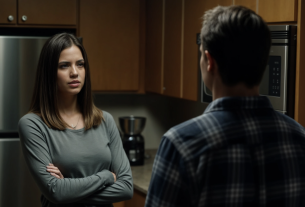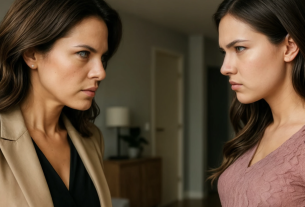
— Come on, Lyuda, it’s an anniversary. Sixty years— a big, round date. Mom will be upset if we don’t come,” Stas said in a coaxing, almost pleading voice. He stood leaning against the doorframe, watching his wife methodically run the iron over his shirt.
Ludmila didn’t answer. The room was filled with damp warmth and the scent of clean laundry. The hot iron hissed softly as it touched the slightly moist fabric, smoothing out even the tiniest creases. Her movements were practiced, almost mechanical: first the collar, then the cuffs, the button placket, the back. She worked in silence—focused—and that silence was louder than any shout. A pile of perfectly pressed shirts was growing at the edge of the board like a neat little tower.
Stas shifted his weight from foot to foot. This was what irritated him about her—this habit of not arguing, just ignoring him and continuing her chores as if he didn’t exist.
“Lyud, do you even hear me? I’m talking to you. This is important. For her, for me, for us.”
She finished with the sleeve, smoothed it carefully, and set the iron down on its metal stand with force. The sound came out sharp, angry. Ludmila raised her eyes to him. Her gaze was calm, heavy—like river water in a deep whirlpool.
“No. We’re not going to your mother’s birthday. I had enough last time, when in front of all the guests she called me a poor freeloader! If you want to go so badly—go alone and say hello from your greedy wife!”
She said it evenly, without strain, and that made her words feel even heavier. Stas winced as if he’d tasted something sour. He stepped closer, almost right up to the ironing board that stood between them like a barricade.
“Upset,” she echoed. “And I wasn’t upset when at her last birthday party, at a table full of your relatives, she announced you found me in a dumpster? That I married you only for the apartment, because I’d never had a roof over my head? I was supposed to swallow that and smile?”
He looked away, embarrassed. He remembered that moment. The awkward pause hanging over the table, the curious stares from his cousin-aunts, and how he’d only coughed stupidly into his fist.
“Well, she didn’t mean it. That’s just her character. You know how she is. No filter.”
“Character?” Ludmila gave a short laugh, without a trace of humor. “Stas, she hates me and doesn’t even hide it. And I’m not going to sit there for hours again pretending to be a happy daughter-in-law while they grind me into the dirt. That isn’t respect for her age. It’s masochism. So go alone. Give her a present from both of us. Tell them I’m not feeling well.”
He flared up. The idea of lying and wriggling in front of his relatives made him furious. It felt humiliating.
“How am I supposed to go alone? What will people say? What will the aunts say, Uncle Kolya? That we have problems?”
“They’ll say you have a wife with a spine who doesn’t let people wipe their feet on her,” she cut him off, grabbed the next shirt, and yanked it hard to spread it on the board. “That’s it, Stas. Topic closed. I’m not going anywhere.”
He realized she was a wall. Cold, unbreakable. Arguing, pushing, pleading—useless. He turned and left the room.
On the day of the anniversary, he woke up earlier than usual. Silently washed, shaved. Took his best suit from the closet—dark blue, the one Ludmila had bought him for their wedding anniversary. He dressed in dead silence, broken only by the rustle of fabric and the click of his watch strap. A large gift box tied with a golden ribbon stood by the door. He picked it up, stuffed his keys into his pocket, and walked out without looking back.
Ludmila didn’t even come to see him off. She sat in the kitchen with a cup of coffee, staring out the window, and she knew this solo visit wasn’t a compromise. After several hours of his mother working on him, he would come back different—angry, wound up, soaked through with her poison. And that would be the beginning of the end.
He returned well past midnight. Ludmila was still awake. She sat in an armchair with a book, but she wasn’t reading—just staring at the lines without taking them in. She heard the key scrape in the lock—slow, not the usual quick motion, as if he couldn’t find the slot at first. The door opened and he came in. Not noisily, not staggering, but heavily, as if he were carrying an invisible weight. He took off his shoes in silence, hung his jacket on the hook, and went to the kitchen without saying a word.
Ludmila put down the book and followed him. He stood with the refrigerator open, its inner light carving his gaunt, angry face out of the darkness. His suit was wrinkled, his tie loosened, but it wasn’t about that. He looked like he hadn’t spent six hours at a family celebration, but several days under interrogation.
“Is there anything to eat?” he asked without turning around. His voice was dull—foreign.
“There’s pilaf in the skillet. You can heat it up.”
He slammed the refrigerator door so hard the jars rattled on the shelves.
“Pilaf again? We ate it on Tuesday. Can’t you cook something normal?”
Ludmila leaned against the doorframe. There it was. It had started. She’d been waiting.
“You always liked my pilaf. You asked me to make it this week.”
“I liked it. Before I did,” he turned to her, and she saw his eyes—tired, but full of some new, unfamiliar contempt. “At Mom’s today the table was loaded. Roast pork, aspic, five kinds of salads. That’s what a real homemaker looks like. And what do we have?”
He wasn’t saying it just to reproach her. He was stating a fact—handing down a verdict. Ludmila met his gaze calmly.
“Your mother prepared for her anniversary for a month. And two of your aunts helped her. I got home from work at seven p.m. And I cooked dinner.”
“That’s not the point,” he waved it away as if her arguments were childish babble. “The point is the attitude. A woman’s home should come first. Clean, cozy. And what do we have? Dust on the shelf. I noticed it today.”
He ran his finger along the top shelf of a kitchen cabinet and showed her the gray film on his fingertip. It was so petty, so unlike him, that Ludmila barely restrained herself from smacking him for it.
The cold war began on Monday. Stas came home from work with a big opaque bag that smelled like home—only not their home, but his mother’s: garlic, dill, and rich broth. Without a word he went into the kitchen, set three glass containers on the table, and announced with forced cheerfulness:
“Mom sent these. Stuffed cabbage rolls, borscht, and her signature liver pâté. She says I’ve gotten too skinny—need feeding.”
Ludmila, who was slicing vegetables for a salad, didn’t even turn her head. She only paused the knife over the cutting board for a second, then kept chopping the cucumber with doubled, deliberate precision.
“Okay. Put it in the fridge.”
He’d expected a different reaction—an accusation, a question, maybe even a fight. But her icy indifference threw him off. He pointedly cleared an entire shelf in the refrigerator, shoving her pot into the far corner, and placed his mother’s food right in the most visible spot.
That evening at dinner, the ritual repeated. Ludmila put a plate of Greek salad and a piece of baked chicken breast in front of herself. Stas took out the container of cabbage rolls, reheated them in the microwave, and sat across from her. The smell of sour cream and tomato sauce—thick and greasy—filled the kitchen, drowning out the fresh scent of olive oil and basil. They ate in complete silence, and it felt like a duel between two cooks, two ideologies, two worlds.
It became a system. Every day he brought something from his mother. He stopped eating what Ludmila cooked, claiming, “You can’t offend Mom, she tried so hard.” Their dinners turned into theater of the absurd: at one end of the table—his plate with homemade cutlets or rich soup; at the other—her light dinner for one. He stopped asking what she wanted to eat. She stopped cooking for two. The apartment—their shared territory—began slowly but surely to be taken over by someone else’s presence.
The next stage of the invasion was photographs. On Saturday he brought three pictures in heavy lacquered frames of dark wood. In one his mother, Valentina Petrovna, posed proudly in front of her roses at the dacha. In the second she was younger, holding little Stas in her arms. In the third—the largest—was the whole family from that very anniversary. Everyone except Ludmila.
He didn’t hang them on the wall. He did something subtler. He set them on the living-room dresser, in the most prominent place, creating a small improvised altar. Now wherever Ludmila went, she ran into her mother-in-law’s stern, judging stare.
Ludmila didn’t comment. She simply stopped dusting the dresser. A week later, a clear gray layer lay on the dark lacquer of the frames. She cleaned the entire apartment, but she avoided that surface, as if it were diseased. It was her silent form of protest—her asymmetrical answer.
The breaking point came on Thursday. Getting ready for work, Stas couldn’t find a single clean shirt. Irritated, he rummaged through the closet, yanking drawers open and shut.
“Lyuda, did you iron my shirts? I’ve got nothing to wear!”
She sat at the table, calmly drinking coffee and reading the news on her tablet.
“No.”
“What do you mean, no?” He came out of the bedroom, already worked up. “Why not?”
“I washed and ironed my things on Tuesday.”
He froze, not immediately grasping what she meant. Then it hit him. He bolted to the bathroom. The laundry basket was almost empty—only his things lay in it: shirts, jeans, socks.
“You… only washed your own stuff?” His voice was a mix of disbelief and rage.
“Yes.” She took another sip of coffee, eyes still on the screen. “I don’t eat the food your mother cooks. It would be strange if she washed my clothes. So why should I wash yours? Now everyone has their own homemaker. You made your choice.”
He stared at her—at her calm face, at the slow swipe of her finger across the tablet—and understood he’d lost. He’d wanted to hurt her, humiliate her, make her feel like a stranger in her own home. Instead, she had simply crossed him out of her life while leaving him physically present beside her. The apartment had become a divided kingdom. And looking at the pile of his dirty laundry, he realized for the first time that on his “occupied territory” he was completely alone.
A week passed. The apartment turned into a border zone with invisible, but sharply felt demarcation lines. They hardly spoke, exchanging only short household phrases. Stas, clumsy and irritated, loaded the washing machine himself, mixing whites with colors. Once he ruined an expensive sports T-shirt that turned a washed-out pink. He threw it into the trash with a muffled curse. Ludmila, walking by, didn’t even turn her head. It didn’t concern her.
He ate from his mother’s supplies, which he now brought every two days in a big thermos, and sometimes ordered pizza. Their lives flowed in parallel inside the same walls, never crossing.
The silence in the house grew dense and heavy, like a wet blanket. It wasn’t the silence of peace—it was the silence of scorched earth, where nothing could grow anymore. Stas cracked first. He was used to Ludmila creating the background of their life: the quiet hum of the TV, the chop of a knife on a board, her laugh during a phone call with a friend. Now the home was mute, and that muteness pressed on him, drove him crazy. He realized his tactic hadn’t worked. He’d wanted to make her jealous, wound her as a homemaker, but instead he’d simply lost the comfort he’d taken for granted.
The reckoning came on Saturday morning. Ludmila sat in the kitchen, drinking her morning coffee and flipping through a magazine. Stas came in, poured himself water from the filter, and without looking at her threw out the phrase that was meant to be his final blow:
“By the way, I talked to Mom yesterday. She’s going to come live with us for a couple of weeks. Starting Tuesday. She’ll help you around the house, because I can see you’re swamped—you can’t handle it.”
He said it deliberately casually, as if everything had been decided long ago. It was an ultimatum. A last attempt to break her by settling their main ally, heavy artillery in the form of Valentina Petrovna, onto their territory.
Ludmila slowly set the magazine down on the table. She didn’t flare up, didn’t shout. She raised an absolutely calm, clear gaze to him. There was no anger or hurt in her eyes. There was something much worse—cold, detached curiosity, like an entomologist studying an insect.
“Fine,” she said softly.
Stas blinked, thrown off. He expected anything—screaming, objections, threats. But not this short, simple agreement. He already had a whole speech prepared about filial duty and helping an elderly mother, but it wasn’t needed.
“What’s fine?” he asked, not believing his ears.
“Let her come,” Ludmila repeated in the same even voice. She stood, walked up to him, and looked him straight in the eyes. They were less than half a meter apart, but it felt like a chasm. “But we need to clarify a few things, Stanislav. So there are no misunderstandings later.”
For the first time in a long while she used his full name, and it landed like the crack of a whip.
“Your mother is coming to visit you. Not us. So she’ll sleep in that room,” she nodded toward the living room. “With you. The sofa folds out. I think you’ll fit. Your marital bedroom is there now.”
He stared at her, his face slowly turning to stone. He opened his mouth to object, but she kept going without letting him get a word in. Her voice was sharp as a scalpel.
“You’ll cook on the stove. I’m taking my multicooker and microwave into my room. You’ll buy your own groceries and keep them on the two bottom shelves of the fridge. The top shelves are mine. You’ll use your own dishes. Take that dinner set she gave us for the wedding—it’s perfect for a case like this. Bathroom and toilet are on a shared schedule. We’ll draw up a cleaning rota separately.”
She paused, letting it sink in. Understanding reached him slowly, like someone half-stunned. He looked at her and didn’t recognize her. This wasn’t his Lyuda. This was a stranger—hard, controlled—who was now dismantling their world brick by brick.
“Y-you… what are you saying?” he rasped.
“I’m saying what you wanted to hear, Stas. Isn’t this what you were aiming for? You wanted more of Mom in your life? Here you go. Enjoy. You won. She’ll cook you borscht, iron your shirts, and tell you what a wonderful life you have. And I… I’m not your wife anymore. I’m your neighbor. Who, by a lucky coincidence, happens to be the sole owner of this apartment.
“You remember how your mother loves to remind everyone I married you only because of it? Well, she was right. Only not because of you. Because of the apartment. And now I’m asking my tenant to follow the dorm rules.”
She turned and walked into the bedroom. He remained standing in the middle of the kitchen, utterly crushed. He’d wanted to win, and instead he’d ended up trapped. He got what he demanded, but the price was unbearable. With his own hands he’d turned his home into a коммуналка—a shared flat—and his wife into the cold, merciless commandant of that hell.
He heard the bedroom lock click.
And he understood that sound was final.
It wasn’t the end of a fight.
It was the end of everything…