Alice had always dreamed of having her own dacha. Not the kind you inherit along with someone else’s memories and worn-out furniture, but one that was truly hers—where she would hammer in every nail herself, where she would know the story of every tree and every bush.
She bought the plot three years before the wedding. Back then she was still working as an engineer for a construction company, knew her way around materials, and wasn’t afraid of hard physical work. She chose for a long time: she drove through dozens of settlements within a hundred kilometers of the city, studied the soil, how close it was to water, the neighbors, and the transport access. When she found the right place—a small hill with pines and a view of a lake, in a quiet village where friendly summer residents lived—she knew at once: this was it.
She registered the land in her own name, took out a loan, and began building. First they poured the foundation, then raised the frame. She hired a crew only for the heaviest work, like digging the pit and pouring the concrete; everything else she did herself or with friends on weekends. By the time of the wedding, the house was already under a roof, the subfloors were done, and the windows were installed.
When Alice showed Oleg the dacha, he was thrilled.
“You seriously did all this yourself?” he walked around the veranda, peered into the cellar, touched the logs. “I can’t even properly nail up a shelf, and you built a house. That’s so much work!”
“Well, not completely by myself, of course. Professionals poured the foundation, and they helped with the frame. But most of it—yes,” Alice smiled, tucking her hair behind her ear. She liked that her husband appreciated her work, saw how much effort she had put in.
“That’s incredible. You really do have golden hands,” Oleg put his arm around her shoulders. “I wish I had that kind of determination.”
After the wedding they started going to the dacha together. Oleg helped with the garden beds, carried boards when they expanded the veranda. Alice could see he liked it there, and that made her happy. It felt like they had a shared project, shared plans.
But one day he let something slip in conversation:
“Mom was asking if she could stay at our dacha for a couple of weeks in the summer. Says it’s hot and stuffy in the city, and there’s a month-long line for doctors. She needs to rest in the fresh air.”
Alice tensed. Her mother-in-law was a domineering woman, used to having everything done her way. Even at the wedding she had bossed everyone around as if it were her own celebration—telling people where to sit, what to serve, what music to play.
“Oleg, let’s ask me first and only then make arrangements,” Alice said carefully, trying not to show her irritation.
“But I am asking!” he looked surprised, even a little offended.
“You said your mom was asking. But no one asked me,” Alice looked him straight in the eyes. “This is my dacha. I built it. And I want to be asked before guests are invited.”
Oleg frowned but said nothing. Apparently, he hadn’t expected that answer.
In the end, her mother-in-law didn’t go to the dacha. Alice never gave her consent, citing the fact that renovations were still ongoing and there was nowhere to accommodate guests. But she remembered that conversation. Remembered how her husband hadn’t considered it necessary to ask her opinion.
Two years passed. Her relationship with her husband cooled. Oleg stayed late at work more and more often, suggested going to the dacha together less and less. And when Alice suggested it, he found excuses.
“I’m tired. Next weekend.”
“There’s still so much work, I’m not ready to strain myself physically—my back hurts.”
“Go by yourself if you want. I need to rest at home.”
So Alice went. Alone. She liked working in silence, without anyone’s advice or dissatisfied grumbling. She finished the bathhouse, put up a new corrugated metal fence, laid out a flower bed in front of the house, planted roses and peonies.
That day she was supposed to be on a business trip to Kazan. The flight was postponed to the evening due to technical problems with the plane, and Alice decided not to waste time and went to the dacha instead—after a strong wind three days earlier she wanted to check the roof for leaks and, at the same time, pick up tools she’d left in the shed.
She didn’t call her husband to warn him. Why? He was at work until seven anyway, and she would be done in a couple of hours and get back to the city in time for the airport.
Alice turned onto the familiar dirt road and slowed down at the gate to her plot. She immediately noticed the wicket gate was slightly open. Strange. She always—without exception—locked it with a heavy padlock.
She got out of the car and looked closer. There were fresh footprints on the path—large ones, clearly not hers. And the veranda window was wide open, though Alice distinctly remembered closing everything before leaving a week earlier.
Her heart dropped. Thieves? But what kind of thieves leave windows open and don’t close the gate behind them?
She cautiously pushed the wicket, listening, and walked to the house along the familiar path. On the porch there were someone else’s shoes—women’s floral house slippers and men’s size 44 sneakers. Alice stopped, staring at them. The slippers looked familiar. Very familiar.
The light was on in the house even though it was still bright outside. From the kitchen window came a quiet sound—someone had turned on the radio; an old pop song was playing.
Alice stepped onto the porch, trying not to make noise, and pushed the door. It wasn’t locked. It wasn’t even fully shut.
The first thing she saw when she walked into the entryway was чужие вещи—someone else’s belongings. Big travel bags, cardboard boxes, grocery bags. A jacket hung on the rack that Alice had seen on her mother-in-law more than once.
“What is going on here?” she said quietly out loud, feeling outrage begin to boil inside her.
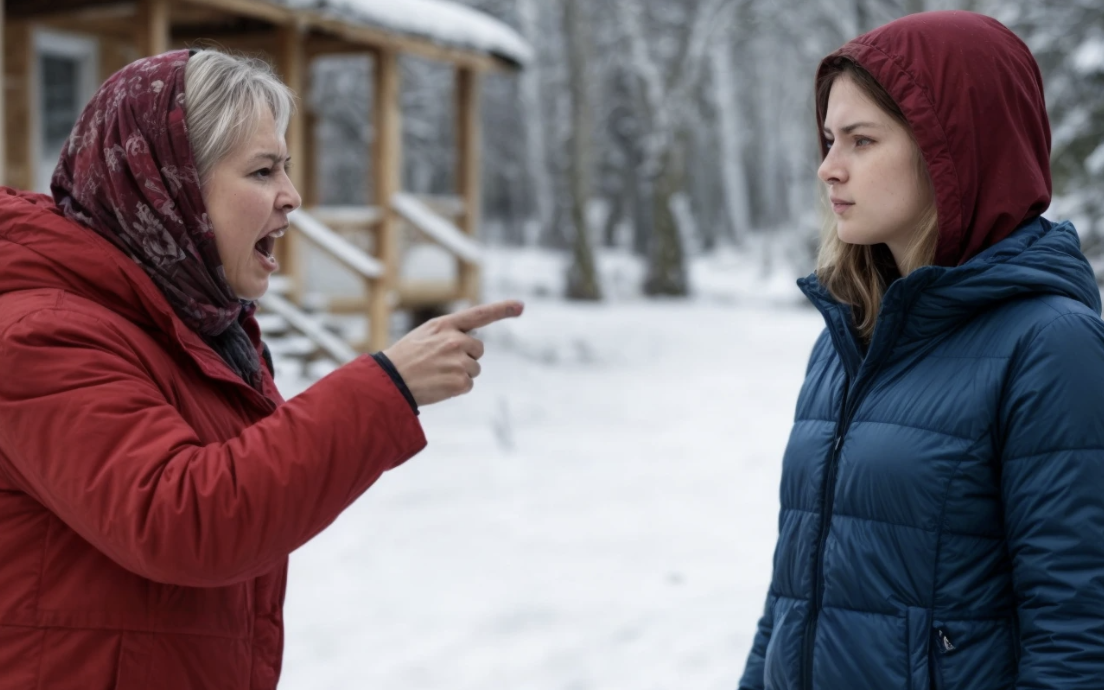
A woman in a light blue robe came out of the kitchen, holding a large ceramic mug. Her mother-in-law. Galina Ivanovna. She stopped dead when she saw Alice in the doorway, and her face instantly twisted with anger and surprise.
“What are you doing here?!” Her voice was sharp, almost shrill, accusatory. “You’re supposed to be on a business trip! Oleg said you’d left!”
Alice slowly—very slowly—exhaled. So she knew. Knew exactly when Alice wouldn’t be here. Knew and deliberately chose that time.
“This is my house,” Alice said calmly, forcing her voice to stay even. “I’m the one who should be asking what you’re doing here without my permission.”
“Your house?” Her mother-in-law slammed the mug onto the nearest shelf and crossed her arms, jutting out her chin. “Have you forgotten that Oleg is your husband? That means it’s shared property. Marital property! And I have every right to be here! You’re legally illiterate!”
“I have documents that say the exact opposite,” Alice didn’t raise her voice, though she wanted to scream. “I bought the land and built the house before the marriage. With my own money. It’s mine. Only mine. It has nothing to do with marital property.”
Galina Ivanovna stepped forward, shoulders tense, eyes narrowing.
“Get out of here right now!” she screamed, flailing her hands. “You have no right to barge in here without warning! I’ll call the police this instant! You’re violating private property boundaries! I’ll sue you!”
Alice froze. She slowly scanned the house she had built with her own hands. On the table stood dishes—clearly not what she had left, чужие тарелки with flowers. In the corner on the sofa lay blankets and pillows that had never been here. On the shelves, lined up neatly, were jars of jam, pickles, compotes—none of this had been here.
“You’re already living here,” Alice stated, feeling the tension tighten. “How long? How many days has it been?”
“None of your business! Absolutely none!” her mother-in-law stepped even closer, her face reddening with rage. “Oleg allowed me to be here! He said you agreed! He brought me here the day before yesterday!”
Alice slowly pulled her phone from her jacket pocket and turned on the voice recorder.
“Oleg couldn’t allow what he doesn’t own,” she spoke evenly, clearly, without emotion. “And I never—do you hear me, never—gave anyone consent to live here.”
Galina Ivanovna kept yelling—waving her hands, demanding Alice leave the house immediately, threatening court, police, a scandal for the whole village.
“You think you can just come and throw me out?!” her voice broke into a shriek; her face turned purple. “I’ll make your life hell! Oleg will put you in your place for talking to me like this! He’ll ruin your life! You’ll regret it!”
Without responding to the screaming, Alice calmly walked to the wall cabinet where she always kept important papers in a special folder. She opened the top drawer and pulled out a thick blue snap folder: the land ownership certificate, the purchase agreement for the plot, the construction contract, all receipts and payment slips for materials and labor. Everything was registered strictly in her name; all dates were three years and a year and a half before the wedding to Oleg.
She laid the documents on the table and smoothed them out.
“Here,” she said quietly but firmly. “You can look carefully. Date the plot was bought—exactly three years before Oleg and I registered our marriage. Date ownership of the house was registered—a year and a half before the marriage. Everything is in my name. Every paper. Every signature.”
Her mother-in-law grabbed the papers with trembling hands, skimmed the lines, flipped pages back and forth. Her face first went pale, then flushed again, but she stubbornly held her ground.
“So what?!” she nearly shouted. “You still can’t just kick me out! I’m not living on the street—I’m with my son! My own son! He’s my only child!”
“You have your own apartment in the city,” Alice calmly took the documents back and folded them into the folder. “Two rooms, a good neighborhood. And your son is not the хозяин of this house. Legally, he’s nobody here.”
“Oh, is that how it is? Fine!” Galina Ivanovna snatched her phone out of her robe pocket. “I’m calling the police right now! Let them come and sort out who’s breaking the law here—who’s barging into someone else’s home. That’s what it’s called: taking the law into your own hands!”
Alice nodded calmly.
“Good. Let’s call the police. That’s exactly what I was going to suggest.”
Her mother-in-law froze with the phone suspended in the air. Alice clearly saw confidence start to melt from her face. The woman opened her mouth, closed it, opened it again, trying to say something, but the words got stuck.
“You… you’re serious right now?” her voice became noticeably quieter, uncertain, almost confused. “The police? On me?”
“Absolutely,” Alice was already dialing the duty station on her phone. “Hello. Yes, good afternoon. I want to report illegal entry into a private house and illegal residence. Yes, I’m the owner. I can provide all documents. The address is…”
While she calmly and clearly gave the address, Galina Ivanovna stood completely still. Her whole body tensed like a wire; her lips pressed into a thin pale line, and her hands with the phone dropped.
“Yes, they’ll be here in twenty minutes,” Alice put the phone back into her pocket. “You have time to pack your things calmly. Or you can wait for the officers and explain to them what legal grounds you’re on in someone else’s private home without the owner’s permission.”
“I… but Oleg told me… he promised…” the mother-in-law faltered, speaking more quietly and stumbling over her words. “He told me the dacha was shared. That you bought it together. That you didn’t mind me coming.”
“Oleg had no right to say that,” Alice opened the front door wide and gestured at the two big suitcases by the entryway wall. “He is not the owner of this house. He has no property rights here.”
“But you’re husband and wife! Legal spouses! Everything one has automatically belongs to both by law!”
“Not everything,” Alice repeated patiently. “Property acquired before marriage remains the personal property of the spouse who acquired it. That’s written in the Family Code of the Russian Federation. You can check it yourself if you don’t believe me.”
Galina Ivanovna shifted from foot to foot, clearly not knowing what to do next. Her face was twisted—a strange mix of anger, resentment, confusion, and fear.
“You’ll regret this,” she hissed through clenched teeth. “Oleg will find out what you’re doing, and you’ll regret it bitterly. He won’t forgive you for treating his mother like that.”
Alice didn’t say a word. She simply stood by the open door, silently watching her mother-in-law and waiting for her to finally pack up and leave.
Galina Ivanovna spun around, grabbed her travel bag from the sofa, and began hastily throwing scattered things into it. She slammed the wardrobe door so hard the glass clinked. She banged the mug against the sink edge in the kitchen, barely avoiding breaking it.
“I never thought you’d turn out like this!” she shouted as she gathered her many bags and packages. “Heartless! Cruel! A real egoist! You’re throwing an old sick person out of the house! Do you even have a conscience?!”
“Out of my house,” Alice corrected calmly, without raising her voice.
“You don’t even have a heart! Stone-cold! I’m your husband’s mother! I took you in like my own daughter!”
“That doesn’t give you any right to live in my house without my personal permission,” Alice stood motionless.
Her mother-in-law hoisted the heavy suitcase, dragged it with difficulty over the threshold onto the porch, the wheels clattering loudly. Then she went back for the remaining bags, boxes, packages. Her face burned with anger and humiliation; her hands visibly trembled.
“You’re destroying our family!” she threw at Alice at last, already standing on the porch. “Because of some pathetic dacha you’re ready to destroy a family! Oleg will leave you! And he’ll be right to!”
Alice silently closed the door behind her. She stood for a few seconds, listening to the sounds outside. A car door slammed, then another. The engine started. Tires crunched over gravel.
She slowly exhaled and leaned her back against the cool wall. Her hands still gripped her phone tightly, the recording still running.
When exactly twenty minutes later, as promised, the police arrived—a white car with blue stripes—Alice calmly explained everything to the local officer. She showed all the required ownership documents and told him about her mother-in-law’s unlawful residence without her knowledge or consent. The officer listened carefully, nodded with understanding, wrote down details in a notebook, and left ten minutes later.
Alice carefully locked the house on both locks and walked the perimeter of the property. She checked the shed where the tools were kept, the bathhouse she’d been finishing last summer, the small greenhouse. Everything was in place. Her mother-in-law hadn’t had time to damage, break, or take anything.
She sat down on the porch steps, admiring the sunset, and pulled out her phone. She dialed her husband. Long, monotonous rings—then an abrupt hang-up.
Alice smirked. So Mommy had already called and told her version. Of course.
She typed a short message: “Come to the dacha tonight. We need to talk seriously.”
The reply came almost instantly: “Have you lost your mind?! You kicked my mother out! Onto the street!”
“Out of my house. Which she occupied without my asking or permission.”
“I allowed her! I’m the хозяин!”
“You are not the owner of this house. Read the ownership documents carefully.”
The phone fell silent. No more messages came. Alice stood up, brushed dust off her jeans, and walked to her car parked by the gate.
Oleg raced in that evening, when the sun had almost set. He burst into the house like a hurricane—red-faced, disheveled, jacket unzipped.
“Are you out of your mind?!” he yelled right from the doorway, not even taking off his shoes. “Mom called in tears, sobbing! She says you called the police on her! The police! On an elderly person!”
Alice sat calmly at the kitchen table, drinking hot tea with honey. She slowly lifted her eyes to her husband, taking her time before answering.
“I called the police because there was an unauthorized person in my house without my knowledge or consent, and she refused to leave.”
“Unauthorized?!” Oleg practically jumped with outrage. “That’s my own mother! The woman who gave birth to me and raised me!”
“Who had absolutely no right to be here without my consent,” Alice took a sip of tea.
Oleg froze in the middle of the kitchen, apparently trying to process what he’d heard.
“Do you even hear yourself right now? Do you understand what you’re saying? What do you mean ‘no right’? I brought her here myself! I personally allowed her to live here!”
Alice slowly and calmly placed the blue folder of documents on the table in front of him and opened it.
“Here is the land ownership certificate. Look at the date—exactly three years before our wedding. Here is the house construction contract. The registration date is a year and a half before we got married. Everything is registered strictly in my name. Only in my name. You are not the owner of this house, and legally you cannot give anyone permission to live here.”
Oleg grabbed the papers with both hands, quickly scanned the text, flipping pages.
“So what?! What difference does it make?! We’re husband and wife! Legal spouses! Everything we have is shared!”
“Not everything,” Alice repeated patiently. “Property acquired by one spouse before marriage remains that spouse’s personal property. That’s the law. The Family Code.”
Oleg slammed the documents back onto the table, sending them scattering across the tabletop.
“So because of some pieces of paper you’re ready to insult my own mother?! Humiliate her?! She’s always been like a mother to you!”
Alice stared at him in a long, heavy silence. Like a mother. The woman who at every meeting made nasty remarks, acidly criticized her cooking, her clothes, her work, her appearance. The woman who, whenever possible, loudly reminded her son that he could have married someone “much better, from a decent family.”
“Oleg,” Alice said very quietly but firmly. “If your mother had asked like a human being—explained why she wanted to stay here—I might have considered it. But she didn’t ask. She didn’t even inform me. She simply moved into my house as if it were hers. And you didn’t consider it necessary to ask for my consent. At all.”
“I didn’t need to ask anything!” he slammed his fist onto the table, making the cup jump. “That’s my family! My own mother!”
“And this is my house,” Alice didn’t raise her voice. “The one I built with my own hands for three years.”
They stood facing each other in the silence that followed. Alice could clearly see her husband boiling with anger and helplessness—how he clenched and unclenched his fists, how a muscle jumped in his cheek.
“So that’s how it’s going to be,” he hissed slowly through his teeth. “If you’re that principled and cold, live here by yourself. All alone. In your precious house. I’m never setting foot here again.”
“Fine,” Alice answered, completely calm, without emotion.
Oleg clearly expected her to be frightened, to beg, apologize, plead with him to stay. But she only sat there, looking at him.
“Do you even understand what you’re saying?!” he stepped closer, looming over her. “You’re destroying our family with your own hands!”
“I’m simply protecting my legal property and my boundaries,” Alice replied evenly.
“To hell with property! To hell with the dacha! Family should matter more than any property!”
Alice looked him straight in the eyes without looking away.
“A real family respects each other. A real family asks, discusses, agrees. It doesn’t just take someone else’s property and treat that as normal.”
Oleg spun on his heel and stormed out of the kitchen, slamming the door so hard the windows rattled. A minute later, the roar of an engine sounded outside; the car screeched away, flinging gravel from under the wheels.
Alice stayed at the table. The tea had gone cold and tasted bitter. She silently poured it into the sink and made herself a fresh cup—hot again.
The next days and weeks passed in complete silence. Oleg didn’t call once. Her mother-in-law was silent too. Alice went to work every day, returned in the evenings to an empty, quiet apartment where there was no trace of anyone else’s presence.
She didn’t regret what she’d done at all. From the outside it might have looked too harsh—throwing an older woman out, calling the police. But Galina Ivanovna wasn’t homeless; she lived in her own comfortable apartment in the city center and had everything she needed. She had simply decided, with arrogant confidence, that she had every right to dispose of someone else’s property without asking.
Exactly a week later, Oleg sent a short, dry message: “Come home tonight at eight. We need to talk seriously.”
Alice came at exactly eight. Her husband sat at the kitchen table, gloomy and tense.
“Mom says you humiliated her badly in front of everyone,” he began without so much as a hello.
“I simply defended my legal rights,” Alice replied calmly.
“Your rights… your boundaries…” he gave a bitter smirk. “You know what I realized this week? You’re not going to compromise. Ever. You’ll always stand your ground to the very end.”
Alice nodded slowly.
“If it’s about my house and my rights—yes, I will.”
“Then we’re definitely not on the same path,” he stood up heavily from the table.
She had expected to hear those words. And still, something inside her tightened painfully.
“You want a divorce?” she asked directly.
“I do,” he turned to the window. “Because I can’t live with someone who puts some dacha, a piece of land, above family. Above relationships.”
“I’m not putting the dacha above family, Oleg,” Alice shook her head. “I’m simply refusing to let even family trample my personal boundaries and take my property.”
Oleg let out a short laugh, but it came out angry.
“Boundaries, property, rights… Fine. Get divorced. Just keep your precious dacha. I don’t need anything from you.”
“It’s already completely mine on paper,” Alice reminded him.
He walked out, stomping loudly. Alice stayed sitting alone at the big empty table, staring out at the street darkening outside.
The divorce was finalized exactly three months later at the registry office—quickly, quietly, without scandals. Oleg made no claim to the dacha; the documents were airtight and clear, and arguing was pointless. Alice didn’t demand any support; they had no children, there was nothing to divide. They simply parted like two strangers who suddenly realized they were heading in completely opposite directions in life.
Her mother-in-law called only once—one month after the divorce. She screamed hysterically into the phone, accused Alice of every mortal sin, cursed her for destroying the family, wished her misery.
Alice listened to the entire stream in silence and calmly hung up without saying a word. They never spoke again.
A whole year passed. Alice finished building the second floor at the dacha, put up a beautiful new gazebo with carved railings, planted an entire orchard—young apple trees, pears, cherries. In the summer, loyal friends came constantly; they grilled fragrant shashlik, sat by a bright fire until dawn, talked about everything under the sun.
One day during another one of those evenings, her best friend suddenly asked:
“Listen… do you really not regret it? Not even a little?”
“Regret what exactly?” Alice tossed more dry logs into the cheerfully crackling fire.
“Well… that you ended up divorcing because of the dacha. Because of that conflict.”
Alice looked thoughtfully at the house she had built with her own hands over three long years. At the wide veranda she had raised herself, hauling heavy boards. At the neat garden she had patiently planted. At everything she had created with stubborn labor, with hands hardened by work.
“I didn’t divorce because of the dacha,” she said calmly and confidently. “I divorced because I was stubbornly denied the basic right to decide what belongs to me by law. Because of total disrespect. Because I wasn’t treated like a person at all.”
Her friend nodded slowly, understanding.
“Now I get it. You’re absolutely right.”
Alice smiled sincerely. She truly didn’t regret her decision even a little. Because it was on that day—when she firmly threw her insolent mother-in-law out of her house—that she finally understood one simple, important thing: no one would ever again decide for her what she owned, whom she should share it with, or how she should live. Her home, her clear rules, her own life.
And that was absolutely right