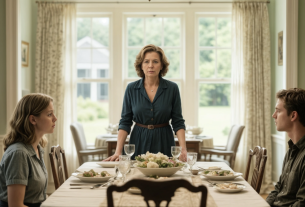
— Bought more junk again? Didn’t you need to consult with me first?
The words, thrown from the bedroom doorway, hit Alyona like a punch to the gut, instantly knocking the air—and the euphoric high—out of her. Just moments ago, after closing the front door behind her, she had happily set a large, glossy, sturdy shopping bag from an expensive boutique down on the floor in the entryway. The satisfied, solid thud as it touched the laminate had been music to her ears—the final chord of a successful day and the anticipation of a small triumph at work tomorrow. She was already imagining slipping her laptop into a new bag that smelled of leather and success, hearing the elegant click of her new heels on the office marble.
Alexey stood leaning against the doorframe, in sweatpants and a T-shirt. His face, still relaxed from a daytime nap, was changing before her eyes. The smile that had been lazily wandering on his lips didn’t just slide off—it broke, and its shards seemed to dig into his cheekbones, making them sharp and angry. His gaze, usually soft and enveloping, turned hard as a drill bit, aimed not at her, but at the brand logo on the bag.
“What do you mean, ‘consult with you’?” Alyona straightened up, and her own smile began to wither like a note left in a draft. “I saw it, I liked it, I bought it. What’s the problem?”
“What’s the problem?” He pushed off the doorframe and took a step forward, invading the space of happiness she’d only just reclaimed. “The problem is that we’re supposedly saving. Or am I mistaken? Or have we suddenly each got our own goals now?”
Alyona was stunned. The accusation was so absurd, so ripped out of reality, that for a second she lost the power of speech. She stared at him, trying to find in this man with burning eyes the Lyosha she’d been drinking coffee with and laughing alongside just that morning.
“Saving?” she finally found her voice. “Lyosh, we’re not saving for anything. We don’t have some shared goal we’re setting money aside for. We’re not buying a car or an apartment. What are you even talking about? And these are my money. Mine. I earned it, and I can spend it however I see fit.”
She emphasized the last words, feeling a cold, unpleasant irritation rising inside her. But her logic—her seemingly reinforced-concrete arguments—simply shattered against the wall of his sudden fury. Her words became the detonator.
“Your money!” he spat, and began pacing the hallway in short, nervous steps. He flung his hands around as if conducting an orchestra of grievances. “So that’s what it is! We’ve got ‘yours’ and ‘mine’ now! Let me explain to you, Alyona, how it works for normal people! For normal couples building a future together! Their budget is shared! A woman—if she respects her man—consults him before throwing half her paycheck away on yet another rag! That’s called respect! That’s called family!”
He wasn’t speaking—he was proclaiming, stamping each word. He didn’t look at her; his gaze was fixed somewhere above her head, as if addressing an invisible audience and proving his point. The bag at her feet, a moment ago a source of pride, now looked like an ugly, poisonous piece of evidence proving her guilt.
“Lyosha, stop it—this is nonsense,” she tried to cut in, but he didn’t hear her.
“Nonsense? Nonsense is when you make financial decisions alone that concern both of us! You think it’s pleasant for me to realize my woman spends money left and right while I’m thinking about how we can set ourselves up better? What are you showing me with this? That you don’t give a damn about me and our future! That your new bag is more important to you than I am!”
He stopped right in front of her. The air between them thickened, turned viscous, hard to breathe. Alyona looked at his face twisted with righteous anger and understood with icy horror: he truly believed it. All this wild nonsense he’d invented on the spot—he considered it the truth. And in that moment she realized: this wasn’t about the bag. Or even about money. It was about something else—something far scarier. It was about power.
The initial stupor caused by the absurdity of his accusations passed, replaced by something different—solid, sharp, and cold, like a shard of ice suddenly forming in her chest. Alyona let out a short laugh, stripped of any humor. In the tense entryway it sounded out of place and harsh, like the crack of breaking wood in the night. Alexey froze mid-step; his sermon faltered.
“What future, Lyosha? The one you invented five minutes ago when you saw a boutique bag? A future where you decide how I spend what I earned with my own back, sitting in the office until eight in the evening? Are you serious?”
She stepped toward him—and now he instinctively leaned back. Her face was perfectly calm, but in her eyes appeared an expression he’d never seen before: a disgusted curiosity, the look people give a suddenly revealed dirty puddle under their feet. Her calm scared him far more than if she’d started screaming back.
“I don’t understand what’s unclear about the words ‘my money.’ Should I have taken it from you? Asked you for it? No. I got my salary and bought myself what I wanted. Period. That’s the whole story. And the performance you put on here…”
His face twisted again. He couldn’t stand that calm, dissecting tone. He needed hysteria, tears, begging. He needed her weakness so he could confirm his strength against it. But all he got was cold, honed steel.
“A performance? So for you normal family foundations are a performance? The idea that a man should be the head of the family—is that a performance too? You just don’t respect me! Not one bit!”
And then the ice in Alyona’s chest cracked, releasing pure, concentrated anger—not loud or market-stall shrill, but sharp and exact, like a rapier’s thrust.
“So what? What does it have to do with you, where I spend my money, Lyosha? You’re not my husband for me to report to you! So tone it down—I’m not spending your money, I’m spending mine!”
That phrase, thrown straight into his face, became the last line for Alexey. He understood that his authority—his self-proclaimed power—had just been publicly trampled. And he went on the offensive. But this time it wasn’t chaotic pacing. He stopped, straightened his back, and completely new notes appeared in his voice—condescending, mentor-like, the way a teacher explains basic truths to a foolish child.
“I see. I understand everything,” he said slowly, looking down at her. “You just haven’t grown up yet. You haven’t grown into a serious relationship. You’re still playing at independence, like a little girl given pocket money. And I’m talking about real partnership. About order. The man earns. The man plans. The man bears responsibility. And the woman secures the rear and trusts her man. She doesn’t squander the shared resource on her little whims.”
He spoke, and Alyona watched him like an exhibit in a cabinet of curiosities. This man she thought she loved was turning before her eyes into a stranger—an unpleasant fanatic reciting dogmas from some archaic, Domostroi past. His words no longer even provoked anger—only a growing sense of disgust.
He saw that expression on her face and realized words no longer worked. And then he made his last, decisive move. He stepped right up to her, almost touching, forcing her to tilt her head up to look him in the eyes. His voice became quiet, and because of that, even heavier and more threatening. There wasn’t a trace of doubt in it—only cold, unbending will.
“Here’s how see it. Starting with your next paycheck, you’ll hand all the money over to me. I’ll decide what we need and what we don’t. Enough playing games, Alyona. It’s time to grow up.”
The ultimatum didn’t hang in the air. It fell like a guillotine, cutting the past off from the present. But Alyona didn’t scream. She didn’t answer. She just looked at him. Her gaze held no emotion—no anger, no fear, no hurt. It was long, attentive, almost scientific—the way an entomologist studies a strange, previously unknown insect. She examined his face distorted by certainty in his own righteousness, his posture full of fake grandeur, his eyes containing nothing but the hunger for absolute control. And in that dead silence she saw everything.
Without saying a word, she slowly turned and walked past him into the kitchen. Her movements were smooth and measured; there wasn’t a drop of fuss or panic. She turned on the tap, poured herself a glass of cold water, and drank it in slow, even sips. Alexey remained standing in the hallway, confused. He’d expected anything: tears, shouting, arguments, pleas. But this detached, icy silence disarmed him and infuriated him far more. Her silence wasn’t agreement—it was total, absolute disregard for him as a person, for his ultimatum as an event. She simply crossed him out of the equation.
That evening became the beginning of a new era in their apartment. When Alexey didn’t get an answer, he went to the living room and turned the TV on with deliberate loudness—a mindless action movie shaking the walls with explosions and gunfire. It was his way of claiming territory, filling the silence with his presence. Alyona went into the bedroom and closed the door firmly behind her. She didn’t cry. She took out her laptop and dove into work, building a cocoon around herself out of reports and numbers—the only understandable, logical world she had left. The apartment that had been their shared home that morning split into two hostile, non-overlapping camps.
The next week turned into a thick, suffocating nightmare without a single shout. Alexey chose a tactic of silent, methodical pressure. He behaved as though his order hadn’t merely been heard, but had been accepted without question. In the mornings they moved around the kitchen like two ghosts, carefully avoiding each other’s eyes. He demonstratively made his coffee, clinking the mug loudly, then sat with his back to her, cutting her off from his world. He stopped asking how her day at work had gone, stopped sharing his news. He simply existed nearby like a heavy, oppressive piece of furniture.
His control showed up in small things. Once she came back from the grocery store and left the receipt on the kitchen table. An hour later, returning, she saw the receipt had been moved—neatly folded, placed elsewhere. Alexey sat in an armchair reading something on his phone, but Alyona physically felt his disapproval, his mental tallying of her spending. He didn’t say a word, but that silent condemnation was louder than any shouting. He’d become a warden in her own home. Every step, every action now passed through the filter of his invisible judgment.
Alyona felt the air in the apartment growing thick, turning viscous. The scent of his cologne in the bathroom began to make her nauseous. The sound of his footsteps in the hallway made her clench inside. The love she thought existed between them evaporated by the hour, leaving behind only a scorched desert of alienation. She watched him at dinner—they ate in complete silence—and didn’t recognize him. Where had that cheerful, easy guy gone, the one she’d once laughed with until she cried? In front of her sat a stranger: a gloomy man with a heavy gaze and tightly pressed lips, convinced of his right to own her and her life. This wasn’t a cold war. It was an occupation.
The evening before payday became the climax of that silent standoff. Alyona sat in the bedroom finishing some project when his figure appeared in the doorway. He leaned on the frame exactly as he had that day a week earlier. A condescending, confident smile played on his face.
“The money comes in tomorrow,” he tossed out casually, as if reminding her of some obvious little detail. “Don’t forget.”
He didn’t say what, exactly, she shouldn’t forget. He didn’t need to. That short phrase was a finishing shot—the last nail in the coffin of their relationship. Alyona slowly raised her eyes to him. There was nothing in her look but cold, crystalline clarity. Something inside her finally clicked into place, and she understood that tomorrow really would be decisive—just not in the way he imagined.
The salary notification hit her phone at six in the evening, when Alyona—already changed into home clothes—was unloading the dishwasher in the kitchen. The brief vibration in her pocket didn’t provoke any reaction. She only froze for a second, holding a warm plate, then placed it in the cupboard with methodical calm. That sound, that message, was no longer a promise of joy or freedom. Now it was just a signal. A signal that the end was beginning.
Alexey materialized in the kitchen doorway about ten minutes later. He’d clearly been waiting for this moment all day, and now his face showed poorly hidden impatience masked as lazy, possessive confidence. He didn’t beat around the bush. He walked up as she was closing the cupboard door and held out his phone with a banking app open.
“So? I’m waiting.”
His voice was even, everyday—like asking someone to pass the salt. It wasn’t a demand or a request. It was a statement of fact, already settled in his head a week ago. He was a king come to collect tribute.
Alyona slowly turned to him. She didn’t look at his phone. She looked straight into his eyes. There was no hatred in her gaze—only a vast, all-consuming exhaustion.
“No.”
One short word. Not loud, not defiant. In the clear, ringing quiet of the kitchen it sounded soft, but it carried the weight of a granite slab. Alexey frowned, not immediately processing what he’d heard. He decided she simply hadn’t understood.
“What do you mean, ‘no’? Alyon, don’t start. We already decided everything. Come on—transfer it.”
He pushed the phone toward her again. And then she moved his hand aside—not sharply, not aggressively, but with a slow, disgusted motion, the way you push away something sticky and unpleasant.
“I said no, Lyosha. I’m not transferring anything to you. Not now. Not ever.”
Now it sank in. His face began to flush a deep crimson, rising from his neck to his temples. The confident smirk slid off, revealing the snarl of rage and wounded pride.
“What the hell do you think you’re doing?! You decided to rebel? We had a deal! I explained to you like a human being how things should be in a family, and you decided to show your attitude?”
He started raising his voice, slipping into the same rehearsed preaching intonations from the week before. But Alyona didn’t let him build momentum. She lifted her hand, stopping him.
“Sit down, Lyosha.”
Her voice was just as quiet, but steel had appeared in it. He was startled by the command and instinctively stepped back to the table and dropped onto a chair. She stayed standing, towering over him. The power in that apartment had just changed hands—finally and irreversibly.
“Do you really think it was about the bag?” she began, her tone calm as a surgeon before an operation. “Or about money? You didn’t even understand what happened. You think you were fighting for the family budget, for ‘proper foundations.’ But you weren’t fighting for that. You got scared.”
“What nonsense are you talking?” he hissed, but his posture was no longer confident. He sat hunched, pressed into the chair.
“You got scared,” she repeated, clipping each word. “Scared that I could buy myself something expensive without asking you. Not because it was ‘shared’ money—it never was. But because it showed you I don’t depend on you. That my world doesn’t revolve around you and your approval. Your whole theory about a ‘real man’ is just a screen. A cheap, pathetic attempt to cover your own fear. The fear of being unnecessary.”
She paused, letting the words sink in and eat away at him from the inside.
“A real man is happy about his woman’s success. He’s proud of her. And you… you’re jealous. It infuriates you that I might earn more than you. That I can afford things you’d have to save up for. And instead of striving for something yourself, you chose the easiest route—take it and control it. Make me dependent so you can seem bigger against my background. That’s not strength, Lyosha. That’s the most miserable form of weakness there is. You’re not a leader. You’re a parasite looking for someone to latch onto.”
He was silent. He stared at the tabletop, and Alyona watched the muscles in his jaw working. He was destroyed—not by shouting, not by a scandal, but by cold, merciless truth laid out in front of him like an unpaid bill.
“I watched you all week,” she finished, with not a drop of pity in her voice. “And I didn’t see a man, or a partner. I saw a petty, jealous, very frightened person trying to play the master of life. I don’t need a person like that.”
She turned and walked into the hallway. He lifted his eyes to her, filled with confusion and rising panic.
“You… where are you going? What are you doing?”
Alyona stopped by the front door and looked back at him over her shoulder.
“I’m not going anywhere. You are. Pack your things…