A black car came to a silent stop in front of massive wrought-iron gates. Beyond them began a short dead-end street with eight identical, solidly built houses, cut off from the rest of the world by a high brick wall.
A small, self-contained kingdom.
A security guard in a uniform jacket, bored in his glass booth, strolled lazily up to the tinted driver’s window.
“Who are you here to see?” he asked, already sure he knew by sight everyone who lived here or ever visited.
Ekaterina Sergeyevna rolled the window down.
“To see myself.”
Her gaze was fixed over his head, on the tiled roof of the house at the very end of the street. That very one.
Thirty-two years. A whole life. She hadn’t been here since that raw, damp November day when Viktor Petrovich—her stepfather—personally shoved her out through these gates with a single cheap suitcase.
“I don’t know you,” the guard frowned, peering at the unfamiliar, commanding face. “Give me the last name and the address of who you’re visiting.”
“You will soon,” she replied evenly.
A dry click sounded in the guard’s earpiece, followed by an order that made him straighten up and step back. The gates began to slide open—slowly, without a squeak.
The car glided onto the perfectly smooth asphalt of the street of her childhood. Ekaterina drove herself, slowly, almost savoring every meter.
House number three. Aunt Valya—Valentina Petrovna—her stepfather’s own sister, lived there with her perpetually dissatisfied husband and son. That day she had stood at the window, lips pressed tight, watching her with a look of righteous condemnation.
House number five. Uncle Igor—Igor Petrovich—the stepfather’s younger brother. Back then he had stood on the porch, smoking, nodding approvingly at his older brother as if to say: you’re doing the right thing, it was long overdue.
Ekaterina drove on, and in her head—like an old film reel—faces flashed past. They were all here. All of his relatives. All of them had received a house through Viktor Petrovich’s generosity when he, having widowed so conveniently, became the rightful master of her mother’s fortune. They were his family. His clan. And she had been an outsider.
She stopped in front of the last house—the biggest one.
Her house.
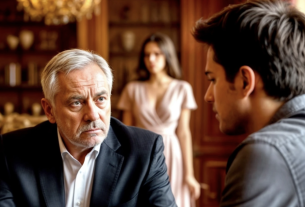
The garden was manicured to the point of fanaticism; not a single weed marred the perfectly trimmed lawn. From around the corner, leaning on a cane, appeared a gray-haired old man—still straight-backed and solid. Viktor Petrovich. He was nearing eighty, but he hadn’t lost his grip.
He looked over the expensive car, then the woman who stepped out. There was something vaguely familiar in her figure, in the costly cashmere coat, in the way she held her head—but he couldn’t quite place it.
“Did you want something?” His voice was as domineering as it had been thirty years ago. The voice of an owner.
Ekaterina took off her dark glasses. She looked straight at him, into his faded, cold eyes.
“Do you recognize me, Viktor Petrovich?”
He stared for several long seconds. His face shifted slowly: from confusion to recognition—then twisted into a disgusted, angry grimace.
“Katka? What brings you here? Come to beg for handouts? Heard I’m still alive?”
She smirked—just the corner of her mouth.
“On the contrary. I came to make you an offer.”
“Me?” He barked a short laugh. “You? Me? What offer could you possibly make me, you ragamuffin?”
Ekaterina swept her gaze over his house, then the neighboring ones. She knew curious faces were already flickering in the windows. The show had begun.
“I want to buy out this street. All of it. Along with your pathetic secrets that have grown into the walls of these houses.”
The old man stopped laughing. He stared at her, trying to understand whether she was joking or had finally lost her mind over the years.
“Get out of here,” he hissed, gripping the knob of his cane.
“I already left once,” Ekaterina answered calmly. “I won’t leave again. My assistant will contact every resident in the next few days. You will be the last.”
She got into the car.
“Think about your price, Viktor Petrovich,” she said through the half-open window. “Though your price is already known to me.”
The car turned noiselessly and rolled back toward the gates just as slowly, leaving the old man alone in the middle of his tiny kingdom—one that was collapsing before his eyes.
Viktor Petrovich watched her until the gates closed. The air around him seemed to thicken. Curtains in the neighbors’ windows stirred like the gills of frightened fish.
He spun sharply and, tapping his cane, headed for house number three, where his sister Valentina lived. The door was opened by her son Oleg—a forty-year-old good-for-nothing.
“Uncle Vitya? What was that circus out there? Who was that lady in that kind of ride?”
“Go get your mother,” Viktor Petrovich snapped, pushing past him. “And tell her to call Igor. Now!”
Ten minutes later, an emergency family council had convened in Valentina’s kitchen. News and photos of the car had flown down the street through messaging apps faster than the old man could walk over.
“She’s lost her mind,” Valentina Petrovna declared confidently, pouring valerian into cups. “Buy out the street… Where did she get that kind of money? She was sleeping at the train station when she left.”
“That car costs as much as three of our houses,” Igor Petrovich added heavily—he’d been summoned at once. “I know what I’m talking about. This is no joke.”
Viktor Petrovich slammed his fist on the table.
“Enough! I said it: nobody sells anything. Nobody talks to her or her people. This is my land. I gave you these houses, and I’ll take them back if anyone makes a move. Is that understood?”
He swept them with a heavy stare. They were used to obeying him. For decades. But today, for the first time, he saw not only fear in their eyes—he saw a greedy glint.
“What secrets did she mean?” Veronika—Igor’s daughter—asked quietly, a pale girl with a hunted look.
“Sick imagination!” the stepfather barked. “She always had weird ideas. You remember. After her mother died, she completely lost it.”
They remembered. They remembered the quiet girl who, after her mother’s death, became a living reproach to them. A nuisance.
The next day at exactly ten in the morning, a business-class taxi pulled up to house number three. A young man stepped out in an impeccably tailored suit, a leather briefcase in his hand.
He walked up confidently, rang the bell. Valentina herself opened.
“Hello, Valentina Petrovna. My name is Kirill. I’m Ekaterina Sergeyevna’s assistant. May I have ten minutes of your time?”
“I’m not talking to anyone!” she blurted, trying to shut the door.
Kirill gently held the door with his hand.
“I would strongly advise you to. This concerns your son Oleg’s debt obligations.”
“As far as I know, the sum has already exceeded ten million, and the creditors are very impatient people. Ekaterina Sergeyevna spent considerable time and resources gathering this information.”
Valentina froze. Her face turned an earthy gray.
“How do you—”
“Ekaterina Sergeyevna is offering you three times the market value for your house. That’s more than enough to pay off Oleg’s debts, buy apartments in the city for both of you, and live comfortably on the interest.”
“Think about it. It’s not just money. It’s a ticket into a different life—one where you won’t flinch every night at the sound of the phone.”
He handed her a business card.
“You have twenty-four hours. If you’re the first to agree, there’ll be a bonus. For courage.”
Kirill nodded politely and left. That same day he visited every house—except Viktor Petrovich’s.
To Uncle Igor he hinted at an upcoming tax audit of his small business, one that would uncover some very interesting schemes.
To the family in house number seven, who had a son in college, he offered to cover tuition and living expenses at any university in the world.
To each of them, he brought not just money—he brought a solution to their biggest, most shameful problem. The one they never spoke about out loud, not even to each other. The street began to buzz like a disturbed beehive.
That evening the street was unusually lively. From his window Viktor Petrovich saw Igor angrily arguing with his wife. He heard excited voices coming from house number seven.
But Valentina worried him most. She sat alone on the porch, smoking. Her son Oleg hovered nearby, talking—yet it was as if she couldn’t hear him at all.
The old man could feel his power—unyielding as the foundation of his home—beginning to crumble.
Exactly one hour before the deadline, at nine in the morning, Kirill’s phone vibrated in his pocket.
“Yes, Valentina Petrovna?”
“I agree,” the woman’s voice was dull, but firm.
“Excellent. I’ll come by now with a preliminary agreement and an advance.”
Twenty minutes later Kirill was ringing the bell of house number three again. Valentina led him into the living room, where Oleg sat on the couch with his head tucked into his shoulders. Kirill placed a folder and a small case on the table.
“A letter of intent. The amount, the terms. After signing—an advance. One hundred thousand dollars. Cash.”
He opened the case. Oleg swallowed hard. Valentina took the pen.
At that moment Viktor Petrovich burst in through the door without knocking.
“Valya, what are you doing?!” He saw the papers, the money—his face flushed purple. “I forbid it!”
Valentina slowly подняла her eyes to him. There was no fear in them.
“You can’t forbid me anything anymore, Viktor Petrovich. This is my house. And my son.”
“I gave you this house!” he roared. “I took you in—my own sister!”
“You took us in so you’d have servants and obedient slaves,” she replied evenly. “Enough.”
She signed with a firm hand. Viktor Petrovich understood he had lost.
“You’ll regret this,” he hissed. “All of you will come crawling back to me when she throws you out onto the street—just like you once begged me to throw her out!”
He slammed the door. Kirill handed the case to Valentina.
“Ekaterina Sergeyevna asked me to tell you that you may live in the house until you find new housing.”
When he stepped outside, Igor Petrovich was already waiting for him.
“I want to talk too,” he said, glancing around nervously. “What guarantees…?”
“Full guarantees,” Kirill answered. “Ekaterina Sergeyevna solves problems. She doesn’t create them.”
The first stone had been pulled out. The dam began to break. By that evening, three more had given in. The domino effect had begun.
Ekaterina watched it all from the panoramic window of her hotel suite.
“They’re breaking even faster than we expected,” Kirill said as he entered.
“They’re not breaking,” Ekaterina shook her head. “They’re simply showing their true price. They’re afraid of losing what he gave them. These houses are their cages. Beautiful, comfortable—but still cages.”
“And what about the main house?” Kirill asked. “The one that, on paper, is still registered to your mother.”
“And that, Kirill, is the main secret of this street,” Ekaterina turned to him. “He didn’t just throw me out. He forged my mother’s will. Back then I couldn’t prove it.”
“This house, this land—it was all supposed to go to me. He knew it. And they all knew it. There was an old notary, my mother’s friend.”
“He refused to falsify anything, but my stepfather threatened his family. The notary left, but before that he managed to make and notarize a copy of the real will.”
“He found me only ten years ago, before his death, and handed everything over. He said it was his debt to my mother’s memory.”
Kirill whistled.
“So that’s why they agreed so easily to throw you out. They were accomplices.”
“Exactly. Their silence was the price of my exile. And now I’ve come to take back what’s mine. With interest.”
On the third day Viktor Petrovich realized he was alone. His empire had fallen. The doorbell rang. He knew who it was. Kirill stood on the threshold.
“Viktor Petrovich,” he said politely. “Now we can talk with you as well.”
“There’s nothing for me to talk to you about,” the old man rasped.
“I’m afraid it’s no longer up to you,” Kirill replied calmly, handing him a folder. “Ekaterina Sergeyevna isn’t making you an offer. She is informing you.”
With a trembling hand Viktor Petrovich took the papers. On the first page was a copy of the will. The real one.
“There are two options,” Kirill continued. “First: you move out within a week. Quietly. In return, Ekaterina Sergeyevna does not pursue the fraud case. You simply disappear.”
He paused.
“Second option: you refuse. And then right now I call the police. And you will spend the rest of your days giving testimony. The choice is yours.”
Epilogue
A week later, early in the morning, an old taxi pulled up to the gates of the settlement. Viktor Petrovich came out of the house at the end of the street.
He was alone. A small cardboard suitcase in his hand. He didn’t look back. The new guard opened the gates in silence.
The car disappeared around the bend. Viktor Petrovich’s era ended not with thunder, but with a miserable, barely audible creak.
Half a year passed. The street had changed. In the houses Ekaterina bought, her people moved in—not relatives by blood, but those she considered her true family.
The doctor who once saved her. The old professor who became her mentor. The young family of her best partner. People tested not by feasts, but by hardship.
On a warm autumn day, for the first time in thirty-two years, Ekaterina entered her house as its owner.
She walked slowly through the rooms. The piano her mother had taught her to play. The armchair where her father read her fairy tales. In the living room hung her mother’s portrait. Ekaterina stepped closer and ran her hand over the canvas.
“I’m home, Mom,” she said softly. There was no pain in the words, no triumph—only a simple statement of fact.
She went out into the garden. The old apple tree they had planted together with her father still stood in the same place. Ekaterina sat on the bench beneath it. From neighboring plots came voices, laughter—sounds of life.
Kirill approached with two cups of herbal tea.
“Everything’s settled, Ekaterina Sergeyevna. The street is completely yours.”
“Thank you, Kirill.”
“You achieved everything you wanted,” he said. “You won.”
“I wasn’t fighting,” Ekaterina replied calmly. “People fight for what isn’t theirs. I simply took back what was mine.”
“For thirty years I built myself brick by brick on the ruins they threw me into. And then I simply built a house out of those bricks.”
“Here. Victory isn’t when you destroy your enemy’s world. It’s when you build your own world on cleared ground.”
She looked at the houses, the light in their windows, the people who had become her new family. She didn’t just buy the street.
She bought back her past to build her future. And that future was only beginning.
Write what you think about this story! It would mean a lot to me