The suitcase was still standing in the hallway, full of sand and sunshine. Dasha was emptying the side pocket, pulling out tickets, a pyramid-shaped souvenir magnet, and a dried starfish. Her tan lay across her shoulders like a fine layer of golden dust, making happiness seem like something physical, something you could almost reach out and touch.
“You know, I never did manage to get a decent photo of you in front of the Sphinx,” Dmitry said. He was sitting on the floor, unpacking the second bag. “Someone kept walking into the frame every single time.”
“But you managed to photograph that camel six times. The camel was charismatic, I’ll give you that, but you didn’t marry him.”
“I reserve the right to have a second opinion.”
“Go ahead. Just don’t bring the camel into the apartment. We just finished renovating.”
The doorbell rang.
It was Roman, Dasha’s father—a tall man with gray stubble and the same old backpack he seemed to carry everywhere. He stepped inside, placed a bag of apricots on the cabinet, and silently set a bunch of keys beside it.
Dasha looked at the keys, then at him.
 
“Dad, what’s this?”
“The apartment. Mine. Now it’s yours,” he said with a shrug, as though he were giving them an umbrella. “I’ve been living at the country house since April. I’ve got fresh air there, vegetable beds, and my radio.”
“Dad, do you understand how expensive a gift this is?”
“I understand that fifteen years ago I left, and instead of being a father, I became a birthday card that showed up once a year,” he replied evenly. “You can’t make up for that with money. But I can give you a roof over your heads. Live here. Don’t pay rent. Breathe.”
Dasha hugged him so tightly his bones nearly cracked.
Dmitry took Roman’s hand in both of his and shook it for a long time, repeating, “Thank you, Roman Ilyich. Thank you.”
The apricots smelled like summer. The keys jingled softly. It was one of those days people later remember as a beginning.
That evening, Dmitry’s mother, Nina, called.
He answered and moved toward the balcony, spending about twenty minutes murmuring agreement while turning from side to side.
Dasha caught fragments of the conversation.
“Yes… yes, we’re back… yes, we got tan… no, we didn’t get burned… yes, I’ll tell her.”
“What are you supposed to tell me?” Dasha asked when he hung up.
“She said she prepared a list for you.”
“A list of what? Tourist attractions? I’ve already seen enough.”
“No idea,” Dmitry laughed. “I even asked her again. She just said, ‘You’ll find out on Saturday.’ Maybe it’s recipes. Maybe TV shows.”
“Wonderful. Then I’ll ask my mother to prepare a list for her son-in-law. That way we’ll have balance and healthy competition.”
“Deal. Make sure one of the rules says I have to carry my wife around in my arms every Tuesday.”
“Only on Tuesdays that fall in leap years. Don’t get greedy.”
They laughed, because at that moment it really was funny.
It stayed funny exactly until it wasn’t.
 
Two days later, Dmitry’s sister Kira stopped by with her husband, Artyom.
They brought a melon the size of a motorcycle helmet and a box filled with seashells.
“You’ve already brought the sea home with you,” Kira said. “We thought we’d add a little more.”
Dasha set out plates while Artyom sliced the melon and told them about a pigeon that had moved onto their balcony and apparently possessed a very difficult personality.
“So,” Kira said with a wink. “Are you ready? Mom has prepared a surprise for you.”
“The list?” Dasha asked.
Kira blinked.
Artyom’s knife froze over the melon.
“You already know?” Kira asked, looking confused as she turned toward her brother. “Who told you?”
“Dima did. And judging by your face, you know too.”
“Well… yes. She read some of it to me.”
“How many items is ‘some’?”
“Oh, Dasha, come on,” Kira fussed, suddenly rearranging the salt shaker. “It’s just… you know, so everyone understands everything. So nobody gets offended later.”
“I love it when people schedule resentment in advance. Very organized.”
Artyom coughed and became intensely interested in cutting the melon.
Kira forced a smile and changed the subject back to the pigeon.
Dmitry sat there with the expression of a man who had walked into a movie halfway through.
 
When the guests left, Dasha stood in front of her husband and met his eyes.
“Dima. What is this list?”
“I don’t know. Honestly.”
“Your sister knows. Your brother-in-law clearly knows, judging by his face. The only person who doesn’t know is me—the person the list was written for. Doesn’t that strike you as slightly ridiculous mathematics?”
“She’ll explain when we get there,” he said, rubbing the back of his neck. “Dasha, don’t work yourself up. You know what she’s like. She loves formal wording. Even her grocery lists have titles.”
“A title is fine. As long as there aren’t subheadings.”
The next day, Dasha went to see her friend Zhenya.
Zhenya was sitting on the floor arranging samples for her workshop. She made models of underwater caves for aquariums—a strange but beautiful profession—and listened with her chin resting in her hand.
“Okay,” she said. “Let me get this straight. A list. For you. From your mother-in-law. Everyone has seen it except you.”
“Everyone. I think even the melon knew about it.”
“My friend, that is not a list. That is a constitution.”
Zhenya sat up straight and raised one finger.
“Rule one: clean her apartment every Saturday. Wet cleaning. Windows included.”
“Zhenya.”
“Rule two: deep cleaning once a month. Rule three: grandchildren according to schedule. First one in a year, second in three years, preferably a boy because the family name must continue.”
“Zhenya!”
“Rule four: money. A shared family fund. She decides what counts as a family need, and she keeps the fund.”
Zhenya took a sip from her water bottle.
 
“Rule five: verbal expense reports, but receipts required as proof.”
Dasha looked pale beneath her Egyptian tan.
“You should see your face,” Zhenya burst out laughing. “Relax. I’m making it up.”
“That’s exactly the problem. Your improvisation sounds like a direct quote.”
Zhenya’s expression suddenly became serious.
“Want some advice? Don’t argue with paper using words. Answer paper with paper. She gives you a list, you give her a list.”
“My list?”
“Yours. Same style. Same tone. And make another one from your mother for her son-in-law. If we’re doing official documents, let’s make sure everyone gets a complete set.”
Dasha pulled out her phone, opened the notes app, and started typing.
Her fingers moved quickly, as though the words had already been sitting somewhere inside her, waiting.
“Keep going,” Zhenya encouraged. “And listen. If your mother-in-law was joking, you’ll all laugh together. But if she wasn’t, at least you won’t be standing in the middle of her apartment with your mouth open like someone who’s just been handed a bill for breathing.”
“Zhenya, you’re a terrifying person.”
“I’m a prepared person. There’s a difference. It’s like insurance: unpleasant to pay for, wonderful to have.”
At home, Dasha printed two sheets of paper and slipped them into her handbag.
She placed a pen separately in the inside pocket.
When she went to bed that night, she caught herself smiling and couldn’t decide whether she was amused or nervous.
On Saturday, Dmitry put on a shirt and joked the entire way there.
“So, we’re off to sign a contract with my mother. Terms are negotiable. Penalty for breach: one jar of fruit compote.”
“Dima, I’m not laughing.”
 
“Dasha, come on. This whole thing is a joke that’s lasted a week. That’s all.”
“A joke is when two people are laughing. When everyone is laughing except me, it’s called something else.”
Nina’s apartment was crowded.
Her sister Larisa had come with her son Egor. Kira and Artyom were there too.
The table was overloaded with food: aspic, three salads, fish pie, and a pitcher of homemade berry drink.
Persik, Nina’s fat white cat, sat on the windowsill watching everyone like a strict inspector of public morality.
“Well, tell us everything!” Larisa clapped her hands. “How was the honeymoon? Was the sea warm?”
Dmitry talked for nearly forty minutes.
He told them about Luxor and the enormous columns, about how the water in Hurghada seemed to be two colors at once, about the camel with the attitude, and about how Dasha had been frightened by a moray eel and then spent half an hour insisting she had not been frightened at all.
Everyone laughed.
Egor asked to see pictures.
Artyom asked about prices.
“Well done,” Nina said when the conversation finally settled. “Congratulations again. And I’ll tell you one thing: the most important thing in a family is supporting one another. Always. In everything.”
“Yes, absolutely,” Dmitry nodded enthusiastically. “We’ll support each other. Definitely.”
“Let’s remember that sentence,” Dasha said quietly.
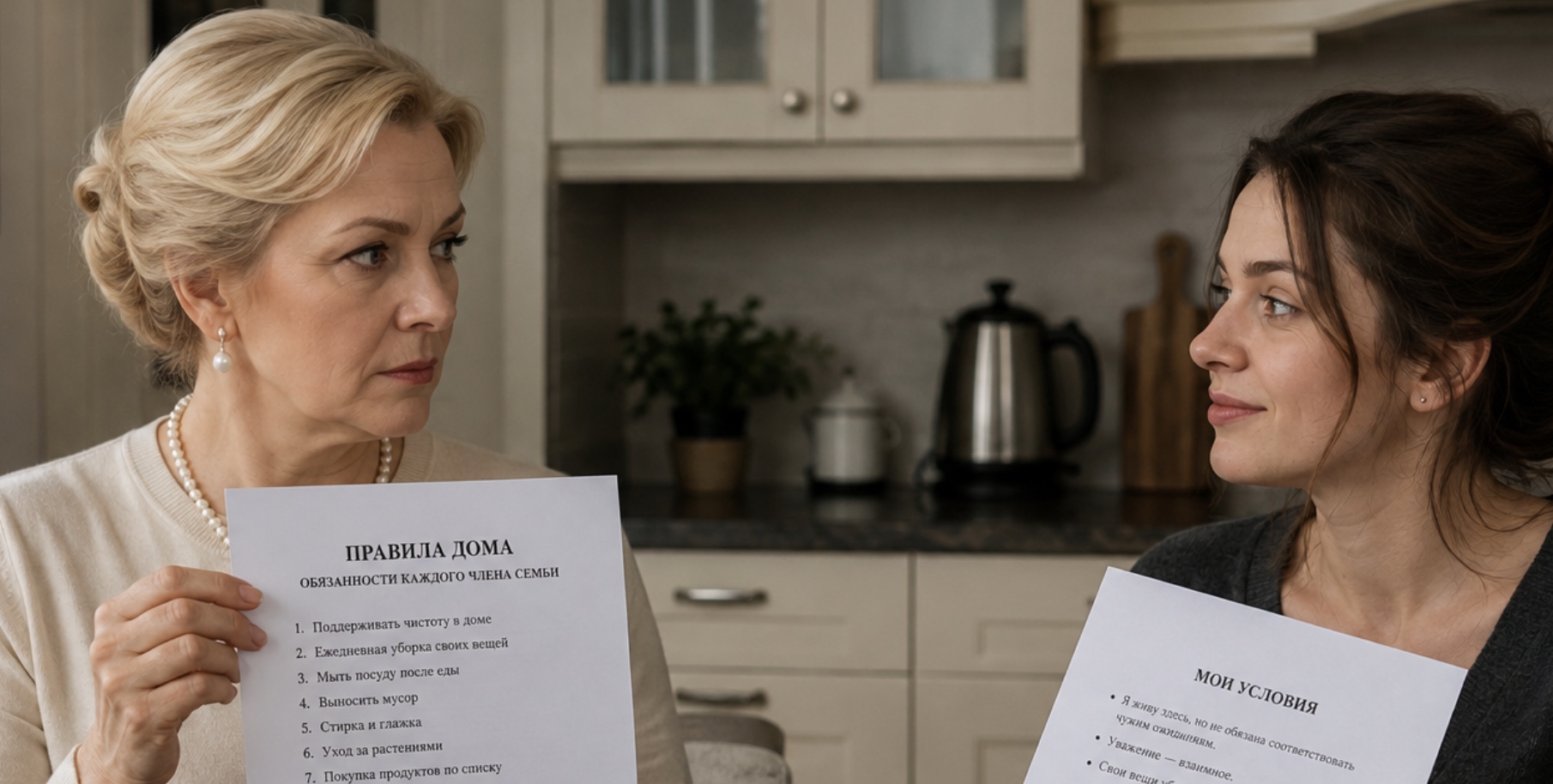
Nina stood up, disappeared into another room, and returned carrying a transparent plastic folder.
From inside, she removed a sheet of thick paper. The text had been printed in large letters, with a neat centered heading at the top.
“Here are your responsibilities in my home,” Nina said, handing the sheet to Dasha.
Dasha took it between two fingers.
She read the title.
Then the first rule.
Then the second.
Then the third.
She reached number eighteen, which said:
“Financial contribution to the family fund—monthly, no later than the fifth day of each month.”
She kept reading until she reached number thirty.
Dasha did not say a word.
She opened her handbag, took out her pen, and calmly began placing check marks beside certain items.
Tick.
Tick.
Tick.
“What are you doing?” Nina craned her neck.
 
“Working with the document.”
“What document?”
“Yours. Please don’t distract me. I’m on number eighteen. There are numbers involved.”
Kira had turned red as a boiled lobster and was studying the pattern on the tablecloth.
Larisa looked from one woman to the other and slowly put down her plate.
Egor raised his phone as though he might record something, then apparently reconsidered and lowered it.
Dasha finished making her marks, added one final dot, gently blew on the ink, and handed the paper to her husband.
“Dima. Half an hour ago, you said you would support me. I believed you. And out of the purest and noblest intentions, I gave you the best responsibilities.”
Dmitry took the sheet.
He read it slowly.
His face darkened—not because of Dasha’s check marks, but because of the words printed beside them.
“Mom…” he finally said. “What is this?”
“It’s order,” Nina snapped and grabbed the sheet from his hands.
Her eyes raced over the check marks, and her voice rose.
“Wait! These are all for her! Everything on this list is written for her!”
“No,” Dasha said, leaning back in her chair. “The list is yours, I won’t dispute that. I fully recognize your authorship. But the responsibilities are divided equally. Like a family. Would you like me to read out the assignments?”
“I do not!”
“Then I’ll do it quietly, for the historical record. Rule four: financial contribution—Dmitry. He’s a man. He has access to a calculator. Rule seven: cleaning your apartment twice a month—Dmitry. His arms are longer, so the windows should go faster. Rule eleven: taking Persik to the veterinarian—Dmitry. He even has the carrier in his trunk.”
Persik stretched on the windowsill and yawned as though giving his approval.
 
“Rule nineteen: trips to your country house twice a month—Dmitry. Rule twenty-three: monthly deep cleaning—Dmitry. Rule twenty-eight: accompanying you to all family celebrations—Dmitry. He looks good in a shirt.”
“Are you mocking me?” Nina almost shrieked. “He’s a man! He has things to do!”
“Wonderful. Believe it or not, I also have things to do. And I have a suspicion that my work and my time are no less valuable. They simply haven’t been turned into a document yet.”
“This is insolence!” Nina slapped the table, making the pitcher wobble. “I’m giving you clear rules, and you’re making a mockery of them!”
“Games have rules. What you’ve done is assign me a role, a uniform, and a schedule without bothering to ask whether I agreed to play.”
“You married into our family!”
“I married your son. You join a family. You don’t enlist in one. Do you know the difference? In a family, people say ‘thank you.’ In military service, people say ‘payment due by the fifth.’”
Artyom coughed quietly into his fist.
Larisa muttered, “Nina, really, what were you thinking…” but fell silent under her sister’s stare.
“I’m doing this for your own good!” Nina was breathing heavily now. “So you two don’t start fighting! So everything is clear!”
“Then I have a gift for you,” Dasha said, opening her handbag. “My mother is also a very organized person. She prepared a list for her son-in-law. Since you’re an author yourself, I thought you might enjoy comparing styles.”
Nina froze.
She had clearly not expected this.
Her fingers twitched as she took the sheet and began reading, silently moving her lips.
“Fifty items?” she gasped.
“Fifty-two. Two are on the back. Mom got carried away.”
“‘Call your mother-in-law at least three times a week’… ‘Financial contribution toward renovation of the country house’… ‘Accompany her on trips at her discretion’…”
Nina looked up, her face turning crimson.
“This is outrageous! Do you hear me? Absolutely outrageous!”
“Really?” Dasha tilted her head slightly. “But your list is apparently a masterpiece of tact. Interesting how quickly perspective changes when a different family name appears on the document.”
“Dima!” Nina turned toward her son. “Have you read this?”
“Dmitry will review it at home,” Dasha said, gently taking the paper back. “In a calm environment. With a pencil. And now, my second gift. I prepared too.”
She took out another sheet and laid it flat on the table in front of her mother-in-law.
“Twenty rules. Exactly twenty. I tried to keep the proportions fair. These are the rules of conduct in my home.”
“Your home?!” Nina’s voice cracked.
“My home. The apartment was a gift from my father, and legally it belongs to me. Go ahead, read it. Everything is very polite. Rule one: calls are accepted between ten in the morning and nine in the evening. At least once a day, so I don’t worry about your health. Rule two: visits must be arranged in advance, with at least two days’ notice.”
 
“What nonsense!”
“Rule three: guests should bring a small gift. There’s a list of approved gifts in the appendix. I’m not cruel—even plain bread rings are acceptable. Rule four: bring your own slippers. We don’t keep spare pairs because we believe in minimalism. Rule five: do not rearrange anything in the kitchen, inspect the pantry, or conduct refrigerator audits.”
“You… How dare you speak to me like that?”
“In exactly the same font you used to speak to me,” Dasha replied without raising her voice. “If you like, we can exchange papers. You take yours back, I take mine back, and we sit down and eat the pie. Which, by the way, is excellent. I mean that sincerely.”
“This is not up for discussion!” Nina sliced the air with her hand. “In my family, things will be done the way I say!”
And that was when Dmitry stood up.
He rose slowly and pushed his chair back.
Everyone fell silent.
Even Persik stopped licking his paw.
“Mom. You made a list. Fine. I’m prepared to take on half of the responsibilities—the ones Dasha marked for me. Every single one. The country house. The vet. Cleaning. Financial contributions. I’m not arguing.”
“At last, someone is being reasonable…”
“But you will also follow my wife’s rules. All twenty. Including the slippers.”
The words “my wife” landed in the silence like keys dropping onto a table.
Nina stared at her son.
Perhaps for the first time, she saw not the boy whose homework she could check, but an adult man standing between her and another woman—and choosing a side.
“Dima,” she said quietly. “Are you serious?”
“Completely. You said yourself that the most important thing is supporting one another. I’m supporting my wife. Half an hour ago, you practically applauded that idea.”
Kira suddenly stood and began collecting plates even though no one had finished eating.
Larisa poured herself a glass of berry drink and swallowed it in one gulp.
Egor stared at the floor with the expression of someone who desperately wished to be anywhere else.
Slowly, using two fingers, Nina pulled her list toward herself.
She folded it in half.
 
Then in half again.
“I was joking,” she said with a crooked smile. “I just wanted to test you. See what kind of character you have.”
“Have you seen enough?” Dasha smiled too, but her eyes remained watchful.
“Yes.”
“Wonderful. Then I’ll fold mine as well. But I won’t put it too far away. I’ll keep it in the top drawer. You know, like a fire extinguisher. It doesn’t eat anything, doesn’t bother anyone, but everyone sleeps better knowing it’s there.”
Outside, the evening was warm.
The asphalt still held the heat of the day like a stove slowly cooling down.
Dmitry walked in silence for an entire block.
Then he stopped beside a trash bin and looked at his wife.
“Dasha. Tell me the truth. Did your mother really write that list?”
Dasha took the sheet from her handbag and turned it between her fingers as though examining someone else’s photograph.
“No.”
She opened her hand.
The paper slipped into the trash.
“I wrote it myself yesterday. Half out of anger, half for fun.”
“Fifty-two items?”
“Fifty-two. I got inspired.”
Dmitry started laughing.
Quietly at first, then out loud.
He pulled her into his arms and buried his face in her hair.
Dasha leaned against him and said softly into his shoulder:
“I still have a copy, though. On a flash drive and in the cloud. So you, my darling, should probably read it sometime.”
“You’re a terrifying woman.”
“I’m a prepared woman. You’ll understand the difference around rule number four.”
They kissed in the middle of the street.
 
A trolleybus rolled past them.
Someone honked from a car.
A week later, Dmitry went to see his mother alone.
They talked for a long time.
There was no shouting and no slamming doors.
Dasha never asked exactly what he had said.
She only noticed that from that day forward, there were no more lists.
Not spoken ones.
Not printed ones.
Not even the kind disguised as, “I’m just reminding you.”
Why Nina had needed that list in the first place remained a mystery.
Maybe it was fear.
Maybe it was habit—the need to keep at least something tightly under control.
Maybe it was simply greed for someone else’s time, because other people’s time is so easy to treat as communal property.
That evening, Nina remained alone in her apartment.
Persik was asleep in an armchair, curled into a white comma.
Nina took an old velvet-covered photo album from the shelf and opened it to the last page.
Between the thick cardboard sheets lay a piece of paper.
Yellowed with age.
Ruled by hand.
Covered in another woman’s neat handwriting.
“Duties of a Daughter-in-Law.”
Twenty-eight items.
Cleaning.
Laundry.
Reports about money.
Arriving immediately whenever called.
Nina remembered reading it at twenty-three years old, standing in the middle of someone else’s room.
She remembered looking at her husband.
She remembered how he lowered his eyes and said:
“Nina, just be patient. She’s old.”
He had not stood up for her.
Not once.
She endured it for four years.
The list only became shorter after Dmitry was born—and even then, only because she had to carry the baby in her arms, and a person only has two hands.
Nina ran a finger over the old lines.
 
She thought about her daughter-in-law—sharp, quick-witted, carrying a pen in her handbag.
She thought about her son, who had risen from the table and said, “my wife,” as though those were the simplest words in the world.
And Nina felt envy.
Not cruel envy.
Something heavier.
Something closer to regret.
That girl had a man who stood up for her.
Nina herself had never had that.
Not for a single day.
She folded the old sheet into four, slipped it back between the pages, and closed the album.