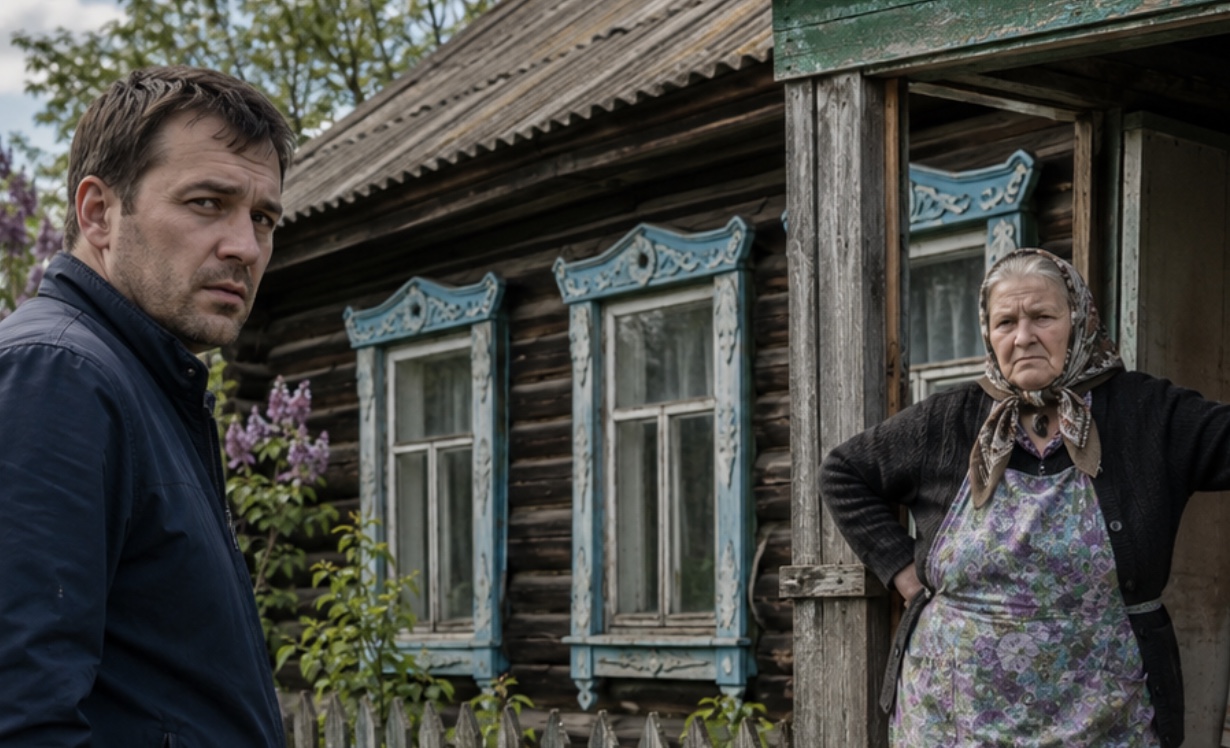
Sergey came to take his mother away during the final days of May, when the bird cherry blossoms had already fallen and the first green shoots were beginning to appear in the vegetable gardens.
He pulled up beside the gate, switched off the engine, and remained in the car for another minute, staring at the house where he had grown up. His father had built the old timber home back in the early 1970s. The porch had sagged noticeably with age, and the paint on the carved window frames was peeling, yet the walls themselves were still strong. With proper care, the house could easily stand for another fifty years.
His mother appeared on the porch, wiping her hands on her apron. When she noticed her son’s car, she narrowed her eyes at first, as though she could not believe what she was seeing. Then she suddenly became flustered and hurried down the steps in small, quick movements.
“Sergey! Why didn’t you call and tell me you were coming? I would’ve baked you some pies!”
“No need, Mom. I’m not staying long.”
She wrapped her arms around him. Small and thin, she barely reached his shoulder. She smelled of fresh milk, woodsmoke, and dried herbs. Sergey recognized that scent instantly every time—the scent of his childhood. And every time, it made something tighten painfully inside his chest.
 
“How was the drive? Are you hungry? I can fry some potatoes for you, add onions and mushrooms. You always loved them.”
“Mom, wait. I came because I need to talk to you.”
They sat down on the old bench beneath the apple tree. The young leaves had only just unfolded and were still soft, pale, and almost transparent. Sunlight filtered through them, scattering unusual patterns across the ground.
Sergey remained silent for a moment before finally speaking.
“Mom, I want to take you with me.”
She turned toward him.
“Take me where?”
“To my place. To the city. Permanently.”
His mother said nothing.
She turned toward the garden instead. Her eyes moved slowly over the freshly dug beds, the newly sprouted onions, the green dill, and the young potato plants.
“Sergey,” she said quietly at last, “I was born here. My whole life has been here. Where am I supposed to go now?”
“Mom, you’re seventy-two. You live here alone. Heating the stove is getting difficult—you’re always saying your back hurts. You carry water and then your legs can barely hold you up. Last winter you almost ran out of firewood and nearly let the whole house freeze. If something happens to you while you’re here alone, I’ll never forgive myself. Come with me. We have a three-bedroom apartment. There’s enough room for everyone. You’ll see Katya every day. Hot water, central heating, a bathroom, a toilet—everything is inside. Why should you keep struggling here by yourself?”
“I’m not alone,” his mother objected. “I have neighbors. Your father is buried here. Every corner of this place belongs to me.”
“Mom…”
She looked at him and gave him a sad smile.
“You’re trying to transplant me like some kind of plant. But not every flower survives in new soil. Some begin to wither after they’re moved.”
“You’ll get used to it,” Sergey replied with confidence. “Give it six months, and you’ll wonder why you held on to this village for so many years.”
His mother did not argue anymore.
She rose heavily from the bench and walked toward the house to pack her things.
Sergey watched her go and understood perfectly well that she did not want to leave.
He knew it.
And still, he intended to take her with him.
Because he was certain he was doing the right thing. Wasn’t it a son’s duty to bring his elderly mother into his home once living alone became too difficult for her?
At the time, he did not yet understand that caring for someone does not always mean taking them away.
Sometimes loving a person means allowing them to remain where their life truly belongs.
Sergey’s apartment really was a good one.
It was spacious, bright, and located on the eighth floor. The windows offered a broad view over the city—rooftops, streets, and a strip of green parkland in the distance. He and Marina had finished renovating it only three years earlier: new laminate flooring, smooth ceilings, a fitted kitchen, and modern doors.
Everything was comfortable.
Everything was clean.
Everything looked exactly as a modern home was supposed to look.
They gave his mother a separate room that had previously been used for guests. They put in a good bed with an orthopedic mattress, cleared out a wardrobe for her belongings, and mounted a television on the wall. They even bought a geranium especially for her and placed it on the windowsill to make the room feel warmer and more welcoming.
When Sergey carried in the final suitcase, he looked around with satisfaction.
 
“Well, Mom? What do you think? Do you like it?”
She slowly surveyed the room.
“It’s nice, Sergey. Very beautiful.”
But one look at her face told him that her words did not match what she truly felt.
She looked at the smooth floor, the modern windows, the new furniture, the pale doors—and found nothing familiar among them.
Not a single object carried any connection to her past.
Everything was neat.
And everything felt foreign.
At first, Nina Andreevna tried not to show how deeply she missed home.
She moved around the apartment carefully, as though she were only visiting for a few days. She was afraid of leaving a mark, bumping into the furniture, or putting a cup in the wrong place.
She tried to help Marina with household chores.
“Let me at least peel the potatoes.”
“No, Nina Andreevna,” her daughter-in-law would answer gently. “You sit down and rest. I can manage.”
“Then I’ll wash the dishes.”
“I’ll put them in the dishwasher. Don’t worry about it.”
And Nina Andreevna would return to her room.
Sometimes she sat in front of the television.
Sometimes she stood by the window.
At times, she could spend hours simply staring outside without saying a word.
Every morning Sergey and Marina left for work. Katya hurried off to school, and after classes she did her homework or met up with friends.
Nina Andreevna remained alone in the apartment.
From morning until almost evening.
Alone in a spacious, warm, perfectly clean home where no garden gate creaked, no neighbor’s rooster crowed, no door slammed in the entryway, and no one wandered in without warning and called out:
“Nina, put the kettle on!”
At first, she tried going outside for walks.
She would go down into the courtyard and sit on a bench near the entrance. But people simply walked past her.
Occasionally someone greeted her.
“Good afternoon.”
“Good afternoon.”
 
And then they continued on their way.
No one sat beside her.
No one asked how she was feeling.
No one cared whether the cucumbers had grown well that year, when garlic should be planted, or why the birds had returned later than usual.
The city neighbors all lived separate lives.
Before long, Nina Andreevna stopped going downstairs altogether.
After several weeks, Sergey began to notice how much his mother had changed.
She had lost a considerable amount of weight.
Her face had taken on an unhealthy grayish tone. She moved slowly now, cautiously, as though every step required effort.
Sergey often found her sitting in an armchair with the television switched off.
She would simply stare straight ahead at one fixed point.
Other times, she stood by the window.
She looked far beyond the streets and rooftops, toward the distant horizon behind the rows of apartment buildings.
“Mom, are you feeling unwell? Are you sick?”
“No, Sergey. I’m fine.”
“Let me make you an appointment with a doctor.”
“I don’t need a doctor.”
She even smiled when she said it.
But the smile looked forced, almost as if someone had painted it onto her face.
At night Sergey began to notice that his mother stayed awake for a long time. Sometimes he heard the bed creak. Sometimes there was a heavy sigh from behind her door.
One night, at around three in the morning, he woke up and went to the kitchen for a glass of water.
 
That was when he saw her.
She was sitting beside the window in complete darkness.
Her shoulders were trembling slightly.
Nina Andreevna was crying.
Quietly.
Silently.
Trying not to wake anyone.
“Mom!”
She turned sharply and hurriedly wiped her face with both hands.
“Sergey? Why are you awake?”
“Why are you awake? What happened?”
“Nothing happened. I just can’t sleep.”
Sergey switched on the small light above the table and sat opposite her.
“Mom, you’re unhappy here.”
“What are you talking about? I’m fine. It’s warm. It’s bright. I have every convenience I could need.”
“Then why are you crying?”
His mother remained silent for a long time.
Then she lowered her eyes.
“I don’t know, son. I truly don’t know. I seem to have everything I need, but inside it feels as though there’s a stone pressing down on me. Sometimes the sadness becomes so heavy I feel like screaming.”
She slowly ran her palm across the tabletop.
“Back home, someone needed me. There were chickens to feed, beds to weed. A neighbor would come over and we’d sit and talk. Someone would stop by for milk. Someone else would ask me for advice. You woke up in the morning and knew exactly why you had gotten out of bed. But here… here I feel like I’m sitting inside an empty jar. Everything is around me, yet there’s no life in it.”
“I need you,” Sergey said immediately. “Katya needs you. Marina does too.”
His mother looked at him calmly.
“No, Sergey. Don’t take this the wrong way. What you need most is the reassurance that nothing bad will happen to me. You want to know that I’m fed, warm, safe, and under a roof. That makes you feel better.”
“Mom, how can you say that?”
“I’m not blaming you. Truly. You have your own lives. Work, responsibilities, Katya to raise. That’s how it should be. But I left my life back there. I came here and somehow became unnecessary even to myself.”
Sergey wanted to argue.
He opened his mouth.
Then closed it again.
Because deep down he knew she was right.
For a long time, Marina failed to notice what was happening.
Not because she was cold-hearted. She simply had enough worries of her own. Work, the house, her daughter, shopping, bills. Her own mother also called constantly, asking why Katya was eating so poorly and whether she was dressed warmly enough.
Her mother-in-law was quiet.
 
She demanded nothing.
She complained about nothing.
From the outside, it might have appeared that she had settled in perfectly.
Then one day Marina unexpectedly finished work earlier than usual.
She returned home in the middle of the afternoon.
The moment she opened the front door, she sensed something strange.
The hallway was dark and unusually silent.
She removed her shoes and walked farther inside.
The door to Nina Andreevna’s room was slightly open.
Marina looked in—and stopped.
Her mother-in-law was sitting in an armchair without even turning on the light.
A plate of food sat on the small table beside her.
It had not been touched.
Nina Andreevna had not noticed that Marina had returned.
She simply sat there with her hands folded in her lap, staring motionlessly at the wall.
Marina quietly stepped backward out of the room, gently pulled the door almost closed, and remained standing in the hallway for a long time.
She leaned against the wall, unable to shake the image she had just seen.
That evening, when Sergey came home from work, Marina spoke to him directly.
“Your mother is fading away right in front of us.”
Sergey sank heavily into a chair.
“I know,” he admitted. “I can see it too. But what am I supposed to do? I can’t let her go back there alone. She won’t manage. Here she has everything—warmth, running water, her own room, food. What else is missing?”
Marina shook her head.
“She isn’t missing comfort. She’s missing a life. She isn’t really living here, Sergey. She’s slowly waiting for her life to end.”
“So what are you suggesting?”
“I don’t know yet,” Marina answered honestly. “But if we leave things the way they are, we’re going to lose her. Something has to change.”
The answer came from a place Marina had never expected.
A few days later, she drove to the village alone.
She said nothing to Sergey, and certainly nothing to her mother-in-law.
At first, she only intended to take a look at the old house. It was standing empty anyway. Perhaps they should sell it or rent it out. She could also sort through whatever belongings had been left behind and make sure everything on the property was still in order. Marina had never been to the village before. All she knew came from Sergey: the house was old, there was a shed beside it, a large vegetable garden, and the property stood on a gentle rise. But hearing about a place was one thing. Seeing it with her own eyes was something else entirely.
The village greeted her with a warm, windless, sunlit day.
Nina Andreevna’s house stood slightly higher than the others, halfway up a soft slope. It was old, but still solid. The grass around it had grown almost waist-high, the shed leaned a little to one side, and the garden beds were overrun with weeds. Yet beside the fence, the bird cherry tree was covered in white blossoms, full and elegant, as if someone had wrapped it in lace.
The neighbors gave Marina the key.
 
She opened the door and stepped inside.
To her surprise, the house was remarkably clean. Even though no one had lived there for quite some time, the floors had been carefully swept, the curtains looked fresh, and bundles of dried herbs hung from the kitchen ceiling—mint, oregano, and St. John’s wort.
An icon stood in one corner.
On the table lay an old photograph.
It showed Nina Andreevna beside her husband when they were young. Her face was round, bright, and happy, and she was laughing.
Marina lowered herself onto a wooden bench.
And then, unexpectedly, she began to cry.
At first quietly.
Then harder.
She sat there in the middle of that simple old house, surrounded by memories, and suddenly understood with painful clarity what they had done.
They had taken a woman out of a world that was entirely her own—a world of familiar smells, sounds, routines, soil, neighbors, memories of her husband, even every crack in the walls—and placed her in a flawless apartment on the eighth floor.
Beautiful, yes.
Comfortable, yes.
But completely foreign.
Marina stepped outside onto the porch.
From there she could see almost the entire village. The road stretched below, the river shimmered farther away, and beyond it the forest formed a dark line. Somewhere, a cow mooed and another answered. A dog barked in the distance. The warm air smelled of grass, earth, and flowering bird cherry.
And in that moment, Marina knew what had to be done.
That same evening, she gathered everyone around the table.
Nina Andreevna sat across from her. Sergey was beside his mother. Katya was doing her homework nearby, but she was listening too.
“Nina Andreevna, I went to your village today,” Marina began.
Her mother-in-law raised her head sharply.
“To my village?”
Sergey frowned as well.
“Why did you go there?”
“I wanted to see the house.”
“And?”
“And I realized something.”
Marina paused.
“The house is good. It’s still strong. The property is large. The garden is excellent. Of course, living there alone through the winter would be difficult. On that point, I agree with Sergey.”
“Exactly,” her husband interrupted immediately. “That’s what I’ve been saying. She can’t manage there by herself.”
Marina raised one hand.
“Wait. I’m not suggesting that we send your mother back there alone.”
“Then what are you suggesting?”
She looked directly at him.
“I think we should sell this apartment.”
Sergey straightened in his chair.
“What?”
“Sell the apartment and buy a house outside the city. A proper house. Warm, comfortable, with some land. Close enough that you can commute to work and Katya can still get to school easily, but with a garden, a yard, maybe a bathhouse.”
For several seconds, no one said anything.
Sergey stared at his wife.
“Marina, are you serious?”
“Completely.”
“We put so much into this place. We renovated it three years ago. The school is nearby. The shops are nearby. The clinic, my job—everything. And what would we have there? Dirt roads, mosquitoes, mud whenever it rains?”
 
“But we’d have a life there,” Marina said calmly. “Not this white box where someone spends all day alone staring at the wall.”
“You’re making it sound too simple.”
“No,” she replied. “I think I’ve finally stopped making it more complicated than it needs to be.”
She turned toward her mother-in-law.
“Nina Andreevna, would you like to live in a house? Not alone. With all of us. Somewhere with land, garden beds, flowers. Somewhere you could step outside into a yard in the morning instead of walking into an elevator.”
Nina Andreevna said nothing.
Her lips began to tremble.
Tears slowly rolled down her cheeks.
But these tears were different.
They were nothing like the tears Sergey had seen that night in the kitchen.
For the first time in a long while, there was hope in them.
“Are you really suggesting that?” she whispered. “For me?”
Marina smiled.
“Not only for you. I’m tired of the city too. The constant rush, the noise, the stuffy apartment buildings, the traffic. It would be better for Katya to spend more time outdoors too. And Sergey grew up in a village himself. He’s just forgotten that.”
Sergey lowered his head.
“It’s still a huge decision.”
“Of course it is.”
Marina moved a little closer.
“But look at your mother. In just a few months, she seems to have aged ten years. If this continues much longer, we won’t be discussing moving anymore. We’ll be discussing doctors. In a house, she’ll feel useful again. She’ll have a garden, chickens, flowers, her granddaughter nearby. Not just nearby through a wall while everyone is busy with their own lives, but truly nearby.”
“And I’ll have to drive to work every day?” Sergey asked quietly.
“Half an hour. Is that really so much? Sometimes we spend longer than that sitting in traffic now.”
Sergey looked at his mother.
Then at his wife.
Katya was already standing in the doorway, listening openly now.
“Grandma, are we really going to move into a house?” she suddenly asked. “Will we have chickens? Like you used to?”
Nina Andreevna laughed through her tears and pulled her granddaughter close.
“We will, Katyusha. We’ll have chickens. We’ll get rabbits too. Maybe even a little goat, if your parents allow it.”
“I want a goat!”
“Then it’s settled.”
Sergey stood up and walked to the window.
Beyond the glass, the apartment blocks were glowing with evening lights. Cars moved along the avenue below, and streetlamps reflected across the asphalt.
He remained silent for a long time.
“I really did think I was doing the right thing,” he finally said. “I wanted Mom to be warm. To have hot water. No firewood, no stove, no heavy buckets. Everything close by. Everything easy.”
“I know,” Marina replied.
“But instead, it’s as if I locked her away.”
“Not locked away,” Marina corrected gently. “You brought her into your world and assumed it would automatically become her world too. What you should have done was either move closer to the life she knew, or create a place that could belong to all of us.”
Nina Andreevna hurried to speak.
“Sergey, don’t turn your whole life upside down because of me. If you don’t want this, I can stay here. It’s all right. I can manage. I’ll endure it.”
Sergey turned around sharply.
“No, Mom. No more ‘I’ll endure it.’ That’s enough. Marina is right. I was a fool. I thought that if a person has warmth, running water, and every modern convenience, then they must automatically be happy.”
He looked at his wife.
“Find us a house.”
 
Marina smiled slightly.
“I already have.”
“What do you mean?”
“I stopped to look at one on the way back today.”
Sergey gave a short laugh.
“Of course you did.”
“It’s not far from the city. It’s on a hill. Your commute would be about thirty minutes. There’s a river below. The plot is around twenty sotkas. The house itself is wooden, but in good condition. And there’s a bathhouse.”
His mother stared at Marina without blinking.
“And an apple tree?” Sergey asked unexpectedly.
“There is one. Huge. Old. Full of branches. Almost like the one at your mother’s house.”
Nina Andreevna covered her face with both hands and suddenly burst into tears.
For the first time since coming to the city, she cried openly and loudly, without trying to hide, without worrying that she might wake someone.
And this time, they were tears of joy.
Two months later, the family moved.
The new house was exactly as Marina had described it.
Spacious, bright, warm.
There was a large kitchen, a real stove, a wide veranda, and a bathhouse in the yard.
On the first morning, Nina Andreevna woke before everyone else.
She stepped barefoot onto the porch and stopped.
Land stretched out before her.
Overgrown for now.
Not yet dug.
Not yet cared for.
But theirs.
A little farther beyond the property, the river glimmered. The air smelled of grass, morning dampness, and a faint trace of smoke from somewhere far away.
Nina Andreevna stood still for almost a minute.
Then she went back inside, pulled on a pair of rubber boots, took a shovel, and headed toward the garden.
Sergey came outside after her.
“Mom, where are you going? You’re supposed to rest. What about your back?”
She did not even turn around.
“I don’t need to rest anymore. Now I can do things again.”
“At least don’t start digging today.”
His mother stopped.
She turned toward him and smiled.
 
A real smile.
A lively one.
Sergey had not seen her smile like that once since bringing her to the city.
“I’m home, Sergey.”
She pressed the shovel into the ground with her foot and turned over the first layer of soil.
The earth underneath was dark, soft, and rich.
It smelled of soil, summer, and something that felt like a new beginning.
Before long, Marina appeared carrying a watering can.
Katya came running behind her with packets of seeds.
“Grandma, let’s plant carrots here!”
“We can plant carrots there.”
“And cucumbers here!”
“Cucumbers too.”
“What about tomatoes?”
“Tomatoes as well.”
Nina Andreevna thought for a moment.
“And we absolutely have to plant dill.”
“Why absolutely?”
“What kind of kitchen doesn’t have dill?”
Katya burst out laughing.
“Then onions too!”
 
“We’ll have everything,” her grandmother promised. “A little of everything.”
They worked in the garden until lunchtime.
They dug, leveled the soil, made rows, and watered them.
At first Sergey stood near the porch and simply watched.
Then he gave in.
He waved a hand, changed his shoes, and picked up a rake.
And suddenly he realized that it had been years since he had held anything like it.
Years since he had felt soft earth beneath his feet.
Years since he had listened to the wind moving through the grass.
Years since he had noticed how good it felt simply to stand beneath an open sky with nowhere urgent to go.
And it had been a long time since he had felt so light, so carefree, almost boyishly happy.
That evening, they sat together on the veranda.
Mint tea steamed on the table.
The sun slowly sank beyond the river, turning the water gold. Dogs barked to one another somewhere far away. Grasshoppers chirped in the grass.
No one wanted to disturb the quiet.
Nina Andreevna watched Marina for a long time.
Then she said:
“Marina.”
“Yes?”
“Thank you.”
Marina turned toward her in surprise.
“For what?”
“For seeing what was happening. For understanding before the rest of us did. For not letting me completely fade away in that apartment. For going to my village alone and seeing the life I had there.”
She paused.
“And for convincing Sergey.”
“I didn’t force anyone.”
“Still. You pulled me out of there. Maybe even my own daughter wouldn’t have thought to do what you did.”
Marina shook her head.
“Nina Andreevna, I didn’t save you.”
“Then what did you do?”
“I simply understood one very basic thing. A home isn’t about how many rooms you have. It isn’t the renovation or the conveniences. Home is where a person is truly living. Where they don’t spend the day waiting for it to end, but actually want to wake up the next morning.”
 
She looked toward the garden.
“In the city apartment, you weren’t living. You were slowly disappearing. Here, you’re alive again.”
Marina smiled.
“And so are we.”
After a short silence, she added:
“And you know what? I feel as if I’ve woken up too. Maybe I hadn’t really been living in the city either. I was just moving through the same routine every day. Work, shopping, home, then work again. I just never noticed it.”
Nina Andreevna placed her hand gently over Marina’s.
And so they remained sitting side by side—mother-in-law and daughter-in-law, two very different women who had somehow learned to understand each other better than many people connected by blood ever do.
The evening air grew cooler.
It smelled of smoke, fresh earth, and herbs.
Beyond the river, dusk slowly settled over the landscape.
And in that simple silence, there was more real warmth than even the most expensive renovation could ever create.