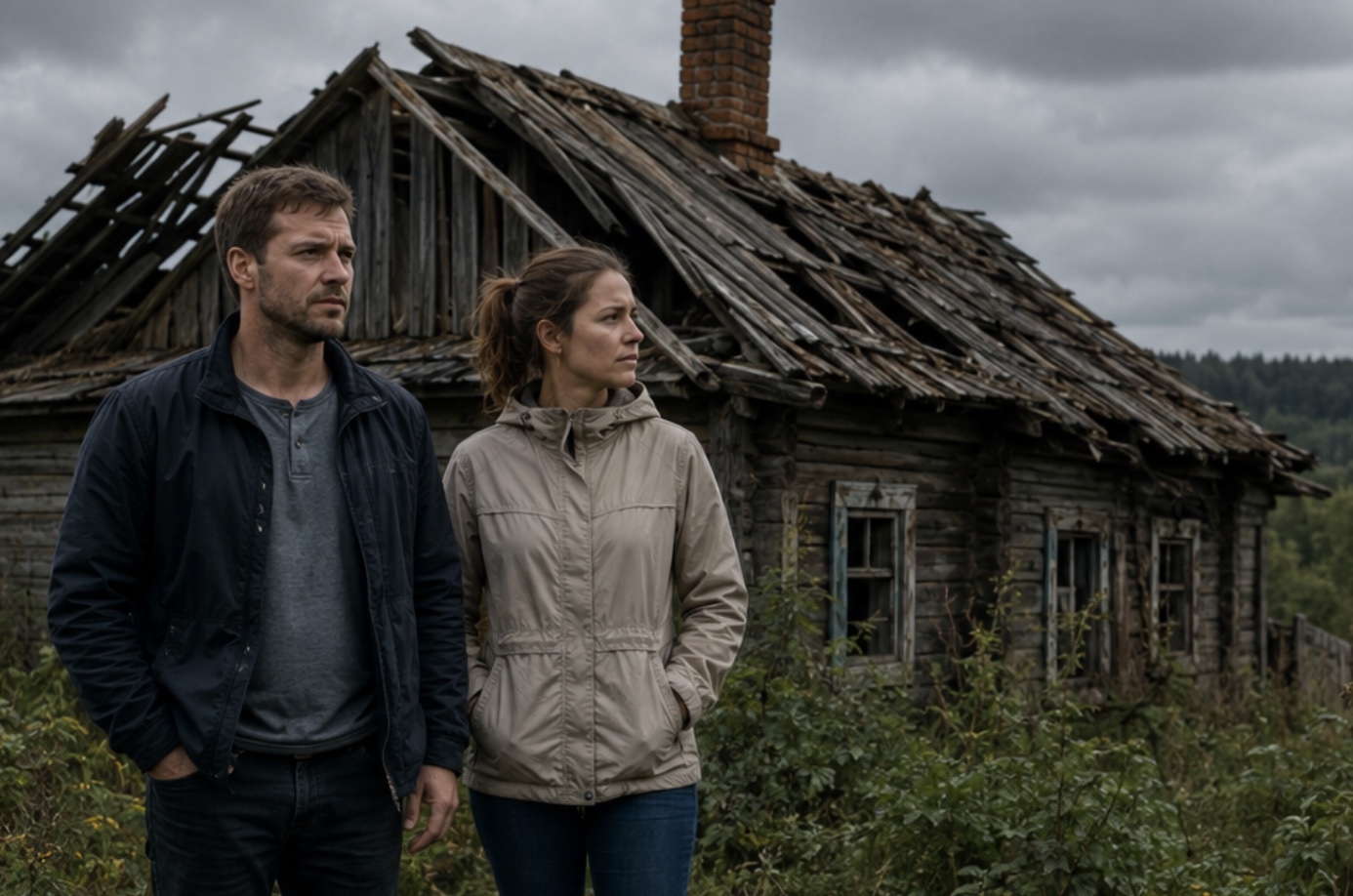
Dima and Alyona stopped in front of their new home and stood there in silence for several minutes, almost as if they were still hoping they had come to the wrong address.
The house looked as though it had been forgotten for many years. Its walls had darkened from rain and age, parts of the roof had sagged, and the empty window openings still held fragments of broken glass. Nettles had taken over almost the entire yard, growing shoulder-high in some places. All that remained of the old fence were a few crooked posts and a pile of rotten boards half-buried in the tall grass.
But once they walked around to the back of the house, the impression changed completely.
Wide meadows stretched beyond the property. Farther away, a river shimmered silver in the sunlight, and beyond it stood an old grove of linden trees. The open land seemed to run all the way to the horizon beneath an enormous, cloudless sky.
Alyona stared into the distance for a long time before finally taking a deep breath.
“Dima,” she said quietly. “Do you really think we can handle all of this?”
He turned toward his wife.
“Of course we can.”
 
“Look at the house.”
“I am looking.”
“The roof is almost collapsing. There are no windows. No fence either. And the weeds are so high you could lose a bear in the yard.”
Dima smiled.
“I warned you it wouldn’t be easy.”
He had recently turned thirty. Alyona was two years younger. Not long ago, their lives had looked completely different.
Dima worked as a programmer, while Alyona handled accounting for a small company. They had a studio apartment bought with a mortgage, a familiar commute between home and work, endless traffic jams, office walls, and a constant shortage of time.
Dima’s workday often ended late in the evening. Even after coming home, he kept answering messages and fixing things on his computer. Alyona came home just as exhausted. Her boss was always nervous, constantly demanded last-minute corrections, and could suddenly remember some urgent report only minutes before the end of the workday.
They had grown used to surviving on strong coffee and five or six hours of sleep.
Weekends brought no real rest either. They had to buy groceries, clean the apartment, deal with chores that had piled up during the week, and by Sunday evening the familiar pressure had already returned: tomorrow, everything would start all over again.
One evening, sitting together in their tiny kitchen, they almost simultaneously realized that they no longer wanted to live that way.
What had first seemed like a crazy idea gradually began to feel completely realistic.
They sold the apartment, paid off the mortgage, and then found this old village house being offered for next to nothing. After completing the purchase, they still had one hundred and twenty thousand rubles left to survive on at first.
And now they were standing in shoulder-high nettles in front of a half-ruined house, beginning to understand what they had gotten themselves into.
The village did not exactly welcome the newcomers with open arms.
It was not that the locals openly disliked outsiders. They simply did not trust them and could not understand their motives.
Why would young people from the city want an old abandoned house?
Were they planning to buy up land?
Were they trying to prove how unusual and different they were?
Or had they read too many romantic stories about rural life, decided to play at being country homeowners, and would run back to the city after the first real winter, back to asphalt roads, shops, and hot running water?
 
The neighbors began watching them almost immediately.
On the second day, Aunt Zina came over. She stopped near the place where the fence had once stood, planted her hands on her hips, and watched Dima work.
He had been fighting the nettles since early morning. Wherever he could, he cut them down with a scythe. Where the stalks were too thick, he chopped through them with an axe.
The woman watched in silence for a while, then shook her head.
“Son, do you even know how long this house stood empty?”
Dima kept cutting.
“I know.”
“No one has lived here for twelve years.”
“That’s what I was told.”
Aunt Zina looked at the half-collapsed porch, then lifted her eyes toward the roof.
“Have you seen the stove?”
“Yes.”
“It’s practically falling apart.”
“I know.”
The neighbor clearly expected more concern from him, but Dima simply continued working.
“And the well? Have you seen that too?”
This time he stopped and wiped his forehead with his sleeve.
“Yes.”
“It’s full of silt. You won’t get water from it just like that.”
“We’ll clean it.”
Aunt Zina narrowed her eyes suspiciously.
“‘We’ll clean it’… You think everything is that simple?”
“No,” Dima replied. “I understand perfectly well that it won’t be simple.”
“And did anyone tell you about winter?”
“A little.”
The woman threw up her hands.
“A little! When the snow comes down here, we can lose electricity for several days. Sometimes for a whole week. Snow piles up so badly you can’t even open the gate in the morning. And getting to the main road becomes a whole adventure.”
Dima straightened his back, set the axe aside, and wiped the sweat from his forehead.
“I know,” he said calmly.
Then, unexpectedly, he asked:
“Is the honey good around here?”
Aunt Zina blinked.
“What honey?”
 
“Bee honey. Alyona and I want to start an apiary.”
The woman stared at him as though she had finally confirmed her suspicion that something was seriously wrong with the newcomers.
For several seconds she said nothing.
Then she turned around and went home.
Within an hour, the entire village knew the news: a young city couple had bought the abandoned house, and now they were planning to keep bees.
Most of the locals laughed and shook their heads. They said the newcomers would play at village life for a while and run back to the city after the first serious winter.
Only one person did not laugh at them.
Stepan Ivanovich was considered the most experienced beekeeper in the entire area.
He was seventy-two years old. His neatly trimmed beard had long since turned silver, and his sun-darkened hands seemed permanently infused with the scent of wax and propolis. His light, attentive eyes were calm and sharp—the eyes of someone who had learned not to rush to conclusions.
Stepan Ivanovich had kept bees for forty years. People willingly bought his honey in the district center, customers ordered it from other places, and he had been invited to local fairs more than once.
When someone told him about the newcomers who planned to start their own apiary, the old man said nothing.
He only gave a small smile beneath his gray beard.
Three days later, he came to see Dima and Alyona himself.
Dima was working on the roof at the time. When he noticed an unfamiliar elderly man standing near the yard, he climbed down the ladder and greeted him.
Stepan Ivanovich went straight to the point.
 
“I hear you’ve decided to keep bees.”
“That’s right.”
“And how much do you know about bees?”
Dima answered honestly.
“Not much yet. We’re reading books and studying everything we can find.”
The old man snorted.
“Reading is useful. But a book is paper, and a bee is alive. She doesn’t know your rules from books. She lives by her own laws.”
He paused, then asked:
“What breed are you planning to get?”
“Central Russian bees,” Alyona answered as she stepped out onto the porch. “We’re also considering Carpathians. Both can handle cold weather fairly well.”
For the first time, Stepan Ivanovich looked at her with genuine interest. He had apparently not expected such an answer from a young woman from the city.
“You’re right to think about frost,” he said. “Winter is long here. But be careful with Carpathians. They’re more delicate. They need good insulation. And you’ll need to leave plenty of feed for winter. Do you know what to give them?”
“Sugar syrup. And fondant can be used too.”
The old man narrowed his eyes.
“And how do you know that?”
“My grandfather kept bees. I spent every summer with him when I was little. I used to help here and there.”
Stepan Ivanovich thoughtfully stroked his beard.
“So that’s how it is…”
He looked at Alyona, then at Dima.
“All right. We’ll see what comes of you.”
And with that, the conversation ended.
The old man turned around and left.
Their first year really was difficult.
Before autumn, they had to bring the house into at least a condition where they could survive the winter. Dima and Alyona did almost everything themselves.
Dima learned how to repair the stove, replace rotten boards, install window frames, and rebuild floors. Alyona plastered walls, painted rooms, sealed cracks, and slowly brought the interior back to life.
Their money disappeared faster than they had expected.
 
But by the first cold weather, the roof no longer leaked, the windows were intact, the stove held heat well, and a decent stack of firewood was waiting in the yard.
They bought their first bee colonies in May.
To begin with, they decided to take only three.
Dima built the hives himself using plans he found online. Alyona spent a long time choosing the best place for the apiary and finally settled on the area behind the house. It received enough sun, was protected from strong winds, and the old linden grove was nearby.
Their first real harvest came in August.
There was not much honey at all—only two three-liter jars.
But when those jars appeared on their kitchen table, they looked at them as though they were priceless treasure.
Alyona scooped up a little honey with a spoon, tasted it, and closed her eyes in pleasure.
“Dima… I don’t think I’ve ever eaten honey this good.”
He laughed.
“That’s because we made it ourselves.”
They decided to give one jar to Aunt Zina.
The other they carried to Stepan Ivanovich.
Aunt Zina was delighted when she saw the gift. She gasped, praised the young couple repeatedly, and finally hugged Alyona. From that day on, her attitude toward the newcomers changed completely. Whenever someone in the village started mocking the “city beekeepers,” Aunt Zina was the first to defend them.
Stepan Ivanovich reacted very differently.
He took the jar.
 
Opened it.
Smelled the honey.
Then he scooped up a spoonful and tasted it slowly, holding it in his mouth as though he were identifying every plant the bees had visited.
He closed his eyes.
Then opened them again.
“Linden,” he said at last. “And sweet clover too.”
Dima and Alyona waited silently.
The old man nodded.
“You did everything right. Good honey.”
Those few words meant more to them than a long speech ever could.
When they left, Stepan Ivanovich stood near his porch for a long time, watching them walk away.
The real test came in winter.
By February, the cold had become so severe that the trees cracked in the mornings from the frost.
Dima checked the apiary every day. He went from hive to hive, placing his ear close and listening for the quiet hum inside.
At first, everything seemed fine.
Then one colony began to weaken.
A few days later, the second one followed.
The sound inside the hives became quieter and quieter. Some of the bees began to die.
Alyona could not hold back her tears. Dima stayed up late into the night searching for information, reading advice from experienced beekeepers, contacting the breeder, trying to understand where they had gone wrong.
Nothing helped.
By the fifth day, they had almost accepted that they were going to lose two colonies.
That was when Stepan Ivanovich walked into their yard.
He was wearing a heavy sheepskin coat and warm felt boots, and a large sack hung over his shoulder.
He did not waste time on greetings or explanations.
“Where are the hives?”
“Behind the house,” Dima replied.
“Lead the way.”
The three of them went to the apiary.
Stepan Ivanovich slowly walked around the hives. He pressed his ear to each one, gently tapped the walls, and listened.
Then he took the sack off his shoulder.
Inside were thick reed mats, pieces of burlap, and a large coil of twine.
“They’re freezing,” the old man said. “You didn’t insulate them enough. This kind of cold is hard on Carpathians. Frost like this can destroy them.”
“What do we do now?” Alyona asked.
 
“We work. Maybe there’s still time.”
They spent the entire day insulating the hives.
Stepan Ivanovich laid down the reed mats and showed them where insulation needed to be thicker and where ventilation absolutely had to remain open. Dima fastened everything in place while Alyona handed them burlap and twine.
The old man barely explained anything verbally.
He simply showed them.
They copied him.
By the time they finished, dusk had already settled over the village. The frost was growing stronger.
Stepan Ivanovich straightened up and carefully rubbed his lower back.
“There. Now they have a chance.”
Alyona looked at him.
“Stepan Ivanovich, why are you helping us?”
The old man raised his eyebrows.
“What do you mean?”
“We sell honey too. Technically, we’re your competitors.”
He stared at her silently for several seconds, then gave a short laugh.
“Bees don’t care about your competitors. They do their work and collect honey. They don’t ask who’s going to sell the jar afterward.”
He paused, then added more seriously:
“And you’re not outsiders anymore.”
Alyona looked surprised.
“What do you mean?”
“Exactly what I said. You’re locals now. You’re one of us. You didn’t abandon the house. You didn’t run from the first difficulty. You’re bringing the land back to life. You respect the bees. That means you belong here.”
Alyona nodded without saying anything.
Stepan Ivanovich looked toward the dark outlines of the hives.
“I’m old already. Seventy-two. I don’t know how many more years I’ll be able to manage the apiary. My son doesn’t want it. He left long ago. My grandchildren don’t care either. To them, honey and ordinary sugar are almost the same thing.”
He looked at the young couple.
“But you understand bees. You feel them. You can’t learn that completely from books. Either a person has it or they don’t. So no, you’re not my competitors.”
“Then what are we?” Dima asked quietly.
Stepan Ivanovich answered simply.
“Heirs.”
He picked up his now-empty sack, threw it over his shoulder, and walked away.
A few steps later, his figure disappeared into the winter twilight.
Alyona suddenly began to cry.
Dima silently pulled his wife close.
 
They stood together in the snow-covered apiary beneath the frozen sky, listening to the weak but living hum inside the newly insulated hives.
The bees were still holding on.
And now they had a chance.
All three colonies survived the winter.
In spring, the bees quickly regained strength, and by summer something happened that Dima and Alyona had never expected: the apiary produced nearly forty kilograms of honey.
Now they faced a completely different problem—what were they supposed to do with so much of it?
They kept some for themselves, gave some away to neighbors, and decided to take the rest to the district fair.
They set up a small table, arranged the jars neatly, and prepared to wait for customers.
They did not have to wait long.
People came over, tasted the honey, and walked away. Then some of them returned to buy jars.
By evening, everything was sold.
“Where does this honey come from?” customers asked.
“From our village,” Alyona answered proudly.
“Did Stepan Ivanovich make it?”
She smiled.
“No. We did.”
In their second year, the couple added five more colonies to the apiary.
This time, Stepan Ivanovich went with them to choose the bees.
At the breeding farm, the old man carefully inspected the colonies and judged each queen with extreme seriousness.
“Take this one,” he would say. “She’s good.”
A few minutes later, he pointed at another.
“This one is hardworking too.”
 
Then he stopped by a third colony and shook his head.
“No. Not this one. Bad temperament. She’ll give you trouble.”
The seller watched the unusual group with curiosity: a gray-haired, experienced beekeeper walking between hives with a young couple, discussing, arguing, and then reaching agreements again.
Gradually, beekeeping stopped being an experiment for Dima and Alyona.
It became their life.
Dima eventually gave up his former remote job completely. Between the apiary, the house, and the rest of the property, there was so much work that almost no free time remained.
Alyona started a blog about village life and beekeeping.
She wrote about their early mistakes, showed the apiary, explained how they prepared the colonies for winter, and shared the things Stepan Ivanovich had taught them.
Within six months, ten thousand people were following her.
Messages came from all over the country. People asked questions, wanted advice about starting their own apiaries, and were interested in the couple’s experience.
Most importantly, they began ordering honey.
Aunt Zina was now so proud of the young neighbors that one might have thought she had raised them herself.
“I knew from the very beginning that they were good people!” she announced whenever she got the chance. “I said it from day one!”
No one reminded her how she had once walked around the village telling everyone about the strange city people who wanted to keep bees.
By the third year, their honey was known throughout almost the entire district.
 
A shop in the district center agreed to sell their products. Later, they received an order from a school cafeteria. Customers started coming from farther away as well—many had discovered Alyona through her blog and specifically wanted to taste the famous linden honey.
By then, the village treated Dima and Alyona completely differently.
People greeted them first.
Neighbors came for advice.
Dima was called whenever someone needed help with wiring or household repairs. Alyona helped people fill out forms, prepare applications, and deal with paperwork.
Sometimes neighbors came over for no reason at all—just to sit, drink tea, and talk.
They had truly become part of the village.
But the most important moment came in August of their third year.
Stepan Ivanovich arrived early one morning.
He came alone, slowly climbed the porch steps, and sat down on the bench.
Dima brought him tea. Alyona sat beside him.
The old man remained silent for a long time.
He looked toward the apiary, where bees were already circling above the hives.
Then he placed his hands on his knees and said:
“I’ve decided to sell my apiary.”
Dima froze.
Alyona turned sharply toward him.
The couple exchanged a glance, unsure whether they had heard correctly.
 
“What do you mean, sell it?” Dima asked first. “Stepan Ivanovich, why?”
“Age catches up with everyone,” the old man said calmly. “I’m seventy-three now. My back bothers me more and more often, my legs aren’t what they used to be. It’s time for me to start stepping away.”
Dima frowned.
“And who are you planning to sell it to?”
Stepan Ivanovich looked at him, then at Alyona.
“You.”
For several seconds, no one spoke.
Alyona almost thought she had misheard him.
“Us?” she asked.
“You,” the old man repeated. “But I don’t want any money from you.”
Dima shook his head in confusion.
“Stepan Ivanovich, that’s impossible. You have more than twenty colonies, hives, equipment… It’s all worth a huge amount of money.”
“Don’t start,” the old man interrupted. “You owe me already.”
“What do you mean?”
“Exactly what I said. Keep the bees. Continue the work. That will be payment enough.”
He fell silent for a moment, looking toward the hives.
“I’ve lived for this apiary for forty years,” Stepan Ivanovich continued more quietly. “And for all those years, one thought has always bothered me: who will get all of this after me? Who will continue it? My son doesn’t want it. My grandchildren don’t either. Selling it to the first stranger who comes along would feel like burying a living thing with my own hands.”
The old man sighed and ran a hand over his knee.
“But now I’m at peace. You’re young. You work hard. You know how to use your hands. You weren’t frightened by the old house, the winter, or the first losses. And most importantly, you love the bees. Not just as a way to make money. You genuinely love them. The rest can be learned.”
“But still…” Dima began.
“I said enough,” Stepan Ivanovich cut him off sternly. “Don’t argue with your elders.”
He slowly rose from the bench and stood for several seconds, straightening his stiff back.
The apiary stretched out before him. Beyond it stood the old linden grove. Farther away, the river glittered in the distance, while bees drifted lazily above the meadows.
Stepan Ivanovich looked at it all for a long time, as though saying goodbye to something deeply important.
Then he said:
“I only have one request.”
“What is it?” Alyona asked.
 
“Every year, bring me one jar of the very first honey. Not for sale. For me. So I can open it, smell it, and know the apiary is still alive.”
Alyona could not hold back anymore.
She stepped forward and hugged the old man tightly.
Stepan Ivanovich froze, clearly unaccustomed to such displays of affection. For a few moments, his arms hung awkwardly at his sides. Then he clumsily patted Alyona’s hair.
“There, there…” he muttered. “No need for all that.”
And then, unexpectedly, he began to cry.
Not loudly.
Not uncontrollably.
Tears simply ran along the deep lines of his face, and the old man turned away, as though he wanted to hide them from the young couple.
In all the years they had known him, Dima and Alyona had never seen him like that.
A month later, everything was officially settled.
Stepan Ivanovich transferred twenty-four strong, healthy, well-prepared bee colonies to them.
Together with their own, Dima and Alyona now had thirty-two colonies.
This was no longer a small amateur apiary behind the house.
It was a serious operation.
Their workload multiplied almost immediately.
They had to find an assistant.
They hired a local young man who, as a boy, had often visited Stepan Ivanovich and helped him carry frames, repair hives, and prepare winter feed. He already knew a great deal and, most importantly, he was not afraid of bees.
 
Dima and Alyona built a proper wintering house so the colonies could survive the cold comfortably.
They bought a new honey extractor—large, efficient, and convenient, the kind of equipment they could only have dreamed of a year earlier.
They replaced part of their old equipment.
Rearranged the hives.
Cleared another section of land.
Their days now began early in the morning and sometimes ended well after dark.
Weekends almost disappeared.
Yet neither Dima nor Alyona complained.
This tiredness felt different—honest and satisfying. The kind of exhaustion that leaves every muscle aching when you lie down at night, yet still makes you smile because you know the day was worth something.
They worked harder than ever, but for the first time in many years, they felt genuinely happy.
In September, Dima and Alyona traveled to a large regional fair.
They prepared carefully.
They poured honey into jars, designed neat labels, assembled gift sets, and Alyona ordered a simple sign with the name of their apiary.
Their stall happened to stand beside that of an elderly beekeeper from a neighboring district.
The man looked about sixty-five, with a deeply tanned face and thick gray eyebrows. He watched the young couple for a while before finally stepping closer.
“Let me taste it,” he said.
Dima handed him a small wooden spoon filled with honey.
The man tasted it.
He held it in his mouth slowly, as if separating the flavor into individual notes.
Then he nodded.
“Good.”
 
He took another taste.
“Very good.”
Dima smiled.
“Thank you.”
The beekeeper looked at the jars.
“Yours?”
“Ours,” Dima replied.
“You keep the bees yourselves?”
“Yes.”
“Who taught you?”
Alyona answered without hesitation.
“Stepan Ivanovich. He lives in our village.”
The man immediately became more animated.
“Stepan Ivanovich?”
“You know him?”
“Of course. Anyone around here who keeps bees knows him. He’s an old-school master. There aren’t many like him left.”
He looked at the honey again and nodded with respect.
“You had a fine teacher. You were lucky.”
Alyona smiled.
“We know.”
And those two words carried more gratitude than any long speech could have expressed.
They returned home close to evening.
The sun was slowly sinking over the meadows. The air was warm and golden, filled with the scent of dry grass, wax, and honey.
As Dima drove into the yard, Alyona was the first to notice someone sitting on the porch.
It was Stepan Ivanovich.
By then, he visited often. Sometimes he brought an old tool, sometimes offered advice, but most of the time he simply sat near the apiary and watched in silence.
He liked seeing the young couple work.
Perhaps it was the way a person looks at a tree they once planted themselves, a tree that has grown strong and finally begun to bear fruit.
Dima took a large three-liter jar out of the car and placed it in front of the old man.
Stepan Ivanovich looked first at the jar, then at Dima.
“What’s this?”
“Your order,” Dima replied.
“What order?”
“The first honey.”
The old man frowned as though he had forgotten for a moment.
 
“From that apiary? From mine?”
“From ours now,” Alyona gently corrected him. “But the colonies were yours.”
Stepan Ivanovich carefully took the jar in both hands.
He lifted it toward the light.
The honey was clear, thick, and golden. In the rays of the setting sun, it seemed to glow from within.
The old man looked at it for a long time.
Then he unscrewed the lid.
Slowly breathed in the aroma.
His eyes narrowed slightly.
“Linden,” he said.
He thought for another moment.
“And fireweed.”
Dima laughed.
“Exactly.”
Stepan Ivanovich took a spoon, scooped up some honey, and tasted it.
For several seconds, he said nothing.
Then his expression changed.
A smile appeared unexpectedly—wide, sincere, almost boyish.
Dima and Alyona had never seen him smile like that before.
“My honey,” the old man said.
He tasted it again and shook his head.
“Only somehow it’s gotten better.”
 
“How could it be better?” Dima asked.
“I don’t know,” Stepan Ivanovich admitted. “Same linden. Same bees. Same place. But the flavor is different. What did you put in it?”
Alyona looked at him seriously.
“Love.”
For one second, silence hung between them.
Then Stepan Ivanovich snorted.
Dima burst out laughing.
Alyona laughed too.
And a moment later, the old man was laughing with them.
The three of them sat together on the porch of the old house that had once been nearly ruined and was now fully restored.
In front of them stood a jar of fresh golden honey.
Above the apiary, the last bees of the day drifted slowly through the air.
Behind the hives, the linden grove grew dark in the evening light.
Beyond it, the river shimmered silver, the meadows stretched toward the horizon, and the village gradually settled into the warmth of an August evening.
The air was thick with the scent of grass, wax, and honey.
And in that moment, Dima thought about how they had once arrived here with almost nothing—with a collapsing house, unfamiliar neighbors, three bee colonies, and only a vague hope of starting their lives over.
Now they had a home.
They had an apiary.
They had work they wanted to devote years of their lives to.
They had people who had become family.
And they had an old man who had once simply told them, “We’ll see,” but who had eventually trusted them with the most precious thing he had spent forty years building.
Stepan Ivanovich looked at the jar again, ran his palm over the glass, and said quietly:
“Good honey.”
Alyona smiled.
“So that means we’re doing everything right?”
The old man looked at her.
“You are. Keep going.”
 
And that was enough.
Above the village, the golden evening slowly faded.
The bees hummed.
The air smelled of honey.
It smelled of earth, warm wood, and the last days of summer.
It smelled of life.
And perhaps that was exactly what happiness smelled like.