The lock clicked twice, and Natalia froze, resting her forehead against the cold upholstery of the front door. It was half past two in the afternoon. The sun was still high, boys were kicking a ball around in the courtyard, and somewhere upstairs a radio was playing. It was an ordinary weekday, no different from hundreds of others.
And yet, on that perfectly ordinary day, Natalia did something she had never done once in five years.
She locked herself inside.
From the stairwell came the sound of approaching footsteps. Heavy and dragging—Stanislav Viktorovich. Over them came the faster, sharper steps of Veronika Pavlovna. Natalia knew those footsteps by heart, the way other people knew multiplication tables. Usually, she could tell from the sound alone what kind of day awaited her.
But today she knew something else.
 
The door would remain closed.
Her heart was pounding somewhere in her throat. Out of habit, her hand reached toward the lock. Open it. Don’t make them angry. Don’t provoke another scene. Do what she had always done.
Natalia pulled her hand back and clenched it into a fist.
Enough.
Not today.
To understand how quiet, endlessly patient Natalia reached the point of locking her own door in broad daylight, you have to go back five years.
Natalia had bought the apartment herself. It was a modest two-bedroom place in a brick five-story building on a quiet street. Technically, she had not paid for all of it alone: her late mother had contributed half the money, while Natalia had taken out a mortgage for the rest long before she ever met Lev. By the time they married, almost the entire debt had been repaid.
The apartment was hers.
She had earned it, struggled for it, and decorated it exactly the way she wanted. She had sewn the curtains herself and spent months choosing the shelves.
When Lev moved in, Natalia had been genuinely happy to welcome her husband into her home.
What she had never imagined was that two other people would enter along with him—and gradually begin acting as though they owned the place.
It started with little things.
One day Veronika Pavlovna asked for a spare set of keys.
“Just in case,” she said. “You never know. You might both be at work, and I could come water the flowers.”
Natalia handed them over without thinking much about it.
A week later, her mother-in-law was already letting herself in without calling.
Natalia would come home from work and find Veronika Pavlovna cooking in her kitchen, rearranging jars inside the cupboards because it was “more practical,” or moving towels to different hooks.
“Natalia, why do you keep your grains in these ridiculous little containers?” her mother-in-law would say casually, without even stopping what she was doing. “I moved everything around. And the sugar was in completely the wrong place, so I put it closer to the tea.”
“Veronika Pavlovna, I’m actually used to having things where—”
“Used to it, are you? You’re still young. You should learn how to run a household properly.”
At first Natalia tried to object gently.
 
Eventually, she stopped.
It was easier.
Every objection led to wounded silence, pursed lips, and a long phone call between Veronika Pavlovna and Lev. Afterward, Lev would come to Natalia with the same complaint.
“Natalia, is it really so difficult for you? Mom means well. She gives us everything she has, and you treat her like she’s the enemy.”
Stanislav Viktorovich settled into the apartment in his own way.
He would arrive in the morning and lower himself into Lev’s favorite armchair—the wide, comfortable one in front of the television. He spent the day switching between fishing programs and political talk shows.
By the time Natalia returned from work, the living room smelled stale. Half-empty mugs with dried tea stood on the coffee table among crumbs and newspapers.
Her father-in-law would barely greet her.
“Oh, you’re back,” he would say over his shoulder. “Put the kettle on, will you? And I could use something to eat.”
And Natalia, sometimes before she had even taken off her coat, would go and put the kettle on.
 
Because it was easier than arguing.
Lev’s parents saw nothing unusual in any of it. In their minds, Natalia’s care was something they were entitled to—her time, her cooking, her apartment.
Nobody noticed that she was exhausted.
After all, people rarely worry about whether a servant is tired.
“Lev,” Natalia would begin at night, the only time she could catch her husband alone. “I can’t live like this anymore. This is my home. I come back and find your father with his feet up in the armchair and your mother going through my cupboards. I feel like a guest in my own apartment.”
“Here we go again,” Lev would mutter, pulling the blanket over his shoulder and turning away. “They’re my parents, Natalia. They won’t be around forever. Just be patient. They do it because they care.”
“Be patient.”
“They care.”
For five years, Lev used those two phrases to end every conversation.
And slowly, something strange began happening to Natalia.
She became afraid.
Truly afraid.
She started flinching whenever the elevator creaked to a stop on her floor. She froze when she heard someone else’s key turning in her lock. Her stomach tightened whenever those familiar footsteps appeared in the stairwell.
Her own home was no longer a refuge.
It had become a place where she was constantly on guard.
One day Natalia finally gathered enough courage to speak directly to her mother-in-law.
“Veronika Pavlovna, I’m asking you seriously. Please call before you come over. And the keys… please give them back. I want to decide for myself who comes into my home.”
She immediately regretted saying it.
Veronika Pavlovna straightened dramatically, pressed one hand to her chest, and adopted a deeply wounded expression.
“So this is how it is. You want my keys back. You’re trying to separate me from my own son! What have I ever done to you? I try to help, and you throw me out like I’m some stranger! Lev! Lev, do you hear what your wife is saying to me?”
Lev rushed in, and once again the whole situation was turned upside down.
By evening, Natalia was the guilty one.
 
Her husband lectured her for upsetting his mother, for forcing an elderly woman to take heart drops, for being ungrateful and disrespectful.
Veronika Pavlovna kept the keys.
Natalia learned another lesson.
No matter how politely she asked, she was talking to a wall.
The final breaking point came when Natalia got sick.
She came down with influenza and developed a fever close to forty degrees Celsius. Her entire body ached, her head felt as though it were splitting apart, and Lev was at work.
Natalia lay shivering beneath the blanket, wanting only to be left alone.
Then she heard it.
A key turning in the lock.
Veronika Pavlovna.
“Natalia, you’re home? Why are you lying in bed in the middle of the day?” her mother-in-law asked, walking into the room and giving her a quick glance without the slightest concern. “So you have a fever. Big deal. I spent my entire life working through illness.”
She did not bring Natalia water.
 
She did not offer medicine.
Instead, following her usual habit, she began another one of her “inspections.”
She opened the wardrobe, then the dresser, and started going through Natalia’s clothes.
In the bottom drawer, beneath a stack of bed linen, she found an envelope.
Inside were forty-two thousand rubles Natalia had been saving for months.
The money was meant for medical tests. Doctors had been telling her for some time that she needed a proper examination at a private clinic.
“Well, well,” Veronika Pavlovna said, pulling out the envelope and counting the bills with quick, practiced fingers. “What’s this little secret stash? Hiding money from your husband?”
“It’s… for the doctor,” Natalia managed through the fever, raising herself weakly on one elbow. “Veronika Pavlovna, please put it back. That’s my money. I need it for the examination.”
“An examination.”
Her mother-in-law calmly slipped the envelope into her handbag.
“Lev needs new winter tires. His current ones are completely worn out. And you’re talking about medical tests. You’ll get over whatever is wrong with you. But the car is serious.”
Natalia tried to get up.
The room tilted violently, and she collapsed back onto the pillow.
She had no strength.
Her body would not obey her, and neither would her voice.
All she could do was watch as her mother-in-law calmly zipped the handbag containing Natalia’s money.
That evening Lev came home.
 
Still burning with fever, Natalia waited for him, convinced that at least this time he would stand beside her.
“Lev, your mother took my money. Forty-two thousand. I was saving it for the medical examination. You know the doctors told me I need it.”
Lev stood in the hallway removing his shoes.
He was silent for a moment.
Then he answered in the tone of someone discussing something already settled.
“Well, what’s the big deal? I really do need new tires. I could get killed driving on the old ones in winter. You can have your tests later. Whatever health problems you have aren’t going anywhere. The car is more important right now.”
Then he walked into the kitchen to heat up dinner.
Natalia remained in the dark bedroom.
Her fever throbbed behind her temples, but through the haze one thought emerged with icy clarity.
Her health meant nothing to these people.
Her fear meant nothing.
Her money meant nothing.
Her home meant nothing.
For five years she had endured, compromised, surrendered, and bent herself smaller, hoping that one day someone would finally listen to her, appreciate her, or feel sorry for her.
They never would.
To them, she was part of the furniture.
Furniture that cooked and cleaned.
 
Natalia did not sleep that night.
She lay staring at the ceiling, but for the first time in years there was no despair in her thoughts.
There was calculation.
Cold, quiet, steady calculation.
By morning, her fever had gone down slightly.
Something else had disappeared with it—the frightened, obedient part of her that had kept her trapped for five years.
As soon as the shops opened, Natalia got dressed.
Still weak and holding onto the walls for support, she went downstairs and walked to a locksmith’s workshop nearby.
She had a little money left, saved for something completely different.
It was just enough.
Enough for one new lock and the locksmith’s labor.
By noon, the old cylinder had been removed and replaced.
There were only two keys to the new lock.
Both belonged to Natalia.
After the locksmith left, she stood in the hallway for a long moment and ran her hand over the new metal, still faintly smelling of lubricant.
And for the first time in five years, standing inside her own home, she did not feel afraid.
She felt calm.
 
It was as if someone had finally switched off the constant buzzing tension that had filled every day of her life.
The peace did not last long.
At half past two, those familiar footsteps appeared in the stairwell.
At first everything happened exactly as usual.
A key scraped inside the lock.
Once.
Twice.
It would not turn.
From outside came Veronika Pavlovna’s puzzled voice.
“Stas, what’s wrong with it? The key won’t go in. Did it break?”
“Give it here,” Stanislav Viktorovich replied.
More scraping.
More fumbling.
“It really won’t turn. Must be jammed.”
Natalia stood on the other side of the door, listening to her own heart hammering.
Then she took a deep breath.
“The lock isn’t broken,” she said quietly but firmly. “I changed it.”
Silence fell outside.
A long, bewildered silence.
 
“Natalia?” Veronika Pavlovna finally said. “Is that you? Open the door. The key isn’t working for some reason.”
“I know. I had a new lock installed this morning. Your old keys don’t work anymore.”
“What do you mean, you changed it?” Confusion still outweighed anger in her mother-in-law’s voice, as though Natalia had suddenly started speaking another language. “Why would you do that? Open the door. Stop this nonsense.”
“I’m not opening it, Veronika Pavlovna.”
That was when understanding finally hit.
A fist slammed against the door so hard that the upholstery shook.
“You’ve decided not to let us in?! Into our own son’s home?!” Veronika Pavlovna screamed, pounding on the door. “How dare you?! This is Lev’s home! Open this door immediately, do you hear me?”
Natalia did not move.
To her own surprise, her voice did not tremble.
 
“This is not Lev’s home, Veronika Pavlovna. This is my apartment. I bought it before I ever met your son. It is registered in my name. And I decide who comes inside.”
“What?! You…!” Her mother-in-law gasped. “Stas, did you hear that? Call Lev! Tell him to come immediately! She… she won’t even let us through the door!”
Forty minutes later Lev arrived.
Natalia heard him climbing the stairs, and then heard his parents talking over each other, giving him their version of events.
His wife had gone insane.
She had changed the locks.
She was humiliating old people and leaving them standing in the stairwell.
Lev hammered on the door.
“Natalia! Open the door right now! What the hell are you doing? Have you completely lost your mind?”
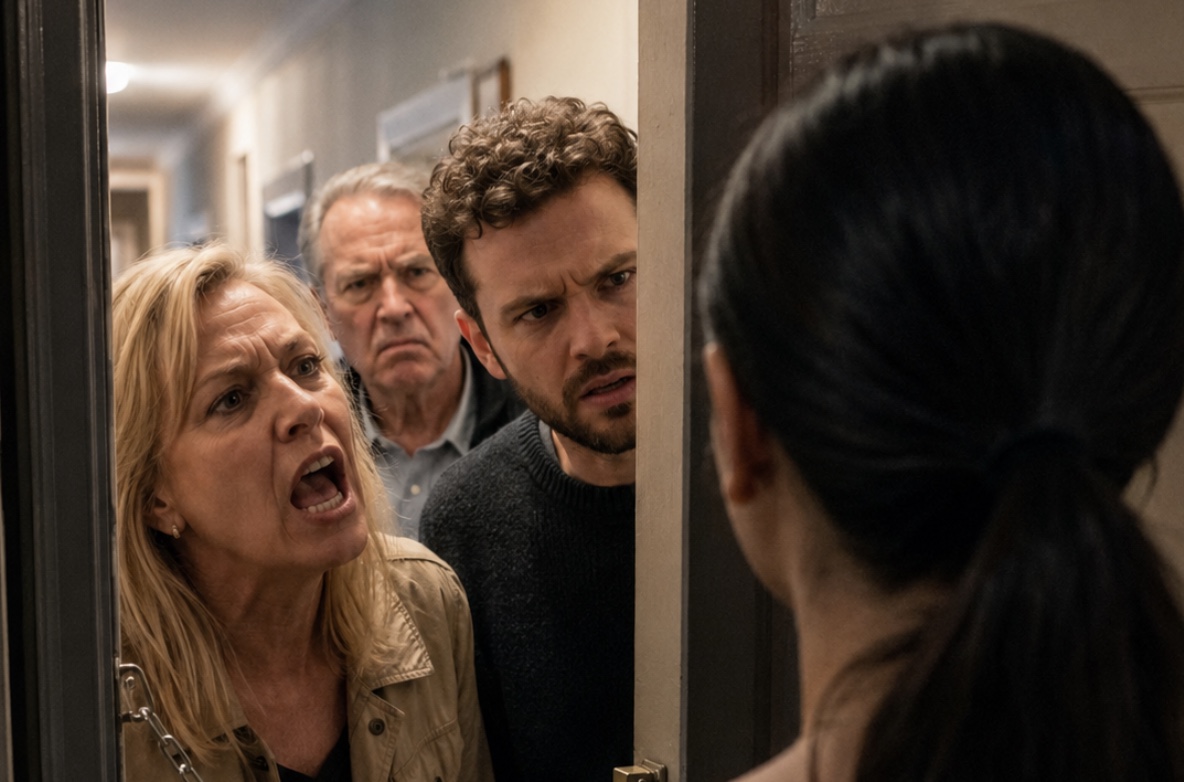
Natalia opened it only as far as the safety chain allowed.
Through the narrow gap she could see all three of them: Veronika Pavlovna red-faced from shouting, Stanislav Viktorovich scowling, and Lev between them—angry, confused, and completely unable to understand what was happening.
“Have you lost all sense of decency?” Lev demanded, leaning toward the opening. “You’ve got my parents standing out here like beggars! Let them in immediately!”
“Lev,” Natalia said quietly.
The calmness in her voice made him stop for a second.
 
“I’m not treating them like beggars. I simply refuse to let people into my home without permission when they go through my belongings and steal my money. Yesterday your mother took forty-two thousand rubles from this apartment while I was sick in bed. And you told me your car was more important.”
“You’re still talking about that money? How long are you going to keep bringing it up?”
“I’m offering you something,” Natalia said, exhaling slowly. “Come inside alone. Without your parents. Just come in, and you and I will talk as husband and wife. For once in your life, choose us instead of them.”
It was a genuine choice, placed openly before him.
Natalia stood behind the chained door, and foolishly, naively, for one final time, she hoped.
She hoped Lev would take the step.
After five years, perhaps he would finally choose his wife.
 
Behind him, his mother immediately erupted.
“Lev, don’t you dare!” Veronika Pavlovna cried, grabbing his sleeve. “She’ll manipulate you in there! Don’t go in alone with her. She’s lost her mind!”
“Son, don’t fall for it,” Stanislav Viktorovich added.
Lev stood between the closed door and his parents.
He looked at Natalia through the narrow opening.
Then he looked at his mother clinging to his arm.
The silence lasted perhaps thirty seconds.
 
Perhaps an eternity.
Natalia understood his answer before he even spoke.
“Natalia,” Lev finally said, avoiding her eyes. “Open the door. Let my parents in. They’re… they’re elderly people. You can’t treat them like this. Open it.”
Something inside Natalia, something that had been cracked for years, finally broke.
There was no pain.
It simply stopped holding her together.
“I understand,” she said. “Thank you, Lev. Now everything is clear.”
Natalia closed the door.
She removed the chain.
Not because she had changed her mind.
Because those three people no longer had any hold over her heart.
She walked into the bedroom, pulled two large travel bags down from the top shelf, and began packing Lev’s belongings.
No tears.
No hesitation.
Shirts.
Jeans.
 
His razor from the bathroom.
His phone charger.
Slippers.
The mug that said “Best Husband,” which she had given him on their first anniversary.
She filled both bags and added a few plastic bags for the rest.
Then Natalia opened the door wide.
She carried everything into the stairwell and placed it at the feet of the stunned family.
“There you go, Lev. These are yours,” she said. “You made your choice. I’m not angry. Really. Just live where you chose to belong.”
“You… you’re throwing me out of my own home?” Lev’s voice cracked.
“It isn’t your home. I already explained that. I’m returning you to your parents. They’re so determined to hold onto you—so now you can all hold onto one another.”
“You’ll regret this!” Veronika Pavlovna shouted, pointing a finger at her. “We’ll drag you through the courts! This is marital property! Lev is registered here! You’ll end up with nothing!”
“I will get something,” Natalia replied, looking directly into her mother-in-law’s eyes without the fear she once felt. “I’ll get peace. And I’ll get my home back.”
Then she closed the door.
Calmly.
Without slamming it.
The new lock clicked into place with a clean, reassuring sound.
For a long time they continued shouting outside.
 
They knocked.
Then the knocking became less frequent, the voices grew quieter, and finally the stairwell fell silent.
Natalia leaned against the door and slowly slid down until she was sitting on the hallway floor.
She did not cry.
She wrapped her arms around her knees and listened.
Silence.
Real silence.
For the first time in five years, it belonged entirely to her.
A silence in which she did not have to flinch at approaching footsteps.
What Natalia did next, she did without fear and without rushing.
 
Her mother-in-law’s threats about “marital property” turned out to be meaningless.
A week later Natalia gathered every document she had: the purchase agreement, the mortgage records, proof of payments, everything showing dates from before the marriage.
Then she filed for divorce.
The lawyer she consulted barely saw anything complicated about the situation. Natalia had acquired the apartment before the marriage using her own money and funds from her mother. It was not jointly acquired property.
Lev’s registration at the address did not make him an owner.
There was nothing to divide.
Veronika Pavlovna still tried to create a scandal among acquaintances, telling everyone that Natalia had “thrown her son into the street.”
But gossip meant very little against signed documents and official records.
Lev moved back in with his parents.
Back into his childhood room.
Back to the mother who ironed his shirts.
Back to the father who now occupied an armchair in his own apartment.
About two months later, Lev appeared again.
This time he came alone.
Natalia was returning from the store when she noticed him standing outside the building.
 
He looked thinner, tired, almost disheveled.
He held a bouquet of flowers that appeared to have been in his hands for quite some time.
“Natalia. Hi. I… I’ve been thinking. Maybe we could start over? I understand everything now, honestly. I was wrong. Mom went too far. I didn’t protect you. I’ve changed. Couldn’t we try again?”
Natalia stopped a few steps away.
She studied the familiar face and the tired bouquet.
She felt no anger.
No pain.
Only calm indifference.
“Lev,” she said, “do you remember standing outside my door? I asked you for one thing that day. To come inside alone. One step. That was all. And you made your choice. I’m not angry with you. But the door you refused to walk through that day is still closed to you.”
“Natalia, please…”
“Take care of yourself.”
She walked past him.
Natalia went upstairs and closed her door.
This time she did not even listen to hear whether Lev had left or was still standing outside.
It no longer mattered.
The apartment remained entirely hers—hard-earned, fought for, and finally returned to her.
Veronika Pavlovna lost the home where she had spent five years behaving like the owner, along with the power she had held for so long that she had mistaken it for a right.
 
Stanislav Viktorovich returned to sitting in the armchair in his own apartment.
And Natalia rearranged her furniture exactly the way she liked it.
She sewed new curtains—light-colored ones covered in large daisies.
For the first time in years, she stopped flinching at the sound of the elevator, at footsteps in the stairwell, or at a key turning somewhere nearby.
Now the only key that opened her door was hers.
Sometimes in the evening, while making tea in the quiet kitchen that finally felt truly like her own, Natalia still caught herself listening toward the hallway out of old habit.
Footsteps.
The elevator.
Voices.
But her heart no longer tightened.
Whoever was out there was simply passing by.
Their footsteps belonged to strangers going somewhere else—downstairs, upstairs, farther along.
They had nothing to do with her.
And every time Natalia realized that, the thought awakened a quiet feeling in her chest, one she had almost forgotten existed.
It took her a moment to remember its name.
Peace.