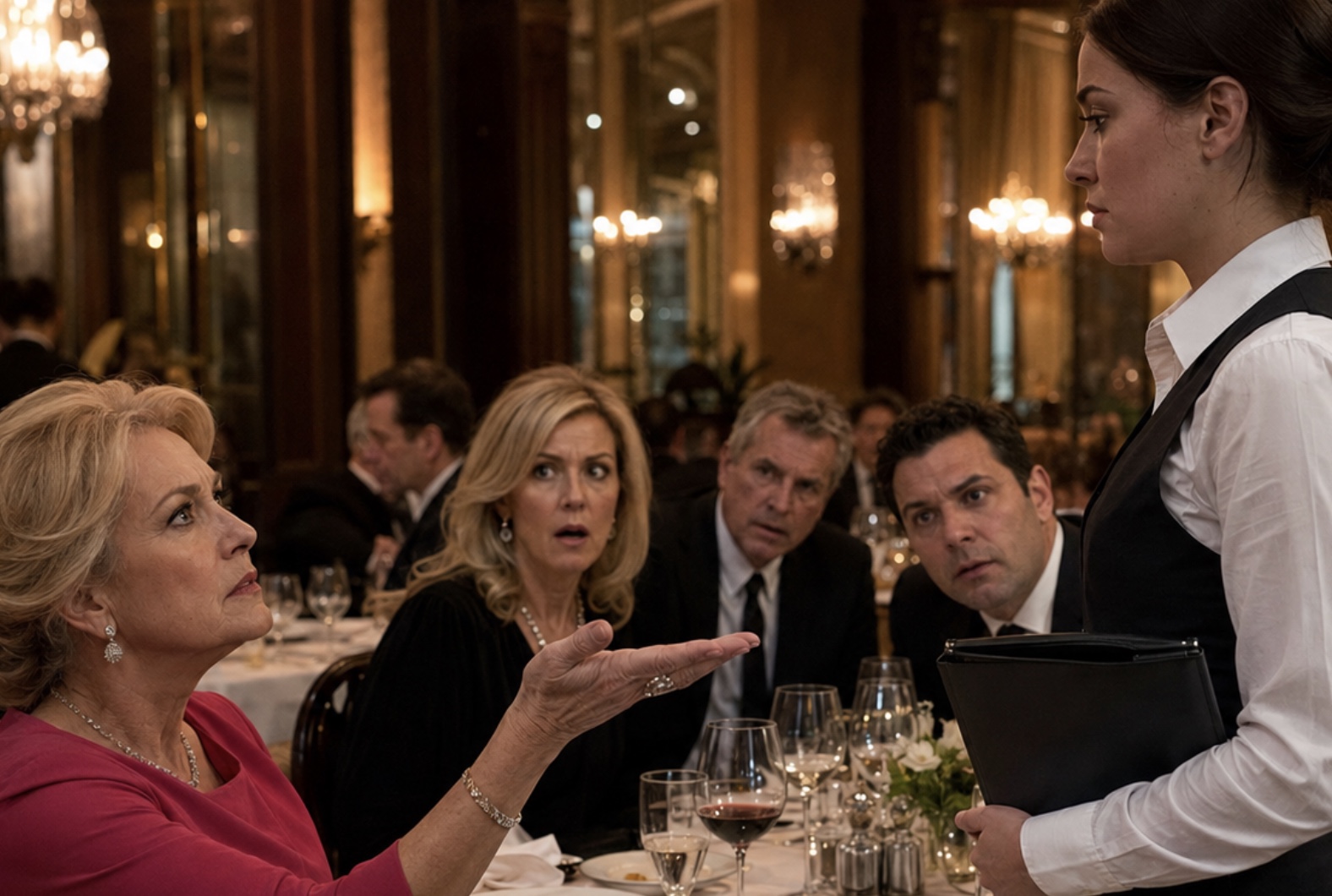
The waitress froze beside the table, the serving tray still balanced in her hands.
One second.
Two.
Three.
The tray trembled almost imperceptibly, and the glasses gave a faint clink—so faint that only Raisa Valeryevna heard it. She had been listening for exactly that sound. Waiting for it.
Albina stared at her mother-in-law.
Raisa Valeryevna stared back.
Between them lay a thick leather check presenter. Heavy, solid, still unopened. Even that was deliberate.
“You’re paying our bill! You’re treating us, aren’t you?” Raisa Valeryevna said.
It did not sound like a question.
It sounded like a verdict delivered by someone absolutely certain that no appeal would be accepted.
Five elegantly dressed women sat around the table. They exchanged cautious glances—the kind people share when they sense that something uncomfortable is happening and understand that it would be wiser not to interfere.
They had eaten foie gras and washed it down with aged wine. They had ordered oysters and marbled beef. And throughout the evening, Raisa Valeryevna had encouraged them.
“Go ahead, girls. Order whatever you want. Don’t be shy. My daughter-in-law is taking care of everything.”
So they had.
Albina carefully placed her tray on the empty table beside them.
Slowly.
Precisely.
Then she straightened, picked up the leather folder, opened it, and looked at the total.
Her face remained perfectly calm.
Not a muscle moved.
“Just one moment,” she said.
Then she walked toward the back of the restaurant.
Raisa Valeryevna leaned back in her chair like a victorious general. She lifted her wineglass and took a satisfied sip.
Victory had always seemed easy to her because she understood women like Albina—or believed she did.
Quiet girls.
Polite girls.
Well-mannered girls.
They broke easily if you applied enough pressure.
The only important thing was knowing where to press.
And yet everything had started very differently.
When Gena first brought Albina home to meet his mother, Raisa Valeryevna had actually been pleased.
The girl was attractive, reserved, and tastefully dressed. Not in the flashy way of someone trying to look wealthy, but with the quiet confidence of someone who had grown up around money and did not need to advertise it.
Albina was only nineteen, yet she carried herself like an adult.
More importantly, during the conversation she casually mentioned that she came from a large family where nearly everyone was involved in business.
One uncle owned restaurants.
A cousin worked in construction.
Her parents were financially comfortable as well.
Raisa Valeryevna immediately became much more interested.
She considered herself a practical woman, which in reality meant she had always been much better at calculating other people’s money than managing her own.
Gena was a good son, of course. He worked at a bank, his career was progressing nicely, and he had prospects.
But a man had only one mother.
And in Raisa Valeryevna’s opinion, that mother deserved attention, care, and—most importantly—a comfortable life.
If her future daughter-in-law came from a wealthy family, the possibilities changed dramatically.
Almost immediately, Raisa Valeryevna began imagining them.
A summer cottage in a respectable area.
A vacation at a decent resort.
A fur coat for winter—not necessarily full-length mink, but something respectable.
She even became noticeably kinder to Albina. She smiled more during family dinners and repeatedly asked about her parents and relatives.
The illusion collapsed during the third or fourth dinner.
The conversation turned to money, as conversations around Raisa Valeryevna often did.
Not directly, of course.
It began with somebody’s wedding, then somebody’s new car, then somebody else’s apartment in a newly built complex.
Eventually Raisa Valeryevna casually remarked how fortunate young couples were when they could rely on their parents.
That was when Albina calmly said that she had no intention of relying on her family.
She did not expect anything from them.
She wanted to achieve everything in her life on her own.
It was a matter of principle.
Raisa Valeryevna stared at her as though Albina had just announced that the Earth was flat.
“A matter of principle?” she repeated.
“Yes,” Albina replied with a soft smile. “It is.”
There was no embarrassment in her voice.
And no apology.
From that evening onward, Raisa Valeryevna began seeing her future daughter-in-law differently.
A student.
A waitress.
Someone earning very little money and saving it for goals Raisa Valeryevna could not understand.
A girl obsessed with principles, as though principles could pay the bills.
She came from a wealthy family, yet lived on tips.
Her uncle owned a restaurant, while his niece carried plates to strangers.
Raisa Valeryevna could not understand it.
And she instinctively disliked anything she could not understand.
Albina and Gena had a modest wedding because Albina insisted on it.
Gena agreed easily.
In fact, he agreed with his wife on many things, which Raisa Valeryevna quietly added to her growing list of complaints.
The newlyweds rented an apartment.
Small, but in a good neighborhood.
They paid for it themselves.
They asked nobody for help.
And that was when Raisa Valeryevna began what she privately called “the fight for fairness.”
Now Gena had rent to pay.
Now Gena had a household of two people to support.
Now Gena was building his own life.
And all of that meant one thing.
He gave his mother less money.
Much less.
Technically, he still helped her regularly. He called, brought groceries, visited, even repaired the kitchen faucet that had been dripping for nearly three years.
But that was not the kind of help Raisa Valeryevna wanted.
It would not pay for the mink vest she had been dreaming about since autumn.
It would not cover a New Year stay at a fashionable health resort with entertainment, live music, and skiing for those who wanted it.
When Gena once again gently explained that he could not afford such expenses because he had other financial responsibilities, Raisa Valeryevna could barely hide her anger over dinner.
By then, she knew exactly who was responsible.
She had known for quite some time.
His wife.
That daughter-in-law with all her precious principles.
Raisa Valeryevna complained to her friends one afternoon over tea and cake.
There were five of them in total—her dependable circle, the kind of friends who were always on your side, always ready to agree, always ready to become outraged on your behalf.
Galina exclaimed, “What kind of behavior is that?”
Lyuda shook her head.
“You need to teach her a lesson.”
Vera added, “Otherwise they start thinking they can do whatever they want.”
Nina said nothing, but her expression was supportive enough that her silence counted as agreement.
By then, Raisa Valeryevna already had a plan.
It formed quickly, the way plans often do in the minds of people who mistake revenge for education.
Albina worked as a waitress at an expensive restaurant in the city center.
Just before the holidays the place would certainly be crowded, noisy, and chaotic.
And right in the middle of all that noise would be her daughter-in-law carrying a tray.
Perfect.
“Girls, I’m inviting all of you to dinner,” Raisa Valeryevna announced. “We’re going somewhere nice.”
Galina clapped her hands.
Lyuda laughed.
“And who’s paying?”
Raisa Valeryevna merely smiled.
The five women arrived at the restaurant that evening dressed for an occasion.
All were over fifty, wearing elegant coats with fur collars and carrying expensive-looking handbags. They entered with the unmistakable confidence of people who intended to enjoy themselves thoroughly.
The maître d’ began leading them toward a table.
Raisa Valeryevna deliberately changed direction.
She did not want the table he had selected.
She wanted another one.
One in Albina’s section.
Albina noticed them immediately.
There was the briefest pause.
Almost invisible.
Then she approached carrying menus.
“Good evening.”
She placed a menu in front of each woman.
“Hello, Albinochka,” Raisa Valeryevna said cheerfully. “We came to see you. Make sure you take good care of us.”
And then they began ordering.
They took their time.
They chose carefully.
With every new dish, Raisa Valeryevna encouraged them.
“Order it. Go ahead. Don’t be shy.”
Foie gras.
Oysters.
Roasted duck with truffles.
Medium-rare marbled beef.
A bottle of aged red wine.
Then another.
Afterward came dessert.
Chocolate fondant.
Crème brûlée.
Tiramisu.
Her friends ordered freely.
They ate.
They drank.
They laughed.
They talked about their own lives.
Only Nina occasionally glanced at Albina with an expression that was difficult to interpret.
Albina continued working.
Calmly.
Professionally.
Without unnecessary conversation.
She smiled at the guests.
Confirmed their orders.
Answered questions.
And did her job.
Raisa Valeryevna watched her all evening with growing satisfaction.
Go ahead, she thought.
Keep pretending you have principles.
We’ll see how strong those principles are now.
Once the desserts were finished and the wine was gone, Raisa Valeryevna raised her hand.
“The bill, please.”
Albina brought the leather folder and placed it on the table.
Raisa Valeryevna picked it up but deliberately did not open it.
Instead, she looked at her daughter-in-law.
“You know, Albina, there’s a big difference between ‘I don’t want to’ and ‘I can’t.’ They’re two completely different things.”
She slid the folder toward the edge of the table.
Closer to Albina.
“Now you need to make the only sensible choice.”
Then she smiled.
“You’re paying our bill. You’re treating us, aren’t you?”
The women around the table went silent.
Nina stared down at the tablecloth.
Albina picked up the folder.
Opened it.
Read the amount.
Her expression did not change.
“Just one moment,” she said.
Then she walked away.
Raisa Valeryevna waited.
Five minutes passed.
Then another five.
Her friends began exchanging glances that were considerably less confident than before.
Lyuda finally whispered, “Maybe she went to get the money?”
Galina gave a nervous laugh.
Then a man approached their table.
He was tall, well dressed, around fifty, and moved with the quiet confidence of someone who had spent many years successfully managing something substantial.
“Good evening,” he said politely. “My name is Andrei Borisovich. I own this restaurant.”
He paused.
“And I’m Albina’s uncle.”
Raisa Valeryevna’s mouth fell open.
“I understand there has been a small misunderstanding,” he continued calmly. “My niece, naturally, will not be paying for your dinner. That is out of the question.”
He placed the leather folder on the table.
The same folder.
“So I must ask you to settle the bill yourselves.”
Raisa Valeryevna turned toward her friends.
Galina stood first.
Without saying anything, she grabbed her handbag and put on her coat.
Lyuda followed.
“I have to get up early tomorrow,” she muttered.
Vera was already standing.
Nina was the last to leave.
She paused for just a second and looked at Raisa Valeryevna.
There was no triumph in her eyes.
No mockery.
Only something resembling pity.
Perhaps that made it even more humiliating.
Within a minute, Raisa Valeryevna was alone.
Alone with the bill.
Andrei Borisovich remained standing nearby.
Waiting.
He did not need to explain anything.
He simply waited.
And somehow that silence said everything.
Raisa Valeryevna opened her handbag.
Counted the money inside her wallet.
Closed it.
Then opened it again.
For the first time that evening, an expression appeared on her face that she had always hated seeing on other people.
Confusion.
Helplessness.
“I…” she began.
“I understand,” Andrei Borisovich said calmly. “In that case, I can offer you two options. The first is that I call the police.”
He paused.
“The second is that you come here during the next week and work off the debt. We need someone to help with cleaning and kitchen duties.”
Silence.
Soft music played around them.
Cutlery clinked against plates.
At another table, somebody’s children laughed.
“The second option,” Raisa Valeryevna whispered.
She returned to the restaurant every day for the next week.
She put on an apron.
She picked up a mop.
She plunged her hands into hot soapy water over a sink overflowing with dirty plates.
She said very little.
She worked.
Albina was there during those shifts as well, serving her tables, speaking with guests, moving around the restaurant with her usual quiet professionalism.
The two women barely looked at each other.
Sometimes their paths crossed in the kitchen, beside the service counter, or in the narrow hallway outside the storage room.
Each time, Raisa Valeryevna looked away.
She was afraid.
It was a new kind of fear.
Bitter and unfamiliar.
She was terrified Gena would discover what had happened.
She worried the neighbors might find out.
She worried her friends would hear about it—although judging from the silence of her phone all week, they already understood enough.
Most of all, she feared that one of the restaurant’s regular customers might recognize her.
After all, this was a respected restaurant in the heart of the city.
On the final day, Raisa Valeryevna took off her apron and prepared to leave.
Albina stopped her in the hallway.
They stood facing each other.
A young woman with tired but clear eyes.
And an older woman who somehow seemed smaller than she had a week earlier, stripped of the arrogant confidence with which she usually entered every room.
“Raisa Valeryevna,” Albina said. “There’s something I want to tell you.”
Her mother-in-law remained silent.
“If you’ve learned the lesson,” Albina continued, “I won’t tell anyone what happened.”
Raisa Valeryevna looked at her.
“Not Gena. Not your friends. Nobody. It stays between us.”
Raisa Valeryevna did not answer immediately.
Then she nodded once.
A short movement, as though even that small gesture cost her something.
She stepped outside into the cold evening.
Shop windows glowed along the street.
The air smelled of snow and mandarins.
People in festive clothes hurried past, busy with their holiday plans.
Raisa Valeryevna stood on the restaurant steps for a moment.
Then she walked toward the bus stop.
The family celebrated New Year quietly.
Gena brought mandarins and champagne.
The three of them sat together, watched television, talked occasionally.
Raisa Valeryevna was unusually quiet.
Albina did not try to fill the silence.
She simply sat there, smiled when appropriate, and poured more tea.
At one point, Gena stepped onto the balcony to watch the fireworks.
His mother and wife remained alone at the table.
Several seconds passed without a word.
“Thank you,” Raisa Valeryevna suddenly said.
Softly.
Without explaining what she meant.
Albina looked at her.
Then nodded.
They never spoke about it again.
The mink vest was never mentioned again.
Neither were expensive New Year vacations.
Raisa Valeryevna began calling Gena less often.
And when she did call, it was usually just to ask how he was doing—not to make another request for money.
Gena noticed the change but never questioned it.
He was intelligent enough to understand that sometimes it was better not to ask.
Only once, in the spring, while he and Albina were driving home after Sunday lunch at his mother’s apartment, he said:
“You know, Mom seems… different somehow. Calmer, maybe.”
Albina looked through the window at streets shining with April rain.
“People change,” she replied. “Sometimes they just need time.”
Gena nodded and changed gears.
Outside, they passed the window of a flower shop filled with tulips, daffodils, and the first delicate hyacinths of spring.
Albina remained silent.
She was thinking about the fact that some things did not need to be explained.
Some lessons were not learned through lectures or arguments.
They were learned through experience.
Through burning-hot water in a restaurant sink.
Through the weight of a mop in your hands.
Through the silent looks of friends who suddenly turned out to be far less loyal than you once believed.
And Albina thought about something else as well.
Raisa Valeryevna had been right about one thing.
There really was an enormous difference between saying, “I don’t want to,” and saying, “I can’t.”
She had simply discovered that difference in a completely different way than she had intended.