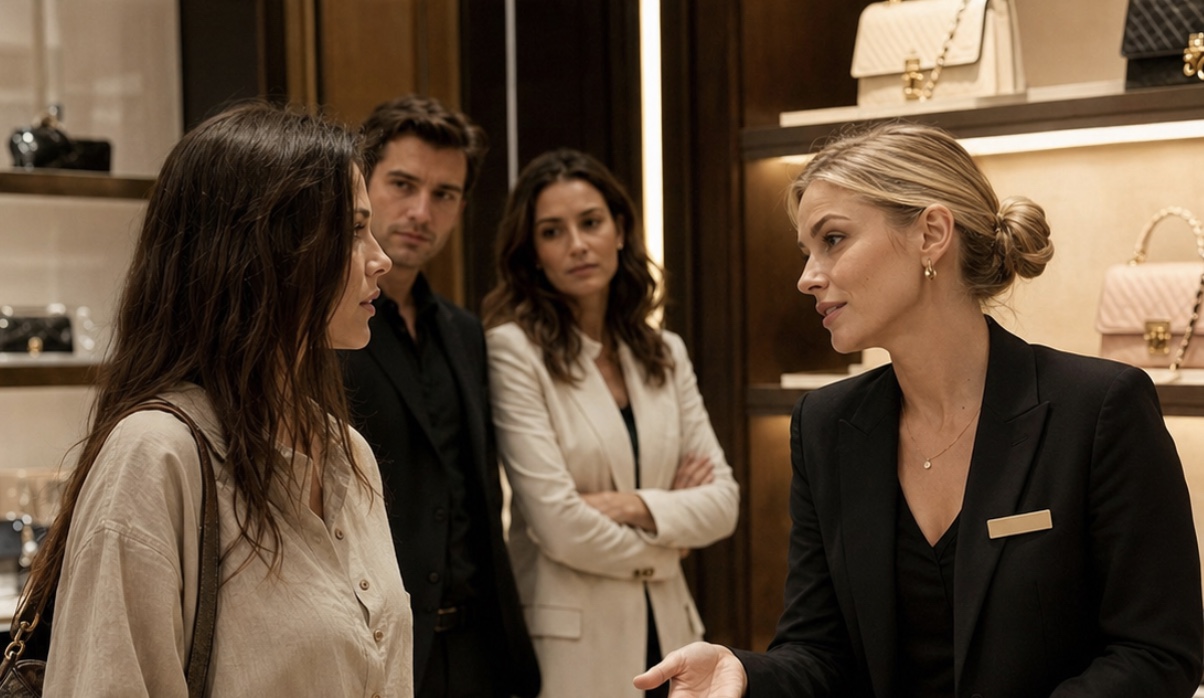
Svetlana did not turn her head right away. She was standing beside a glass display case where, beneath soft lighting, a dark cherry handbag from the new collection rested like a centerpiece. That was exactly what she had come for on this stifling July afternoon, when the city seemed to be melting in the heat, the asphalt outside the shopping center shimmered in the sun, and people stepped indoors more for the air conditioning than for shopping.
The boutique suddenly became quiet. A woman near the belt display froze with a bank card in her hand. A man in a light-colored shirt, apparently choosing a gift, glanced over his shoulder. A young woman taking pictures of herself near a mirror lowered her phone and openly stared at Svetlana.
Svetlana slowly ran her fingers along the strap of her old fabric bag, then looked at the sales associate.
“Could you repeat that, please?”
The sales associate was young, perfectly groomed, with flawless hair and a name badge that read “Elina.” She did not appear embarrassed. If anything, her smile widened.
“I said that this model is expensive. Very expensive. We have a more affordable department downstairs on the first floor.”
“I didn’t ask where the more affordable department was,” Svetlana replied calmly. “I asked you to show me the handbag.”
“I simply don’t want to waste anyone’s time,” Elina said, tilting her head slightly as she examined the customer more openly now. “Some people come in, touch everything, take pictures, and then leave. These are premium products, after all.”
Svetlana looked at her so carefully that, for the first time, the saleswoman’s confidence faltered.
There was indeed nothing flashy about Svetlana’s appearance. She wore linen trousers without visible designer labels, a plain light-colored T-shirt, an old jacket she had thrown on that morning because of the strong air conditioning in her car, and comfortable sneakers. Her hair was tied back in a low ponytail. There was no heavy jewelry, no dramatic lipstick, and nothing that loudly announced wealth.
Elina mistook that simplicity for weakness.
Svetlana treated it as useful information.
“Please call the manager,” she said.
“Because of a handbag?” Elina gave a short laugh, though there was less confidence in it now.
“Because of your behavior.”
“Of course,” Elina replied slowly. “I’ll call her. But the manager won’t lower the price.”
The man in the light shirt tightened his jaw. He clearly wanted to say something, but changed his mind. Svetlana noticed. Mentally, she gave him credit for wanting to intervene and took some of it back for remaining silent.
She had never liked loud public scenes. Not because she was afraid of confrontation. She simply considered drama inefficient. Shouting rarely achieved anything useful. A precise sentence delivered to the right person at the right moment, however, could cost an arrogant employee far more than any emotional outburst.
A minute later, a woman emerged from the staff corridor. She was short, around forty-five, dressed in a strict business suit, with her hair neatly pulled back and the expression of someone who had already solved five other people’s problems that day and was not thrilled to be dealing with a sixth.
“Good afternoon. I’m Oksana Viktorovna, the shift manager. What seems to be the problem?”
Svetlana turned toward her.
“Your employee refused to show me a product and explained that items like this were not meant for my wallet.”
Oksana Viktorovna looked at Elina.
Elina immediately lifted her chin.
“I was only warning the customer about the price. We often have people come in who don’t understand the level of the store.”
“Oh, I understand the level perfectly,” Svetlana said. “Especially now.”
Oksana Viktorovna opened her mouth, probably preparing a standard apology, but then looked more carefully at Svetlana’s face. Her expression changed.
“Svetlana Andreevna?”
Elina blinked.
Svetlana gave a small nod.
“Yes. We met last year during the presentation of your corporate collection. The order was processed through your head office.”
Oksana Viktorovna straightened immediately.
“Of course. I didn’t recognize you at first. You were with your colleagues, and…” She stopped, casting a brief glance at Svetlana’s jacket. “Please forgive me. I’m very glad to see you again.”
“I didn’t come here to make anyone happy,” Svetlana said evenly. “I came to make a personal purchase and discuss a corporate gift order for an August event. I intended to begin with this location because it’s the closest store to our office.”
The atmosphere in the boutique seemed to change instantly.
Elina stopped smiling. The skin around her nose went pale, and her fingers nervously touched her name badge.
“A corporate order?” Oksana Viktorovna asked carefully.
“Yes. Twenty-five items in individual packaging, plus several accessories for executives from our partner companies. But judging by your employee’s attitude, this location does not seem particularly interested in customers who aren’t wearing recognizable luxury logos.”
“Svetlana Andreevna, this is completely unacceptable. I apologize on behalf of the store.”
“I’ve heard the apology. Now I’d like your customer complaint book.”
Elina looked up sharply.
“Maybe that isn’t necessary? I didn’t mean to…”
Svetlana turned toward her.
“You meant exactly what you did. You wanted to humiliate someone in front of other customers. You simply failed to consider that the person you were judging might be more valuable to the business than you assumed from her jacket.”
Oksana Viktorovna silently went to get the complaint book.
Svetlana took out her phone and opened her notes. She never wrote complaints in anger. She recorded facts first: time, place, names, exact wording. Events, not emotions. Life had taught her that the person who documents things accurately has less explaining to do later.
Elina remained standing beside the display. She no longer looked like the confident queen of the boutique. Instead, she resembled a student who had suddenly been called to the board to answer a lesson she had never bothered to read.
“I really didn’t know who you were,” she said quietly.
“That is exactly the problem,” Svetlana replied. “You believe people deserve respect only when you know they are useful to you.”
Oksana Viktorovna returned with the book.
Svetlana carefully filled out a page. She wrote without insults or exaggeration. She described the refusal to show the product, the comment about her wallet, the presence of other customers, and the employee’s attitude. At the end, she added that the decision regarding the corporate purchase would be made only after speaking with the network’s senior management.
Elina watched the pen move across the page as though every sentence were removing another layer of security from beneath her feet.
When Svetlana finished, she closed the book and handed it back.
“Now show me the handbag.”
Oksana Viktorovna personally removed the model from the display, placed it on a soft surface, and put on gloves. Elina instinctively moved as if to assist, but the manager stopped her with one look.
The handbag was even better than it had appeared online. The color was rich and deep, the stitching perfect, the shape practical, and the hardware elegant without being overly shiny. Svetlana picked it up, tested the clasp, opened the inner pocket, and checked the strap.
“I’ll take it,” she said.
Elina visibly flinched.
“And please bring me the corporate catalog as well,” Svetlana added. “But Elina will not be advising me.”
Oksana Viktorovna nodded.
“Of course. I’ll handle everything personally.”
By now, the other shoppers were no longer pretending not to watch. The young woman near the mirror had completely forgotten about taking pictures. The man in the light shirt pretended to examine a wallet while watching everything through the reflection in the glass.
Svetlana noticed all of it.
She was not embarrassed by the attention. The uncomfortable scene had already happened. Now the important thing was to finish it without unnecessary theater.
While the manager processed the purchase, Elina stood near a distant counter. Her lips moved several times, as though she were practicing an apology, but she never found the courage to approach.
Svetlana paid, took the receipt and the boxed handbag, then turned to the manager.
“I’ll contact your head office regarding the corporate order. I haven’t made a final decision about this location.”
“I understand,” Oksana Viktorovna said. “May I still send you a proposal today?”
“You may. But include the name of the person who would be responsible for managing the order. I need someone who knows how to work with clients, not someone who evaluates them by their clothing.”
Elina lowered her eyes.
Svetlana left the boutique and stepped into the cool central hall of the shopping center. Beyond the glass entrance, the summer heat looked almost white.
She was in no hurry.
She sat on a cushioned bench near the fountain, placed the box beside her, and took out her phone.
Two minutes later, she sent a short message to her assistant, Artyom.
“Keep the brand under consideration for the corporate gifts. Ask two alternative suppliers for proposals. Deadline: this evening.”
Artyom replied almost immediately.
“Understood. Did something happen?”
Svetlana typed back:
“A useful customer-service test happened.”
She was not interested in revenge for entertainment.
But in business, rudeness had a price. Especially when that rudeness revealed something larger than one employee’s personality. If a premium retailer failed to teach its staff that a customer in sneakers was still a customer, trusting that company with gifts for important partners was a risk.
Svetlana worked as the head of administrative projects for a large construction company. She never considered herself an important person, but she was responsible for events, corporate purchases, vendor negotiations, and all the details people usually noticed only when something went wrong.
Years of experience had taught her that professionalism was not tested in a conference room where everyone smiled politely.
It was tested in small moments.
How people treated a courier.
How they spoke to a cleaner.
How they reacted to a customer who did not look like someone from an advertising campaign.
That day, the boutique had failed exactly that kind of test.
But the story did not end there.
While Svetlana was drinking cold water in a café on the second floor, an unfamiliar number called her.
“Svetlana Andreevna? Good afternoon. My name is Irina Sergeyevna. I’m the regional manager for the retail network. I’ve been informed about what happened at our store. May I take a few minutes of your time?”
Her voice was calm and controlled. Not frightened. Not excessively sweet.
Svetlana appreciated that.
“Yes, you may.”
“First of all, I want to apologize. I’ve already received a statement from the shift manager and reviewed your entry in the complaint book. We will also check the security footage, including audio if the system retained it. I would like to personally discuss whether there is any way for us to restore your trust in our company.”
Svetlana looked around the café.
At the next table, a young couple shared a lemonade. A boy of about five was desperately trying to finish an ice cream before it melted all over his hand.
It was an ordinary summer day.
And in the middle of it, they were having a conversation that could completely change one sales associate’s comfortable routine.
“Trust is restored through actions, not words,” Svetlana said. “What are you proposing?”
“A personal meeting. Today. I can come wherever it’s convenient for you. And I want to be clear: the employee has already been temporarily removed from customer-facing duties pending an internal review.”
“Firing someone for appearances can look impressive,” Svetlana replied, “but it doesn’t always solve the problem.”
There was a short silence on the other end.
“That’s an unexpected response from a customer who was treated badly.”
“I didn’t ask for blood. I asked for service. If you simply fire Elina, tomorrow another Elina will say the same thing to another woman who just happens not to have a large corporate order behind her.”
“You want a systemic solution?”
“I want to know whether you have one.”
Irina Sergeyevna was silent for two seconds.
“Then let me suggest this. I’ll meet you in forty minutes. I’ll show you an action plan we can implement both at this store and across the region. If you consider it credible, we can return to the discussion of your order.”
Svetlana smiled faintly.
“Come to the café on the second floor, near the fountain.”
After ending the call, Svetlana leaned back in her chair.
She had not expected the issue to reach the regional manager so quickly.
That meant the shift manager had correctly understood the scale of the problem.
Or perhaps headquarters simply understood the value of corporate clients very well.
Exactly forty minutes later, a woman in a blue pantsuit approached her table. She was tall, lightly tanned, carrying a tablet, and had the expression of someone accustomed to solving problems rather than explaining them away.
“Svetlana Andreevna?”
“Yes.”
“Irina Sergeyevna.”
They shook hands.
The regional manager sat opposite her, ordered water, and immediately opened her tablet.
“I’m not going to waste your time with promises like ‘this will never happen again.’ Anything can happen again if the cause remains unchanged. I’ve already requested the staff training schedule. Over the past six months, this location has been overly focused on sales numbers and not enough on customer experience. That is my responsibility.”
Svetlana studied her carefully.
“It’s rare to hear someone begin with their own responsibility.”
“There is no point beginning with someone else’s when the failure has already reached the customer.”
“A customer of my level?”
Irina Sergeyevna tilted her head slightly.
“A customer of any level. But I understand that those words sound especially convenient right now.”
Svetlana appreciated the answer.
Not perfect honesty, perhaps.
But useful honesty.
“Continue.”
Irina showed her a concise improvement plan: reviews of staff communication, additional training, a change in mentorship at the boutique, mystery shoppers, and revised standards for first contact with customers.
Nothing revolutionary.
But everything was practical.
Svetlana asked hard questions.
Who was responsible?
What were the deadlines?
How would progress be measured?
What would happen if the behavior repeated?
The regional manager answered without irritation.
“You speak as though you conduct internal audits yourself,” she eventually remarked.
“Sometimes I do.”
“Now I understand why your assistant checked the packaging three times during your previous order.”
“Artyom is smart. He understands that business partners don’t remember the gift itself nearly as much as they remember how it made them feel.”
Irina nodded.
“Then I have a question for you. What would it take for you to still consider our company for the order?”
Svetlana took a sip of water before answering.
“First, the order must be handled by you or someone personally appointed by you. Second, I want a normal commercial proposal without attempts to compensate for yesterday with a discount. I don’t need a consolation prize for being insulted. I need professional service. Third, Elina needs to apologize personally. Not because someone ordered her to, but because she understands what she did.”
“The third condition may be difficult.”
“Then the order may also be difficult.”
Irina Sergeyevna closed the tablet.
“Fair enough.”
They agreed that the proposal would be sent before the end of the day.
Svetlana stood, picked up the box containing her new handbag, and headed toward the exit.
Near the shopping center doors, a male voice called after her.
“Excuse me.”
She turned.
It was the same man in the light-colored shirt from the boutique. He was carrying a small shopping bag.
“I saw what happened,” he said. “I wanted to tell you that you handled it with a lot of dignity.”
“Thank you.”
“I stayed silent. Afterward, I felt ashamed.”
Svetlana looked at him without judgment.
“Next time, don’t stay silent.”
The man nodded, suddenly serious.
“I’ll try.”
“Don’t try. Do it. It’s usually faster.”
He gave an uncertain smile, and Svetlana stepped outside.
The heat hit her immediately, but after the freezing air inside the shopping center, she almost welcomed the summer warmth. The air smelled of dust, linden trees, and sun-heated metal.
She walked to the parking lot, placed the handbag box in the trunk, and got behind the wheel.
There was already another message from Artyom.
“Two alternative suppliers have responded. One can show samples tomorrow. The second needs until Monday.”
Svetlana replied:
“Meet with the first tomorrow. Keep the second as backup. We’ll wait for the current network’s proposal.”
She never relied on a single option.
Not in business.
Not in life.
Perhaps that was why other people’s mockery rarely unsettled her.
Svetlana had learned long ago that calmness did not come from believing the world would always treat you kindly.
It came from having alternatives prepared.
That evening, she returned home, placed the box on the hallway cabinet, and finally took the handbag out.
Under the softer lighting of her apartment, the color seemed even richer, almost like dark wine.
Svetlana turned the bag in her hands and smiled.
It was beautiful.
But somehow it no longer felt like the most important purchase of the day.
The most valuable thing she had received was information.
The following morning, Svetlana arrived at the office in a light dress carrying the new handbag.
Artyom noticed it immediately but said nothing. He only raised his eyebrows meaningfully.
“Yes, it’s the one,” Svetlana said.
“The scandalous one?”
“The educational one.”
“For whom?”
“For everyone involved.”
Artyom handed her several printed proposals.
“The first supplier is very interested in winning our business. They brought samples ahead of schedule. Their manager is already in the conference room.”
“Excellent. Let him wait five minutes.”
“The retail network also sent its proposal last night. There’s a letter from the regional manager.”
“I read it.”
“Are we going to work with them?”
Svetlana opened the folder, scanned the table quickly, and set the page aside.
“We’ll decide after the meeting. Emotions shouldn’t control procurement decisions. But disrespect shouldn’t be free either.”
In the conference room, a representative from another brand was waiting for her. His name was Nikita, a young, energetic man who had brought product samples, catalogs, and several packaging options. He spoke quickly, but stayed focused on the important details.
Svetlana asked questions.
Artyom recorded the answers.
Within an hour, one thing became clear: the alternative supplier had a weaker product range, but was more flexible with deadlines and more attentive to operational details.
After the meeting, Artyom asked:
“What do you think?”
“I think we now have leverage.”
“Are we going to negotiate?”
“We’re going to choose. That isn’t the same thing.”
After lunch, another email arrived from Irina Sergeyevna.
It contained the commercial proposal, the order preparation schedule, the name of the personal account manager, and a separate document describing the corrective measures being introduced at the boutique.
At the end was a short note:
“Elina is prepared to apologize. If you agree, she will do so personally in the presence of the shift manager.”
Svetlana read the message twice.
Then she replied:
“Today at 6:30 p.m. At the store.”
Artyom saw the message and frowned.
“Are you sure? Maybe we should just forget about them.”
“No. I want to see whether they know how to finish a difficult conversation properly.”
“And if she says something stupid again?”
Svetlana closed her laptop.
“Then the decision will become much easier.”
At exactly 6:30 that evening, Svetlana entered the same boutique again.
There were fewer customers this time.
Oksana Viktorovna met her near the entrance.
Elina stood beside her.
Her makeup was just as perfect as before. Her hair was still immaculate.
But her face was different.
She had probably not slept well.
“Svetlana Andreevna,” Elina began, then swallowed. “I want to apologize for what happened yesterday. I behaved unprofessionally and rudely. I judged you by your appearance and allowed myself to make a humiliating comment. It was unacceptable.”
Svetlana remained silent.
She did not help her.
She did not suggest words.
She did not soften the pause.
Elina clasped her hands tightly.
“I understand now that it wasn’t simply an unfortunate phrase. I really believed I could judge what kind of customer someone was by their clothes. And now I understand how foolish that was.”
“Foolish is a gentle word,” Svetlana said.
Elina nodded.
“Yes. Arrogant.”
“That’s more accurate.”
Oksana Viktorovna remained silent beside them.
“I accept your apology,” Svetlana finally said. “But not so that you can feel better. I’m accepting it so the situation can be closed like adults. Your management can decide what professional consequences are appropriate.”
Elina raised her eyes.
“Thank you.”
“Don’t thank me. Just remember something next time you see a woman in simple clothes. You are not looking at a wallet. You are looking at a person.”
Svetlana turned toward Oksana Viktorovna.
“We’ll handle part of the corporate order through Irina Sergeyevna. But I’m giving some of the positions to another supplier.”
The manager visibly tensed, but maintained her composure.
“May I ask why?”
“Because trust isn’t completely restored in twenty-four hours. You’ll get another chance, but not the entire order.”
Oksana Viktorovna nodded.
“That’s fair.”
Svetlana left the store without feeling triumphant.
She did not feel like a winner.
“Victory” seemed too small a word for a situation in which one adult woman had simply forced a system to notice something it should have understood from the beginning.
Two weeks later, the corporate order was divided between the two suppliers.
Irina Sergeyevna’s network completed its part flawlessly. The packaging arrived on time, every item was checked against the order list, and all the paperwork was correct.
The alternative brand also performed well, though there were a few minor mistakes that Artyom caught before they became problems.
“So in the end, the rude people turned out to be better to work with?” he joked when they closed the project.
“Not the rude people. The regional manager.”
“And the saleswoman?”
“The saleswoman became expensive training material.”
The story could have ended there.
But toward the end of August, Svetlana found herself at the same shopping center again. This time it had nothing to do with work. She had stopped by to buy a gift for her nephew and decided to walk past the boutique.
Not because she was curious, she told herself.
It was simply on the way.
Elina was standing near the entrance.
She was helping an elderly woman dressed in a simple summer dress and carrying a worn handbag. Several expensive wallets were displayed beside them.
Svetlana slowed down without meaning to.
“Of course, I can show you both models,” Elina was saying. “Let’s compare the size and the clasp. The prices are different, but what matters more is which one will be comfortable for you to use.”
The elderly woman looked embarrassed.
“I’m only looking. I might not buy anything.”
“That’s completely fine,” Elina replied. “You’re welcome to look.”
Svetlana did not enter the store.
She simply continued walking, a barely noticeable smile appearing on her face.
Not everyone changes after one uncomfortable lesson.
But some people at least begin paying attention to their behavior.
Sometimes that is enough to prevent the next person from being humiliated in public.
By the time Svetlana reached the parking lot, she had received another message from Irina Sergeyevna.
“Good afternoon. I wanted to let you know that since we introduced the new service standards, positive customer feedback at this location has increased. Thank you for the tough but useful signal.”
Svetlana read the message and put her phone away.
She liked the word “tough.”
It was more honest than “wise” or “kind.”
She was not obligated to be kind.
She certainly was not obligated to be convenient.
But fair?
Yes.
As fair as her patience and judgment allowed.
She got into the car, switched on the air conditioning, and looked at the dark cherry handbag resting on the passenger seat.
The very same handbag that had started everything now looked like exactly what it was.
A thing.
A beautiful, well-made thing, but still only a thing.
The lesson was worth far more than leather, stitching, or polished hardware.
Never mistake simplicity for poverty, calmness for weakness, or politeness for a willingness to tolerate humiliation.
Svetlana never shouted.
She never threatened anyone.
She never created a public scandal.
She simply calculated the real cost of someone else’s arrogance—and calmly presented the bill.