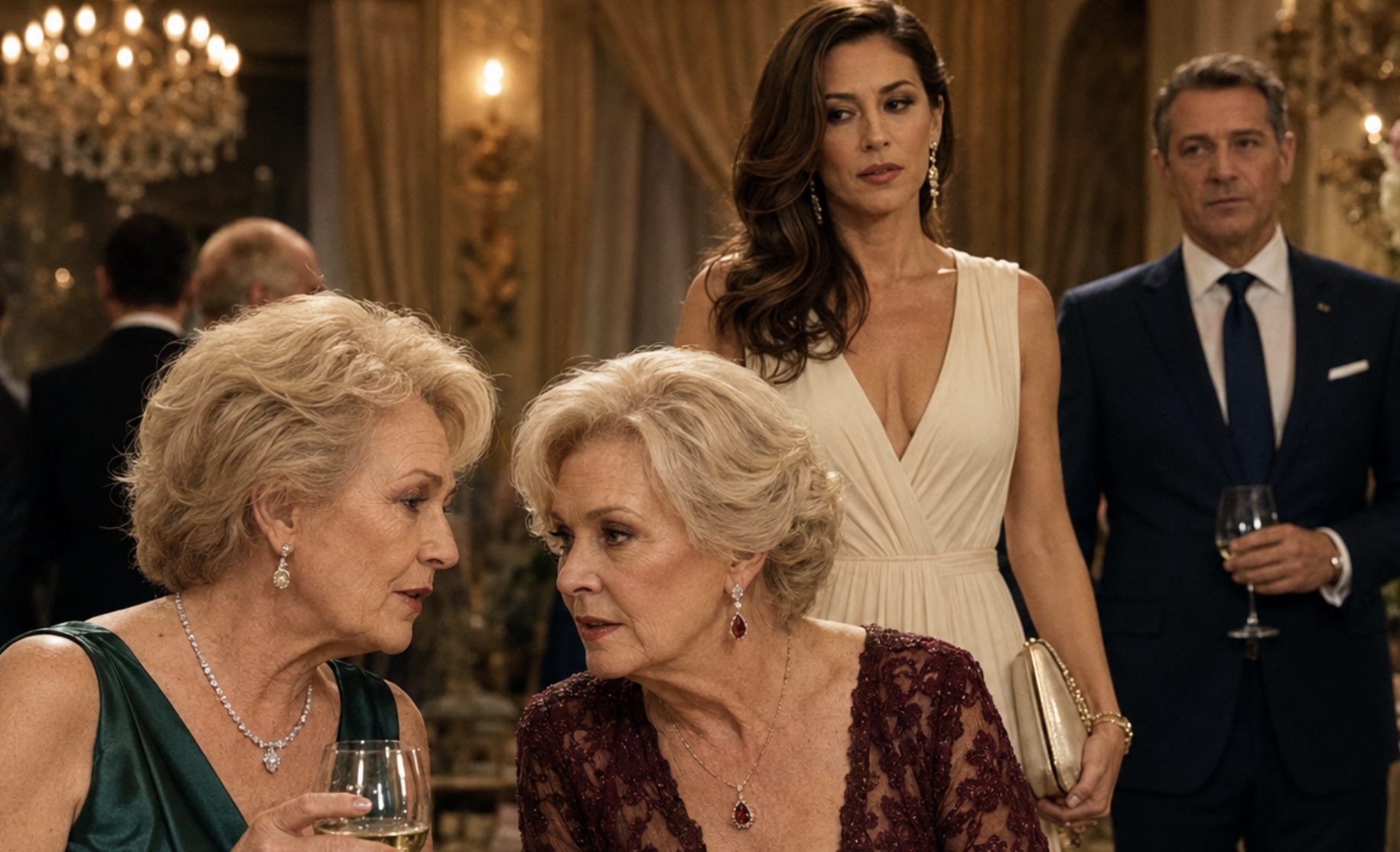
“Today everyone will finally see what kind of woman my son brought into this family,” Nina Arkadyevna smirked, leaning toward a heavyset woman wearing pearl earrings. “Then Pavel won’t be able to say I never warned him.”
Vera stopped so abruptly at the entrance to the banquet hall that the strap of her small handbag slipped from her shoulder. She had just returned from the cloakroom after leaving her light jacket there. The July evening was hot, and even after sunset the air outside still carried the day’s warmth. Inside the restaurant, despite the air-conditioning, it felt stuffy from the crowd, perfume, and steaming dishes.
Her mother-in-law was sitting at a table near one of the columns and didn’t notice Vera.
But Vera heard every word perfectly.
“Nina, maybe you shouldn’t do this tonight,” her friend said cautiously. “It is your birthday celebration, after all.”
“That’s exactly why tonight is perfect, Tamara. Everyone is here. Relatives, friends, Pasha’s colleagues. Let them all get a good look at this little gray mouse. He could have married Lilia. Her father is influential, her mother is respected, and Lilia herself knows how to carry herself. And this one? She came out of nowhere, latched onto him, and settled in.”
Vera slowly lifted the handbag strap back onto her shoulder.
Her fingers didn’t tremble.
Only her expression changed, becoming more focused, as though she hadn’t just overheard an insult but received an important piece of business information.
She had understood long ago that Nina Arkadyevna wasn’t merely dissatisfied with her. She was methodically building an image of Vera as some accidental, unworthy woman who had somehow slipped into Pavel’s life.
She did it through small, carefully chosen remarks.
Sometimes she compared Vera to Pavel’s former girlfriend. Sometimes, in front of guests, she wondered aloud whether it was difficult for her son to “carry the whole family on his shoulders.” On one holiday, she gave Vera a set of towels and said with a smile, “They’ll be useful around the house, since there isn’t much else you seem to be good at.”
Vera was not the kind of person who quietly endured humiliation.
She had simply spent the first two years observing.
She knew when silence was useful and when it was better to strike back in a way that would make someone think twice before testing her boundaries again.
And apparently, tonight was that moment.
Vera didn’t approach her mother-in-law immediately.
Instead, she took out her phone, opened her notes, and wrote down the sentence she had overheard.
Not for court.
Not for a scandal.
Not even for Pavel.
For herself.
So that later she wouldn’t soften it in her memory and tell herself, “Maybe I misunderstood.”
Then she glanced at her reflection in the glass door.
Her dark navy dress was elegant and restrained. Her hair was gathered low at the back of her head, and she wore almost no jewelry.
Nina Arkadyevna called that boring.
Vera called it practical.
When a person looked composed, it was easier to speak firmly.
She returned to the table and sat beside Pavel.
“Where were you?” he asked quietly.
“I took my jacket to the cloakroom.”
“Everything okay?”
Vera looked at her husband.
Pavel had been tense since the beginning of the evening. He smiled at guests, poured lemonade for his grandmother, accepted congratulations, but his attention constantly drifted toward his mother.
He knew she had a habit of turning family gatherings into performances.
Still, until the last possible moment, he hoped she would restrain herself at her own sixtieth birthday celebration.
“Everything’s fine,” Vera said. “Eat. It’s going to be a long evening.”
Pavel immediately became alert.
“What did she say?”
“Later.”
He was about to ask again when Nina Arkadyevna rose with a glass in her hand.
She was turning sixty and looked impressive in a pale tailored suit, with professionally styled hair and a large expensive ring.
Appearances had always mattered deeply to her.
Even at home, she wouldn’t answer the door to a neighbor without lipstick because, as she often said, “A woman must maintain a certain standard.”
“My dear friends and family,” she began in a bright, carrying voice, “I’m so happy to see all of you gathered around this table. Family is the most important thing in life. Family shows who we truly are.”
Vera tilted her head slightly.
Interesting opening.
There were around thirty guests in the hall: Pavel’s relatives, several family friends, Nina Arkadyevna’s former colleague, cousins, nephews, and nieces.
Beyond the windows, the summer city was growing dark. People strolled slowly along the embankment, and voices from the restaurant’s open terrace blended into the evening noise.
“I’m especially happy that my son is here beside me,” Nina Arkadyevna continued. “Pavel is my pride. Intelligent, well-mannered, dependable. I always knew he deserved the very best.”
She paused.
A few guests smiled politely.
Pavel lowered his fork.
“It’s just unfortunate,” his mother sighed softly, “that children don’t always listen to their parents. We see further ahead. We understand who truly belongs in a family and who simply happened to be nearby at the right moment.”
Tamara, the woman with the pearl earrings, quickly glanced toward Vera.
Pavel’s uncle, Grigory Semyonovich, frowned.
Someone else suddenly became very interested in the flower arrangement in the center of the table.
Vera didn’t move.
She simply lifted her glass of water and took a small sip.
“Mom,” Pavel said quietly, though several people nearby heard him.
“What is it, sweetheart?” Nina Arkadyevna turned toward him affectionately. “I’m not saying anything bad. A mother naturally wants a worthy partner for her child.”
“Then talk about yourself. Not about my wife.”
The table grew noticeably quieter.
But Nina Arkadyevna’s smile only widened.
Apparently, she had anticipated this reaction too.
“Pavlik, you always become so passionate when it comes to Vera. That’s admirable. A husband should defend his wife. Even when defending her sometimes prevents him from seeing what’s obvious.”
Under the table, Vera placed her hand over Pavel’s.
Not to comfort him.
To stop him.
He looked at her.
She gave the slightest shake of her head.
Not yet.
Nina Arkadyevna continued the evening as though the first insult had been accidental.
But after that, she became bolder.
When the main course arrived, she loudly began reminiscing about Lilia, Pavel’s ex-girlfriend.
“I remember how Lilia always knew how to behave at a table. You could immediately tell she came from good breeding. Her mother took her to proper places from childhood.”
“Nina,” Grigory Semyonovich said dryly, “what does Lilia have to do with anything?”
“Oh, I just remembered her. Am I not allowed to remember things? We’re all family here.”
Vera carefully cut a piece of chicken, then placed her fork beside the plate.
She had no intention of playing the wounded woman.
Wounded people looked weak, and Nina Arkadyevna sensed weakness instantly.
“By the way, Vera,” her mother-in-law said, turning toward her, “why didn’t your parents come? Aren’t they interested in their daughter’s husband’s family?”
Vera raised her eyes.
“My mother is taking care of my grandmother after surgery. My father died when I was seventeen. You know that.”
Half the table froze.
For a second, Nina Arkadyevna’s smile disappeared.
Then she quickly restored it.
“Oh, yes. I forgot. So much to keep in mind.”
“It happens,” Vera replied evenly. “Especially when someone only remembers the things they can use as weapons.”
Pavel turned toward his wife.
Surprise flashed across his face.
He was accustomed to Vera answering briefly, but never like this in front of everyone.
There was something different in her voice tonight.
Cold precision.
Nina Arkadyevna narrowed her eyes.
“I wasn’t attacking you, Vera dear. You simply take everything too personally.”
“No,” Vera said. “I take things exactly as they are.”
Tamara suddenly coughed and reached for her water.
After that, Nina Arkadyevna changed tactics.
She began telling pleasant stories about Pavel as a child—how well he studied, how he helped her at the country house, how responsible he had always been.
The guests relaxed.
Even Pavel seemed to breathe more easily.
But Vera could see it was only an intermission.
She was right.
After the third toast, Nina Arkadyevna asked for the projector to be turned on.
The restaurant had a small screen for celebratory slideshows. Pavel had prepared a collection of family photographs in advance: his mother with flowers, at the seaside, with friends, and with Pavel as a little boy.
Everything had been carefully selected.
No surprises.
But when the restaurant manager started the file, a photograph suddenly appeared of Pavel and Lilia from five years earlier.
They were standing together at some summer event, tanned, well-dressed, and smiling.
“Oh!” Nina Arkadyevna exclaimed theatrically, lifting her hands. “Some old photographs must have gotten mixed in by accident. But what a beautiful couple they were, weren’t they?”
Vera didn’t even look at the screen.
She looked at Pavel.
His fingers had gone white around his glass.
“Mom. Turn it off.”
“Why are you reacting like that? It’s the past. You can’t erase the past.”
“Turn it off,” Pavel repeated more firmly.
The restaurant manager looked uncertainly from the screen to the birthday woman.
Nina Arkadyevna pretended not to understand the problem.
“There are probably family photos after this.”
Another picture appeared.
Lilia beside Nina Arkadyevna at the country house.
Then another.
Lilia sitting in Pavel’s car.
Vera understood immediately.
There was nothing accidental about this.
It had been planned.
Cruelly, stupidly, but deliberately.
Without saying anything, Vera took out her phone and sent a message to the restaurant manager. She had his number because she had handled the advance payment for the reservation.
“Please stop the slideshow. The approved file has been replaced. Come to the screen now.”
The manager, standing near the wall, checked his phone, immediately tensed, and within seconds switched off the projector.
“We’re having a brief technical pause,” he announced.
Nina Arkadyevna turned toward him irritably.
“Young man, who told you to turn it off?”
“The person responsible for the reservation.”
“I am responsible for the reservation.”
“The payment and arrangements for the hall were handled by Vera Sergeyevna,” the manager replied politely.
Now the guests openly turned toward Vera.
Nina Arkadyevna slowly placed her glass on the table.
“What do you mean, handled by Vera Sergeyevna?”
Pavel looked at his wife too.
He knew Vera had helped with the restaurant, but he didn’t know the details.
Meanwhile, Nina Arkadyevna had been telling everyone that she had organized the entire birthday herself and that her daughter-in-law merely “stood nearby and tried not to get in the way.”
Vera put her phone away.
“It means I booked the restaurant. I chose and approved the menu. I paid the deposit. I arranged the musicians and the projector too. At your request, Nina Arkadyevna. You told Pavel you didn’t have time.”
“I asked you to help,” her mother-in-law snapped. “There’s no need to present yourself as some great benefactor.”
“I’m not presenting myself as anything. I simply explained why the manager followed my request.”
Grigory Semyonovich leaned back in his chair and looked carefully at his sister.
“Nina, you told us you organized everything yourself.”
“What difference does it make who called the restaurant? The money is family money.”
“No,” Vera said calmly. “It isn’t. I paid from my personal savings. Pavel didn’t pay for tonight. Neither did you.”
Pavel turned sharply toward her.
“Vera.”
“Later,” she said softly.
Nina Arkadyevna’s face flushed, but she wasn’t ready to retreat.
“How generous of you. Did you decide to buy everyone’s affection?”
“No. I wanted to do something kind for Pavel. He wanted his mother to have a beautiful birthday. I respected his wish. You decided to use that same evening to humiliate me in front of everyone.”
Her mother-in-law gave a short laugh, though it sounded far less confident now.
“What dramatic words. Who humiliated you?”
“You did. First, by the column, you told Tamara that tonight everyone would see what kind of woman your son had brought into the family. Then you spent the evening bringing up Pavel’s ex-girlfriend. Then you asked about my parents even though you know perfectly well why they aren’t here. And then you replaced the approved family slideshow with photographs of Lilia.”
The guests were silent.
But now the awkward silence surrounded Nina Arkadyevna, not Vera.
“You were eavesdropping?” the older woman demanded.
“You were speaking loudly enough.”
“And now you’ve turned my birthday into an interrogation?”
Vera tilted her head slightly.
“No. I simply refused to let you publicly punish me at my own expense.”
The phrase was unpleasant.
But accurate.
Tamara lowered her eyes.
She clearly regretted not stopping her friend earlier.
Pavel slowly stood.
“Mom. Enough.”
Nina Arkadyevna looked at her son.
For a moment, almost childish hurt appeared in her eyes.
“You’re going to turn against your own mother because of her?”
“I’m not against my mother. I’m against humiliating my wife.”
“She turned you against me.”
“No. You did that yourself.”
The words came out louder than Pavel probably intended.
But once spoken, they couldn’t be taken back.
At the far end of the table, Vera noticed Pavel’s elderly aunt, Raisa Pavlovna, shift forward and rest one hand on the handle of her cane.
She was over seventy, rarely spoke during family disputes, but everyone respected her.
Nina Arkadyevna herself often called her “the voice of reason”—at least when that voice agreed with her.
“Nina,” Aunt Raya said quietly, yet everyone heard her, “why have you spent your entire birthday discussing your daughter-in-law?”
Nina Arkadyevna froze.
“Raisa Pavlovna, you misunderstood.”
“No, I understood perfectly. We’ve been sitting here for two hours. First you mention Lilia, then Vera’s parents, then her background. Your son is sitting right beside his wife. They’re alive, healthy, not fighting, not running through divorce courts dividing furniture. Be grateful.”
Someone at the table gave a cautious nod.
Then another person did the same.
Pavel remained standing beside Vera, still tense but no longer uncertain.
“I’m his mother,” Nina Arkadyevna said. “I have the right to say what I think.”
“You do,” Aunt Raya agreed. “And they have the right to stop visiting afterward.”
For the first time that evening, Vera allowed herself the faintest smile.
Nina Arkadyevna noticed it and turned sharply toward her.
“Are you satisfied now? Is this what you wanted? To make me look like a villain in front of everyone?”
Vera stood slowly, sliding her chair back.
“No, Nina Arkadyevna. You managed that yourself. I simply didn’t interfere.”
“You are such a—”
“Careful,” Pavel interrupted.
There was so much coldness in his voice that his mother stopped mid-sentence.
Pavel looked around the table, then directly at her.
“I’m going to say this once. Vera is my wife. I didn’t choose her by accident, out of stubbornness, or because someone tricked me. I chose her because when I’m with her, I can live peacefully instead of constantly proving I have the right to breathe. If you dislike my choice, that’s your problem. But I will no longer allow you to use family gatherings to insult her.”
“You’re speaking to your mother like this?” she asked quietly.
“Yes. Because when people speak to you gently, you don’t listen.”
Vera looked at her husband.
This mattered.
Not because she needed someone to rescue her.
She could handle herself perfectly well.
But for the first time, Pavel wasn’t hiding behind phrases like, “Mom is difficult,” or, “Just ignore her.”
He was standing beside his wife and speaking clearly.
Nina Arkadyevna sat down.
Her expression resembled that of an actress who had arrived onstage with every line memorized, only to discover the scenery collapsing on her instead of her intended victim.
The manager approached Vera.
“Should we continue serving dinner?”
“Of course,” Vera replied. “The celebration has been paid for. The guests aren’t responsible for this.”
That sentence became the final blow.
Not loud.
Not dramatic.
But merciless.
Vera wasn’t leaving.
She wasn’t slamming doors.
She wasn’t giving Nina Arkadyevna the opportunity to later tell everyone that her daughter-in-law had ruined her birthday.
Instead, Vera remained in control—calm, calculated, and polite.
The musician picked up his guitar again.
Someone asked for more water.
Aunt Raya called Pavel over and whispered something to him.
Gradually, conversation returned.
But Nina Arkadyevna’s mood never recovered.
She sat with her back perfectly straight, answered people briefly, and never mentioned Lilia again.
Half an hour later, Vera stepped onto the terrace.
The heat of the night still lingered, though cooler air drifted in from the river.
Streetlights glowed below, their reflections sliding across the water.
Vera checked her phone.
The restaurant manager had sent her the file that Nina Arkadyevna had attempted to play.
Vera had asked him earlier to preserve everything connected to the booking in their correspondence.
Now she had confirmation that the presentation had been replaced on the day of the event using a flash drive personally brought in by Nina Arkadyevna.
Pavel came outside a moment later.
“Why didn’t you tell me you paid for the birthday?”
“Because you would have argued.”
“I would have.”
“It was easier for me to handle it. You wanted to make your mother happy. I didn’t see the point of turning every plate of food into a household debate.”
He rubbed his face wearily.
“Did she say something to you before dinner started?”
“By the column. Enough.”
“I’m sorry.”
“For what exactly?”
Pavel looked at her.
“For spending too long trying to smooth things over.”
“Yes,” Vera said. “You did.”
He had probably expected a soft, reassuring, “It’s okay.”
But Vera wasn’t going to comfort him at her own expense.
“I thought if I didn’t give her a reason…”
“Pavel, she doesn’t need a reason. She needs an audience.”
He nodded.
Not immediately.
But he did.
“You’re right.”
“I know.”
He gave a short laugh.
“Very modest.”
“But honest.”
He stepped closer but didn’t automatically reach for her.
Vera appreciated that.
After evenings like this, physical affection shouldn’t be used to bury a difficult conversation.
It should come from trust.
“So what happens now?” he asked.
“Now you decide how you want to communicate with your mother. But I will no longer sit at a table where I’m being picked apart for other people’s entertainment. And she only comes to our apartment if we both agree. Not if she only arranges it with you. With me too.”
Pavel looked at her carefully.
“Agreed.”
“And one more thing. If she wants to apologize, she apologizes with words. Not with a bag of food and the expression of an offended queen.”
“Agreed.”
“You’re agreeing very quickly tonight.”
“I spent two years being slow.”
For the first time all evening, Vera laughed.
It wasn’t exactly cheerful, but some of the tension finally disappeared.
They went back inside together.
Nina Arkadyevna watched them return.
Vera met her eyes.
Her mother-in-law was the first to look away.
Toward the end of the evening, it was time for presents.
Guests came forward with envelopes, flowers, and boxes.
Pavel gave his mother a bracelet he had personally chosen.
Nina Arkadyevna accepted it stiffly but still thanked him in front of everyone.
Vera approached last.
She carried a small, thick envelope.
“This is from me,” she said.
Her mother-in-law looked suspicious.
“I hope it isn’t the restaurant bill?”
The guests grew quiet again.
Nina Arkadyevna had tried to reclaim some of her old sharpness, but the joke sounded weak.
“No,” Vera said. “It’s a certificate for a family photo session. For you, Pavel, Grigory Semyonovich, Aunt Raya, and anyone else you’d like to invite. That way you can make some new, beautiful memories instead of using someone else’s pictures from the past.”
Aunt Raya gave a quiet snort.
Grigory Semyonovich coughed into his fist to hide a smile.
Nina Arkadyevna took the envelope.
Her face turned hard.
“Thank you.”
“You’re welcome. It’s valid for three months.”
Vera returned to her seat.
Pavel leaned toward her.
“You bought that beforehand?”
“Of course.”
“And if the evening had gone normally?”
“Then it would simply have been a nice gift.”
“And if it didn’t?”
“Then it became a useful full stop at the end of the conversation.”
Pavel shook his head.
“You scare me sometimes.”
“Good.”
“Why is that good?”
“It means you’re finally paying attention.”
When the guests began leaving, Nina Arkadyevna lingered near the exit.
Tamara with the pearl earrings had already gone.
Pavel was helping Aunt Raya down to her car, while Vera reviewed the final bill with the restaurant manager.
Her mother-in-law approached, gripping her handbag with both hands.
“You didn’t have to bring everything out in public,” she said.
Vera signed the receipt, thanked the manager, and only then turned toward her.
“I didn’t bring anything out. I answered you where you started it.”
“I am Pavel’s mother.”
“I am Pavel’s wife.”
“There can be many wives.”
Vera looked at her without smiling.
“That’s where you’re wrong. A man can have many women around him. A wife is the woman he chooses to build a life with. And tonight he said that in front of everyone.”
Nina Arkadyevna tightened her grip on the handbag.
“You think you won?”
“No. I think you lost your audience.”
Her mother-in-law went pale.
That was something she understood immediately.
Her power had never depended only on her son.
It depended on having an audience—people who nodded, stayed silent, and treated her behavior as normal.
Tonight, for the first time, that audience had seen not a concerned mother, but a woman who had spent two hours poisoning her own birthday celebration with insults toward her daughter-in-law.
“You’re cruel, Vera.”
“No. I’m precise.”
Pavel returned just then.
He heard the last words and stopped beside his wife.
“Mom, your taxi is here.”
“I thought you were going to drive me home.”
“No. Not tonight.”
Nina Arkadyevna looked from her son to Vera.
“I see.”
“Have a good evening,” Vera said.
Her mother-in-law looked ready to respond but changed her mind.
She left the restaurant alone, though Pavel still walked her to the car.
Vera remained by the entrance, watching through the glass.
Pavel opened the taxi door for his mother and said a few words.
Nina Arkadyevna refused to look at him.
Then the car pulled away.
Pavel and Vera drove home in silence.
The summer night was thick and warm, smelling of dust and linden blossoms.
Vera watched the scattered shop lights pass outside the window.
She wasn’t thinking about her mother-in-law.
She was thinking about herself.
In the past, she would have allowed a situation like this to destroy the whole evening.
She would have replayed every sentence in her head, argued with imaginary versions of Nina Arkadyevna, and tried to understand why the woman refused to accept her.
Now Vera no longer cared why.
Something else mattered more.
She would never again pay for someone else’s right to humiliate her—not with money, not with silence, and not in the name of keeping peace in the family.
The next morning, Nina Arkadyevna sent Pavel a long message.
Vera didn’t ask to see it, but Pavel handed her the phone anyway.
It contained everything she expected:
“I’m your mother.”
“I was humiliated.”
“Vera has turned you against me.”
“I only wanted what was best.”
“You’ve changed.”
And at the end:
“If your wife wants war, she’ll get one.”
Vera finished reading and handed the phone back.
“What should I answer?” Pavel asked.
“Nothing.”
“Nothing at all?”
“Nothing. She’s waiting for an argument. Don’t give her another stage.”
“What if she comes here?”
“Is this apartment yours and mine?”
“Ours. We bought it during the marriage, and both our names are on it.”
“Then decisions about guests are made together. If she arrives without being invited, we don’t open the door. If she starts making a scene in the hallway, we call the police. No heroics.”
Pavel studied his wife.
“You’ve already thought through everything.”
“I started thinking before you started noticing.”
He didn’t take offense.
He simply sat beside her and nodded wearily.
“I deserved that.”
Three days later, Nina Arkadyevna did exactly what Vera had predicted.
She arrived unannounced.
Vera was working from home.
Documents for a new exhibition were spread across the table, her laptop was open beside them, and photographs of museum exhibits filled the screen.
The doorbell rang long and insistently.
Pavel was at work.
Vera looked through the peephole.
Her mother-in-law stood in the hallway holding a shopping bag and wearing an expression that was probably meant to suggest peace.
Her eyes told a different story.
Vera opened the door but left the security chain fastened.
“Good afternoon.”
“I came to see my son.”
“He isn’t home.”
“Then I’ll wait.”
“That won’t work.”
Nina Arkadyevna lifted her chin.
“You’re not going to let me into my son’s apartment?”
“It’s our apartment. And I’m not ready to receive visitors right now.”
“I’m not a visitor. I’m his mother.”
“Today, you’re an uninvited visitor.”
Her mother-in-law glanced toward the neighbor’s door as though hoping someone might appear as a witness.
“You’ve become completely shameless.”
“No. I’m simply at home.”
“Open the door properly.”
“No.”
Nina Arkadyevna raised the shopping bag.
“I brought food. Pavel loves my meat patties.”
“You can take them to his office or arrange a visit in advance.”
“Now you’re going to tell me how I’m allowed to communicate with my son?”
“In my home, yes.”
For several seconds, Nina Arkadyevna stared at Vera through the narrow opening.
Then she said quietly:
“He’ll get tired of you.”
Vera didn’t blink.
“Maybe. If that happens, he and I will deal with it together. Not with you.”
She closed the door.
She didn’t slam it.
She simply closed it and turned the lock.
A minute later, angry footsteps echoed in the hallway.
Then came the sound of the elevator.
Vera returned to her laptop and sent Pavel a message:
“Your mother came without warning. I didn’t let her in. I didn’t take the food.”
His reply arrived five minutes later.
“You did the right thing. I’ll message her myself.”
That evening, Pavel showed Vera the short message he had sent his mother:
“Mom, don’t come over without arranging it first. Vera did the right thing. If you want to see me, call beforehand. I’m no longer discussing insults toward her.”
Nina Arkadyevna didn’t respond for an entire day.
Then she sent one word.
“Understood.”
It wasn’t reconciliation.
Vera had no illusions about that.
People like Nina Arkadyevna rarely changed overnight.
They paused, evaluated what they had lost, and searched for another way to regain influence.
But now Vera had something far more important.
Pavel was no longer standing between his mother and wife like a shapeless cushion absorbing blows from both sides.
He had chosen a position.
And for the first time, Nina Arkadyevna understood that Vera couldn’t be pushed out using shame, pity, or public comparisons.
At the end of August, Aunt Raya called Vera herself.
“Girl, don’t worry about Nina. She’s spent her whole life thinking that if she talks louder than everyone else, it means she’s right.”
“I’m not worried.”
“I can hear that. That’s why I called. I respect calm predators.”
Vera laughed.
“Was that supposed to be a compliment?”
“Of course. We already have enough people in this family who tolerate everything.”
Vera smiled for a long time after that conversation.
Not because an older relative had approved of her.
But because Aunt Raya’s description was surprisingly accurate.
Vera wasn’t some unfortunate daughter-in-law.
She wasn’t a victim of her mother-in-law.
And she wasn’t a woman sitting around waiting for her husband to finally defend her.
She was simply someone who knew how to think several moves ahead.
Nina Arkadyevna had wanted to organize an evening where everyone would see exactly what kind of woman Pavel had brought into the family.
And everyone did see.
Just not what Nina Arkadyevna had expected.
The guests saw a woman who couldn’t be shaken by cheap insults.
Pavel saw a wife he had left alone for too long to deal with his mother’s behavior.
The relatives saw that behind Nina Arkadyevna’s beautiful speeches about family was an ordinary desire to control other people’s lives.
And Vera saw the most important thing of all.
Sometimes you don’t need to shout to put someone in their place.
Sometimes all you need is to hold their gaze, call things by their real names, and understand exactly where the weak point in the situation lies.
After that, family celebrations became less frequent.
But they also became much more peaceful.
Nina Arkadyevna never mentioned Lilia in Vera’s presence again.
Not because she had suddenly become kinder.
She had simply understood that every remark like that now came with a price.
Not money.
Her dignity.
And for Nina Arkadyevna, appearances had always been more valuable than anything else.