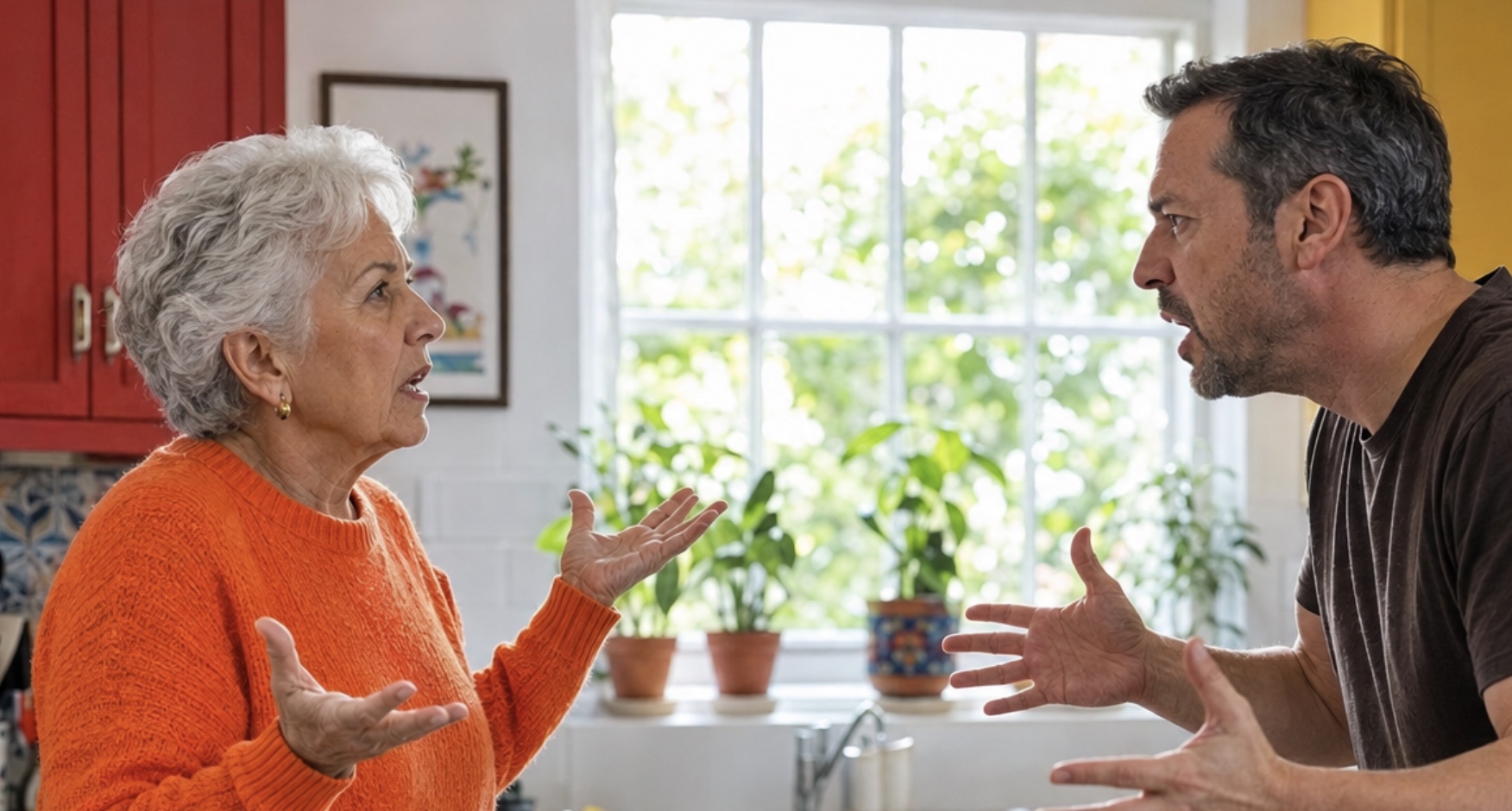
My voice cracked on the last word, and even I was startled by how it sounded—sharp, angry, almost as if it belonged to someone else. My mother-in-law froze with a cup in her hand, while Vitya stared at me as though I had suddenly started speaking a language he didn’t understand.
“Tanya, what’s gotten into you…” he began, but I cut him off.
“Don’t you dare call me Tanya like that! The two of you are sitting here discussing how to divide an apartment that isn’t even mine yet, making plans behind my back as if I’m not even a person! Get out!”
Vitya’s mother, Lyudmila Anatolyevna, put her cup down so abruptly that the saucer clattered.
“How dare you speak to your mother-in-law that way!”
“And how have you been speaking to me all these years? Huh? Get out! Both of you!”
The door slammed behind them so hard that a framed wedding photograph fell from the shelf in the hallway. I didn’t pick it up. I simply stood in the middle of the room, trembling violently. I couldn’t tell whether it was from anger or from the realization that I had finally found the courage to do what I should have done long ago.
Just a month earlier, I would never have believed I was capable of something like that.
I met Vitya at a mutual friend’s birthday party. He seemed calm and dependable—not the kind of man who showered women with promises and pretty words, but someone you could rely on. We didn’t date for very long before getting married. After the wedding, we moved into my apartment, which my father had left to me when he relocated to another city.
From the first months of our marriage, I somehow felt as though I was constantly doing something wrong, even though I had no reason to feel guilty.
Whenever Lyudmila Anatolyevna came to visit, she would look me over the way someone might inspect an item in a store that had been sitting on the shelf too long. She rarely insulted me directly. She preferred hints, meaningful sighs, and comments that could always be dismissed as harmless.
“My Vitenka is such a handsome man,” she would say while pouring tea, as though I wasn’t even sitting there. “He could have found someone prettier, someone who took better care of herself. Oksana’s daughter from the next building used to be a figure skater, you know. She even won competitions. And you’re always working, working, working…”
I worked for a small company, and yes, my job took a lot of energy, but not so much that I had completely neglected myself, as my mother-in-law liked to imply. I simply didn’t see the point in spending every morning putting on makeup just to impress a woman who would have found fault with me anyway.
Whenever his mother made comments like that, Vitya either stared at his phone in silence or gave her a weak warning.
“Mom, come on. That’s enough.”
But he never truly defended me.
At home, he behaved as though the apartment were a hotel where the maid was responsible for cleaning, cooking, and doing the laundry while the guest simply enjoyed the service. I would come home from work to find his clothes scattered all over the room, dirty breakfast dishes still sitting in the sink, while he relaxed in front of the television waiting for me to make dinner.
“You could at least vacuum once in a while,” I said one evening when I was completely exhausted.
“Tanyush, I’ve been at work all day. I’m tired,” he replied without taking his eyes off the screen. “And you got home earlier today anyway.”
I didn’t have the strength or desire to argue. I told myself it was simply his personality, his upbringing, something that might change with time.
Maybe when we had children, he would become more responsible.
Maybe his mother would soften once she saw how hard I was trying to be a good wife and daughter-in-law.
Days turned into months, and months into years.
I grew used to Lyudmila Anatolyevna’s coldness. I grew used to my husband’s laziness and indifference. I became accustomed to living as though it were perfectly normal to tolerate everything, adjust to everyone else, and keep my complaints to myself.
Then Uncle Grisha died.
Uncle Grisha was my mother’s cousin. He lived alone in a spacious three-bedroom apartment in the city center, with high ceilings and large rooms. I had only met him a handful of times at family gatherings. I remembered him as a slightly eccentric, withdrawn man who liked telling long stories about his youth and had never married.
When I received the phone call telling me that he had passed away, I was saddened. He hadn’t been someone close to me, so the grief wasn’t overwhelming, but there was still a feeling of loss.
Then we learned that he had no immediate heirs.
Under inheritance law, his property would pass to the closest surviving relatives.
I was apparently one of them.
The news spread through the family like wildfire.
That was when I first noticed how dramatically my husband and his mother changed.
The moment Lyudmila Anatolyevna heard about the inheritance, she suddenly began calling me every day.
“Tanechka, sweetheart, how are you feeling? Don’t work too hard. Make sure you get plenty of rest,” she would coo into the phone in a voice she had never once used with me before.
Vitya changed too.
Suddenly he started washing the dishes without being asked. He offered to cook dinner. He wanted to know how my day had gone. He even began bringing me flowers.
For a while, I was genuinely touched.
I thought perhaps the death in the family had somehow brought us closer, made him see me differently.
“You’re amazing,” he told me one evening, hugging me in the kitchen. “You’ve been through so much, and you’re handling everything so well.”
And I was handling a lot.
I was visiting the notary, collecting documents, dealing with the inheritance proceedings. The process took time. Nothing had been finalized yet, and there were still months remaining before the legal inheritance period expired.
But Vitya and his mother behaved as though the apartment already belonged to me.
“What did you say the layout was?” my mother-in-law asked casually over dinner one evening. “Three rooms, right? And the bathroom is separate from the toilet?”
“Mom, why are you asking her about that now?” Vitya said, pretending to be embarrassed.
But the excitement in his eyes was impossible to hide.
I gave vague answers and reminded them that nothing had been finalized. It was too early to make plans.
Still, I could sense that plans were already being made.
There were conversations I wasn’t included in. Decisions being discussed somewhere behind my back.
Then one day I came home earlier than usual.
I had developed a headache and asked my boss if I could leave early.
The lights were on when I entered the apartment, but everything was unusually quiet.
I was about to call out to Vitya when I heard voices coming from the kitchen.
Something made me stop in the hallway.
I stayed completely still, careful not to reveal that I was home.
My mother-in-law’s voice sounded excited and businesslike.
“You have to understand, son, an opportunity like this comes once in a lifetime. We sell the inherited apartment and buy two smaller places. You and Tanya can have a nice one-bedroom apartment in a new building, and I can get something decent for myself. Then we can rent out the apartment you live in now. It’ll give us steady income.”
“Mom, what if Tanya refuses to divide it?”
“She won’t. Where is she going to go? You’re her husband. You’re supposed to be the head of the family. Explain it properly. And anyway, I told you from the beginning—you didn’t marry her because she was some extraordinary beauty. You married her because she already had her own apartment. And you made the right choice. Look how things turned out. Now another apartment has practically fallen into your lap. It would be foolish to waste an opportunity like that.”
I stood frozen in the hallway, gripping the strap of my handbag so tightly that my fingers hurt.
Every word felt like a needle piercing my skin.
So that was why he had married me.
Not because he loved me.
Not because he saw me as the woman he wanted to build a life with.
Because I owned an apartment.
And now that another property had appeared on the horizon, he and his mother had already divided it between themselves as though my life were nothing more than a business arrangement.
“What if she digs her heels in and says she doesn’t want to sell?” Vitya asked.
There wasn’t even a hint of doubt in his voice about whether their plan was morally wrong.
His only concern was whether I might become an obstacle.
“She won’t. I’ll speak to her nicely and explain that family should stick together, that you share a budget and common interests. And you need to be firmer with her. Put some pressure on her if you have to. You’re her husband. You have rights to marital property too.”
“But the apartment won’t be marital property. It’s an inheritance.”
“So what? We sell it and buy two new apartments. Then technically they’ll have been purchased during the marriage. The important thing is making sure she doesn’t suddenly decide to be stubborn.”
I felt sick.
I turned around quietly, slipped back out of the apartment, and walked several floors down the staircase.
Only then did I allow myself to cry.
I cried silently for a long time, covering my mouth with my hand so none of the neighbors would hear me.
Eventually, I wiped my face, composed myself, went upstairs, and entered the apartment again as though I had only just arrived home from work.
Something inside me broke that day.
On the outside, I tried to behave normally. I smiled. I talked. I made dinner.
Inside, however, everything had burned away.
Every affectionate gesture from Vitya now seemed fake. Every kind word from his mother sounded calculated.
I watched them almost as though I were watching actors in a play.
They were pretending to be a loving family while mentally calculating square footage and discussing the most convenient way to manipulate me.
Lyudmila Anatolyevna began visiting even more frequently.
She brought homemade pies. She asked how I was feeling. She constantly wanted updates about the inheritance proceedings.
“Tanechka, have you been to the notary this week? How is everything going? Have you collected all the documents?”
“I’m working on it,” I would answer carefully.
“Don’t rush, but don’t delay either,” she would say, patting my hand. “We’re one family now. We’ll decide together what the best thing to do with everything is.”
Her touch made my skin crawl.
But I tolerated it.
I smiled when necessary while constantly wondering how I was supposed to continue living with a man who had turned out to be nothing like the husband I had imagined.
Vitya also worked hard to appear caring.
He brought me tea in bed in the mornings. He asked about my weekend plans. He suggested we visit Uncle Grisha’s apartment together, as though its future was already a joint family decision.
“Maybe we should move there ourselves,” he suggested one evening, wrapping an arm around my shoulders while we sat on the sofa. “It’s downtown, the neighborhood is great, the ceilings are high. Then we could rent this place out. Or sell it.”
I listened to his voice and felt the warmth of his arm around me.
But all I could hear in my mind was that conversation in the kitchen.
His mother saying he had married me because I owned property.
I wanted to scream.
I wanted to push his arm away and tell him everything I had heard.
I wanted to see the expression on his face when he realized he had been exposed.
But I held myself back.
Something told me to wait.
First, I needed the inheritance situation settled.
Then I would decide what to do about the family that had turned out to be nothing like the one I thought I had.
The days passed, and carrying the secret became harder.
Every evening, whenever Vitya or his mother started talking about dividing apartments, future investments, or the wonderful new life awaiting “the whole family,” I wanted to stand up and walk away without looking back.
But I waited.
I waited for the notary to finish the case.
Eventually, the day came when I went in for another appointment.
The weather was gray, and a light rain was falling. Strangely, though, I felt calm.
It was as if the storm inside me had finally settled and been replaced by cold clarity.
The notary, a middle-aged woman with tired but attentive eyes, invited me into her office.
After looking through several documents, she told me something that changed everything.
“You know, Tatyana Sergeyevna, new circumstances have come to light regarding your case,” she said, adjusting her glasses. “Another relative of the late Grigory Petrovich has been found. It turns out he had a biological nephew on his father’s side whom we were previously unaware of. He had been living abroad for a long time, which is why he did not come forward immediately.”
I listened without fully understanding what this meant.
The notary noticed my confusion and continued.
“The issue is that this nephew is a closer relative to the deceased than you are. Under inheritance law, closer relatives take precedence over more distant ones. You were Grigory Petrovich’s cousin’s daughter, whereas this man is his direct nephew. Therefore, the right to inherit the apartment passes to him.”
Something seemed to fall away inside me.
Surprisingly, it wasn’t despair.
It was almost relief.
The apartment would not be mine.
All the plans Vitya and his mother had made, all their calculations, all their dreams about dividing those square meters—they had disappeared in a single moment.
“So I’m no longer an heir?” I asked, even though I already knew the answer.
“That is correct. We’ll send you the formal notice, but for practical purposes your involvement in the inheritance proceedings ends here. I apologize for the confusion. Situations like this occasionally happen when family relationships are not immediately known.”
I left the office feeling as though a heavy weight had been lifted from my shoulders.
On the way home, I kept thinking about how I would tell Vitya and his mother.
And I’ll admit that one small, less generous part of me was looking forward to seeing their sugary smiles disappear.
Both of them were waiting for me when I got home.
Vitya and Lyudmila Anatolyevna were sitting in the kitchen drinking tea and talking animatedly.
My mother-in-law had been visiting almost every other day lately, practically behaving as if she already lived with us while waiting for the glorious moment when the property would finally be divided.
The second they saw me, both of them smiled warmly.
“Tanechka, well? What did the notary say?” Lyudmila Anatolyevna asked immediately.
I sat down at the table, poured myself some tea, and spoke as calmly as I could.
“It turns out they found another relative of Uncle Grisha. His biological nephew. He had been living abroad, so no one knew about him at first. He is a closer relative than I am, which means the inheritance goes to him instead of me.”
Silence filled the kitchen.
It became so quiet that I could hear the old wall clock ticking.
Lyudmila Anatolyevna slowly lowered her cup onto the saucer.
Her pleasant smile disappeared before my eyes, revealing an entirely different expression underneath—angry, frustrated, bitter.
“What do you mean it goes to him?” Vitya asked as if he couldn’t believe what he had heard. “Are you sure you understood everything correctly? Maybe you should have asked again. Maybe there’s something else you can do.”
“I understood perfectly, Vitya. The notary explained everything. His relationship to Uncle Grisha is closer than mine. He has priority. The apartment is his.”
My mother-in-law jumped to her feet so quickly that she nearly knocked over her cup.
“Well, that’s just wonderful! And we thought… We spent all this time making plans! We had everything figured out!” She no longer bothered hiding her irritation. “So now it was all for nothing?”
I stared at her, then at Vitya.
I was amazed by how quickly their fake concern disappeared.
Where had all the tenderness gone?
Where were the “Tanechka, sweetheart” and all the questions about my health?
Sitting in front of me were two people whose affection had apparently depended entirely on the possibility of getting their hands on somebody else’s property.
“So that’s why you’ve both been treating me so well lately,” I said quietly. “Because of the apartment.”
“Tanya, come on, that has nothing to do with it,” Vitya began.
But even his voice had changed.
The warmth was gone.
There was only irritation because his plans had collapsed.
“It absolutely has something to do with it,” his mother snapped. “We planned everything, and now what? All that effort for nothing? Maybe you handled the documents badly. Maybe you should have gone to a lawyer sooner instead of dragging this out.”
I listened to her scolding me because I had failed to inherit an apartment, as though I had deliberately arranged the situation just to spite them.
And something inside me finally switched off.
The last traces of patience, illusion, and hope disappeared.
“So you decided to divide my inheritance?” I said.
My voice sounded low, but completely steady.
“Get out of my apartment. And take your precious son with you.”
Lyudmila Anatolyevna opened her mouth to argue, but apparently saw something in my face that made her change her mind.
She grabbed her handbag, shot her son an accusing look as though the failure of their entire scheme were somehow his fault, and stormed out, slamming the door.
Vitya remained standing in the kitchen, confused.
He clearly couldn’t understand why I had exploded now, when, in his mind, there was even less reason to argue because the inheritance no longer existed.
“Tanyush, what’s wrong with you? Is this because of the inheritance? But you’re not getting it now anyway, so why are you angry?”
I looked at the man I had spent years living beside.
We had shared a bed, a home, meals, routines, and ordinary daily problems.
And all I felt now was exhaustion and an almost liberating indifference.
“I heard your conversation with your mother in the kitchen.”
Vitya went still.
“I heard her say you married me because I already owned an apartment. I heard the two of you discussing how you would sell Uncle Grisha’s apartment, buy one place for us and another for her, and then rent out the apartment we live in now.”
His face turned pale.
He tried to say something, but the words wouldn’t come.
“I stayed quiet that day. I decided to wait until the inheritance situation was settled. Part of me thought maybe I had misunderstood. Maybe I had heard something out of context. But I didn’t. Everything was exactly what it sounded like.”
He lowered his eyes.
“And now that you know there won’t be any apartment, you’re standing here wondering why I’m angry? I’m not angry because I lost an inheritance, Vitya. I’m angry because I spent years living with a man who didn’t see me as a wife. I was just a convenient way for him to get property.”
He said nothing.
And somehow, his silence confirmed everything more clearly than any confession could have.
“Leave, Vitya. Pack your things and go. I don’t want to see you or your mother again.”
“Tanyush, wait. Let’s talk about this calmly. We’re a family…”
“We’re not a family,” I said firmly. “A family is built on love and respect, not calculations about square meters. Go.”
The next day, I filed for divorce.
Vitya tried calling several times afterward. He came to my door, apologized, promised everything would change.
He said his mother would never interfere again.
He promised he would become more caring, more attentive, that he would help around the house and treat me differently.
But those promises meant nothing anymore.
I listened to them with complete indifference, the same way you listen to rain against a window—a familiar sound that no longer makes you feel anything.
The divorce went fairly quickly.
We had no children, and there was almost no property to divide. The apartment had belonged to me before the marriage, and we had accumulated very little together.
Vitya moved in with his mother and took his belongings with him.
For a while, he continued calling and sending messages, but eventually even those attempts stopped.
I remained alone in my apartment.
At first, the silence felt strange.
But it wasn’t oppressive.
It was peaceful.
I had to learn how to live for myself again—without constantly worrying about somebody else’s opinion, without adjusting myself to fit another person’s expectations, without tolerating coldness and indifference as if they were normal parts of marriage.
Sometimes I thought about Uncle Grisha, that distant relative I had barely known while he was alive, and silently thanked him.
Not for the apartment.
I never received it.
But strangely enough, his death gave me something far more important: the chance to see the true faces of people I had considered family.
I never saw the three-bedroom apartment in the city center again.
The newly discovered heir completed the paperwork and, from what I later heard, sold the apartment to improve his financial situation abroad.
By then, I didn’t care.
I had closed that chapter along with the part of my life in which I had been married to a man who chose me not out of love, but because he saw practical value in what I owned.
Time passed.
Gradually, the pain of betrayal faded and was replaced by calmness and a stronger understanding of my own worth.
I began meeting new people.
I became closer with women from work.
I started going out more often and doing things because they brought me happiness, not because someone else expected them from me.
And whenever I remembered that evening in the kitchen, the conversation I had accidentally overheard while standing silently in the hallway, I no longer felt regret.
Instead, I felt grateful that the truth had revealed itself when it did—before I completely lost myself in a marriage built on deception, convenience, and calculation.