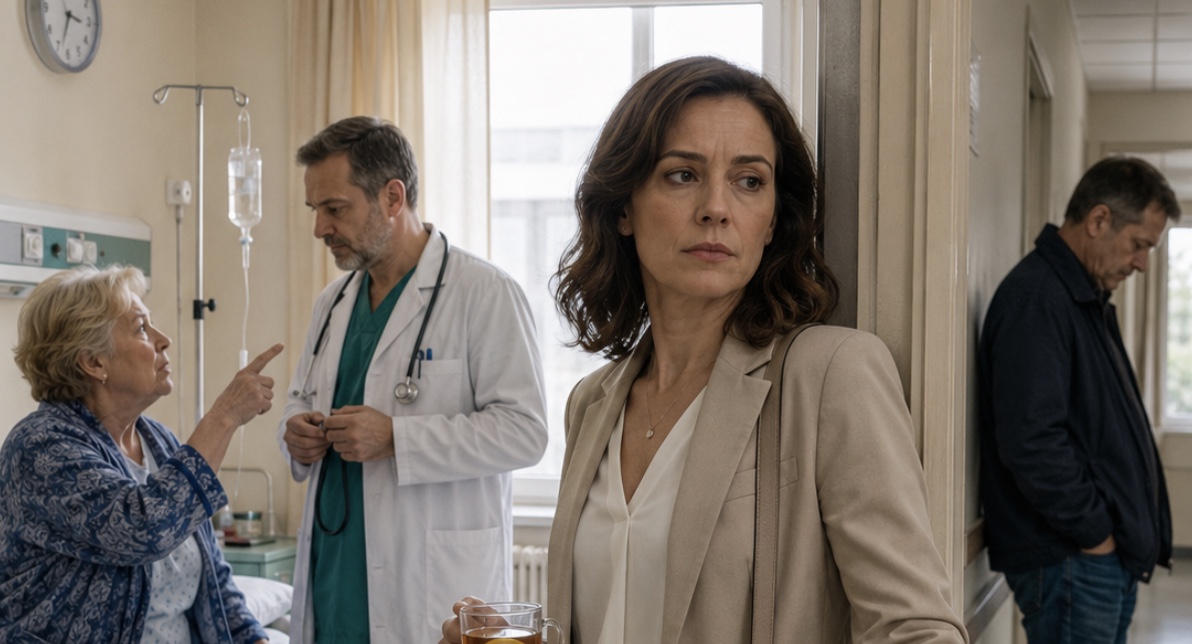
“— The broth is watery again, Kira. How many times have I told you to make it thicker? I’m not a cow, I don’t want to drink flavored water!”
Kira placed the food container on the bedside table.
It was a municipal hospital on the outskirts of Balashikha, the cardiology department, room six with three beds. The bed by the window was empty. The one nearest the door belonged to Alevtina Igorevna, Kira’s mother-in-law, who had been there for almost two weeks on IV drips after another heart episode.
Alevtina Igorevna stirred the broth with her spoon, grimaced, and pushed the container to the edge of the table without even tasting it.
“Go on now. Don’t get in the way. The doctors will be making their rounds soon.”
Kira stepped into the corridor.
Her husband Viktor, Alevtina Igorevna’s only son, was sitting near the window. His headphones hung around his neck. The moment he caught sight of his mother through the half-open door, he jumped to his feet.
“I’m going out for a smoke,” he said.
He didn’t return ten minutes later.
Or twenty.
Kira knew that routine by heart.
Over eight years, Viktor had perfected it until it had become automatic: his mother felt unwell — he went out for a cigarette. His mother ended up in the hospital — he went out twice an hour.
The amusing part was that there was nothing for him to smoke. Viktor had quit three years earlier, right around the time he bought a treadmill on credit. The treadmill now stood in their living room covered with his shirts. It had never been switched on even once.
In the neighboring bed lay Gennady Palych, three days after a heart attack. He was filling in a crossword puzzle with a ballpoint pen, barely pressing down, as though trying to save ink. From time to time, he muttered to himself.
“Seven letters, starts with ‘K’…”
“Crocodile,” the woman in the third bed suggested without looking up.
“Doesn’t fit,” Gennady Palych replied, and returned to his puzzle.
Half an hour later, a nurse came in carrying a list of prescriptions.
Alevtina Igorevna immediately switched to the special voice she always used when there was an audience.
“Just look at her,” she said to the nurse, nodding toward the door Kira had just gone through. “My daughter-in-law. She’s been fussing around me for eight years, and somehow she still never gets anything right. My own daughter can’t come — she has her own life and her own family, so that’s understandable. But this one keeps running around after me for nothing. I don’t understand it.”
The nurse wrote something in the medical chart and left without answering.
Kira said nothing either.
She had stopped counting how many times a week Alevtina Igorevna said things like that in front of witnesses — doctors, hospital roommates, pharmacists at the kiosk across the street.
Even dressed in a hospital gown, Alevtina Igorevna never forgot to pin on her favorite brooch, an enamel dahlia she had bought either at a fair or during some television shopping sale. She would throw a checked flannel robe over her shoulders, stubbornly refusing to look like an ordinary hospital patient. She carried herself as though she were the lady of her own house receiving visitors, not a woman attached to an IV stand.
Eight years earlier, in 2018, she had suffered her first stroke.
There had been an ambulance, an emergency department, and a confused doctor on duty asking who would fill out the paperwork and who would stay with her overnight.
Galina, Alevtina Igorevna’s daughter, had been vacationing in Sochi.
Kira stayed.
The doctor asked again whether there was anyone closer — an immediate family member.
“There is,” Kira had answered. “Me.”
And she signed the first form.
In a way, everything started with that signature.
From then on, there were food containers three times a week, along with the one and only kind of boiled sausage Alevtina Igorevna approved of: Doktorskaya. No other brand or variety was acceptable.
There were taxis to the clinic whenever Kira’s car was unavailable — twelve hundred rubles for the round trip.
Adult diapers cost thirteen hundred rubles a pack and had to be bought every two weeks.
The previous year, when her mother-in-law fractured her hip, Kira had reduced her full-time accounting job to one-third of her normal hours for an entire month. That meant losing twenty thousand rubles in salary. In return, there were IV drips, bedpans, and turning Alevtina Igorevna over every two hours.
Galina called twice that month.
Once to ask how her mother was doing.
The second time to explain that she would not be able to visit because little Alisa had exams.
“Our Alisochka has grown up so much,” Alevtina Igorevna would say tenderly whenever Galina mentioned her daughter on the phone.
Viktor and Kira’s children were never discussed.
They didn’t have any.
Galina visited twice a year: for her mother’s birthday and on New Year’s Day. She always brought a cake from Lenta supermarket.
Every single time, she peeled the price label from the box only halfway, as though she had accidentally forgotten to remove it properly.
One day, while Kira was sorting pills into the compartments of a medication organizer, Alevtina Igorevna remarked:
“Instead of running around after doctors, you should think about your own life. No children of your own and barely a place you can call yours. I don’t understand why you’re wasting your youth taking care of somebody else’s mother.”
Kira set the pillbox aside and snapped its lid shut.
“Children aren’t something you can simply ‘get around to in time,’ Alevtina Igorevna. And I do have a home of my own. I live there.”
Her mother-in-law snorted and turned toward the window.
Kira knew perfectly well that caring for someone did not create inheritance rights.
Inheritance was determined either by a will or by the legal order of succession.
Had they signed a lifetime maintenance agreement, that would have been different. There would have been a notary, formal obligations for both parties, and the responsibility for care written clearly into a legal document rather than hidden behind an unspoken “that’s just how things worked out.”
No such document had ever existed.
Kira had simply carried food containers back and forth for eight years.
Nothing more.
Two days passed.
Kira went to the pharmacy kiosk across the road to buy medication prescribed that morning. When she returned carrying the small bag, the door to the hospital room was slightly open. The orderly had forgotten to latch it after the doctors’ rounds.
Alevtina Igorevna’s voice sounded muffled, but every word was clear.
“She’s been running around after me for eight years, doctor, but I don’t trust her,” she was saying. “She doesn’t love me. She’s paying off what she owes — I can see it. I’m leaving the apartment to Galya. I promised it to her years ago. Let this one keep trying. The harder she works, the easier my life is.”
The doctor answered something short that Kira couldn’t make out. From the sounds inside the room, he was already putting his stethoscope back into his bag.
Kira didn’t enter immediately.
She stood by the doorframe.
Eight years of work.
Payment for an apartment that had already been promised to somebody else.
Then she walked inside.
She placed the medicine on the bedside table.
“Good afternoon, doctor,” she said evenly.
Then she left to help a nurse prepare an IV in the next room.
Not a word to her mother-in-law.
Not even an unnecessary glance.
For the remaining four days before Alevtina Igorevna’s discharge, Kira behaved exactly as she always had.
She brought meals.
She delivered test results.
She stood in line at the pharmacy.
But inside her head, something completely different was happening.
She was making a list.
It was straightforward: medications, exact times and dosages, the local doctor’s phone number, IV treatment days, and the number of the massage therapist who came once a week to work on Alevtina Igorevna’s arm after the fracture.
Kira typed everything out in the evenings while Viktor sat in the kitchen watching football.
Gennady Palych was discharged on the third day after Kira overheard that conversation.
Before leaving, he paused beside her insulated food bag.
“You’re carrying everyone on your shoulders here,” he said. “I heard what happened.”
Then he picked up his belongings and left.
Alevtina Igorevna was discharged on Friday.
On Saturday, Kira waited outside the apartment building for Galina, who had suddenly decided to “visit Mom” outside her usual twice-a-year schedule.
“What are you standing around here for? I’m going to see Mom,” Galina said, pulling a bag of apples from her car.
Kira held out another bag.
It was sturdy, with a printed sheet placed neatly on top.
“Here. Everything is written down for the next two weeks — what she takes, when she takes it, how much, and who to call if her blood pressure spikes. After that, you handle it.”
“What do you mean, I handle it?”
Galina didn’t even take the bag. She pulled her hand away.
“I have a job! I have Alisochka! I have my own family, you know!”
“So do I,” Kira replied. “Mine has been on hold for eight years. Now yours can go on hold for a while.”
Galina’s defensive expression lasted exactly until Kira said the next sentence.
“On Thursday, I heard your mother telling the doctor that the apartment is going to you. Apparently everything I’ve been doing was just me paying my dues. So if you’re the heir, Galina, the caregiving shift is yours too.”
The bag of apples slipped from Galina’s hand, struck the pavement, and rolled toward the storm drain.
As luck would have it, Viktor was in the courtyard at that exact moment.
He had come outside to “smoke,” even though he hadn’t smoked in three years.
The moment he heard his sister’s voice, he stared down at his phone as though something urgent had suddenly appeared on the screen and silently headed back toward the building.
“Vitya!” Galina shouted after him.
The entrance door slammed shut.
“Mom can’t be left without care! She has a heart condition!” Galina tried from another angle.
“Then take care of her,” Kira said. “Or hire a caregiver. Your mother gets a pension of forty-one thousand rubles. I know because I’ve always helped her calculate her utility bills. It’s enough to pay someone to come three times a week.”
Galina finally took the bag with the instructions.
She said nothing.
She didn’t look at Kira.
A month passed.
Aunt Valya, Alevtina Igorevna’s neighbor from the fourth floor, ran into Kira outside Pyaterochka supermarket and couldn’t resist sharing the latest news.
Galina had hired a caregiver.
Three visits a week.
Twenty-five thousand rubles a month.
The money came directly from her mother’s pension.
Galina herself hardly visited. She checked on her mother’s health through messenger apps.
Aunt Valya added that through the wall she could hear Alevtina Igorevna complaining endlessly to the caregiver about absolutely everything.
The caregiver simply listened in silence.
Two weeks later, Galina called Kira herself.
The caregiver had fallen ill.
Galina had a deadline at work.
Couldn’t Kira come over “just for two days, for old times’ sake”?
Kira listened calmly.
“I go swimming on Tuesdays and Fridays. On the other days, I’m working full-time again — the job I’ve finally managed to return to.”
As far as Kira could tell, Viktor didn’t call his mother at all.
Once a week, he asked his sister how Mom was doing, listened to the answer, and then went back to whatever was playing through his headphones.
Kira later spotted Gennady Palych in line at the clinic.
He no longer had an IV stand beside him.
But the same crossword puzzle was tucked under his arm.
And with one phone call, Kira canceled the standing order for broth ingredients at the butcher shop.