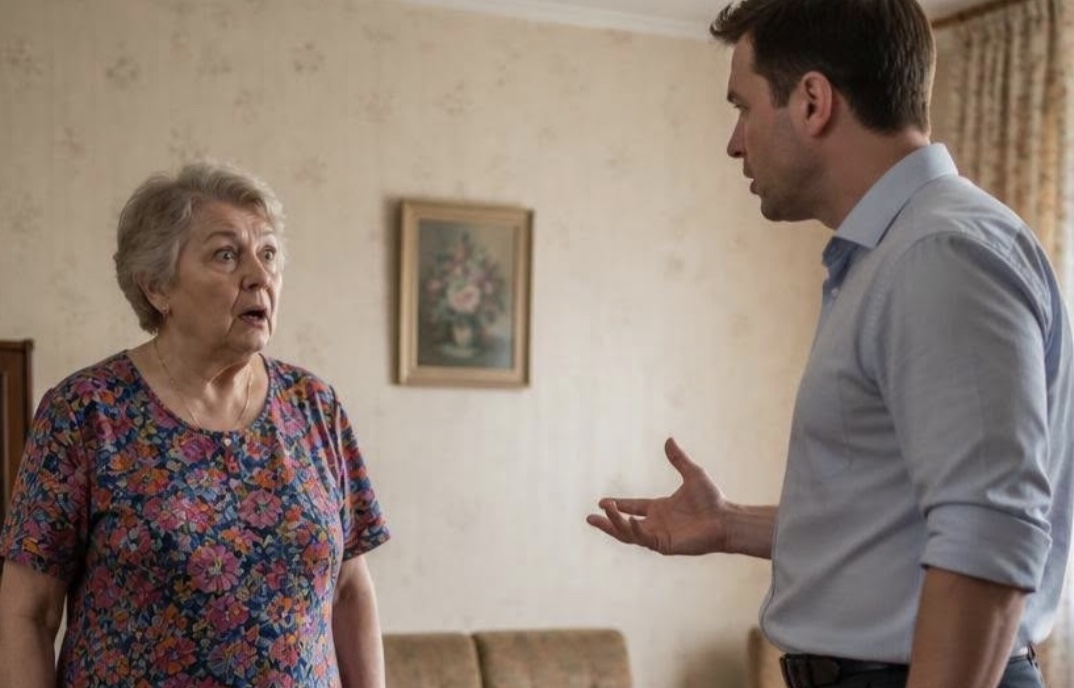
The doorbell rang late in the evening, just as Vitya was getting ready for bed. He opened the door expecting to see the neighbor with yet another request, but froze the moment he looked outside.
His mother was standing on the landing. Beside her sat an old, battered travel bag and a large plaid shopping bag.
“Mom? What are you doing here?”
“Vitenka…” she sobbed, pressing a hand dramatically to her chest. “I have nowhere else to go. Katya threw me out.”
Vitya’s wife, Lena, appeared in the kitchen doorway. The instant she saw her mother-in-law standing there with luggage, she stopped cold, still holding a dish towel in her hands. Her expression slowly hardened.
“Come in, Mom,” Vitya said uncertainly, stepping aside.
His mother entered the apartment, dragging her feet more heavily than usual and groaning with every step. Then she lowered herself onto a stool in the hallway as if all her strength had suddenly abandoned her.
Without saying a word, Lena turned around and walked into the bedroom.
Vitya put the kettle on and followed her.
“Lena, what’s wrong? I don’t understand…”
She stood by the window with her arms folded across her chest, refusing to turn around.
“Vitya, listen to me carefully. I don’t know what happened between your mother and Katya, and frankly, I don’t care. But your mother is not going to live with us. Not for a week. Not even for a day. Do whatever you want. Call your sister. Sort it out with her. Buy your mother a trip to a health resort if you have to. But she will not be staying in this apartment.”
“She’s my mother, Lena. What am I supposed to do with her? Leave her on the street?”
“She has her own apartment back home. She has a daughter who invited her to move in. Whatever happened between them is their problem. We are not getting dragged into it.”
Vitya opened his mouth to argue, but Lena finally turned to face him.
The look in her eyes made it clear that continuing the discussion would be pointless.
“I’m serious, Vitya.”
To understand how his mother had ended up on their doorstep that night, however, you would have to go back several months.
Katya had moved to the capital before her brother and had built a comfortable life for herself. She had her own apartment, a stable job, and a husband named Dima, with whom she had lived happily for years.
The only thing that troubled her was her mother, who still lived alone in their hometown.
Her mother called frequently, complaining about her health.
Sometimes her heart was acting up. Other times she felt dizzy. Her blood pressure would suddenly rise so dramatically that, according to her, she never knew whether she would survive until the ambulance arrived.
“Mom, why don’t you move in with us?” Katya finally suggested after another worrying phone call. “I’d feel much better knowing you were nearby. If anything happened, I could help you immediately.”
At first, her mother resisted.
She said she didn’t want to become a burden. She insisted she could manage alone somehow.
But Katya kept asking, and eventually her mother agreed with the solemn air of someone making an enormous personal sacrifice for her daughter’s peace of mind.
For the first few weeks, everything went surprisingly well.
Her mother helped with the housework, cooked meals, asked Dima about his job, and repeatedly praised how cozy and comfortable their apartment was.
Katya felt relieved.
Finally, she thought. This was the solution.
Now she wouldn’t have to worry constantly.
But little by little, things began to change.
At first, it was harmless.
Her mother would walk into the kitchen while Katya was preparing dinner and shake her head.
“You cut onions like that? No wonder your eyes water afterward. You should put them in the refrigerator first.”
Soon, however, the advice stopped being limited to cooking.
Her mother began inserting herself into conversations between Katya and Dima. She had opinions about where they should go on vacation, how they should spend money, and even when they ought to have children, although Katya and Dima were not planning a family yet.
“Dima, how come you’re still not a department manager at your age?” she asked one evening at dinner, as casually as if she were commenting on the weather.
Dima nearly choked on his tea.
Katya gave her mother a warning look.
Her mother simply shrugged.
“What? I’m saying it for your own good. I know how life works.”
Gradually, every family conversation became a minefield of unsolicited advice, criticism, and instructions.
And whenever Katya or Dima ignored her recommendations, her mother would fall dramatically silent, purse her lips, and spend the rest of the evening walking around the apartment as if she had suffered an unforgivable insult.
Then came the attacks.
Whenever Katya mentioned that she might have to go away on a business trip, her mother suddenly became dizzy.
If Dima suggested spending the weekend alone with his wife and taking a short trip without her mother, the older woman’s blood pressure would mysteriously spike.
She would lie down in bed, groaning and begging them not to leave her alone.
Naturally, Katya panicked.
She called ambulances.
She canceled plans.
She rearranged her entire schedule.
But one day, another sudden “attack” happened at the exact moment Katya was preparing to meet an old university friend she hadn’t seen in years.
Something inside her finally snapped.
The ambulance arrived quickly.
The doctor examined her mother, checked her blood pressure, and then gave Katya a puzzled look.
“Your mother’s readings are within an acceptable range. Her blood pressure is slightly elevated, but there’s nothing dangerous here. Are you sure calling an ambulance was necessary?”
Katya stood in the doorway of the bedroom and stared at her mother.
Only minutes earlier, the woman had been groaning and clutching her chest.
Now she was lying quietly under the blanket, facing the wall.
After the doctor left that evening, Katya sat alone in the kitchen for a long time.
She began thinking about every attack that had happened over the past few months.
And slowly, an uncomfortable pattern became impossible to ignore.
Almost every single episode had occurred right when Katya was about to do something without her mother.
A trip.
Dinner with friends.
A weekend with her husband.
She also remembered the phone calls that had convinced her to move her mother into the apartment in the first place.
The trembling voice.
The complaints about her heart.
The dizziness.
The terrifying blood-pressure stories.
Yet after months of living under Katya’s roof, her mother had never once become seriously ill.
Suddenly, all those earlier calls looked very different.
“Dima,” Katya said that evening, “I think my mother has been lying to me this whole time.”
Dima didn’t look surprised.
He had noticed the same pattern long ago but had been afraid to say anything because he knew Katya might interpret it as an attack on her mother.
“Katya, I noticed it a while ago,” he admitted. “She manipulates you. Every time you want to do something without involving her, she suddenly gets sick. Could it be coincidence? Maybe. But there have been too many coincidences.”
Katya covered her face with her hands.
“What am I supposed to do? I can’t just throw my own mother out.”
Another few weeks passed.
The tension inside the apartment grew steadily worse.
Sensing that her daughter had become more distant, Katya’s mother increased the pressure.
Now she criticized almost everything.
What Katya wore to work.
The food she bought.
The way Dima spoke.
The friends Katya invited over.
“That friend of yours, Olya… You should spend less time with her. She’s a bad influence on you.”
“Mom, Olya has been my best friend since school.”
“So what? I can see how irritated you are whenever you come home after seeing her.”
It wasn’t true.
But arguing was pointless.
Her mother had created an entire system in which disagreement itself somehow became proof that she was right.
Eventually, after yet another argument—this time because her mother had scolded Dima for supposedly managing the family finances badly, even though Katya had always handled the budget—Katya finally made a decision.
“Mom,” she said, walking into the room where her mother was watching television, “I think you should stay with Vitya for a while.”
Her mother slowly turned her head.
“What did you say?”
“I can’t do this anymore, Mom. I’m exhausted. You criticize Dima and me constantly. You interfere in everything we do. And these attacks of yours…”
Katya paused, trying to choose her words carefully.
Then she decided there was no point pretending.
“They happen at very convenient times. I think you should live with Vitya for a while. We both need some space from each other.”
Her mother stared at her for several long seconds.
Then suddenly she began crying.
Quietly at first, but with the devastated expression of a child who had been cruelly abandoned.
“So this is how it ends. My own daughter throws her mother onto the street.”
“Nobody is throwing you onto the street, Mom. I’m asking you to stay with your son.”
But there was no reasoning with her.
From that moment on, she cast herself completely in the role of the betrayed, unwanted victim.
And now that same woman was sitting in Vitya’s hallway, wiping away tears and describing how heartlessly her daughter had treated her.
After speaking with Lena, Vitya returned to the hallway feeling trapped between two sides.
His mother sat there dabbing her eyes with a handkerchief, looking at him with a mixture of hope and silent accusation.
“Mom, tell me exactly what happened. Why did Katya… why did you leave?”
“She threw me out, Vitenka. She said I interfere in everything, that I make her life difficult, that I fake my illnesses.”
Her voice trembled.
“Me? Pretending to be sick? My heart gets so bad sometimes even doctors are shocked.”
Vitya frowned.
Something about the story didn’t seem right, although he couldn’t yet explain why.
Still, he let his mother sleep on the sofa in the living room.
He didn’t exactly ask Lena’s permission.
He simply hoped she would tolerate it for one night.
Then he called his sister.
Katya answered almost immediately, as if she had been expecting him.
“Vitya. Hi. She’s already there, isn’t she?”
“Katya, what the hell happened? Mom says you threw her out. And what’s this story about her pretending to be sick?”
There was a long silence on the phone.
When Katya finally spoke, she sounded tired, almost bitter, as though months of frustration were pouring into every word.
“Vitya, I’m not going to explain everything right now. I lived with her. Now it’s your turn. Take care of her and figure it out yourself.”
“Wait a second. Moving her here was your idea. You wanted her nearby. Now she appears on my doorstep and you just wash your hands of the whole thing?”
“I’m not washing my hands of anything. I’m saying I need a break too! Do you have any idea what it’s like living with her every single day? She interferes in everything. She criticizes Dima and me from morning until night. And the moment I try to do anything without her, she suddenly has another health crisis. I’ve called ambulances several times, and the doctors say she’s fine!”
“Well, bringing her here was your idea! I told you from the beginning I wasn’t sure it was a good plan, and you insisted!”
“Because I was worried about her, Vitya! How was I supposed to know that she…”
“That she what?”
Katya hesitated.
Vitya immediately realized she was holding something back.
“That she manipulates me,” Katya finally said quietly. “That all those illnesses are just a way to keep me close and make sure I do what she wants.”
The conversation quickly turned into an argument.
They accused each other of promises made and responsibilities avoided.
Whose fault was it that their mother was now sitting in an apartment where she clearly wasn’t welcome?
Who was supposed to take care of her?
Who was behaving like the bad child?
Their voices grew louder.
Without thinking, Vitya stepped into the hallway so he could speak more freely.
And then he saw his mother.
She was sitting on the sofa inside the living room.
The door was slightly open.
She was listening to every word.
But what stopped him wasn’t the fact that she was eavesdropping.
It was her expression.
There was no sadness on her face.
No anxiety that her children were arguing because of her.
Quite the opposite.
Her lips were pressed together in the faintest hint of a satisfied smile.
Her eyes were bright with interest.
Almost excitement.
She looked like someone watching an especially entertaining television drama.
Vitya stopped speaking mid-sentence.
“Wait,” he said into the phone, lowering his voice. “Wait a second.”
He quietly closed the living-room door and moved into another room.
“Katya,” he said slowly, “something just clicked in my head. I walked out here so I could talk more freely, and I saw Mom listening to us. Do you know what her face looked like?”
“What?”
“Happy.”
“What do you mean?”
“She was enjoying it, Katya. She was actually enjoying listening to us argue about her.”
Silence filled the line again.
But this time it was thoughtful rather than angry.
“Vitya…” Katya finally said. “I’ve seen that expression too. A few times, when Dima and I argued because of something she said. I thought I was imagining it.”
“And those attacks,” Vitya continued, pieces of the puzzle falling into place. “They only happened when you were planning to do something without her, right?”
“Exactly.”
“And now she comes here acting like you threw her onto the street when all you actually did was suggest that she stay with me for a while. And suddenly you and I are fighting over which one of us is a terrible son or daughter and whose responsibility she is.”
He paused.
“Meanwhile, she’s sitting there listening to the whole thing like she’s enjoying a show.”
Katya let out a long breath.
“God, Vitya. Do you realize what that means?”
“I think I do.”
“She created all of this.”
“Maybe not in some cold, calculating way,” Vitya said. “But think about it. She’s lonely. Nothing happens in her life anymore. She watches television. Talks to neighbors. Works in the garden. That’s basically it. And suddenly she comes here and becomes the center of everything. We call her. We worry about her. We change our plans because of her. We argue over her. For her, this might be the most exciting thing that’s happened in years.”
“She’s turning us against each other,” Katya whispered. “And she’s doing it so subtly that we didn’t even notice.”
For a while, neither of them said anything.
Then Katya gave a bitter little laugh.
“You know what? I think I finally understand what happened between Mom and Dad years ago. Remember how Dad always said it was impossible to live peacefully with her? He said she always found some way to keep everybody nervous.”
“I remember.”
“We thought he was exaggerating.”
“Apparently, he wasn’t.”
Vitya returned to the living room.
His mother was still sitting exactly where he had left her.
But the moment she saw him, her expression changed.
The alert curiosity disappeared.
In its place came exhaustion, sadness, and offended dignity.
The transformation was so fast Vitya might have missed it if he hadn’t seen her real expression only moments earlier.
“Well?” she asked, filling her voice with wounded resentment. “Did you talk to your sister? I suppose she told you all kinds of terrible things about me.”
“Mom,” Vitya said, sitting down across from her, “Katya and I just talked, and we realized something.”
“What exactly did you realize?”
For the first time, there was a trace of caution in her voice.
“That you’re turning us against each other. Maybe you’re doing it deliberately, maybe you’re not. I don’t know. But every time Katya and I need to make some decision that doesn’t involve you, somehow we end up fighting with each other because of you.”
His mother threw up her hands in outrage.
“How can you say such a thing? I’m your mother! I raised both of you, and now you…”
“Mom,” Vitya interrupted gently but firmly. “I saw your face while Katya and I were arguing on the phone.”
His mother froze.
“You weren’t upset,” he continued. “You weren’t worried that your children were fighting. You were interested. You were enjoying it.”
She opened her mouth to protest.
But something in her son’s expression stopped her.
There was no fury there.
No cruelty.
Only recognition.
And maybe even a little pity.
For several seconds, the room was silent.
Then his mother lowered her gaze.
Her shoulders dropped slightly.
This time, there was nothing theatrical about it.
“I’m lonely, Vitenka,” she whispered.
Vitya said nothing.
“Back home, the house feels empty. Everyone has their own life. Most of my old friends are gone. Some moved away. Some are sick. I watch television. I work in the garden. That’s about it.”
Her voice became quieter.
“And then both of you were nearby. You called. You worried. You came to visit. You needed me. I suppose I really didn’t want that to end.”
Something tightened painfully in Vitya’s chest.
It wasn’t anger.
It was pity mixed with exhaustion.
“Mom, you can’t do this. Katya and I shouldn’t have to fight with each other just so you don’t feel lonely. We’re your children. We’re not a cure for boredom.”
His mother nodded without looking up.
And for the first time that evening, her tears seemed genuine.
The next day, Vitya and Katya drove their mother back to her hometown together.
They barely spoke during the trip.
The exhaustion of the previous weeks hung heavily over all three of them.
Their mother sat quietly in the back seat, staring through the window, unusually subdued.
When they arrived at her house, Katya took her hand before saying goodbye.
“Mom, Vitya and I talked about this. We’ll call you more often. We’ll take turns so one of us speaks to you every day. We’ll help you find something to do too. Maybe a club, some classes, a group nearby, people you can spend more time with.”
Her mother listened silently.
“But you won’t live with me or Vitya anymore,” Katya continued. “Not because we don’t love you. We do. But this arrangement is healthier for everyone.”
Her mother nodded.
And for the first time in a very long while, there was no performance in her eyes.
No manipulation.
No victimhood.
Only the tiredness of someone who had finally been understood.
Vitya and Katya drove back to the capital together.
Somewhere outside the city, Katya suddenly began to laugh softly.
“What?” Vitya asked.
“Nothing. I was just remembering that phone call. You suddenly said, ‘Wait a second.’”
She shook her head.
“If you hadn’t noticed her face at that exact moment, we’d probably still be fighting over which one of us had to keep her.”
Vitya smiled, keeping his eyes on the road.
“Good thing I noticed.”
They fell silent again.
Each of them was lost in their own thoughts.
They thought about their mother and about the fact that from now on, they would have to learn how to love her differently.
Without guilt.
Without manipulation.
Without anyone playing the victim or the judge.
From a little distance, perhaps.
But genuinely.