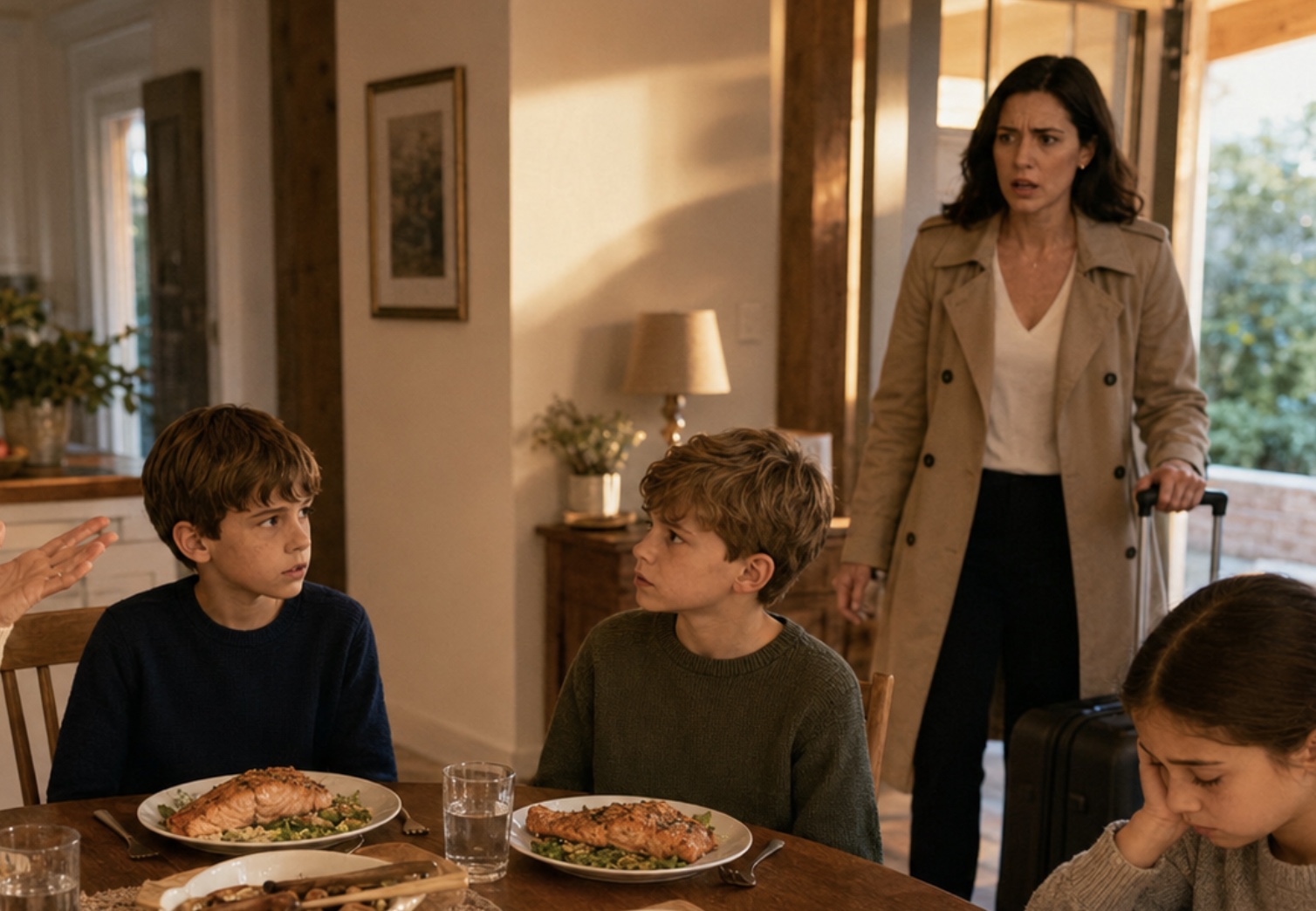
The entryway smelled of roasted garlic, rosemary, and melted butter. Two pairs of muddy children’s boots were tossed carelessly onto the pale rug, an unfamiliar backpack stood beside the mirror, and Lidia Semyonovna’s bulky winter coat barely fit on the crowded rack.
From the kitchen came the clinking of forks, the cheerful voices of two boys, and Marina’s mother-in-law fussing affectionately over them.
Marina had not expected to be home until eight that evening, but a work meeting had unexpectedly been rescheduled. She unlocked the door, slipped off her shoes, and was about to call out that she was home when something stopped her.
The apartment was warm, almost stuffy, yet an unpleasant chill ran down her back.
Without making a sound, Marina walked down the hallway and stopped at the kitchen doorway.
The children were sitting at the same table, but they were being fed very differently
Eleven-year-old Artyom and Vlad, the sons of her husband’s sister, were seated at the large oak dining table. In front of each boy was a porcelain plate holding a thick piece of salmon, creamy mashed potatoes, and cherry tomatoes.
The fish looked delicious. Its golden crust glistened with butter, and sprigs of rosemary rested beside it—the same rosemary Marina had bought with the groceries the day before.
Near the refrigerator, sitting on a low folding stool, was nine-year-old Anya.
In front of Marina’s daughter stood a plastic bowl of cold pasta.
The noodles had stuck together into one grayish lump. There was no butter, no sauce, not even a little grated cheese.
Lidia Semyonovna stood by the stove holding a wooden spatula.
“Eat up, boys. No need to rush,” she said warmly. “The fish is fresh and healthy. You especially need proper food now.”
Anya looked at the boys’ plates for several seconds before finally gathering enough courage to ask quietly:
“Grandma Lida, can I have just a little piece too?”
The older woman did not even turn around.
“You have pasta. Eat what you were given and stop being difficult. Red fish is expensive. It’s for my real grandchildren. The boys have sports practice, so they need nutritious food. All you do after school is sit around on your phone.”
Something inside Marina shifted.
There was no sudden explosion of anger, no dramatic breaking point. Instead, everything simply clicked into place.
Every comment she had ignored over the years, every uncomfortable moment she had tried to excuse, suddenly formed one very clear picture.
She stepped into the kitchen.
“Would you please explain why you think you have the right to decide what my child eats in my apartment?”
Lidia Semyonovna spun around sharply. The wooden spatula slipped from her hand and struck the edge of the stove.
“Marina? Why are you home so early?”
“That wasn’t my question.”
The boys stopped chewing.
Anya hunched her shoulders and stared down at her bowl as though somehow she were the one responsible for the tension in the room.
Marina walked over to the drying rack, took a clean plate, and went to the stove.
One piece of salmon remained in the pan—the biggest and most beautifully browned portion.
Her mother-in-law immediately stepped in front of it.
“That piece is for Seryozha! Your husband will come home hungry after work. He needs a proper dinner.”
“Sergey can have pasta tonight.”
Marina did not argue.
She picked up another spatula, gently moved her mother-in-law’s hand aside, placed the salmon on the clean plate, and set it in front of her daughter.
“Anya, eat. Just be careful in case there are any bones.”
The girl did not touch her fork.
“Mom, Grandma said I’m not allowed.”
“You are now.”
The money had disappeared, and somehow Marina was still the one being blamed
Lidia Semyonovna threw her hands into the air. Red blotches appeared across her face.
“Look at this! You’re making an enormous scene over one piece of fish. After your little performance, the poor child won’t even be able to swallow her dinner.”
Marina rested one hand against the counter.
“This is not about one piece of fish. On Monday, I transferred twenty thousand rubles to you for Artyom and Vlad’s food. You said your daughter’s apartment was being renovated and the boys would stay with us temporarily. Where is that money?”
Her mother-in-law turned away and unnecessarily straightened a kitchen towel that was already hanging perfectly straight.
“Have you seen prices lately? Everything is expensive. I bought the boys fruit, juice, yogurt.”
“The refrigerator is full of groceries I bought. There’s no fruit, juice, or yogurt in there. Where did the twenty thousand go?”
Lidia Semyonovna stayed silent for several more seconds before answering sharply:
“I paid off an overdue apartment bill. Your father-in-law and I have almost nothing to live on. Our pensions are tiny, medication keeps getting more expensive, and utility bills keep rising. You have two cars and a nice apartment, yet you begrudge your husband’s own mother a little help.”
Marina looked at her without surprise now.
“So you took money I gave you to feed the children and used it to pay your own bills. Then you came into my home, cooked dinner using food I bought, and decided my daughter wasn’t worthy of even one piece of salmon.”
“Stop exaggerating. Your money is family money anyway.”
“Then why isn’t my daughter family to you?”
Lidia Semyonovna gave a contemptuous little smile.
“She’s family to you. Sergey only puts up with her because the apartment belongs to you. Someone else’s child will never become your own, no matter how hard you try to pretend you have some perfect happy family.”
The kitchen seemed to freeze.
Anya stopped breathing for a moment.
Artyom and Vlad stared at their plates, too uncomfortable to look up.
The only sound was the steady hum of the refrigerator.
Marina pulled out her phone, found her husband’s number, called him, and switched the phone to speaker.
Her husband saw nothing more serious than an argument over a piece of fish
Sergey answered after several long rings.
“Marin, I’m at work. What happened?”
“Your mother just told me Anya is a stranger to your family and that you only live with me because this apartment is mine.”
There was a brief silence on the other end.
“Are you two fighting again? You’re grown women, but you behave like children.”
“She took the twenty thousand I transferred for your nephews’ food and used it to pay her own debts. Then she cooked salmon I bought for the boys and gave Anya plain pasta.”
Sergey let out a long, exhausted sigh, as though his wife had interrupted him over something utterly trivial.
“You’re seriously starting a scandal over fish? The boys are growing. Let them eat. We’ll buy more. Mom is just trying to save money.”
“By saving on my daughter?”
“Don’t start dividing the children into yours and someone else’s.”
“I didn’t.”
“That’s enough. I’m busy right now. I’ll come home tonight and we’ll talk calmly. Just don’t turn this into a circus or work yourself up.”
Marina ended the call and placed the phone facedown on the table.
Now there was no uncertainty left.
Her husband was not going to defend Anya.
He was not going to demand the money back.
He was not even willing to admit that his mother had crossed a line.
To him, this was simply another argument between two women—something he could ignore until evening.
Marina turned to the boys.
“Artyom. Vlad. Put your forks down.”
They exchanged frightened looks.
“Leave everything on the table and go to the hallway. You’re going back to your mother.”
Lidia Semyonovna gasped.
“Where are they supposed to go? The floors are torn up over there, the whole apartment smells of paint, and everything is covered in dust. It’s cold outside, and it’ll be dark soon.”
“Those are things their mother should have worked out before you brought them here.”
“You can’t throw the boys out!”
“I can stop hosting guests when those guests are being taught that humiliating my daughter in her own home is acceptable.”
Her mother-in-law had one minute to leave the apartment
Marina walked into the hallway, took the boys’ jackets from their hooks, and carried them out onto the landing.
Then she placed their boots and backpacks beside them.
Lidia Semyonovna hurried after her.
“Have you completely lost your conscience? They’re children!”
Marina removed her mother-in-law’s heavy coat from the rack.
“Exactly. Which is why I find it especially disgusting that you showed them one child can be given expensive fish while another is humiliated at the same table.”
“My handbag is inside! My medicine is in there!”
Marina picked up the worn leather bag from the cabinet and carefully placed it beside the coat.
“Everything that belongs to you is outside. Get dressed and leave.”
“You have no right to throw me out of my son’s home!”
“This is not your son’s home. The apartment belongs to me. If you are still here in one minute, I will call the police and report the twenty thousand rubles as well. I still have the bank transfer and our messages.”
Her mother-in-law went pale, although she continued to speak defiantly.
“Sergey will divorce you over this. You’ll be left alone with your daughter, and then you’ll understand what you’ve done.”
“Maybe. But tonight, you’re leaving.”
The boys were already pulling on their shoes.
Marina took their hats from the shelf and handed one to Artyom.
“Dress properly. It really is cold outside.”
Lidia Semyonovna walked past her, loudly complaining about Marina’s heartlessness and ingratitude.
Marina waited until all three of them were out on the landing.
Then she closed the door and turned the key twice.
The apartment immediately became quieter.
It even seemed larger.
Her daughter wasn’t crying because of the salmon
When Marina returned to the kitchen, Anya was still sitting in front of the untouched fish.
Tears were running down her cheeks, and she was still clutching the fork in one hand.
Marina sat beside her.
“What’s wrong?”
“Mom, they’re all going to hate us now. And the boys didn’t do anything wrong. It’s cold outside.”
Marina wrapped an arm around her daughter’s shoulders.
“You’re right. The boys didn’t do anything wrong. That’s why I made sure they had warm coats and hats. But you didn’t do anything wrong either. Nobody has the right to make you feel inferior in your own home.”
“I didn’t want you to fight because of me.”
“We didn’t fight because of you, and we didn’t fight because of salmon. Some people simply spent too many years believing they could do whatever they wanted in our home.”
Anya looked at her mother with red, swollen eyes.
“Does Dad Sergey think the same way?”
Marina could not answer immediately.
“We’ll talk to him tonight.”
She pushed the plate closer to her daughter.
“Try the fish before it gets completely cold.”
That evening, her husband demanded an apology
Sergey arrived at around eight thirty.
First he rang the doorbell several times, then tried the handle and began pounding insistently on the door.
Marina took Anya to her bedroom, gave her headphones, and put a movie on the tablet.
Only then did she return to the hallway and open the door.
Her husband stood on the landing, red-faced and furious.
“Do you understand what you’ve done? Mom had to spend half an hour getting to Irina’s place with the boys. She became ill and they had to call a doctor.”
“So they made it to your sister’s.”
“You think this is funny? Tomorrow you’re going to Mom’s house, apologizing to her, and buying her a health-resort treatment package. That is not up for discussion.”
Sergey stepped forward.
Marina did not move.
“Look to your right.”
Three large travel bags stood against the wall.
They were tightly packed with his clothes, shoes, and personal belongings.
His computer sat beside them, carefully wrapped in protective material.
Sergey stared at the bags for several seconds.
“What the hell is this?”
“Your things. Your documents are in the side pocket. Chargers and cables are packed separately. Take everything.”
He gave a short laugh.
“You’re destroying our marriage over a bowl of pasta?”
“Not over pasta. Over the fact that you believe humiliating my child and spending my money without permission is normal.”
“My money too, by the way. I’m your husband, not some tenant.”
“Then let’s remember how we’ve actually lived for the last three years.”
Behind all the talk about family was a very convenient financial arrangement
Marina folded her arms.
“I pay the mortgage on this apartment using money left over from the sale of my aunt’s house. During all this time, you haven’t made a single mortgage payment.”
“I renovated this place. I bought furniture. I paid for groceries.”
“Some of the furniture was yours, which is why it’s already packed into boxes. You can pick it up this weekend when you arrange a vehicle and movers. Now let’s talk about money. A year ago, you withdrew three hundred thousand rubles from our joint savings account and gave it to your sister for a down payment.”
Sergey stopped smiling.
“Irina had nowhere to live. She’s my sister.”
“I know. Which is why you took our savings without telling me and informed me only after the money was gone. Today your mother took twenty thousand that was meant to feed the children. That is apparently how your family operates: my money, my apartment, and my groceries become ‘ours’ whenever your relatives need something. But their apartments, debts, and purchases remain strictly their own responsibility.”
“You reduce everything to money.”
“No. I’ve simply stopped pretending that respect has nothing to do with how people treat someone else’s work and resources.”
Sergey stepped closer and lowered his voice.
“I put several hundred thousand into this place. I laid the flooring myself. I renovated the bathroom. I replaced the doors. I have a right to live here.”
“If you kept the receipts, we can deal with it in court. We’ll calculate the renovation expenses and then subtract the money you gave your sister without my consent.”
“I’m registered at this address.”
“Temporarily. Your registration expires in twelve days.”
Sergey stared at his wife as though he were seeing someone entirely different.
For the first time, she was not the convenient woman who could always be pressured into giving in.
“You’ve been planning this for a long time, haven’t you?”
“No. I just kept hoping I was wrong. Today I stopped hoping.”
“You’ll regret this”
Sergey kicked the nearest bag with the toe of his shoe.
“You think anyone is going to want a woman with a personality like yours? You’ll end up alone, and then you’ll regret all this.”
“Maybe. But being alone isn’t more frightening than living in a home where my daughter is fed leftovers and then told she doesn’t belong.”
“Mom said it in the heat of the moment.”
“And you calmly defended her.”
Sergey pressed his lips together, grabbed two bags, and carried them onto the landing.
He had to come back for the third.
He dragged it across the floor, scraping it against the wall.
Near the staircase, he turned back.
“You’ll call me yourself.”
“Don’t count on it.”
Marina shut the door, locked both locks, and slid the security chain into place.
An unfamiliar silence filled the apartment.
It was not light or joyful.
It was heavy, perhaps, but it was honest.
There were no more demands echoing through the rooms and no familiar expectation that Marina would once again surrender just to keep the peace.
This was never really a story about salmon
Marina returned to the kitchen, picked up the bowl of cold pasta, and threw it away.
Then she washed the dishes, wiped down the table, and put the remaining fish in the refrigerator.
The next day, she would need to call a locksmith and have the locks changed.
After that, she would find a lawyer, gather her documents, and file for divorce.
There would be unpleasant conversations ahead, arguments over belongings, and endless explanations to people who would find it easier to accuse her of cruelty than to try to understand what had actually happened.
But that night, Marina lay beside her daughter, gently pulled the blanket over her, and for the first time in a very long while, she did not feel guilty for protecting her own home.
Within a few days, their neighbor, Tamara Viktorovna, was already telling everyone in the building that Marina had thrown an elderly woman and two children out into the cold because of expensive fish and had left her husband without a roof over his head even though he had renovated the apartment with his own hands.
She never mentioned the twenty thousand rubles.
She did not mention what had been said to Anya either.
In other people’s retellings, inconvenient details are usually the first things to disappear.
Some people called Marina cold-hearted and calculating.
Others said she should have put her husband’s relatives in their place years earlier.
What would you have done in Marina’s position: waited for your husband to come home and tried to discuss everything calmly, or after seeing your child treated that way, would you have sent the entire family out immediately?