“I’m moving to the country house for the entire summer. I’ve already packed everything,” Valentina Andreyevna announced cheerfully over the phone. “Clear all the unnecessary things out of the room on the right. I need somewhere bright. And I’ll redo the garden beds my way because you’re letting all that land go to waste.”
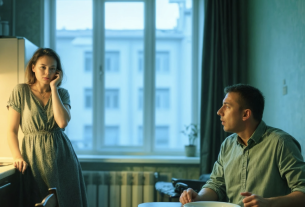
Alina slowly lowered the phone from her ear and looked at Kirill.
Her husband sat across from her at the kitchen table, holding a fork with a slice of cucumber balanced on it. At his mother’s words, he had frozen before managing to bring it to his mouth.
“Mom,” he finally said, leaning closer to the phone, “are you serious?”
“Of course I’m serious,” Valentina Andreyevna replied brightly. “The city is unbearable in summer, while you have fresh air out there. I’ve already told my neighbor Zoya that I’ll be staying from June through August. She’ll come over a few times too. Together, we’ll help Alina get the place into proper shape.”
Alina took the phone back and switched on the speaker.
She was not trying to create a dramatic scene. She simply wanted Kirill to hear every word himself, without softened explanations or carefully edited retellings.
“Valentina Andreyevna,” she said evenly, “you seem to have forgotten to ask whether I am inviting you to stay for the whole summer.”
A short laugh came through the phone.
“Oh, Alina, don’t start. What difference does it make? The place isn’t a museum where people need tickets to enter. We’re family.”
Kirill lowered his fork onto his plate. His face tightened, but Alina already knew that expression. In a moment, he would try to smooth things over. He would ask her not to argue and explain that his mother merely missed being close to nature.
In the past, Alina had allowed him to do that.
Not anymore.
“It makes a great deal of difference,” she said. “The house and the land belong to me. I never agreed to let you move in.”
“Yes, yes, of course they belong to you. No one is arguing about that,” her mother-in-law replied, her voice growing louder. “But Kirill is your husband, which means it’s his home too. And I’m Kirill’s mother, not some stranger off the street.”
“It is inherited property. Marrying Kirill did not turn it into jointly owned property.”
Silence followed.
Valentina Andreyevna disliked being confronted with facts. Facts were inconvenient. She preferred emotional accusations, wounded sighs, and grand speeches about respect.
“Why don’t you read me the entire legal code while you’re at it?” she said dryly. “I have keys. I’ll come tomorrow and see everything for myself.”
For the first time during the conversation, Alina smiled.
“The old keys won’t work.”
“What do you mean, they won’t work?”
“All the locks were replaced a month ago. On the house, the main gate, the shed, and the smaller entrance gate.”
Kirill’s head snapped up.
He knew that the locks on the house and the main gate had been changed, but Alina had never mentioned the shed or the smaller gate. Not because she had been hiding it from him. She had simply decided to secure everything at once rather than take half-measures.
“What have you done?” Valentina Andreyevna’s voice cracked. “You changed the locks?”
“Yes.”
“Without my knowledge?”
“Your bucket is stored there, not your share of the property.”
Kirill covered his mouth with one hand, concealing a nervous laugh. Alina did not even look at him. She intended to finish the conversation.
“Alina, you are crossing every boundary!” her mother-in-law snapped, no longer trying to hide her irritation. “I’ve helped there for two years! I pruned the currant bushes, planted dill, and I know your neighbors better than you do!”
“That is exactly why the locks were changed. You handed keys to the neighbors, brought guests without asking us, and allowed your sister to live there for almost three weeks while we were away.”
“She was looking after the house!”
“She was using my house, my water, and my electricity. When she left, I found a broken chair, a burned saucepan, and someone else’s slippers under the bed.”
Valentina Andreyevna inhaled sharply.
“So that’s it, then. Everything is clear. My daughter-in-law has finally shown her true face.”
“I have shown you my boundaries.”
“Kirill!” his mother called sharply. “Can you hear the way your wife is speaking to me?”
Kirill straightened.
Alina turned her calm gaze toward him. She did not plead for protection, push him toward an answer, or pretend to be wounded. She simply waited to see which side he would choose.
“I hear her, Mom,” he said. “And Alina is right. You cannot move into her country house without being invited.”
The silence on the other end of the line was so complete that they could hear a television playing somewhere in Valentina Andreyevna’s apartment.
Then she spoke quietly, her voice dripping with venom.
“I see. Completely under her thumb.”
“No,” Kirill replied. “I simply don’t want us to lose our place to rest because of you.”
“Our place?” Alina quickly repeated.
Kirill turned toward his wife.
“Your place. I’m sorry.”
Alina nodded.
It was a small correction, but an important one. In their household, things like that needed to be called by their proper names.
Valentina Andreyevna ended the call.
Kirill leaned back in his chair and dragged a hand over his face.
“Now it’s going to begin,” he said.
“It began two years ago,” Alina replied calmly. “Today, she simply found herself standing in front of a locked door.”
She was not exaggerating.
The country house had belonged to Alina’s grandmother, Tamara Stepanovna—a strict, meticulous, extraordinarily capable woman. Six months after her grandmother’s death, Alina completed the inheritance process and registered both the house and the land in her own name.
During the first summer, she went there almost every weekend.
She loved waking to the sound of birds, walking barefoot across the wooden veranda floor, opening the door, and seeing the apple trees her grandmother had planted when she was young.
At first, Kirill treated the house without any particular attachment. He helped repair the steps, mowed the grass, and transported boards, but he never tried to claim the role of owner.
He understood that, for Alina, the property was more than real estate. It was a family memory, the result of several generations of work, and the first place where she had been able to breathe freely after an exhausting year.
Valentina Andreyevna first appeared there that July.
Initially, everything seemed harmless. She came for Kirill’s birthday, brought containers filled with homemade cutlets, admired the apple trees, praised the bathhouse, and said Tamara Stepanovna would have been pleased with how the property was being maintained.
At the time, Alina had even felt happy.
She thought her mother-in-law had finally begun to see her not as the strange young woman who had stolen her son, but as an adult capable of managing a home.
That happiness did not last long.
A week later, Valentina Andreyevna came again without warning. She called only after reaching the gate and announced:
“Open up. I’m staying overnight.”
After that, she began arriving with bags of seedlings no one had asked for. Then she started telling the neighbors that “the young people didn’t understand anything about working the land.”
Eventually, she asked for a spare key. According to her, it was only a precaution. If Alina and Kirill were delayed on the road, she could arrive before them and heat the bathhouse.
Alina agreed.
One key.
One person.
One specific purpose.
A month later, Alina discovered that Zoya, Valentina Andreyevna’s neighbor, also had a key because “you never know what might happen.”
Then she found out that Valentina Andreyevna’s sister, Lidia, had one too.
After that came Viktor Palych, some man Alina barely knew, who wandered onto the property one day to inspect the water pump. His unexpected appearance frightened Alina so badly that she grabbed a hoe before realizing who he was.
The incident involving Lidia finally exhausted Alina’s patience.
She and Kirill returned from a trip on a Sunday evening and found someone else’s belongings in the house. An open cosmetics bag lay on the nightstand, a damp towel hung over the back of a chair, and Lidia was stretched out on the sofa looking at her phone.
“Oh, didn’t Valya tell you?” she asked in surprise. “I’m going to live here for a while. My apartment is being renovated. There’s dust and noise everywhere, but the air is wonderful here.”
Alina did not shout.
She told Lidia to pack her belongings.
Kirill called his mother. His mother became outraged. Lidia acted deeply offended. Nevertheless, an hour later, she left.
Alina demanded that every key be returned.
Valentina Andreyevna swore that she understood. She even cried over the phone and complained that they had treated her like a thief.
At the time, Alina chose to believe in exhaustion rather than promises.
She wanted peace.
The peace lasted until spring.
In May, Zoya sent Alina a message.
“Valya says she’ll be staying at your place this summer. When should I come over to water the strawberries?”
Alina read the message three times.
Then she calmly opened her contacts, found the number of a locksmith recommended by a neighbor from the far end of the street, and arranged to have all the locks changed.
She went to the property alone on a weekday.
The locksmith worked quickly. He removed the old mechanisms, fitted the replacements, and tested every key. Alina separately asked him to reinforce the latch on the smaller gate and replace the padlock on the shed where the tools were kept.
“Relatives?” he asked while tightening the final screw.
“More like a natural disaster,” Alina answered.
He chuckled but did not ask any more questions.
From that day onward, only Alina and Kirill possessed keys.
She spoke to Kirill plainly.
“If your mother receives a key without my permission, I will change all the locks again. And then our conversation will no longer be about the country house.”
Kirill had been offended.
“You don’t trust me?”
“I trust your intentions. I do not trust your ability to withstand pressure from your mother.”
He wanted to argue, but could not.
They both knew that Valentina Andreyevna had a talent for getting what she wanted. She did not force doors open. Instead, she called in the morning, afternoon, and evening. She sent wounded messages. She brought up her illnesses, Kirill’s childhood, old gifts, and neighbors she was supposedly too ashamed to face.
After three days of relentless pressure, Kirill usually surrendered at least a little.
For Valentina Andreyevna, a partial concession was enough to declare a complete victory.
Only two hours after the conversation about her summer relocation, Kirill’s phone began vibrating.
First his mother called.
Then his father.
Then Lidia.
Then his cousin Igor, who generally remembered Kirill existed only when he needed help moving furniture or repairing his car.
Kirill sat on the sofa staring at the screen as though it were displaying a court sentence.
“Don’t answer,” Alina said.
“They’ll keep calling forever.”
“Let them write. People often become more reasonable when their words are recorded in messages.”
He looked up at her.
“You were prepared for this.”
“Of course.”
“For what?”
“For the fact that your mother would not accept the word ‘no’ the first time she heard it.”
Kirill placed the phone face down on the table.
“What happens if she comes tomorrow anyway?”
“Then she can stand outside the gate.”
“What if she makes a scene in front of the neighbors?”
“The neighbors have already seen her sister living in someone else’s house. They’re not easy to shock anymore.”
“What if she starts telling everyone that you turned me against her?”
Alina sat down beside him.
“Kirill, you are thirty-nine years old. If an adult man can be turned against his mother by a locked gate, the problem is not his wife.”
He gave a tired smile, but understanding appeared in his eyes.
Alina loved Kirill.
Not because he was heroic—he was not.
Not because he possessed an iron will—around his mother, he often became a nervous schoolboy caught with a failing grade.
But he was intelligent, kind, and capable of admitting when he was wrong, provided no one left him an easy escape route.
The following morning, they drove to the country house.
Alina deliberately chose a weekday. She did not intend to wait until Valentina Andreyevna arrived with luggage and an audience. If her mother-in-law wanted to wage a battle over the property, Alina preferred to meet her on her own ground and fully prepared.
Summer was already in full force.
The road shimmered in the heat. Tansy grew thick along the roadside, and the dry fragrance of grass hung over the fields.
Kirill drove in silence.
Alina looked through the window while mentally reviewing her checklist. The ownership documents were in a folder. A copy of the land-register extract was saved on her phone, with a printed version in the glove compartment. The keys were with her. She had saved the phone numbers of the local police officer and the head of the garden association.
She had installed cameras after the incident with Lidia. They were small and discreet, but one had a clear view of the gate and the other covered the porch.
“You installed cameras too?” Kirill asked when he saw her checking the application.
“Yes.”
“When?”
“After I found your aunt wearing a bathrobe in my house.”
He grimaced.
“That sounds terrible.”
“It looked terrible too.”
They reached the property at around eleven.
Zoya Pavlovna was standing outside the gate—the same neighbor to whom Valentina Andreyevna had once given a key. She was short and thin, wearing a sun hat and carrying a bucket of strawberries.
When she saw the car, she smiled nervously and hurried toward them.
“Alina! I was just coming to see you.”
Alina got out of the car and closed the door.
“Good morning, Zoya Pavlovna.”
“Well, there’s something I should mention. Valentina Andreyevna said she would be managing things here all summer. She asked me to tell you not to use the room at the back if you happened to arrive early. She wanted to put her things there.”
Kirill stepped forward, but Alina stopped him with a slight movement of her hand.
“Zoya Pavlovna, Valentina Andreyevna will not be living here. And I will be the person managing this property.”
The neighbor hesitated.
“I’m not arguing with you. It’s just that she sounded so certain.”
“She often speaks confidently about property that does not belong to her.”
Zoya Pavlovna flushed and lowered her gaze toward the bucket.
“I threw away that key you gave me. The old one. Once I realized the situation wasn’t right.”
“Good. It wouldn’t work anymore anyway.”
“Please don’t be angry with me, Alina. Valya told me that you had agreed.”
“Now you know that questions like that should be confirmed with the owner.”
The neighbor nodded quickly.
She had clearly not come to argue. She had come to discover which way the wind was blowing. Once she realized it was blowing against her, she retreated.
“I brought you some strawberries. They’re from my garden. Please take them.”
Alina looked at the bucket.
Refusing would have been petty. Accepting the gift might allow Zoya Pavlovna to believe that the awkwardness had been erased and a debt had been created.
Alina chose a third option.
“Thank you. Let me buy half of them from you. Just one neighbor buying from another—no debts and no embarrassment.”
Zoya Pavlovna understood the message.
She nodded, named a price, and Alina transferred the money immediately.
No promises to pay later. No claims that payment was unnecessary.
After the history with the keys, Alina wanted no loose threads for anyone to pull.
By lunchtime, she and Kirill had aired out the house, checked the water, removed last year’s boards from the porch, and carried old jars out of the shed.
Alina worked quickly and silently.
Kirill tried to begin a conversation several times, but each time changed his mind.
At approximately three o’clock, a car stopped outside the gate.
One door slammed, followed by another.
Then they heard Valentina Andreyevna’s voice.
“There! I told you they were here!”
Kirill went pale.
“She came.”
“I can see that.”
Alina removed her work gloves, placed them neatly on the bench, and walked toward the entrance.
She did not run.
She did not hide inside the house.
She did not ask Kirill to deal with the situation.
It was her property, and she would be the one to speak.
Valentina Andreyevna stood outside wearing a pale blouse. Beside her was a large wheeled suitcase and two shopping bags.
Lidia stood next to her—the same sister who enjoyed making herself comfortable in other people’s homes.
A short distance away, Kirill’s cousin Igor shifted uneasily from foot to foot, holding a folding barbecue grill as though it were an entry permit.
“Open the gate,” Valentina Andreyevna demanded. “Enough of this performance.”
Alina stopped on the inside.
“Why are you here?”
“What do you mean, why? We came to the country house. We discussed this.”
“You discussed it. I refused.”
Lidia snorted.
“Oh, Alinochka, why are you behaving like a child? It’s summer, and the city is unbearably hot. We’ll settle in quietly and won’t disturb anything.”
“Lidia Sergeyevna, last time you also promised to be careful. Later, I found your face cream on my grandmother’s dresser and a greasy stain on the bedspread.”
Lidia raised her chin and turned toward her sister.
“Do you hear that? She was examining my belongings too.”
“Your belongings were inside my house,” Alina replied. “The matter is closed.”
Valentina Andreyevna pulled a ring of keys from her bag. Her expression became triumphant.
“Now we’ll see what you’ve locked.”
She approached the smaller gate, inserted one key, and turned it.
Nothing happened.
She tried a second.
Then a third.
The metal scraped uselessly inside the new lock.
Her face reddened as she yanked at the gate.
“Have you completely lost your mind?”
Kirill walked over and stood beside Alina.
“Mom, we already talked about this.”
“You stay quiet!” Valentina Andreyevna shouted. “She has manipulated you. You’re leaving your own mother standing outside the gate!”
“I am not throwing you out of your own house,” Kirill said. “This house belongs to Alina.”
“Oh, enough of that! Alina’s house, Alina’s house! What does that make you? A dependent living on her charity?”
Alina turned toward her husband.
The words were unpleasant, but useful.
Sometimes a person needed to hear exactly how they were treated when there was no possibility of hiding behind the familiar excuse that “Mom is just emotional.”
Kirill went pale, but kept his voice steady.
“I am her husband. I am not the owner.”
Valentina Andreyevna fell silent for a moment.
She had clearly not expected her son to say those words aloud.
Igor finally decided to intervene.
“Listen, why is everyone being so stubborn? Let the women in. We’ll grill some meat, sit down together, and discuss everything calmly.”
Alina looked at the barbecue grill in his hands.
“Igor, who invited you?”
“Valya said—”
“Then take it up with Valya.”
“But we’re already here.”
“Arriving here does not create a right to enter.”
Igor smiled, though without confidence.
He was accustomed to people becoming flustered when confronted directly.
Alina did not become flustered.
She stood calmly with her phone in her hand and looked at him as though he were not an intimidating relative but a delivery driver who had brought a package to the wrong address.
Lidia suddenly tugged at Valentina Andreyevna’s sleeve.
“Valya, perhaps we should leave. People are watching.”
Indeed, an elderly neighbor stood across the road beside his fence.
Zoya Pavlovna pretended to be tending her strawberries, although her bucket had been resting on the ground for quite some time.
When Valentina Andreyevna noticed the audience, she straightened her shoulders.
“Let them watch! Let everyone see how a daughter-in-law leaves her husband’s mother standing in the street!”
Alina unlocked her phone.
“I’m going to start recording now. Please repeat why you came to my property after I explicitly refused to let you stay.”
Her mother-in-law stopped abruptly.
“You’re going to record me?”
“I already am.”
That was not entirely true. Alina had only opened the camera, but the effect was immediate.
Lidia stepped backward.
Igor lowered the barbecue grill.
“You arrived without an invitation, attempted to open the gate using old keys, and demanded access to the house,” Alina continued. “I am asking you to leave. If you damage the lock or attempt to enter the property, I will call the police.”
“The police?” Valentina Andreyevna pressed a hand to her chest. “You would call the police on your husband’s mother?”
“I would call them on people attempting to enter my home without permission.”
“Kirill!” his mother cried, turning toward him. “Do you hear this?”
“I do,” he said. “And if Alina calls the police, I will confirm that none of you were invited.”
For the first time, Valentina Andreyevna appeared genuinely lost.
Her fingers trembled, and the ring of keys struck the metal handle of her suitcase with a sharp jingle.
She looked from her son to Alina, then at Lidia, and finally back at Kirill.
“So that’s it? You no longer need your mother?”
“Mom,” Kirill said quietly but firmly, “I need my mother. I do not need her trying to take over our country house.”
Realizing there would be no victory, Lidia quickly began distancing herself from the situation.
“Valya, let’s leave. I told you that we should have arranged everything properly first.”
Valentina Andreyevna spun toward her.
“You told me? You were the first one to pack!”
“I thought everything had been agreed.”
“Of course. Now you thought it was agreed!”
Alina watched the exchange calmly.
Her calculation had been correct. The moment it became clear that the gate would remain closed and the scandal might have consequences, Valentina Andreyevna’s allies began retreating from her.
Igor placed the barbecue grill on the ground.
“I only came along for company. I have work tomorrow anyway.”
“Take the grill with you,” Alina said. “I don’t need it left outside my gate.”
Without answering, Igor picked it up again.
Valentina Andreyevna remained in front of the locked entrance for several more seconds.
The hot sun shone directly into her face, and her makeup had begun to run slightly around her temples. All the triumphant certainty with which she had arrived to stay “for the entire summer” was visibly melting away.
“You will regret this,” she finally said to Alina.
“What exactly will I regret?”
“Treating me this way.”
“I already had regrets—back when I remained silent.”
Her mother-in-law tightened her grip on the suitcase handle.
“Kirill, choose. Your mother or her.”
Kirill did not answer immediately.
Alina did not turn toward him.
She did not try to catch his eye or give him a hint.
In her opinion, a mother’s ultimatum was not a test for the wife. It was a test for the son.
“I choose not to live under threats,” Kirill said.
Valentina Andreyevna turned away sharply.
Lidia was already hurrying toward the car. Igor followed her with the grill, carefully avoiding everyone’s gaze.
Valentina Andreyevna’s suitcase bounced over the uneven ground, one wheel becoming stuck in the sand.
The entire scene appeared less tragic than absurd: three adults had arrived to occupy someone else’s country house and were leaving because the gate happened to be locked.
After the car disappeared around the bend, Kirill remained silent for a long time.
Then he said:
“Thank you for not humiliating her more than necessary.”
Alina turned toward him.
“That wasn’t why I locked the gate.”
“Then why did you?”
“So she would finally understand the difference between being a guest and being the owner.”
Kirill nodded.
Drops of sweat covered his forehead—from the heat, the tension, or both.
“I used to think you were reacting too harshly.”
“And now?”
He looked down the road his mother had taken.
“Now I think you tolerated it for far too long.”
Alina raised an eyebrow.
“Don’t become too attached to the word ‘tolerated.’ I don’t plan on doing it again.”
They returned to the house.
That evening, Alina took a sheet of paper from her folder and wrote a short list.
It was not a legal notice, a formal complaint, or a police statement. It was simply a set of rules for relatives visiting the property.
Visits were permitted only after prior agreement with Alina.
Overnight stays required her explicit approval.
Keys could not be passed to anyone else.
Guests were not allowed onto the property in her absence.
Any planting or work on the land had to be discussed in advance.
At the end, she added:
“Violation of these rules will result in no further invitations.”
Kirill read the list and scratched his eyebrow.
“That’s strict.”
“It’s clear.”
“Mom won’t sign it.”
“I’m not asking her to sign anything. I’m sending it to everyone involved so no one can later claim they misunderstood.”
She sent the message to Valentina Andreyevna, Lidia, and Igor.
She also sent a gentler version to Zoya Pavlovna without including any private family details.
Then she contacted the head of the garden association and asked him not to provide anyone except her or Kirill with access to the property if questions arose regarding the shared road.
Valentina Andreyevna replied an hour later.
“You are destroying this family.”
Alina typed:
“I am protecting my property and my peace.”
She did not continue the conversation.
The second wave began over the following days.
Kirill’s relatives wrote to tell him that Alina had gone too far, his mother was devastated, they could have allowed her to stay for at least one week, and an older woman had the right to rest somewhere in the countryside.
At first, Kirill tried to explain everything.
Then Alina suggested a simple response:
“The country house belongs to Alina. She decides who stays there. I support her decision.”
Kirill copied the sentence and sent it to everyone.
Within two days, the flow of messages had almost disappeared.
Valentina Andreyevna lasted one week before arriving at their city apartment.
Alina saw her on the intercom screen and did not open the entrance door.
Kirill was at home, but he did not reach for the button either.
“We need to talk,” his mother said into the camera.
Alina pressed the intercom button.
“Go ahead.”
“Not through an intercom!”
“After you attempted to move into my country house without permission, the intercom is more than sufficient.”
Valentina Andreyevna glared at the camera.
“I am not your enemy.”
“Then stop behaving like an invader.”
Kirill exhaled loudly beside her but did not interfere.
“I only wanted to help,” her mother-in-law said more quietly. “That house is being neglected. The land is sitting unused. You young people only go there to lie around, while I could have put everything in order.”
“You wanted to put it in order according to your preferences, without my permission.”
“What is wrong with bringing order?”
“Nothing, provided it does not begin with keys to someone else’s house.”
Her mother-in-law fell silent.
Through the camera, Alina could see her clutching the handle of her handbag.
“Are you never going to allow me there again?”
“Not this summer.”
“Never?”
“That will depend on your behavior.”
Valentina Andreyevna lifted her chin indignantly.
“You’re speaking to me as though I were a child.”
“Because an adult does not arrive with a suitcase after being told no.”
Kirill spoke quietly.
“Mom, go home. We’ll speak later.”
“And you?” she asked. “Do you truly believe I am the one at fault?”
He moved closer to the intercom panel.
“Yes. But that does not mean I don’t love you. It means that, in this situation, you are wrong.”
For Valentina Andreyevna, those calm words were worse than shouting.
She remained there for several seconds before turning and leaving.
Afterward, silence descended.
It was not peace. They were still a long way from peace.
It was more of a pause during which everyone finally understood that the old methods no longer worked.
Alina and Kirill spent the summer at the country house by themselves.
They arrived on Friday evenings and returned to the city on Sundays.
Occasionally, they invited friends, but always in advance and never for extended stays.
Alina decided which garden beds would remain, where to place the bench, and which branches needed pruning.
She did not turn the property into a fortress.
She did not display the keys as trophies or tell everyone about her victory.
She simply lived the way the owner of a home had every right to live.
In August, Svetlana, Igor’s wife, called her.
They barely spoke under normal circumstances, so Alina was surprised.
“Alina, may I ask you a strange question?”
“That depends on how strange.”
“Valentina Andreyevna said you changed the locks and refused to let anyone inside. Is that true?”
“Yes.”
Svetlana was silent for a moment before laughing softly.
“I wanted to thank you.”
“For what?”
“After that incident, Igor stopped bringing his relatives to our home without warning. I told him, ‘See? Some people know how to close their doors. If you bring someone to stay overnight without asking me again, I’ll learn how to do the same thing.’”
Alina smiled.
“An effective teaching method.”
“Very. At least now he asks first.”
After the call, Alina sat on the porch for a long time, watching the sky darken above the apple trees.
It turned out that the locked gate had helped more than just her.
Sometimes, when one person establishes a boundary, others suddenly remember that they also have a right to their own doors, their own rooms, and their own word “no.”
Valentina Andreyevna did not return to the country house until September.
She did not bring a suitcase.
She did not bring Lidia.
She did not bring a barbecue grill.
She called Kirill in advance and asked whether she might come for one day to help collect apples, provided Alina gave permission.
Alina agreed.
However, she immediately wrote out the conditions: arrival at ten in the morning, departure by six in the evening, no overnight stay, no additional guests, and no copying or sharing keys.
Kirill read the message and smiled.
“You’re like an air-traffic controller.”
“At least no one lands without clearance.”
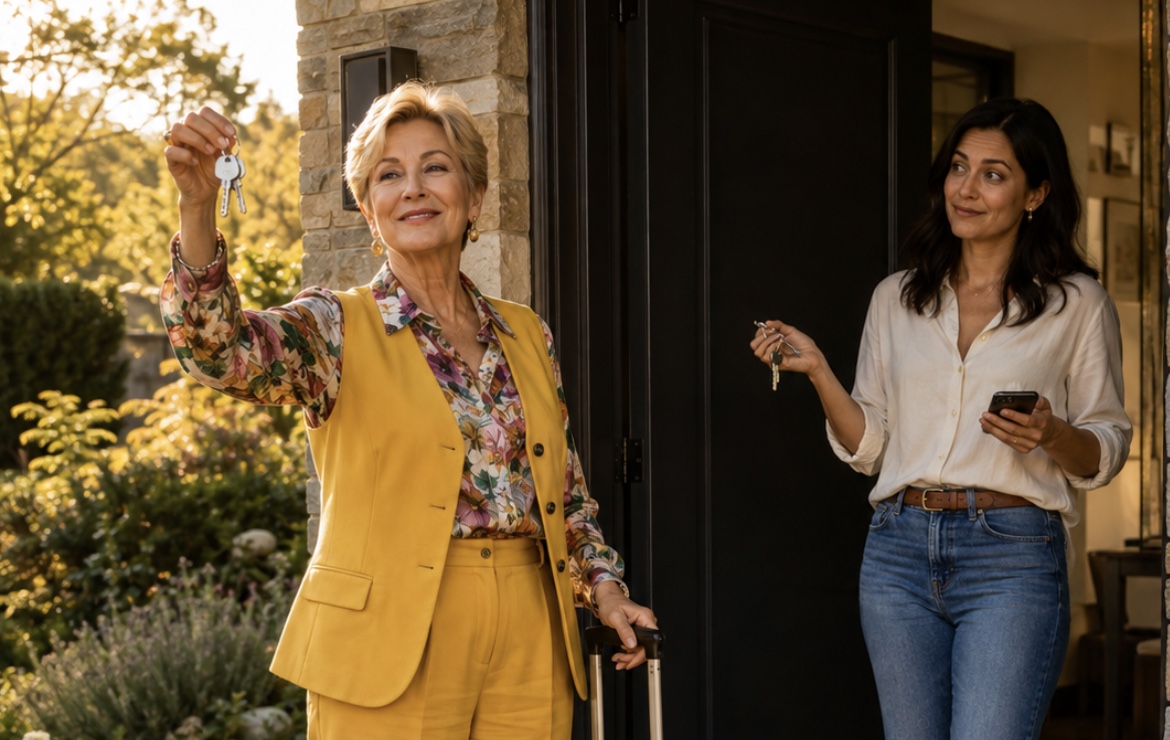
His mother arrived wearing a simple dress, carrying empty bags, and looking unusually subdued.
She stopped outside the gate without touching the handle and waited for Alina to open it.
“Hello,” she said.
“Hello.”
Valentina Andreyevna entered and looked around.
The apple trees were heavy with fruit, their branches bending under the weight. Yellow leaves lay scattered over the grass, while the air smelled of dry earth and ripe apples.
“It’s beautiful here,” her mother-in-law said after a pause. “You’ve taken good care of your place.”
Alina noticed the wording.
Your place.
Not “your shared place.”
Not “our place.”
One small phrase that had required an entire summer of locked doors.
“Thank you.”
They collected apples in near silence.
Kirill carried the crates.
Valentina Andreyevna carefully removed fruit from the lower branches.
Alina sorted the firm apples from the bruised ones.
At one point, her mother-in-law stopped beside an old tree and ran her palm across the bark.
“I suppose I went too far back then.”
Alina looked at her.
“Not ‘suppose.’”
Valentina Andreyevna grimaced but did not become angry.
“Yes. I went too far. I thought that because I was his mother, I was entitled to more.”
“Motherhood does not provide keys to someone else’s house.”
Her mother-in-law nodded.
Reluctantly and heavily, but she nodded.
“I was accustomed to Kirill giving in.”
“I noticed.”
“But you don’t.”
“I am not Kirill.”
Valentina Andreyevna looked at her with a new expression.
It was not affection. They were nowhere near that.
But the old contempt had disappeared.
In its place was a cautious recognition of strength—something she could not pressure, shame, or force into submission.
“You are a hard woman, Alina.”
“When someone interferes with what belongs to me, yes.”
“And when people approach you properly?”
“Then I’m perfectly reasonable.”
Her mother-in-law gave a quiet snort.
It did not sound mocking. It almost sounded respectful.
At six o’clock, Valentina Andreyevna packed a bag of apples herself, thanked them, and walked toward her car.
She paused at the gate.
“I won’t ask for a key.”
“A wise decision.”
“But may I visit occasionally?”
“If we arrange it in advance.”
“I understand.”
She spoke without pleasure, but also without defiance.
Alina closed the gate behind her and turned the key only after the car had driven away.
Kirill stood beside her.
“Do you think she truly understood?”
Alina looked down the road and then back at the house she had inherited from her grandmother.
“I don’t know. That’s why the new lock is staying.”
He laughed and wrapped an arm around her shoulders.
Alina allowed him to.
Not because she needed protection, but because the person beside her had finally understood that loving one’s relatives did not require handing them the keys to someone else’s home.
From then on, Valentina Andreyevna never again referred to the country house as though it belonged to her.
Occasionally, she still tried to advise Alina on where to plant garlic or how to prune the bushes, but Alina had learned to respond briefly.
“Thank you. I’ll decide for myself.”
That was enough.
The country house survived the summer without anyone else’s suitcases, unexpected visitors, or relatives who confused family ties with the right to control another person’s property.
Alina had not started a conflict for the sake of fighting.
She had simply identified the weakness behind other people’s entitlement: audacity remains powerful only when doors are opened out of fear of appearing rude or unkind.
That year, the door remained closed.
And it turned out that restoring order sometimes requires nothing more than a new lock, a calm voice, and a homeowner who has finally stopped explaining the obvious twice.