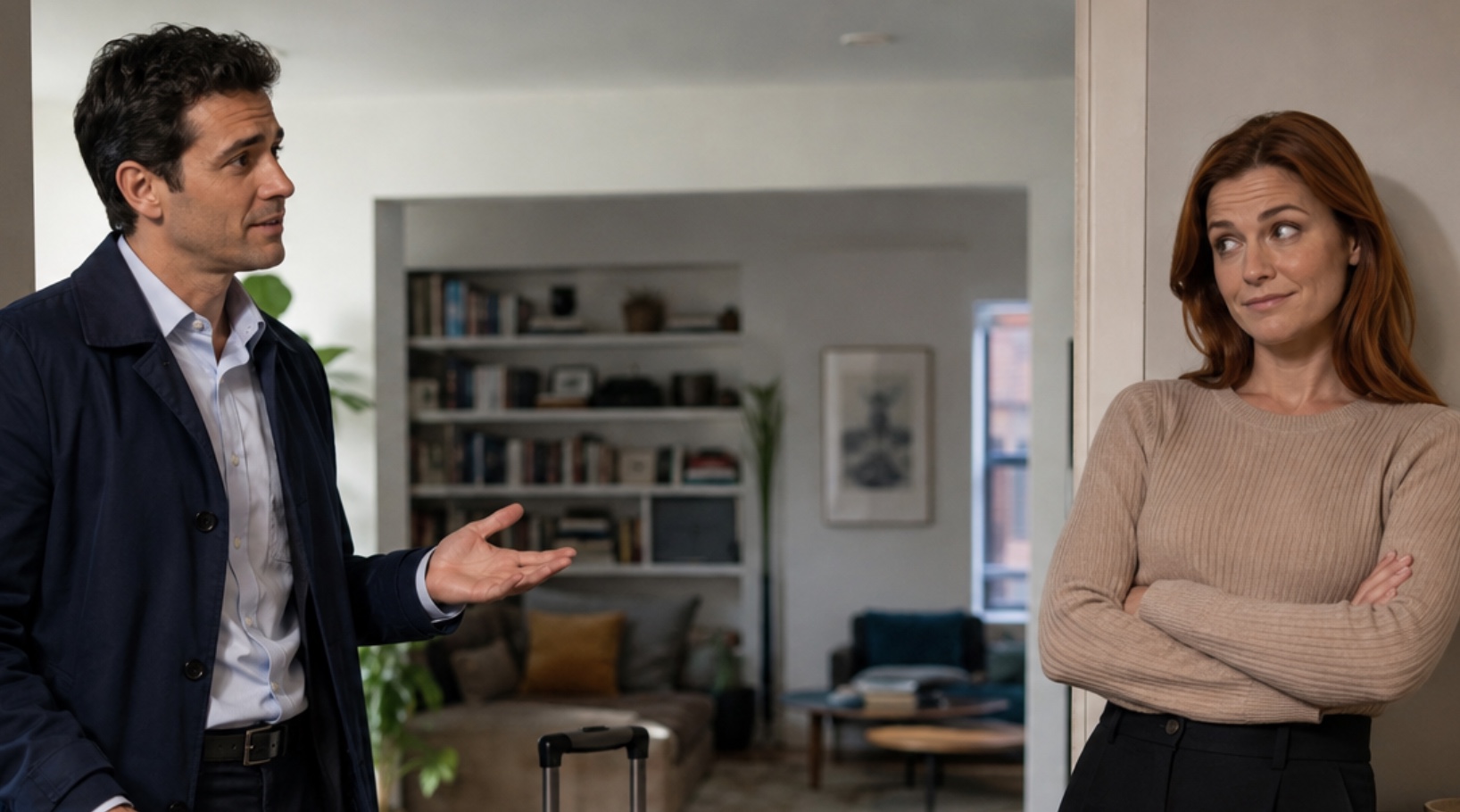
Marina opened the door and found Sergey standing on the landing. He was holding a bouquet of chrysanthemums—white, stiff flowers that looked almost artificial. She was not surprised to see him.
“Hi, Marina,” he said, offering her the bouquet. “These are for you. You used to love chrysanthemums, remember?”
“I loved daisies,” Marina replied without reaching for the flowers. “Chrysanthemums were Nastya’s favorite. The woman from your contacts. Or maybe it was Olya. I’ve lost track.”
Sergey lowered the bouquet, but the smile remained on his face. It was the same smile that had once been able to melt her resistance in seconds.
It had no effect on her now.
“All right, maybe I got confused,” he said, shifting awkwardly from one foot to the other. “Can I come inside? We need to talk.”
“You can talk from there.” Marina leaned against the doorframe. “I’m not in a hurry.”
“Marina, I’ve spent the whole month thinking.” Sergey looked directly into her eyes. “I understand everything now. I was wrong. Let’s start over.”
“And what exactly would starting over look like?” she asked without anger, almost gently. “You would once again ‘fly to Kazan for work,’ and I would once again discover receipts from restaurants in Moscow?”
He looked away.
Marina immediately realized that he had not prepared an answer for that question. Apparently, he had assumed that a bouquet and an apology would be enough.
“They were business dinners,” he said quietly, almost in a whisper. “You misunderstood everything.”
“Sergey, I saw myself in the mirror the day I found you in someone else’s social media story at Leningradsky Station, standing beside a woman in a red coat,” Marina said evenly, without raising her voice. “That was the day you were supposedly flying to Samara. The problem is that flights from Moscow to Samara leave from Domodedovo. People don’t board trains to Samara at Leningradsky Station.”
Sergey said nothing.
The bouquet trembled slightly in his hand.
“I don’t love you anymore,” Marina said. “That isn’t resentment. It’s simply a fact, like the fact that the Earth is round. There’s no point arguing with it.”
“And what about Danil?” Sergey suddenly lifted his head. “Have you thought about our son?”
“I thought about him every night while you were somewhere else instead of coming home.” Marina straightened. “That’s enough, Sergey. Leave, and stop complaining.”
She closed the door gently, without slamming it. For several seconds, she stood with her palm resting against the lock.
Then she went into the kitchen to put the kettle on.
Danil was sitting on his bed, turning his mother’s old phone over in his hands. He had discovered it in one of the dresser drawers—the phone with the cracked screen that Marina had replaced six months earlier.
His father’s number was still saved in the contacts.
The boy called.
Three rings.
Four.
Five.
“Hello?” His father sounded surprised. “Who is this?”
“Dad, it’s me,” Danil said, swallowing nervously. “Danil.”
“Danilka!” Sergey’s voice immediately became livelier. “Finally! I’ve called you so many times, but you never answered. How are you?”
“I’m okay.” Danil paused. “Dad, why did you and Mom separate?”
There was a long silence on the other end. Danil heard his father clear his throat.
“That’s a complicated subject,” Sergey began carefully. “Your mother… she tried to control me all the time. She checked my phone and questioned me about everything. I felt as though I couldn’t breathe. Do you understand?”
“Mom isn’t like that,” Danil said, frowning.
“You didn’t see everything that happened between us, son,” Sergey sighed. “She pushed the situation too far. I tried to save our family, but it was impossible to reason with her.”
Danil bit his lower lip.
He remembered the nights when his mother had cried into her pillow, pressing it against her face so he would not hear.
But he had heard her.
Every single time.
“Dad, could you come to my competition?” Danil asked, deciding to change the subject. “It’s in two weeks. I’ve been training for a long time.”
“Of course I’ll come!” Sergey replied enthusiastically. “I wouldn’t miss it. And you know what? Afterward, let’s go to St. Petersburg together. Just the two of us. A proper father-and-son trip. How does that sound?”
“Really?” Danil’s eyes lit up.
“Absolutely. I’ll arrange everything—the tickets, the hotel, the opening of the bridges at night,” Sergey continued excitedly. “You deserve a real adventure.”
“All right, Dad.” Danil smiled. “I’ll be waiting.”
He ended the call and stared at the cracked screen.
For some reason, his chest felt warm and uneasy at the same time. It was like the moment before a storm, when the sun was still shining but the wind had already begun to change.
That evening, he told his mother about the trip to St. Petersburg. Marina listened silently while pouring him a cup of tea.
“Mom, are you angry?” Danil asked.
“No.” She placed the cup in front of him. “I want you to have a father. A real father. If he keeps his promise, I’ll be happy for you.”
“He will,” Danil said confidently. “He promised.”
Marina did not answer. She only stroked her son’s hair and turned toward the window.
The word “promise” had stopped meaning anything when it came from Sergey.
The day of the competition arrived on a Saturday.
Danil warmed up before his performance, constantly glancing toward the seats. Marina was sitting in the third row. The chair beside her remained empty—the seat Danil had asked her to save for his father.
By the middle of the first round, it was still unoccupied.
Danil performed well and finished in third place. It was not first, but he had earned it honestly.
He came over to his mother afterward, sweaty and exhausted, with a medal hanging around his neck.
“He didn’t come,” Danil said.
It was not a question. It was a statement.
“No,” Marina answered, pulling him into her arms. “But I’m proud of you.”
Sergey called an hour later, when they were already walking home.
Danil answered.
“Danilka, forgive me,” Sergey said guiltily. “Work became completely overwhelming. I couldn’t get away. You understand, don’t you?”
“I understand,” Danil replied dully.
“But St. Petersburg is still happening,” Sergey added quickly. “That’s sacred. I’m already checking the tickets. We’ll definitely go in a couple of weeks. I swear.”
“When exactly?” Danil asked.
“Well… I need to confirm a few things. Soon. I’ll send you the date.”
“You always say that.” Danil stopped in the middle of the pavement. “‘Soon.’ ‘I’ll confirm.’ ‘I’ll message you.’ It’s like a train that appears on the schedule but never arrives.”
“Danilka, don’t talk like that,” Sergey said as something rustled in the background. “I’m trying.”
“Trying is when you actually show up,” Danil replied. “When you don’t show up, it’s called something else.”
He ended the call.
Marina stood beside him without saying a word.
Danil put the phone into his pocket and looked at his mother. There was something new in his eyes. It was no longer the wounded expression of a child. It was a quiet, almost adult disappointment.
“Mom,” he said softly, “why don’t you and I go to St. Petersburg? Just the two of us.”
“We don’t have much money for a trip like that,” Marina answered honestly.
“We can travel in a cheap sleeper carriage,” Danil said with a shrug. “And stay in the simplest hotel. I don’t need to watch the bridges open from some luxury room. I just want to see St. Petersburg. With you.”
Marina looked at her son and smiled genuinely.
Not because she wanted to reassure him. Not because she was forcing herself to appear cheerful.
She smiled because she truly wanted to.
“Then we start saving tomorrow,” she said.
For three weeks, they put money aside.
Danil gave up buying new sneakers. Marina canceled her appointment at the hair salon. They kept a notebook in which they recorded every banknote they managed to save.
When they finally had enough, Danil bought the tickets himself through an app. They were traveling in a basic open sleeper carriage, both on upper bunks, departing on Thursday evening.
“Upper bunks,” he said, showing his mother the screen. “But at least we’re going.”
“We’re going,” Marina confirmed.
St. Petersburg welcomed them with a gray sky and a cold wind blowing from the Neva.
Danil walked out of the railway station and stopped, tilting his head back. The city was enormous and real—not a photograph on the internet, but something alive around him.
“Mom, look!” He pointed toward the Admiralty spire. “It’s gold. It’s actually gold.”
“It really is.” Marina took his hand. “Come on. We still have to find the hotel.”
Their hotel room was tiny. It had two beds, an old wardrobe, and a window overlooking a narrow enclosed courtyard.
But the room was clean and warm.
Danil threw his backpack onto one of the beds and immediately began pulling his mother back toward the door.
For two days, they explored the city on foot.
They visited bookshops on Liteyny Avenue and stopped at a small café beside the Fontanka, where Danil tasted a St. Petersburg-style cheesecake for the first time. They joined an official rooftop tour and looked out over the city from above.
Beneath them, St. Petersburg stretched endlessly—gray, heavy, and beautiful.
On the roof, surrounded by antennas and old chimneys, Danil sat on a low ledge and remained silent for a long time.
“Mom,” he said eventually, without turning around, “I was angry with you for a long time. I thought you had driven Dad away. I thought that if you had been gentler with him, he would have stayed.”
“I know,” Marina said, sitting beside him.
“But I understand now.” Danil turned to face her. “You didn’t drive him away. You only stopped pretending that everything was fine. Those aren’t the same thing.”
“No,” Marina agreed. “They’re completely different.”
“You didn’t only endure everything,” Danil continued, choosing his words slowly, as though selecting stones along a riverbank. “You stayed and kept living. You worked. You cooked for me. You checked my homework. And then you cried at night. I heard you. Every time.”
Marina remained silent as the wind lifted strands of hair from her face.
“I’m sorry I called him,” Danil said, lowering his head. “And I’m sorry I believed him instead of you.”
“You have nothing to apologize for.” Marina placed her hand on his shoulder. “You wanted a father. That’s normal. There’s nothing wrong with that.”
“But he didn’t really want to be a father,” Danil said steadily. “He only wanted to look like one.”
They stayed on the roof for another half hour, watching St. Isaac’s Cathedral in the distance.
Afterward, they went to eat doughnuts on Bolshaya Konyushennaya Street. Danil laughed with powdered sugar covering the end of his nose, and Marina realized that the city had done more for them than any conversation ever could.
On the third day, they entered a large two-story bookshop on Nevsky Prospect. It had wooden staircases and shelves reaching almost to the ceiling.
Danil disappeared into the science fiction section while Marina browsed through albums containing old photographs of Leningrad.
Then she saw him.
Sergey was standing near the checkout counter with a book in his hand.
Beside him stood a fair-haired woman in a beige raincoat, perhaps thirty years old. She was smiling as she spoke to him, while he nodded and looked at her with the same expression Marina had once believed was meant only for her.
Marina did not move.
Sergey turned, noticed her, and froze.
“Marina?” His face turned pale. “What… what are you doing here?”
“Traveling,” she replied calmly. “With our son.”
“With Danil?” Sergey glanced around nervously. “Is he here?”
At that moment, Danil stepped out from behind a shelf, holding a book.
He saw his father.
Then he saw the woman beside him.
He stopped.
“Danilka,” Sergey said, moving toward him. “Son, I’m so glad to see you. I missed you. I really did.”
Danil looked at his father, then at the woman, who awkwardly stepped backward. Finally, he looked at Sergey again.
“Don’t,” Danil said.
There was no anger in his voice, but there was no warmth either.
“I’m here with Mom. We have plans. You have endless promises.”
“Wait. At least let’s talk.” Sergey reached toward his shoulder.
“We already talked, Dad.” Danil stepped away. “You promised to take me to St. Petersburg. Well, I’m here. Just without you. And do you know something? It turned out better this way. Without all your stupid, never-ending promises.”
He walked over to his mother, took her hand, and led her toward the exit.
Marina gave Sergey one final look.
It was simply the look of someone who had closed that door a long time ago.
Sergey remained beside the checkout counter, still holding the book he had forgotten to pay for. The woman in the beige raincoat touched his sleeve, but he did not react.
He stared at the shop door as it closed behind Marina and Danil.
There was something on his face that Marina had never seen before.
Perhaps it was realization.
Their final evening in St. Petersburg was spent in a small café on Mokhovaya Street.
There were two chairs, a table beside the wall, and two mugs of hot chocolate.
Danil sat across from Marina, breaking a croissant into pieces.
“Mom,” he said, raising his eyes. “Thank you.”
“For what?” Marina smiled.
“For always being there.” Danil placed the piece of croissant on his plate and continued seriously. “Even when I was angry with you. Even when I trusted him instead of you. Even when I said stupid things. You never left.”
“I’m your mother.” Marina shrugged gently. “There’s nowhere I would rather be. I don’t want to leave you.”
“No, it isn’t just something a mother is supposed to do,” Danil said, shaking his head. “Dad was supposed to be there too. But he chose everything else instead of us. You chose us every day. That’s different.”
Marina blinked rapidly.
Danil noticed and pushed a napkin toward her.
“Just don’t cry,” he said with a faint grin. “Otherwise I’ll start crying too, and I’m supposed to walk down Nevsky Prospect in half an hour. It would be embarrassing.”
They both laughed.
Quietly, together, in a little café where nobody knew them.
And that felt good.
Their train home departed at eleven that night.
They climbed onto their upper bunks, and Danil leaned over the edge to watch the railway platform begin to slide past the window.
“Mom,” he whispered through the darkness of the carriage, “you’re strong.”
Marina stretched out her hand and touched his palm.
“We’re strong together,” she replied.
The train gained speed.
Beyond the glass, the lights of St. Petersburg flashed and disappeared—yellow, white, and scattered like coins along the darkness.
Two days after returning to Moscow, Marina received a message from an unfamiliar number.
It was from the woman who had been wearing the beige raincoat. Her name was Alyona. She had found Marina through mutual acquaintances.
“Hello, Marina. I’m sorry for contacting you unexpectedly. My name is Alyona. After we met in the bookshop, I began asking Sergey questions. He gave me his version of your marriage. He claimed you controlled him and pushed him too far. But one sentence from your son told me more than Sergey’s entire explanation.
“I checked everything. I found messages and receipts. I discovered the same supposed business trips. It was exactly the same story all over again. I left him yesterday.
“Thank your son for me. He is more mature than his father.”
Marina read the message several times before replying.
“Alyona, you made the right decision. Take care of yourself.”
She put down the phone and looked over at Danil. He was sitting at the table, reading the book he had brought home from St. Petersburg.
He lifted his eyes.
“What is it?” he asked.
“Nothing.” Marina smiled. “I’m just glad you’re here.”
Danil nodded and returned to his book.
Outside the window, it was an ordinary evening in an ordinary city.
But inside their small apartment was something Sergey could never purchase, imitate, or create with another empty promise.
There was silence in which no one lied.
There was warmth that did not have to be paid for with fear.
That same evening, Sergey sat alone in his rented apartment.
Alyona had collected her belongings that morning and left her keys on the bedside table. He had sent her seven messages.
She had not answered any of them.
He called Danil, but the phone was unavailable.
He called Marina and listened to the ringing until the call was rejected.
For the first time in his life, Sergey’s train never arrived.
And there was no one left waiting for him.