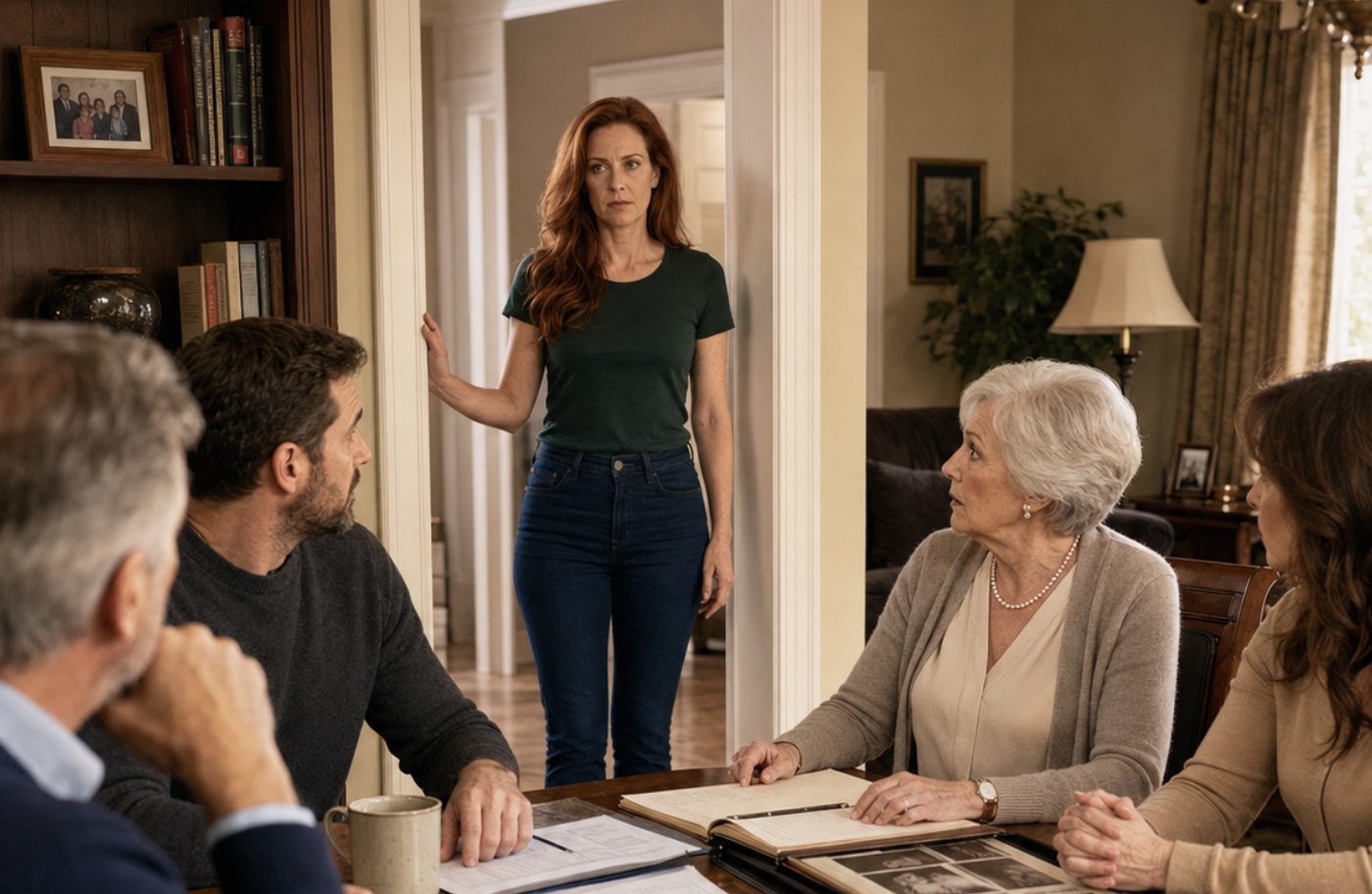
“So, here’s what we’re going to do. We’ll put the country house up for sale in the spring, as soon as the snow melts,” Marina heard her mother-in-law announce from the living room in her usual firm, commanding tone. “We’ll divide the money fairly. Most of it will go toward a down payment on an apartment for Pavlik. He’s already nineteen; it’s time for him to have a place of his own. We’ll use what’s left to buy Anton a proper car—something respectable. He’s embarrassed himself long enough driving that old wreck.”
Marina froze in the entryway without even removing her rain-soaked coat. The keys she had just quietly pulled from the recently oiled lock dug painfully into her palm.
“Mom, what if Marina refuses?” came the uncertain voice of her husband, Anton. “She loves that house. She’s put so much work into it. She only finished the renovations last year.”
“Who’s going to ask her?” Anton’s sister, Sveta, scoffed.
Marina could clearly imagine her rolling her eyes with contempt while stirring her tea.
“We’ll handle it cleverly. You’ll get her to sign a general power of attorney. Tell her it’s needed to renew the garbage collection contract or connect the gas. She’s always disappearing into that clinic of hers, fiddling around with animals. She never has time to read paperwork. She’ll sign without looking. Then we’ll simply present her with the finished deal. We’re family, after all. She should understand that Pavlik needs the money more than she does.”
Marina closed her eyes as an icy chill spread through her body, even though the apartment was warm.
She was forty-six years old and had been legally married to Anton for the past fifteen years. Marina was a veterinary surgeon and owned a small private clinic on the ground floor of a newly built apartment complex in the neighboring district.
Her working days usually consisted of endless examinations, vaccinations, complicated abdominal surgeries, frightened owners shouting questions, and the persistent smell of medicine.
That evening, she had returned home three hours earlier than usual. The remaining appointments had been canceled because of the terrible weather, and a scheduled operation had been postponed until the following day.
She had driven through the autumn downpour dreaming only of a hot shower and a cup of strong tea.
Instead, she had walked into a secret family council discussing how to divide her property.
The country house they were talking about had been left to Marina by her grandfather long before she ever met Anton. It was a solid brick house near a lake, with a large apple orchard and a spacious veranda.
For the past five years, Marina had invested every spare ruble in it. She had replaced the roof with modern materials, installed proper heating, and fitted new windows throughout the house.
Anton had taken no part in the work. He always blamed his bad back, his allergy to construction dust, or his demanding schedule.
His demanding schedule consisted of sitting around in a district archive, where he worked as a junior research assistant for a salary that barely covered fuel for his aging Renault and lunches in the staff cafeteria.
Marina carried nearly all of the family’s financial responsibilities.
She paid the electricity and water bills, bought a week’s worth of groceries at a time, filling the trunk with bags from the supermarket, covered the internet bill, and even bought Anton’s winter shoes.
On top of that, she paid the full cost of their daughter Dasha’s education. Dasha had been accepted into the architecture department at a university in Saint Petersburg.
Anton had said that paid education was an unnecessary luxury and that their daughter could easily have enrolled in a local culinary college instead.
Yet he constantly worried about his nephew Pavlik, Sveta’s son, because the boy had grown up without a father and supposedly needed male support.
Marina slowly hung her coat on a hook, removed her wet boots, and walked down the corridor.
She stopped in the living-room doorway.
The scene before her looked almost peaceful.
A teapot sat on Marina’s expensive oak table, purchased with one of her own work bonuses. Her mother-in-law, Zinaida Petrovna, occupied the seat at the head of the table like a queen, biting into shortbread biscuits and scattering crumbs across the clean tablecloth.
Sveta sat nearby, staring at her phone, her brightly manicured fingers tapping at the screen, while Anton nervously twisted the corner of a napkin.
“Of course,” Marina said loudly and clearly as she stepped into the room. “Why should I waste my time reading documents when my loving relatives have already decided everything behind my back? By the way, what price are you planning to ask for my property? I hope you’re not going to sell it too cheaply.”
A thick, oppressive silence filled the room.
Sveta dropped her phone onto the table.
Anton turned so pale that his face nearly matched the beige wallpaper.
Zinaida Petrovna choked on her biscuit and began coughing, covering her mouth with one hand.
“Marina? Why are you home so early?” Anton finally managed to say, forcing an expression of happiness that looked more like a grimace of pain. “We thought you were working until nine.”
“As you can see, I finished early,” Marina replied, approaching the table and folding her arms across her chest. “So, what was that about the power of attorney for the gas connection? Have you already prepared the form for me to sign without reading?”
Once she recovered from her coughing fit, Zinaida Petrovna was the first to attack.
The best defense was an aggressive offense, and Marina’s mother-in-law had perfected that technique.
“Why are you eavesdropping in your own home?” she demanded, adjusting her hair. “We were only discussing hypothetical possibilities. The family is having difficulties. Pavlik needs an education, and poor Sveta can’t manage everything alone. She works as an eyebrow technician. How much can she possibly earn? Meanwhile, you have a huge house sitting empty! You only visit it on weekends, and even then, only in summer. Why do you need such a mansion? You have to share, Marina. You married into our family!”
“I married into your family fifteen years ago, Zinaida Petrovna,” Marina replied calmly. “And I have been supporting that family for all fifteen of those years. I work around the clock treating animals so we can eat properly, dress well, and take vacations. My daughter studies in another city, and I pay every ruble of her living expenses. Why should the country house I inherited from my grandfather be sold to buy an apartment for your grandson?”
“Dasha can get a job as a waitress. She’s not some noble lady!” Sveta snapped, her eyes flashing. “Pavlik is a young man. He needs a good start so he can find a decent wife someday! Besides, Anton has a right to part of that property. He mowed the lawn there two years ago!”
For a moment, Marina could not think of an answer to such astonishing logic.
Anton had indeed mowed the lawn once. Afterward, he had spent two weeks lying in bed with back pain, demanding expensive ointments and massages.
Marina looked around the room and suddenly noticed her old tablet lying on the cabinet beside the television. It was usually kept in the drawer of her writing desk.
Next to it sat a thick blue folder bearing the logo of a well-known real estate agency.
Marina crossed the room quickly and picked up the folder.
Anton jerked in his chair as if he intended to snatch it away, but he lost his nerve and sank back down.
Marina opened the cardboard cover.
The first page contained an official property valuation report.
Inside were recent photographs of her country house. Judging by the yellow leaves on the trees, they had been taken no more than two weeks earlier.
At the end of the report was a substantial seven-figure valuation and the appraiser’s blue official stamp.
“Hypothetical possibilities, you said?” Marina’s voice turned cold. “This report is dated October tenth. You hired an appraiser and brought him onto my property while I was working a twenty-four-hour shift. How much did this service cost?”
She threw the folder onto the table in front of her husband and picked up the tablet.
The screen was unlocked. Anton had always known her password because Marina had never hidden anything from him.
The banking application was open—not on Marina’s personal account, but on the transaction history of their joint household account.
Every month, Marina transferred one hundred and fifty thousand rubles into that account to cover shared expenses.
Anton contributed the modest fifteen thousand rubles left from his salary after buying fishing equipment and historical magazines.
Marina began scrolling through the transactions.
With every new entry, her illusions about her marriage crumbled further.
“September twenty-fifth,” she read aloud, ignoring Anton’s desperate attempts to breathe normally. “A transfer of fifteen thousand rubles to a real estate agency. Payment for an appraiser. Wonderful. Let’s continue. October second. Twenty thousand transferred to Svetlana. Comment: winter jacket for Pavlik. October eighth. Thirty thousand paid to a dental clinic. Sveta, did you get new veneers? Congratulations. October fifteenth. Another ten thousand transferred to Svetlana, this time with no explanation at all.”
“That money belongs to me too!” Anton squeaked weakly. “I have the right to use the family budget!”
“The family budget?” Marina looked at him, and there was no warmth left in her eyes. “Ninety percent of the money in this account was earned by me. I stand at an operating table for six hours at a time removing rubber balls from Labradors’ stomachs so that you can secretly finance your sister and pay for an appraisal of my house before selling it behind my back?”
Zinaida Petrovna realized that their plan had collapsed and decided to use her most reliable weapon: accusing Marina of being cold and heartless.
“All you ever think about is money!” her mother-in-law cried, clutching her chest theatrically. “You don’t have a drop of compassion for the people closest to you. You’ve dried yourself up with work! All you care about are numbers, and you’ve made your husband miserable in the process. There is no femininity left in you. A man needs encouragement and understanding, but you speak to Anton as though he were one of your employees. You’ve driven him to the point where he has to help his own nephew in secret!”
Marina listened to the passionate speech and suddenly felt unexpectedly light.
The heavy burden of responsibility for the helpless man she had carried for so many years began to dissolve.
She finally understood that they had simply been using her.
They had used her house, her money, her time, and her kindness.
She placed the tablet on the table and slowly walked around it until she was standing directly in front of her husband.
“Here is what is going to happen, Anton,” she said in a steady, emotionless voice. “You have exactly one hour. Go into the bedroom, take your suitcases down from the storage shelf, and pack your belongings. Take everything—your fishing rods, your historical reference books, and your collection of beer mugs. You may keep the car. It is registered in your name, even though I paid for it. Consider it my charitable contribution toward your fresh start.”
“You can’t throw me out!” Anton shouted, leaping to his feet and trying to appear righteously indignant. “I’m registered at this address! This apartment belongs to me too!”
“I bought this apartment two years before we were married,” Marina reminded him. “Your residence registration is temporary, and it expires next month. I will not renew it. Tomorrow morning, I am filing for divorce. And if all of you are not out of my apartment within sixty minutes, I will call the police and report the theft of money from my account. I have the bank statements right in front of me. Proving that the funds were used without my consent will not be difficult.”
Sveta jumped up from her chair, her face twisted with rage.
“Who do you think will want you at forty-six?” she screamed, spraying saliva as she spoke. “You’re old, and you always smell like dogs! Anton will find himself a younger woman, while you’ll sit alone in this apartment growing old with your cats!”
“Sveta, don’t waste your time predicting my romantic future,” Marina replied, pointing toward the door. “Go help your brother pack. You’ll have to find room for him in your two-bedroom apartment with your fully grown Pavlik. I hope the three of you enjoy living together.”
Chaos erupted.
Zinaida Petrovna continued moaning, clutching her chest and demanding heart drops.
Marina silently poured her a glass of ordinary tap water and placed it on the table, refusing to participate in the performance.
Anton rushed around the bedroom, pulling sweaters and trousers from the shelves. One moment, he threatened to demand his share of the marital property. The next, he switched to pathetic pleading, reminding Marina of the vacation they had taken to Turkey five years earlier and how happy they had once been.
Marina stood in the doorway and watched as though she were observing a boring documentary about someone else’s life.
When Anton attempted to remove the new flat-screen television from the living-room wall, Marina calmly took her smartphone from her pocket.
“That television was purchased last December using my personal bank card,” she warned him. “I have the electronic receipt. Put it back.”
Fifty minutes later, the procession headed toward the front door.
Anton dragged two heavy suitcases behind him. Sveta carried several bags filled with shoes, while Zinaida Petrovna marched at the front, every movement expressing the deepest possible outrage and wounded dignity.
“You’ll regret this,” Anton said from the threshold, trying to make his voice sound strong and masculine, though it trembled despite his efforts. “You’ll come crawling back to beg for forgiveness, and I won’t take you back.”
“Leave your keys on the cabinet,” Marina replied before shutting the door behind them.
She turned the lock, leaned against the cold metal door, and released a long breath.
Complete silence filled the apartment.
No one was muttering in front of the television.
No one was complaining about how unfair life was.
No one was dividing up her money.
Marina walked into the kitchen, poured the cold tea down the sink, threw away the remaining biscuits, and opened the window.
Fresh air carrying the scent of wet pavement flowed into the room.
Approximately six months passed.
A warm and sunny May arrived.
Marina stood on the veranda of her country house—the same house her relatives had nearly sold behind her back—and transplanted petunia seedlings into large hanging planters.
Birds sang in the apple orchard, now covered in white blossoms.
Her daughter Dasha, who had returned from Saint Petersburg for the May holidays, sat on a nearby bench eating fresh strawberries with obvious pleasure.
Marina’s veterinary clinic was thriving.
Now that she no longer had to support a grown husband and his resourceful relatives, she had been able to purchase new equipment and hire a capable assistant. For the first time in years, she could take proper weekends off.
She had gotten a stylish haircut, bought several new dresses, and looked rested, younger, and more confident.
Anton’s life after the divorce had predictably fallen apart.
After moving into Sveta’s apartment, he quickly discovered that his sister had no desire to cook soup for him or wash his shirts.
Instead, she demanded that he hand over half of his modest salary to pay for utilities and groceries.
They argued constantly over everyday inconveniences, while Pavlik openly insulted his uncle for taking over his favorite sofa in the walk-through room.
Eventually, Zinaida Petrovna grew tired of listening to her children’s endless fights and moved to the countryside.
Anton tried several times to rebuild his relationship with Marina.
He called her on her birthday, complained at length about his aching back, told her how much he missed her homemade meat patties, and hinted that he was prepared to forgive her for her emotional outburst.
Marina listened for exactly two minutes.
Then she politely thanked him for the birthday wishes and permanently blocked his number.
She had finally understood the most important truth.
Her ability to solve other people’s problems had become a convenient shelter for people who had no intention of solving their own.
Once she stopped being everyone’s sponsor and rescuer, she finally became a happy woman—the owner of her life, her home, and her future.
And under no circumstances was she ever going back to the past.