Part 1. A Concrete Foundation
“Concerning my property, the matter is closed. It’s taboo. The apartment has nothing to do with you or any of your relatives,” Svetlana told her husband, setting the folder of documents aside.
Her voice was even, without the slightest tremor, but Eduard, sitting across from her at the kitchen table, felt the air in the room grow heavier. He was chewing a sausage sandwich, and suddenly it tasted dry, as if he were trying to swallow a piece of cardboard.
“I only asked,” Eduard said, trying to make his face look indifferent, though his lips twisted against his will. “We are family, after all. We’ve been living together for three years.”
Svetlana looked at him over her glasses. There was no warmth in her eyes, only the same practical calculation with which she usually checked budgets at her language school.
“We live in an apartment that belonged to my mother, and now belongs to me by deed of gift. That, Edik, is called separate property.”
The whole story had started six months earlier. Galina Sergeevna, Svetlana’s mother, was a tough woman of the old school. When her own mother became bedridden in Voronezh, Galina Sergeevna packed her bags without hesitation and left to care for her. Svetlana and Eduard remained the full-time occupants of the two-room apartment on Prospekt Mira. They lived quietly. Eduard laid asphalt, coming home with the smell of tar and diesel fuel clinging to him so stubbornly that no shower gel could wash it away, while Svetlana stayed late at her school, building lesson plans.
When the grandmother passed away, the apartment in Voronezh went to Galina Sergeevna. Svetlana’s mother did what she considered right: she stayed in the province, where the climate was milder, and officially gifted the Moscow apartment to her daughter.
When Eduard heard the news, he felt a complicated mix of emotions. At first, joy — having a home of their own, even if it belonged to his wife, was better than renting a corner somewhere. Then resentment crept in. Sticky, thick, like hot bitumen. Why only her? Hadn’t he contributed? Wasn’t he the one who had changed the bathroom faucet and put up the shelves in the hallway?
“So that means I’m nobody here,” Eduard concluded, pushing his plate away.
“You are my husband here. But the owner of the square meters is me,” Svetlana said sharply. “And let’s not ruin the evening. I have a difficult seminar with native speakers tomorrow.”
Eduard said nothing. But inside him, a dark seed of dissatisfaction had already begun to grow. Very soon, it would sprout, generously watered by outside advice.
Part 2. Poisonous Whispers
Tamara Pavlovna, Eduard’s mother, lived in a nearby district in an old Khrushchev-era apartment block. She was an energetic woman, but uselessly energetic — always fussing, giving advice no one asked for, and believing the world was unfair to her sons.
“And what, she didn’t even put you down as a co-owner?” Tamara Pavlovna asked, stirring her tea and looking at her son with a pity that humiliated him more than an open insult would have. “So that’s how it is? She uses you because she needs a man in the house, but when it comes to serious matters, everything is hers?”
“Mom, her mother gifted it to her. She has the right,” Eduard tried to defend weakly, though his mother’s words were falling on fertile ground.
“She may have the right, but she has no conscience!” the woman exclaimed, throwing up her hands. “Just look at Kirill. His situation is exactly the same, only the people there are decent.”
Kirill, Eduard’s younger brother, lived with Polina. Quiet, modest Polina had recently suffered a tragedy — her father had died. Her mother had passed away from cancer long ago, and now Polina was left an orphan. She inherited a good apartment. And what did Polina do? As soon as she entered into her inheritance rights, she transferred half of it to Kirill.
“We are one whole, and we have a daughter growing up,” she had said back then.
For Tamara Pavlovna, this became a banner she now waved in front of her eldest son’s face.
“Polina is a saint,” his mother proclaimed, pouring more boiling water into her cup. “She understands that a husband is the head of the family. And your Svetochka? A business lady, so important… She looks at us like we’re dirt. To her, Edik, you’re just a convenient function. Bring this, carry that, fix this. And what if there’s a divorce tomorrow? Where will you go? To my place, on a folding bed?”
Eduard grew darker. The comparison with his brother struck painfully at his pride. Kirill, who worked as an ordinary logistics manager, was now a co-owner of property. And he, Eduard, the elder brother, sweated on the roads under the blazing sun and remained a “freeloader.”
At family gatherings, Kirill carried himself confidently, clapping his brother on the shoulder, and Eduard felt as if there was condescension in that gesture.
“You should talk to her more firmly,” Kirill advised one day while they smoked on the balcony. “A woman must feel strength. Polinka offered it herself. I didn’t even ask. Because she respects me. But you, brother, look like you’re being taken for a fool.”
Eduard’s anger grew stronger. He began noticing things in his wife’s behavior that he had never seen before. It seemed to him that she deliberately left money on the dresser as if it were a tip. That she spoke English too loudly on the phone, emphasizing his lack of education.
One evening, he tried to approach the subject from afar.
“Sveta, what if we ever want a bigger place? Sell this one and buy something larger…”
“Why?” she replied without looking up from her laptop. “There’s enough space for the two of us. Besides, this is my premarital property. I don’t need risks.”
The word “risks” cut his ear. She saw him as a threat. Not a partner, but a potential invader.
“Oh, risks…” Eduard hissed as he walked into the bedroom. “Just wait.”
Part 3. The Asphalt Roller
Work was going badly. The hot asphalt mixture smoked, the roller rumbled, but Eduard’s thoughts were far away. He kept replaying imaginary conversations in his head, conversations where he put Svetlana in her place and she, realizing how wrong she was, ran to the notary.
Tamara Pavlovna called every day.
“Well? Did you talk to her?” her voice demanded through the phone. “Edik, time is passing. If she behaves like this now, what will happen when you’re old? She’ll throw you out into the street like a dog. Polina has already started renovating, and she asks Kirill’s opinion on every nail. And you?”
“ENOUGH!” Eduard roared into the phone so loudly that his coworker flinched and dropped his shovel. “I’ll handle it. Aliska’s birthday is coming soon. Everyone will be there. That’s when we’ll talk.”
The plan formed spontaneously. Eduard decided that doing it in public would work in his favor. In front of witnesses, in front of relatives, Svetlana would be ashamed to refuse. She valued her reputation, didn’t she? She played the intellectual. Family opinion would crush her.
Deep down, Eduard understood that what he was planning was vile. But greed, disguised as a search for justice, had already taken over his mind completely. He did not just want square meters. He wanted triumph. He wanted his brother to stop looking down on him. He wanted his mother to stop nagging.
Svetlana was especially busy during those days. She was preparing her school for accreditation. She came home late, exhausted.
“You could at least have made dinner,” she said one evening, seeing the empty table.
“I didn’t sign up to be a cook,” Eduard snapped. “We have equality, don’t we? The apartment is yours, so the rules are yours too. I’m just a guest here.”
Svetlana did not answer then. She only looked at him strangely. At that moment, she resembled a stretched bowstring, ready to snap at any second. But Eduard, blinded by his resentment, mistook her silence for weakness. He decided she felt guilty.
“She’s scared,” he thought. “That means I’m right.”
He began behaving with insolent arrogance, as if he were the master of the place. He stopped picking up after himself, turned the television on loudly when she was working. It was petty domestic revenge, a prelude to the main blow.
Part 4. A Celebration of Broken Dishes
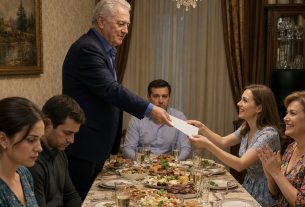
Alice’s birthday, the daughter of Kirill and Polina, was celebrated lavishly. They rented a small hall in a café and invited the family. Tamara Pavlovna sat at the head of the table, glowing like a polished copper samovar. Kirill poured drinks, while Polina, sweet and smiling, accepted congratulations.
Svetlana arrived from work, slightly late. She looked impeccable in a strict dress, though tired. She handed over a gift — a huge interactive doll — and sat down beside her husband.
Eduard had already swallowed a couple of shots of vodka for courage. Inside him, anger boiled together with determination. He was waiting for the right moment.
Toast after toast followed.
“To our dear Polinochka!” Tamara Pavlovna announced. “Smart, domestic, a real wife! Kirill is lucky — a golden woman, everything for the family, everything for her husband. Not like some others…”
An awkward silence settled over the table. Svetlana calmly cut a piece of meat, pretending not to notice the jab.
“Mom, don’t start,” Polina said quietly.
“And why shouldn’t she start?” Eduard suddenly said loudly, rising to his feet. The chair scraped back with an ugly sound. “Mother is telling the truth. Polina is a decent person. She has a conscience. And I live with… a miser.”
The hall went silent. Only the buzzing of the coffee machine behind the bar could be heard.
“Edik, sit down,” Svetlana said in an icy voice.
“NO, I won’t sit down!” His voice broke into a shout. “Today we’re celebrating Aliska’s first birthday. A good occasion to talk about the future. Polina signed over half an apartment to her husband. And you, Sveta? When will you stop hiding everything like a rat? Are we family or not? I demand that you do the same! Tomorrow we’re going to the notary. Or don’t you respect me?”
Svetlana slowly put down her fork.
“You’re drunk, Eduard. We’ll talk at home.”
“We’ll talk HERE!” he shouted, slamming his fist on the table so hard that the plates rang. “Let everyone know how calculating you are…”
“Shut up, Edik,” Polina suddenly said firmly.
She stood up, and her usually soft face became stern.
“Don’t you dare compare us. I did what I did because I wanted to. But you are extorting her. It’s disgusting. Sveta works herself to exhaustion, and all you do is envy her.”
Eduard was stunned. He had not expected support to come from Polina.
“What… what are you saying?” he turned toward his brother’s wife. “Who asked you?”
“Eduard!” Svetlana stood up. “We are leaving. Now.”
“I’m not going anywhere until you promise!” His face turned red. “Do you think I’m a fool? I’m a man! I DEMAND my share!”
He grabbed Svetlana roughly by the elbow, hurting her.
“Let go,” she said quietly.
“I won’t let go! You’ll sign!” He yanked her toward him and, losing control, slapped her across the face.
The sound of the slap cracked through the hall like a gunshot.
Everyone gasped. Kirill jumped up, but it was too late.
Svetlana staggered but did not fall. She did not grab her cheek. She did not cry. She froze for a second, as if calibrating her aim. Then, with one short breath, she struck back.
It was not a woman’s slap. It was a direct, trained punch to the nose — the kind her father had taught her when she was a child.
Eduard howled, covering his face with his hands. Blood splattered onto the white tablecloth.
Part 5. Cold Fury
Eduard had expected anything: tears, hysteria, pleas for forgiveness, maybe even a call to the police. But no one could have predicted what happened next.
Svetlana did not run away. Something primitive awakened inside her, yet it was completely rational. Rage on the edge of madness, but controlled like a nuclear reaction inside a reactor. She began to shout. Not shriek from fear — shout, crushing his will, filling the entire room with herself.
“YOU WANT A SHARE?!” she roared, advancing on him. “YOU WANT WHAT’S MINE?! THEN TAKE IT!”
She grabbed a bowl of Olivier salad from the table and dumped it over his head with full force. Then came a pitcher of fruit drink.
“Sveta, calm down!” Tamara Pavlovna squeaked, shrinking into her chair.
“SILENCE!” Svetlana barked at her mother-in-law so sharply that the woman hiccupped. “Isn’t this what you wanted? You raised a greedy coward? Then take him back!”
Svetlana grabbed Eduard by the collar of his shirt, now soaked with fruit drink. He was disoriented by the pain in his nose and by the force of her sudden attack, and he did not resist. He saw her eyes. There was no pity in them — only a furious, scorching cold.
“Out!” she shouted straight into his face. “I don’t want your shadow in my apartment! You have one hour to gather your rags!”
“Sveta, wait…” Kirill mumbled, trying to come closer.
“And you stay out of it!” she snapped, spinning toward her brother-in-law. “Your brother hit me. You kept silent while he dragged me through the mud. You are no longer family to me.”
She kicked Eduard from behind, literally pushing him toward the café exit.
“Keys!” she demanded.
Eduard, smearing bloody mucus mixed with mayonnaise across his face, pulled out the keyring with shaking hands.
“GET OUT!” Her scream cut through the air. It was the hysteria of a victor. She was not a victim. She was a punishing sword.
At home, everything happened all over again. Eduard arrived a little later, hoping to slip in quietly, collect his things, and perhaps stay overnight by saying he had nowhere to go. He did not believe it was over. He thought she would cool down.
But Svetlana was not “cooling down.” She was acting methodically, with terrifying speed, throwing his belongings out onto the stairwell. The suitcases were not packed neatly. Clothes flew out in piles: socks, shirts, shoes, his tools.
“Sveta, let’s talk calmly. I was wrong…” he began, standing in the doorway.
Instead of an answer, his favorite fishing rod came flying at him, crashing against the wall of the stairwell.
“GO TO YOUR MOTHER!” she shouted, laughing — and that laughter was more frightening than any threat. There was no madness in it, only the steel will of a person getting rid of dead weight. “Divide her Khrushchev apartment! Divide her pension! And don’t come near me again!”
She slammed the door in his face. One lock clicked. Then the second.
Eduard remained standing on the dirty landing among scattered underwear and a broken fishing rod. His nose ached unbearably, and his shirt stuck to his body.
A month passed.
Eduard was living with his mother. His life had turned into the very hell he had feared.
Kirill stopped speaking to him. After that evening, Polina gave her husband an ultimatum: either he maintained a relationship with a brother who hit women, or she would leave. Kirill chose his wife. He did not answer Eduard’s calls, and when they happened to meet by chance, he crossed to the other side of the street. For Kirill, Eduard ceased to exist. He had lost face. He had lost his dignity.
But worst of all was Tamara Pavlovna.
Now that the “project” of squeezing out part of the apartment had failed, she changed her tune. Every evening, she nagged her son relentlessly.
“You spineless rag,” she hissed when he came home from work. “You couldn’t keep a woman. You couldn’t put yourself in charge. Now you’re sitting on my neck. There’s no room for us here. And you could have lived like a king.”
She locked herself in her room, rattling the key demonstratively, as if afraid he would try to take something from her too.
Eduard tried to snap back, but his mother would immediately clutch her heart and begin wailing loud enough for the whole building to hear. He became afraid of her. Afraid to come home.
Svetlana filed for divorce and changed the locks. She flourished. Her school expanded.
One day, Eduard saw her from a distance. She was stepping out of a new car, confident, stylish, laughing. She did not even look in his direction.
And he, hiding behind the corner, adjusted the collar of his old jacket and trudged toward the bus stop. At home, another scandal over an unwashed cup was waiting for him, along with his mother’s endless reproaches that he was a failure who had missed his chance.
His punishment became the very “family” he had boasted about so loudly — and the very greed that left him with nothing, trapped in a cramped Khrushchev apartment with a mother who despised him.