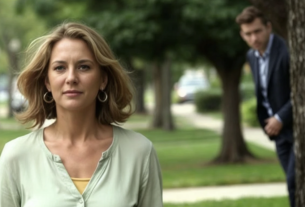
“Are you seriously saying that right now?”
I stood by the windowsill with a cup of tea in my hands, looking at Ilya as if I were seeing him for the first time — not as my husband, but as a man who had started dividing up something that was never his far too soon.
He wasn’t even embarrassed. Quite the opposite — he grew more animated. His face came alive, almost glowing with excitement, like a little boy who had suddenly been told he could take everything in a store he had only ever stared at from behind the glass.
Our rented one-room apartment already felt cramped, but his joy made the air feel even heavier. Grocery receipts lay scattered on the table. My tights were drying near the radiator. His boots, still caked with mud, stood in the hallway. Outside the window, Stavropol had already sunk into early darkness. Cars crawled through the black slush, and the glass reflected our kitchen — small, rented, with cheap cabinet fronts and a refrigerator that never stopped humming.
“What’s the big deal?” he said with a smirk. “You said it yourself: ten million. That’s not a joke. We need to be smart about it. A one-room apartment for Mom. Something small for Alena too, so she stops suffering in rentals. And we can keep living here for now. What’s the rush? Is one room not enough for you or something?”
I looked at him and felt something inside me go very quiet.
It didn’t even hurt anymore.
It was empty.
Clear.
Not “us.”
Not “let’s think about it.”
Not “maybe we should buy something for ourselves.”
An apartment for his mother. An apartment for his sister.
And me — the woman who had brought that money into the house — he had already assigned the role of patient wife in a rented box, where I could keep “getting by.”
“So you’ve already decided everything?” I asked.
Ilya spread his hands.
“What’s there to decide? You’re a reasonable woman. You can see how expensive everything is getting. If we distribute it wisely, everyone benefits. Mom will stop whining about rent, Alena will finally get herself together, and we’ll buy something later too.”
That word — “later” — was when I understood the most important thing.
There was no “we” in his mind.
There was his mother, who had spent years convincing her son that he was responsible for dragging her through life.
There was his sister, who had long ago learned to live as if someone else’s salary were simply a convenient natural resource.
And then there was me.
A woman lucky enough to bring in money.
Which meant I could keep enduring.
I set my cup down on the table.
“Interesting,” I said. “And if it were your money, would you also explain to me that I could stay in a rental for now?”
He grimaced.
“Vera, don’t start. I’m not buying myself a Mercedes. I’m talking about family.”
“And what am I to you?”
He froze for a second.
Only a second.
But it was enough.
“That’s not what this is about,” he muttered. “It’s not that simple.”
No.
It was exactly that simple.
A man heard a sum of money and immediately showed me where his wife ended in his mind — and where a convenient source of funds began.
I hadn’t received an inheritance.
I had won.
And that evening, for the first time, I realized it was probably a good thing I hadn’t told him the truth right away.
A month earlier, Marina from work had told me:
“Don’t tell him everything at once. Say it’s an inheritance or a gift from some distant relative. Not because you need to lie. But because sometimes it’s very useful to see a person unprepared. To see who they become when they think money is already within reach.”
I hadn’t liked the idea then.
Tests, tricks, little games — all of that had always seemed dirty to me. I hated when people circled around the truth instead of speaking directly. But that lottery ticket didn’t work like a miracle.
It worked like an X-ray.
Until the very end, I thought I wouldn’t test anyone. I would simply tell him, and we would decide together how to live from that point forward.
Then I imagined Lidia Semyonovna.
Her voice on the phone. Her endless, “My dear Ilyusha, you’re all I have.” Her ability to talk about money as if everything belonging to someone else had long ago become morally hers — it just hadn’t been legally transferred yet.
I imagined Alena, who at thirty still lived as though life were obligated to provide her with warm, comfortable options without effort.
And I decided: no.
First, I would see who exactly I had been calling my husband all these years.
I found out about the win during my lunch break. I had bought the ticket by chance at a gas station while waiting for my coffee. Not out of hope. Out of boredom.
The app on my phone froze at first, then displayed the amount, and for a moment I thought the screen was lying. I checked the number three times. Then again. Then I went into the restroom, locked myself in a stall, and simply stood there with my hand pressed to my mouth so I wouldn’t burst out laughing and crying at the same time.
Ten million.
Not a billion.
Not a fairy tale.
But enough to stop living in a cramped rented apartment with a crooked bathroom door and the landlady’s eternal phrase: “Please don’t touch the wallpaper.”
Enough to buy a decent two-room apartment, breathe out, and for the first time in years stop calculating whether we would make it to the end of the month after utilities, English lessons, and winter tires.
The first thing I did was call Marina.
She was silent for about three seconds. Then she exhaled.
“Where are you?”
“At the office.”
“Stay calm. Don’t tell anyone. No one at all.”
“I have to tell Ilya.”
“You do. But not everything right away.”
“I don’t like this.”
“Neither do I. But I like even less the idea of Lidia Semyonovna mentally choosing a kitchen set tomorrow at your expense.”
Marina knew my family too well to be wrong.
Lidia Semyonovna always spoke sweetly.
That was exactly why she had gotten away with everything for so long.
“Verochka, don’t think I’m interfering…”
After that sentence, interference usually followed for at least half an hour.
“Verochka, I’m only giving advice…”
And after that came a ready-made decision, one I was expected to quietly fit into without making a scene.
She was a former accountant and was deeply proud of it, as if working with numbers made her not just careful, but morally impeccable. In reality, she counted other people’s money as though it already belonged to her. Especially if that money happened to be close enough to her son.
When Ilya and I had just gotten married, Lidia Semyonovna loved to say:
“A family budget must be managed strictly. Otherwise women start thinking they have something of their own.”
Back then, I used to laugh it off.
Ilya shrugged.
His mother was “old school,” he said. I shouldn’t take it to heart.
So I didn’t.
And that was my mistake.
At first, she interfered in small things. Why I spent that much on winter boots instead of buying cheaper ones. Why I needed good shampoo if “my hair wasn’t complaining.” Why I couldn’t help Alena “just a little,” since the poor girl was going through a difficult time.
Alena’s difficult time, by the way, had lasted since she was about nineteen.
First, the job was wrong. Then the man was wrong. Then the landlady was greedy. Then the exchange rate wasn’t in her favor. Then she simply “wanted to live a little.”
And all that time, she was remarkably good at finding people whose wallets she could lean on.
Ilya never argued with his mother.
Never.
That was his greatest flaw.
In ordinary life, he was calm, kind, not a bad man. He bought ice cream for his nephews, paid for gas here and there, and didn’t seem greedy in small things. But next to Lidia Semyonovna, he seemed to deflate inside and turn back into a boy whose task was not to think, but to agree.
I had watched it for years.
At first, I didn’t give it much importance. Then it annoyed me. Then I got used to it.
And getting used to imbalance is the most dangerous state for a woman.
You already see that you are being pushed aside, but you still explain it away as someone else’s personality.
After that evening with “an apartment for Mom and one for Alena,” I didn’t make a scene.
That surprised him too.
He had expected an argument. Hurt feelings. Tears. Any understandable reaction that would allow him to become the tired, reasonable one again.
But I simply cleared the cups from the table, washed a knife, folded the towel, and went to the bathroom. In the mirror, my face looked very calm. Almost unfamiliar.
Maybe that is what people look like when they have finally seen everything and are quietly changing their route.
The next morning, Ilya behaved as if no catastrophe had happened.
“I won’t tell Mom yet,” he muttered while buttoning his shirt. “First we’ll think through the options. No emotions.”
No emotions.
Men love that phrase most when they are talking about someone else’s resources.
“Of course,” I replied. “Think it through.”
He nodded, satisfied that I had “calmed down.”
At work, Marina saw me in the hallway and understood immediately.
“Well?”
I repeated the conversation to her almost word for word. She listened with her hand wrapped around a paper cup of coffee.
“That’s it,” she said after a pause. “You got your answer.”
“Yes.”
“Does it hurt?”
“Very much.”
“Then it’s good you found out before the money was transferred.”
I sat on the edge of the table in the meeting room and allowed myself to close my eyes for the first time that morning.
“He didn’t even ask what I wanted.”
“Of course not. Because in that family structure, you’re not a person with plans. You’re a lucky find.”
That sentence cut deeper than I wanted it to.
Because it was true.
“What now?” I asked.
Marina shrugged.
“Now you either swallow it again for the appearance of marriage, or you play it through to the end. You’re an economist. So calculate the risks without romance.”
I gave a bitter smile.
“You’re very comforting to talk to.”
“I’m not comforting you. I’m dragging you back into reality.”
Egor Kovalyov turned out to be exactly the kind of person I needed to meet that week.
Not charming. Not overly talkative. None of that “oh, this apartment has wonderful energy” nonsense.
Only addresses, floors, deadlines, risks, registration, payment.
Calm. Focused. Professional.
He didn’t ask unnecessary questions about my husband, but from one look at my face, he seemed to understand everything anyway.
“Whose name are we putting it under?” he asked during our second meeting.
“My mother’s,” I replied. “And the payment will come from her account.”
He gave a short nod.
“Does she live in the city?”
“Yes. But she won’t be involved in this story. Just a signature, and then silence.”
“I understand.”
He didn’t ask why.
For that, I was grateful.
We looked at apartments for three days in a row. A modern residential complex on the outskirts, where the entrances already smelled of fresh plaster, new construction, and something else — the feeling that life could begin without anyone else’s permission.
The two-room apartment on the ninth floor turned out to be the one.
I stepped inside and immediately understood: Lidia Semyonovna would not stand here by my sink with her heavy gaze. Ilya would not come in, rejoice, and then start dividing everything. Nothing from the old arrangement would exist here.
Only me.
A kitchen with a window overlooking the courtyard. A bright bedroom. A small second room. A balcony with a view of a piece of the city and the parking lot below.
Not luxury.
But my future.
Or, more precisely, my mother’s on paper.
And mine by the right to breathe there freely.
When we signed the documents, my hands began trembling for the first time in days. Not from fear. From the realization that it was all so right and so bitter at once.
I wasn’t just buying an apartment.
I was buying myself an exit from a marriage that had not yet legally fallen apart, but had already stopped feeling safe.
Egor put the folder into his briefcase and said:
“The keys will be ready on Friday. Planning a housewarming?”
I looked at him.
“Yes.”
“A big one?”
“No. But memorable.”
I think he understood.
And he asked nothing else.
During those days, Ilya, Lidia Semyonovna, and Alena behaved as if the money were already in their hands.
It wasn’t even disgusting.
It was educational.
I felt as if I were sitting inside a very expensive and very unpleasant play, where my consent had long ago stopped being required — but they still didn’t know the ending had already been rewritten.
Ilya began choosing appliances “for Mom.”
At first, cautiously.
“Well, if we’re buying her an apartment, we shouldn’t fill it with old junk. At least the stove should be decent.”
Then he got a taste for it.
“And a washing machine right away. What’s the point if she has to suffer afterward?”
Alena sent me links to curtains, a sofa, kitchen chairs, and various “cute little things,” as if I had already stopped being her brother’s wife and become the department responsible for fulfilling her dreams.
“Vera, this sofa color is so cozy,” she wrote. “And it’s not expensive, it’s on sale.”
Not expensive.
With other people’s money, nothing ever seems expensive.
One evening, Lidia Semyonovna came to our rented one-room apartment with a notebook. She sat at the table, put on her glasses, and began speaking in that voice that always made Ilya’s shoulders stiffen.
“Right. For my apartment, not the first floor. My joints. Alena can be higher up, she doesn’t care. We won’t buy the cheapest appliances, otherwise we’ll have to replace them later. And Ilyusha, talk to Vera about registration. If my apartment is in my name, you never know. Everything must be done properly.”
I remember that evening down to the smallest detail.
There was a pot of rice on the stove. Cold air and the smell of someone else’s cigarette smoke drifted in through the cracked window. My work shoes were drying under the radiator. In the corner, on a chair, sat the bag with the documents for the new apartment.
And Lidia Semyonovna sat in our cramped rented kitchen, already discussing how she would live on my money in the most convenient legal arrangement possible.
“And where do you see me in this plan?” I asked.
She looked up.
“What do you mean?”
“I mean exactly what I said. Where am I?”
“Verochka, what kind of tone is that? You’re not a stranger. This is all for family.”
I even smiled.
Very calmly.
“That’s what I especially like. When it’s time to take, I’m family. When it’s time to live, apparently I can manage in a rental.”
Ilya immediately tensed.
“Vera, don’t start.”
“No,” I replied. “We’re continuing. I’m simply curious whether any of you, even once in these past few days, thought that the woman bringing ten million into this family might want more than the joy of watching you all be distributed into apartments. Maybe she might want to live decently too.”
Alena buried herself in her phone.
Lidia Semyonovna pressed her lips together.
“There you go again, making it about yourself.”
It was so blatant that even Ilya couldn’t find an answer right away.
My near-defeat happened at night, two days before the deal.
I lay in the dark, staring at the ceiling. Ilya was already asleep, his face turned toward the wall. The elevator hummed beyond the wall. Someone laughed outside. A dog barked in the neighboring apartment.
And suddenly I thought: what if I am the monster here?
What if all of this is too much?
The secret purchase, the test, putting the apartment in my mother’s name, the housewarming as the final point.
What if afterward I wouldn’t be able to look at myself without feeling that I, too, had acted inhumanely?
It was an unpleasant thought.
Because there was some truth in it.
I really had tested him. I really had kept quiet, observed, drawn conclusions while he divided something he hadn’t even seen in his hands yet.
Someone in the comments would surely say: you provoked him yourself, you set a trap yourself.
Maybe.
Let them say it.
But then I remembered his face that first evening.
That light, joyful greed.
That “an apartment for Mom, an apartment for Alena.”
That “you can manage in the rental.”
Without a pause.
Without hesitation.
Without including me as a person in the calculation.
And I understood: no.
I had not provoked anyone.
I had simply given a person the chance to speak without rehearsal.
And he had spoken more honestly than he ever would have in any long family conversation.
After that, it became easier to sleep.
I organized the housewarming on Saturday.
The new apartment already smelled of showroom furniture, fresh paint, and something crisp and young. I deliberately didn’t make it cozy with blankets and candles yet.
Not yet.
First, I needed a clean stage.
A kitchen table, a box of glasses, a couple of plates, tea, grapes, a box of chocolates, and a folder with documents.
Ilya was sure we were going to look at an option “for Mom.” Lidia Semyonovna wore her dark green coat and lipstick a little brighter than usual. Alena arrived with the expression of someone already deciding where to put her vanity table.
I looked at them in the elevator and felt no anger.
Almost curiosity.
That must be how you look at people who are about to open a door — not to the place they wanted, but to the place where the truth is already waiting for them.
They liked the apartment immediately.
Lidia Semyonovna went into the kitchen, ran her fingers over the countertop, and nodded.
“Not bad. Bright. With warm curtains, it could be very nice.”
Alena was already opening cabinets.
“And whose bedroom is this? Mom, yours or mine?”
Ilya looked around with the pleased expression of a man who believed he had finally made one big, correct move in life. Even his shoulders straightened.
“See?” he said. “I told you, if everything is done wisely, everyone can be settled properly.”
I placed the folder on the table.
“Yes,” I said. “A lot can be done wisely.”
They didn’t even become suspicious at first.
Lidia Semyonovna sat down first and removed her gloves.
“Well then, let’s look at the papers.”
“Let’s,” I nodded.
And I took out the lottery ticket.
Ilya blinked.
“What is that?”
“It wasn’t an inheritance,” I said. “It was a ticket. A winning one.”
The silence in the room became so dense that I could hear someone outside the door on the landing walking a child by the hand, a plastic bag rustling beside them.
Alena slowly straightened.
“What do you mean?”
“I mean exactly what I said. I won the money. And I deliberately didn’t tell the truth right away because I needed to see how you, Ilya, would behave when you heard the amount.”
He went pale.
“You tested me?”
“Yes.”
Lidia Semyonovna flushed.
“That’s vile!”
I turned my gaze to her.
“No. Vile is when a woman brings ten million into a household, and within one minute her husband decides that his mother and sister will get apartments while she keeps living in a rental.”
She opened her mouth, but I had already pulled out the documents.
“And this is the ownership statement. The apartment belongs to my mother.”
Ilya stared at the papers as if he no longer understood letters.
“What?”
“I bought the apartment and registered it in my mother’s name. Legally, none of you have anything to do with it. Not you. Not your mother. Not your sister.”
Alena was the first to lose control.
“So you brought us here just to show us what we lost?”
I shook my head.
“No. I brought you here so that maybe, for the first time, you would see that I am not an ATM with a patient face.”
Ilya sat down.
He simply dropped into the chair like a man who had suddenly been stripped not only of a plan, but of the very support beneath it.
“You’re sick,” he breathed. “You actually set all of this up.”
“No. You set everything up. That evening. When you heard the amount and didn’t ask a single question about me.”
Lidia Semyonovna turned so pale that her lipstick looked even brighter.
“And what now?”
I looked toward the window. At the courtyard of the new complex. At the playground. At the cars below. At someone else’s life continuing without our arguments.
“Now you go home. More precisely, to that rented apartment you were so ready to leave me in. Only I don’t intend to keep living there.”
Ilya lifted his head.
“What do you mean?”
“I mean exactly what I said. I’m moving here. Without you.”
He tried to argue in the car.
“You can’t destroy a marriage over one conversation.”
“Not over one conversation. Over the fact that this conversation showed me who you are without decoration.”
“I only wanted to help my family.”
“At my expense. Don’t leave out the most important part.”
“You handled this very cunningly.”
“You weren’t exactly straightforward either, Ilya. It’s just that when you do it, it’s called ‘family care,’ and when I do it, suddenly it’s ‘cunning.’”
Lidia Semyonovna stayed silent in the back seat the whole way. Alena complained at first, then began sniffling, but without real tears. It was more wounded calculation than pain.
She wasn’t hurt.
She was offended that a ready-made life had suddenly failed to arrive.
When we reached our rented one-room apartment, Ilya tried one more time to appeal to pity.
“Vera, you can’t do this. We are still husband and wife.”
I looked at him for a long moment.
“No. For too long, we were something where my money was treated as shared, while my interests were treated as unnecessary.”
He opened his mouth.
Closed it.
And in that moment, he didn’t look angry, frightening, or even miserable.
Just very small.
A man who had grown so used to counting someone else’s property as his future that he became lost when that future suddenly closed the door in his face.
Marina helped me move my things into the new apartment two days later.
We carried boxes, laughed from exhaustion, drank coffee out of paper cups among bags and a rolled-up rug. Wet snow fell outside the window, the radiators hissed with heat, and the kitchen smelled of new plastic and freedom.
“So,” she asked when we sat down right on a box of dishes. “Do you feel like you went too far?”
I thought about it.
“I feel like I spent a very long time not going far enough.”
She nodded.
“That happens.”
“And I also feel like the comments are going to tear me apart.”
Marina laughed.
“Excellent. That means the story is alive.”
I walked over to the window.
In the courtyard, a little boy was dragging a sled through wet snow. Car headlights blinked in the parking lot. On a neighboring balcony, a woman shook out a blanket.
Ordinary life.
No grand finale.
But with a very clear aftertaste.
Because perhaps the most frightening part of this story was not that my husband turned out to be greedy.
It was how quickly and naturally he imagined me as unnecessary the moment money appeared.
Not an enemy.
Not a rival.
Just a woman who could keep managing in a rental.
That was what I could not forgive him for.