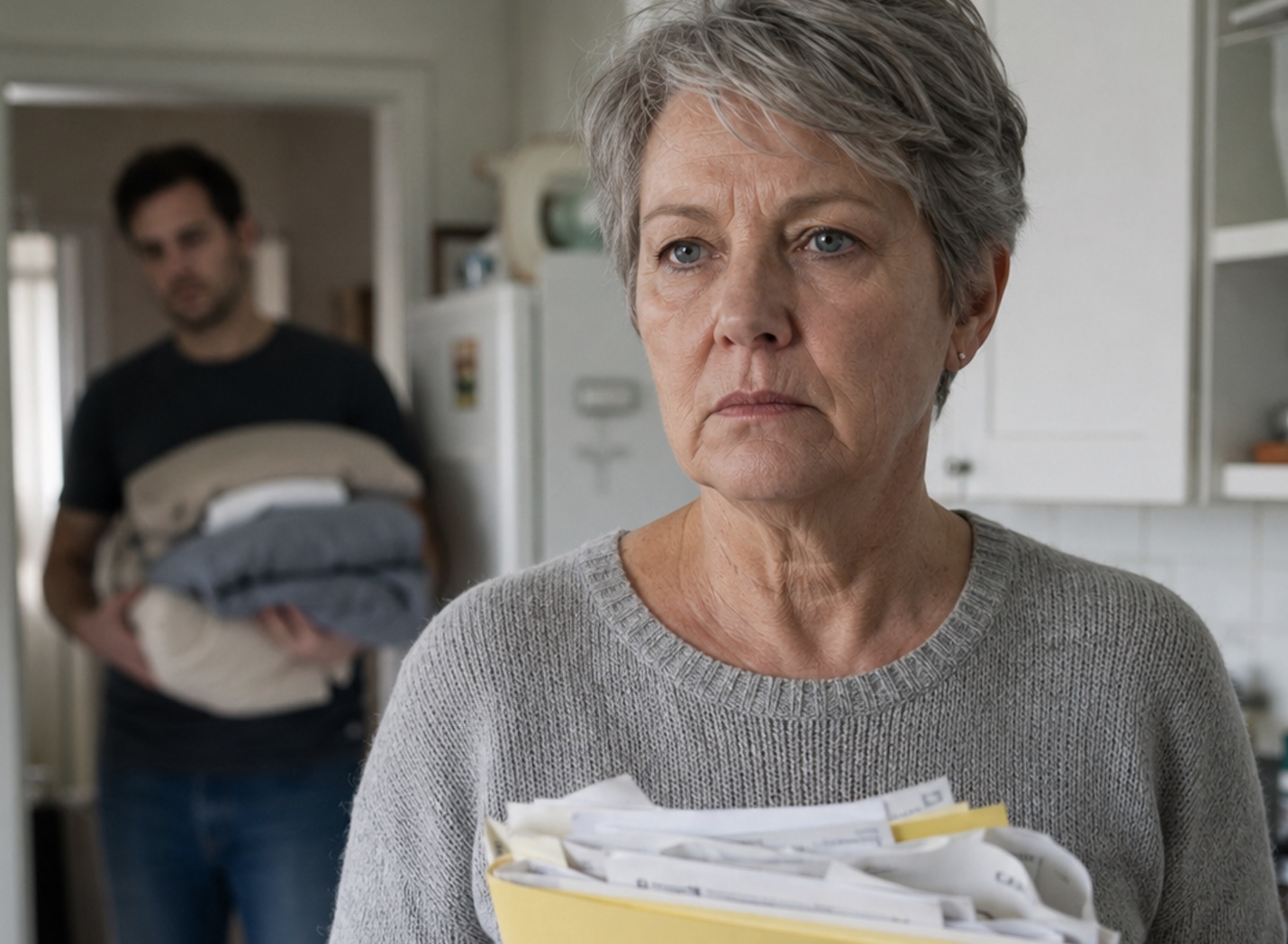
“Just put up with it. Mom needs it more,” Vadim said without even turning around.
He was standing in the bedroom doorway, stuffing my bed linen into a bag.
Mine.
From my bedroom.
The bedroom I had furnished with my own money.
Eight years ago, I walked into that apartment with two suitcases and a husband who promised me, “We’ll have everything, Nelly. We’ll manage together.”
We managed, all right.
Only somehow, “together” very quickly turned into “you’ll manage.”
We paid the mortgage equally, that was true. But the furniture, the appliances, the bathroom renovation, the curtains, the rug in the living room, even the hooks in the hallway — I paid for all of it.
Because Vadim’s salary went toward the car loan. The same car he crashed a year later.
I have worked as a senior accountant for twenty-six years. In all that time, I have never lost a single receipt.
Not one.
Zoya Pavlovna appeared in February.
With a cane, a suitcase, and tightly pressed lips. Heavy chin, pinched mouth.
“Blood pressure,” she announced from the doorway. “The doctors say I can’t live alone anymore.”
Vadim grabbed her suitcase.
I picked up the cane she had leaned against the wall and immediately forgotten. She walked down the hallway without it — straight, steady, confident. As if she were not seventy-eight, but fifty. Strong. Energetic.
My own mother lived alone until she was seventy-five and never once complained. But here we had “blood pressure.”
I said nothing.
Who knew? Maybe she used the cane outside but not at home. Things happen.
“I’ll make up the sofa for you in the living room,” I said. “It’s comfortable, it folds out. Sometimes I fall asleep on it myself while watching TV.”
“In the living room?” Zoya Pavlovna looked at Vadim.
Not at me.
At him.
“Mom, of course you’ll take the bedroom,” he said, as if the decision had been made long ago. “There’s a proper bed there. Nelly and I will stay in the living room for now.”
For now.
I remembered that phrase.
That evening, after my mother-in-law had shut herself inside my bedroom, I said:
“One month, Vadim. One month, and then we look for another solution. A caregiver, a care facility. Or we renovate the living room so she can be comfortable there.”
“Nelly, she is my mother.”
“And this is my home too. I’m not against helping. But one month. Agreed?”
He nodded.
Back then, I believed a nod meant agreement.
After eight years, I should have known better.
Vadim’s nod meant, “Leave me alone.”
A week later, Zoya Pavlovna rearranged the photographs on my dresser. She packed my cosmetics into a cardboard shoebox and put her icons, a bottle of Corvalol, and a large-numbered alarm clock on my bedside table.
The Corvalol was unopened. I checked when I went in to get a blouse.
Two weeks later, she said to Vadim right in front of me:
“Son, this mattress is uncomfortable. My back hurts all night. I need an orthopedic one.”
That mattress had cost forty-two thousand rubles.
I bought it two years earlier. I had gone to the showroom myself, tried seven different mattresses, and spent an hour and a half choosing it.
“Maybe we should order a new one?” Vadim looked at me. “It’s for Mom’s health.”
“Vadim. This mattress is two years old. It is orthopedic.”
“Well, it’s uncomfortable for her.”
I didn’t argue.
I thought the month would end, and everything would go back to normal.
The month ended.
Nothing went back.
Zoya Pavlovna lived in my bedroom, slept on my mattress, and kept her things in my closet.
And I slept in the living room, on the sofa, under a throw blanket.
At the end of the fifth week, I overheard a conversation.
By accident.
I was doing laundry in the bathroom, and the door was open. Zoya Pavlovna was talking on the phone with Rimma — Vadim’s younger sister. She was in my bedroom. The door wasn’t fully closed, and my mother-in-law’s voice could be heard through three walls.
“Rimmochka, the tenants paid for March. Transfer the money to my savings account, as usual.”
I froze with a wet pillowcase in my hands.
Tenants.
Her apartment — a two-bedroom place on Leninsky Prospect — was being rented out.
Zoya Pavlovna wasn’t “unable to live alone.”
Zoya Pavlovna had rented out her apartment and moved in with us.
The blood pressure, the cane, the Corvalol — it was all a performance.
Thirty-five thousand rubles a month.
That was roughly what a two-bedroom apartment in her area rented for. I knew exactly, because last year I had helped a colleague look for housing, and we had searched that very neighborhood.
Then Rimma said something I couldn’t hear.
But I heard Zoya Pavlovna’s answer clearly.
“No, no, Vadimka agrees. Nelly will put up with it. Where is she going to go?”
Where is she going to go?
The pillowcase twisted into a rope in my hands. My fingers turned white.
That evening, I said to Vadim:
“Your mother is renting out her apartment on Leninsky. For thirty-five thousand.”
“How do you know?”
“I heard the conversation.”
“You were eavesdropping?”
“I live in the same apartment, Vadim. The door was open. I was doing laundry. Your laundry, by the way.”
He was silent for a moment. Then he rubbed the bridge of his nose.
“So what? Mom’s pension is small. She needs income.”
“She needs income. I need my bedroom. We agreed on one month. It’s been five weeks.”
“The situation has changed.”
“What changed? She’s healthy. She walks around the apartment without her cane when she thinks nobody is watching. She is renting out her own place and living with us for free.”
“She is my mother!” he raised his voice.
For the first time in eight years.
“What do you want me to do, throw her out onto the street?”
I looked at him.
The man with whom I had shared a bed for eight years.
A bed I had bought myself.
In an apartment where every single item — from the forks to the television — had been paid for with my card.
I went into the living room.
I lay down on the sofa.
And that night, for the first time, I thought:
Where would I go, really?
The answer did not come right away.
But it came.
The kitchen became a battlefield.
A quiet, polite, daily battlefield.
Zoya Pavlovna cooked.
Not because she wanted to help, but because she wanted to command.
She got up at six in the morning, clanged pots, and made porridge for Vadim. By seven, when I got up, the kitchen was occupied, the sink was full, the table was covered in crumbs, and the stove was splattered.
“Nelly, you’re cutting the onion wrong. Too small. Vadim likes big pieces.”
“Nelly, why so much oil? He’ll gain weight.”
“Nelly, the dishwasher is running half-empty. Electricity isn’t free.”
I bought that dishwasher three years ago. Twenty-eight thousand rubles.
I chose it myself and paid for the installation myself. The repairman came on a Saturday. I took time off work and waited three hours because he was late.
The washing machine was mine.
Forty-four thousand.
The refrigerator — mine.
Sixty-one thousand.
The stove — mine.
Thirty-eight.
The microwave, multicooker, coffee machine, vacuum cleaner, the television in the living room, the television in the bedroom.
All mine.
I kept every receipt in a yellow folder labeled “Household Appliances.”
Twenty-three receipts.
An accountant’s habit. After twenty-six years of work, I knew one thing: if you have a document, you are protected. If you don’t, you are nobody.
Almost half a million rubles.
Four hundred eighty-three thousand, to be exact.
I calculated it one night when I couldn’t sleep on the sofa. The living room ceiling had cracks in it. I lay there and counted.
I remembered every receipt.
One day, I came home earlier than usual.
I had a headache and had asked to leave work early. I opened the door quietly and took off my shoes in the hallway.
Voices came from the kitchen.
Zoya Pavlovna.
Without her cane.
She was standing on a stool, wiping the top cabinet. The stool wobbled, but my mother-in-law held on to the cabinet door with one hand and calmly cleaned with the other.
For a woman with blood pressure problems and bad legs, she was surprisingly agile.
The next day, I called the clinic.
I introduced myself as her daughter and asked to clarify her prescriptions.
The nurse said, “Zoya Pavlovna is not registered for any chronic condition. Her last visit was in October, for a routine checkup. Everything is normal for her age.”
Normal.
Four times in two months, my mother-in-law had complained about different things: blood pressure, heart, knee, lower back.
Four diagnoses.
Not one confirmed.
And then Vadim moved me into the kitchen.
Zoya Pavlovna’s belongings multiplied.
She took over four sections of the wardrobe out of six. Then the fifth.
My blouses — four of them, plus one skirt — ended up in a bag by the front door.
“There isn’t enough closet space,” my mother-in-law explained. “It’s not my fault.”
That evening, Vadim said:
“Maybe you could sleep in the kitchen for now? The folding bed will fit there. Mom gets up at night, it’s inconvenient for her in the living room, and she’s already used to the bedroom.”
Used to it.
In six weeks.
“You are suggesting that I sleep in the kitchen.”
“Temporarily, Nelly. Why are you making such a big deal out of it?”
I took a pillow, a blanket, and went to the kitchen.
Not because I agreed.
Because in that moment, I needed to be alone.
I placed the folding bed between the refrigerator and the wall.
The gap was forty centimeters.
The refrigerator hummed all night. It switched on every half hour — I knew because I woke up each time.
The faucet was leaking. Vadim had been promising to fix it since January.
Drip.
Drip.
Drip.
A draft came through the gap under the door.
The first night, I lay there thinking:
Tomorrow I’ll talk to him. Seriously. Calmly. I’ll tell him this cannot continue.
The second night, I thought:
He’ll understand on his own. He has to understand.
By the third night, I stopped thinking.
I just lay there and listened to the refrigerator hum.
At six in the morning — footsteps.
Zoya Pavlovna came to the kitchen.
She opened the door and switched on the light.
I lay on the folding bed, covering my eyes with my hand.
“Oh, are you still sleeping?”
Every morning, the same thing.
Surprise in her voice. As if she had forgotten that her daughter-in-law lived there.
Then she rattled pots.
Put the kettle on.
I got up, folded the bed, leaned it against the wall behind the door, went to wash my face, and came back.
The table was occupied.
My mother-in-law was slicing bread.
“Wait, Nelly. I’m making breakfast for Vadim.”
So I waited.
Twenty minutes.
Every morning.
In twenty-three days, that added up to almost eight hours of standing near the door of my own kitchen.
My back started hurting on the fifth day.
Not “uncomfortable.”
Hurting.
Really hurting.
By the end of the second week, I couldn’t bend down to tie my shoes. In the morning, I got up sideways, holding onto the edge of the table.
In the evenings, I came home from work to a dirty kitchen, a splattered stove, and a full sink.
My mother-in-law cooked dinner.
Vadim watched television in the living room.
My television.
Thirty-one thousand rubles.
I walked past him, and he never turned around.
Not once in twenty-three days did he ask, “How is your back?”
During the second week of my kitchen life, Rimma came over.
With a cake and advice.
“Nelly, Mom is old. Just be patient a little longer.”
“Rimma, your mother is renting out her apartment for thirty-five thousand and living here for free. I’m sleeping on a folding bed in the kitchen. And I have receipts for every item in this home.”
I took out the folder.
The yellow one.
I placed it on the table.
Twenty-three receipts, spread like a fan.
“Property acquired during marriage is joint property,” Rimma said without even looking at the receipts. “It doesn’t matter who paid.”
Vadim nodded.
Another one of his nods.
“Joint property is what was bought with joint money,” I said. “This was bought with my money. My name. My card. I can prove it.”
Rimma snorted.
Zoya Pavlovna struck the floor with her cane.
Vadim said nothing.
But I remembered her words.
“Joint property.”
I remembered — and made a decision.
That night, I took out my phone.
I found the number of a moving company in my contacts. I had looked it up for a friend last year, and the number was still there.
I saved it to Favorites.
For now — just in case.
The next day, I photographed every receipt.
I sent copies to my work email.
I made a spreadsheet: item name, purchase date, amount, payment method.
Twenty-three lines.
Total: 483,200 rubles.
The accountant in me worked clearly, even when my back wouldn’t straighten.
The coffee machine had cost thirty-six thousand.
I had saved for three months — twelve thousand from each paycheck.
I brought it home myself in a taxi and connected it myself using the instructions.
Every morning — a double espresso.
It was the only thing that still felt truly mine in that apartment.
When I made coffee, I was not “the daughter-in-law,” not “the wife,” not “you’ll put up with it.”
I was Nelly.
Just Nelly.
On Saturday, I came back from the store.
There were shards on the kitchen floor.
Black, glossy shards.
I recognized them immediately.
My heart tightened.
“Zoya Pavlovna?”
“Oh, I accidentally knocked it over. It was standing right on the edge.”
The coffee machine had not been on the edge.
I kept it against the wall, behind the sugar bowl.
Always.
The same place.
For eight years.
I crouched down and picked up a shard.
Smooth.
Still warm.
Its sharp edge pressed into the pad of my finger.
A small pain.
Precise.
“Accidentally,” my mother-in-law repeated.
Then she turned toward the window.
Vadim came home an hour later.
“Well, it’s just a coffee machine. We’ll buy a new one.”
“Who will buy it, Vadim? You? With what money?”
“Well… together.”
“Together. Like the mattress? Like the wardrobe? Like the folding bed in the kitchen — also together?”
“Nelly, enough. Don’t start a war over a coffee maker.”
A coffee maker.
He didn’t even know the right word.
I went into the hallway.
Closed the bathroom door.
Took out my phone.
My hands were calm.
Completely calm.
I dialed the moving company.
The operator asked, “What volume are we talking about?”
“Household appliances. Refrigerator, washing machine, dishwasher, stove, microwave, multicooker, vacuum cleaner, two televisions. Fourth floor, no elevator.”
“When should we pick it up?”
“Today. In two hours.”
I hung up.
I looked at myself in the mirror.
Short haircut with gray I had stopped dyeing two years earlier.
Dry hands.
Calm eyes.
Vadim heard me.
He came into the hallway.
“What are you doing?”
“I’m taking my property. I have receipts for every item. My name, my card, my money.”
“Nelly, have you lost your mind? This is our home! Where are you taking all of it?”
“To a temporary storage facility. And then — to my own place.”
“Your own place?! What own place?”
Zoya Pavlovna came out of the bedroom.
My former bedroom.
Without her cane.
She noticed my look and immediately leaned against the wall.
“What’s all this noise?”
“Your daughter-in-law called movers,” Vadim said, spreading his hands. “She’s taking the appliances. All of them.”
My mother-in-law stared at me.
Heavy chin.
Tight lips.
“Nelly, you can’t be serious.”
“Twenty-three nights on a folding bed, Zoya Pavlovna. Your apartment on Leninsky is being rented out for thirty-five thousand. Four health complaints, none of them confirmed — I called the clinic. And I have 483,000 rubles invested in this apartment. In appliances. My appliances. And I am taking them.”
“Vadim!” my mother-in-law turned to her son.
Her voice became thin and weak.
The familiar tone: “I feel faint, protect me.”
“Nelly, put the phone down. Let’s talk normally.”
“We talked for eight years. That’s enough.”
The movers arrived in one hour and forty minutes.
Two men.
Young, strong, fast.
I pointed things out.
The refrigerator from the kitchen.
The washing machine from the bathroom.
The dishwasher.
The stove.
The microwave.
The television from the living room.
The television from the bedroom — the very one in front of which Zoya Pavlovna watched her soap operas.
The vacuum cleaner.
The multicooker.
Vadim stood in the hallway.
White-faced.
His arms hanging at his sides.
He didn’t stop them.
He didn’t dare.
Zoya Pavlovna sat down on a kitchen chair and started crying.
I looked at her.
For the first time in two months, I saw real tears on my mother-in-law’s face.
Not manipulation.
Real fear.
Fear of what life would be like without a refrigerator.
The movers worked for forty minutes.
They wrapped everything in plastic and carried it out carefully.
I paid eleven thousand for the move and two months of storage.
The apartment became empty.
The kitchen was bare.
The living room had a blank wall where the television had hung.
The bathroom had a mark on the floor where the washing machine used to stand.
I stood in the doorway with the yellow folder and the bag I had packed that morning.
“Nelly,” Vadim took a step toward me. “You understand this is the end, right?”
“No, Vadim. The end was when you put a folding bed in the kitchen and said, ‘Just put up with it. Mom needs it more.’ That was the end. This is the beginning.”
I walked out.
The door closed quietly.
The lock clicked.
The stairwell smelled of whitewash.
I leaned against the railing and exhaled.
Slowly.
Deeply.
For twenty-three days, I hadn’t been breathing properly.
Only now did I realize it.
I called Larisa — my friend, my colleague.
“Did you take it?”
“I took everything. Even the refrigerator.”
“Good Lord, Nelly. Even the refrigerator. Come to my place. I have a room.”
“I’ll be in your way.”
“You slept for twenty-three nights between a refrigerator and a wall. I have a separate room with a window. Come.”
I called a taxi.
For the first time in a month, I was going somewhere that was not work and not back home.
It was raining outside.
The raindrops on the window were long and slanted.
Beautiful.
Three weeks have passed.
Vadim calls every day.
During the first week, he shouted:
“Bring the appliances back.”
“You stole them.”
“I’ll go to the police.”
I didn’t answer.
During the second week, his voice became quieter.
“Nelly, let’s talk.”
“Mom left, come back.”
By the third week, he sounded almost small.
“I feel bad here alone.”
Zoya Pavlovna moved out after four days.
She evicted her tenants and went back to her apartment on Leninsky.
She left her cane in Vadim’s hallway.
Her blood pressure is stable.
Her heart is fine.
Her knee works perfectly without a stick.
Rimma sent me a message:
“You destroyed a family over some receipts.”
I didn’t reply.
I didn’t destroy the family.
The folding bed in the kitchen did.
Vadim bought a used refrigerator online — a small one, for nine thousand.
He cooks on a portable electric hot plate.
He washes his clothes by hand.
Yesterday he called. His voice was guilty and quiet.
He said, “I didn’t think you would really leave.”
For eight years, he didn’t think.
But I did.
Every receipt.
I live with Larisa now.
The documents are with a lawyer.
The lawyer looked through the folder, calculated the sums, and said, “The appliances are yours. Everything is clean.”
I sleep in a proper bed.
My back stopped hurting after a week.
In the morning, I make coffee in a cezve.
It’s enough.
Sometimes I wonder: maybe I shouldn’t have taken the refrigerator.
Maybe the television and coffee machine would have been enough for him to understand.
But then I remember:
“Just put up with it. Mom needs it more.”
And I think — no.
I did the right thing.
Or did I?
Did I go too far by calling the movers and taking everything, leaving the kitchen empty?
Or was I right?
What would you have done in my place?