“Accept it,” Artur said. “I have two families now.”
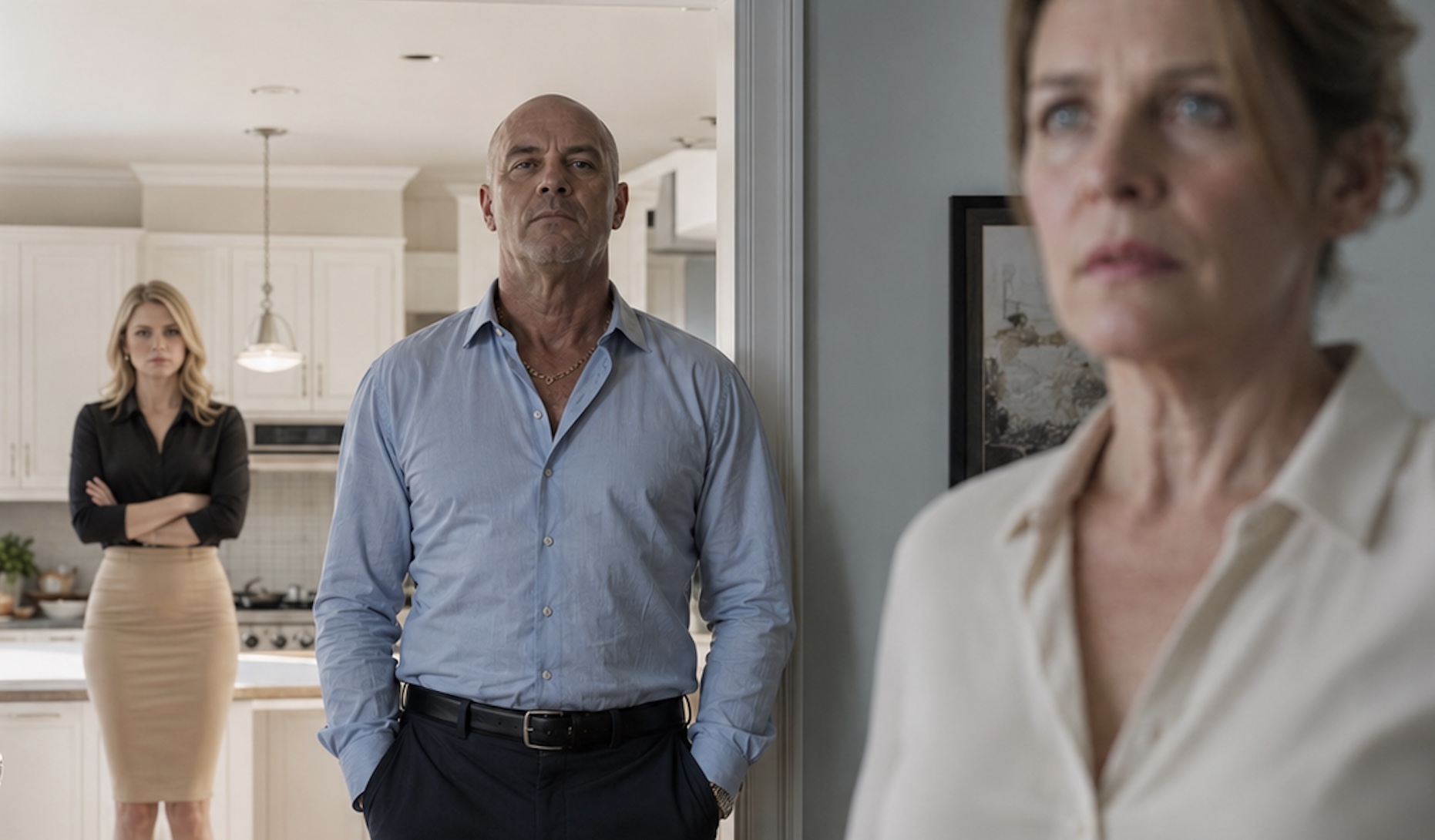
He stood in the kitchen doorway with his legs planted wide, the way he used to stand at his car wash in front of customers. A gold chain rested over his unbuttoned shirt. His tanned bald head shone under the lamp.
Behind him stood a young woman. Thirty at most. Blonde hair, a short skirt, heels tapping against the tile — click, click, click.
I was holding a plate of dinner.
His dinner.
The dinner I had spent forty minutes preparing.
“This is Zhanna,” he said. “She’s part of my family now too. Get used to it.”
Eighteen years.
For eighteen years I had stood beside this man. Cooked for him, washed his clothes, counted his money, paid his taxes, kept his books. Fourteen of those years without a salary. Because, as he always said, “We’re family, Nelli. What kind of salary is there between our own?”
I placed the plate on the table. Slowly. Carefully. So it wouldn’t break.
“Meet each other,” Artur said with a careless wave of his hand. “Nelli, Zhanna. Zhanna, Nelli.”
Zhanna smiled. Nervously, but with a hint of challenge. I knew that kind of smile. I had seen it behind counters, in queues, at the tax office. The smile of someone who isn’t sure she has the right to be there but has decided to bluff anyway.
“Hello,” she said.
I didn’t answer. I looked at Artur.
“Are you serious?”
“Completely,” he said, sitting down at the table. He pulled my plate toward himself and picked up a fork. “Zhanna, sit down. Nelli cooks well.”
Zhanna didn’t sit.
She stayed in the doorway, shifting from one heel to the other. At least she understood that this was not the moment for dinner.
“Artur,” I said. “Come outside. We need to talk.”
He sighed as if I were being difficult. Then he dropped the fork onto the plate and stood up.
It was cold on the balcony. March. Wind coming from the river. I stood there without a coat, but I couldn’t feel the cold.
“Have you lost your mind?” I asked quietly.
“I’ve made my decision. This is how it’s going to be.”
“Who is she?”
“She works as a cashier at the Magnit store. We’ve been together for three years.”
Three years.
I looked at him and started counting.
The “business trips” had begun three years ago.
The “Saturday business dinners” had started three years ago.
The smell of another woman’s perfume on his collar had appeared exactly three years ago.
“So you lied to me for three years.”
“I didn’t lie. I protected you.”
“Protected me?”
“You wouldn’t have understood.”
I turned around and went into the bedroom. I closed the door. I didn’t slam it. I simply closed it.
My hands were shaking.
But not from fear.
From anger. Thick, bitter anger that left a metallic taste on my tongue.
Through the wall, I heard him tell Zhanna, “Don’t worry. She’ll get used to it. Women always get hysterical at first.”
Women.
After eighteen years, I was just “a hysterical woman.”
I took out my phone and opened the folder marked “Accounting.”
Inside were the files I had been collecting for the past year.
Bank statements. Tax reports. Acts. Copies of founding documents.
Not because I had suspected anything.
But because I was an accountant.
And an accountant always keeps documents.
The next morning, Artur left early.
Probably to see Zhanna.
He came back around noon, fresh and cheerful, whistling in the hallway as he took off his shoes.
“Nelli, I need three hundred thousand from the company. For development.”
He stood in the kitchen drinking my coffee from my mug, as if nothing had happened. As if he hadn’t brought another woman into my home the night before.
“What kind of development?” I asked.
“A new Kärcher. And a compressor. For the car wash.”
I knew the prices. I checked supplier catalogs every quarter. That was part of my duties.
My unpaid duties.
A professional Kärcher cost one hundred and twenty thousand. A compressor, eighty. Two hundred thousand in total. Not three.
“That leaves one hundred thousand extra.”
“Nelli, don’t get involved. I understand business. You just press buttons.”
Buttons.
For fourteen years, I had “pressed buttons.”
Tax declarations. Payroll sheets. Supplier contracts. Reconciliation acts. Bank payments. Every quarter — reports. Every year — balance sheets. No weekends in January and July, because deadlines had to be met. No vacations, because “who else will do it, Nelli?”
No salary.
Not a single ruble in fourteen years. No bonuses. Not even a written thank-you.
And he “understood business.”
I opened the laptop and logged into the online bank. I transferred two hundred thousand from the company account for business expenses. Using my electronic signature.
Because the general director and majority shareholder was me.
Fifty-one percent.
Artur had wanted it that way back in 2012.
“Put it in your name,” he had said. “I’ve had problems with the tax office.”
“Two hundred,” I said. “For equipment. Bring receipts.”
“I said three hundred!”
“Two hundred. And receipts.”
Artur turned red. The chain on his neck started moving with his breath, bouncing against his chest.
“Are you forbidding me?”
“I’m controlling expenses. As director. As accountant. As founder.”
He shouted for two hours.
He slammed doors — kitchen, hallway, bedroom. He called me greedy. Said the business was nothing without him. Said he had built everything with his own hands, from scratch, in dirt and water, from morning until night. And I just sat in a warm office “pressing buttons.”
The warm office was the kitchen table.
A laptop, a calculator, folders.
In winter, the apartment was sixteen degrees because, according to him, “heating is expensive, put on a sweater, Nelli.”
Then he slammed the front door and left.
I sat there alone in silence.
I looked at my hands — dry, sinewy, with short-cut nails. The hands of an accountant who hadn’t had a manicure in fourteen years because “there’s no money, the business is barely surviving.”
I opened that same folder.
Last year’s bank statement.
Twelve pages of tiny print.
Palermo Restaurant — 4,200 rubles.
I had never been to that restaurant. In fact, the last time we had eaten out together was five years ago, on our wedding anniversary. At a dumpling place.
Flower shop on Lenin Street — 2,300 rubles.
The last bouquet he had given me was for my fiftieth birthday. Carnations. From a gas station. The wrapper still had the price tag on it — 190 rubles.
Zolotoy Jewelry Store — 17,400 rubles.
A ring.
The last ring he had given me was at our wedding in 2008. Since then, nothing. Not even earrings for my birthday. “Why do you need them, Nelli? You don’t wear jewelry anyway.”
I took the calculator and began adding.
Line by line.
I highlighted every expense that had nothing to do with our family.
Eighty thousand a month.
On average.
For three years.
Two million eight hundred eighty thousand rubles.
And I hadn’t been to the dentist in three years.
My tooth ached at night, and I swallowed painkillers because “there’s no money, wait until next quarter.”
My winter boots were in their fourth season. The soles were worn thin, and my feet froze from November to March.
“Be patient until spring, Nelli. We’ll buy new ones then.”
Two million eight hundred eighty thousand.
And I got gas-station carnations.
Artur returned two days later as if nothing had happened. He sat down to dinner and asked for more food.
I served him.
Silently.
But I didn’t put the folder away.
Twelve pages.
Every line marked in yellow.
A week later, he came home with a new announcement.
“Zhanna is pregnant,” Artur said.
He stood in the middle of the room as if he had just won a government grant. Hands in his pockets, chin raised, gold chain shining.
I was sitting on the sofa with a book. I closed it and looked at him.
“And?”
“She needs a place to live. A normal place. She’s renting a room — eight square meters. That’s no place for a baby.”
“And you’re suggesting…”
“She’ll move in here. Temporarily. Until we find her an apartment.”
An apartment.
My apartment.
The one bought with my parents’ money.
My mother had sold her dacha — two million eight hundred thousand. My father sold his garage with the cellar — one million four hundred thousand.
Four million two hundred thousand rubles.
My mother cried when she signed the papers for the dacha. We had spent every summer there for thirty years.
But she said, “It’s for you, Nelli. So you’ll have something of your own.”
The apartment was registered in my name.
Back then, Artur nodded and said, “That’s right. It’s safer in your name. My credit history is a mess.”
He always said that.
Put it in your name.
It’s safer in your name.
You sign it.
“Artur,” I said, “Zhanna is not moving in here.”
“Nelli, she’s pregnant! You’re a woman. You should understand!”
“I am a woman. A woman you lied to for three years. A woman you told there was no money while you spent eighty thousand a month on someone else. I am a woman who hasn’t been to the dentist for three years. A woman whose feet froze all winter in worn-out boots. And all that money went to restaurants, flowers, and rings. Not for me.”
“How do you know…”
“Statements. Twelve pages. I’m an accountant, Artur. I have access to everything. The business account. The corporate card. Every payment from the past three years.”
He fell silent. Swallowed. The chain twitched against his throat.
“This is my home too,” he said quietly.
“No. The documents are in my name. Four million two hundred thousand came from my parents. I have the receipt. The purchase agreement is in my name. And the car is mine too. The Hyundai, 2022. Registration, insurance, contract — all of it.”
“You wouldn’t dare.”
“I’m not doing anything yet. I’m stating facts. For eighteen years, you were the one saying, ‘Put it in your name.’ So I did. And now everything is in my name.”
He stood up and stared at me for a long time. His nostrils flared. Then he turned and left.
He didn’t slam the door.
He closed it quietly.
For some reason, that was scarier than shouting.
I sat there with the book still open on my lap, on the same page.
My heart was pounding, but my hands weren’t shaking.
They simply weren’t.
That evening, Kirill called.
“Mom, Dad called me. He was yelling that you’re throwing him out of the house.”
“I’m not throwing anyone out. Not yet.”
“Mom… I know something. I didn’t want to say anything. I thought it wasn’t my business. But I saw that Zhanna woman at the mall two weeks ago. She wasn’t alone.”
“With Artur?”
“No. With some guy. Young. About twenty-five. They were kissing by the fountain on the first floor.”
I hung up and sat in silence.
So that was how it was.
Artur had two families.
And Zhanna had two men.
Interesting accounting.
The debit and credit didn’t match at all.
Three days later, Artur came back.
With pink suitcases.
Two of them.
On wheels.
One large, one smaller.
“Zhanna is moving in,” he announced. “The matter is settled.”
Zhanna stood behind him.
A different skirt, but the same heels.
Click, click on the tile.
I recognized the sound already.
Two meetings had been enough.
I came out of the study holding a folder.
That folder.
With yellow marks on every page.
“Zhanna,” I said, “may I speak to you for a minute?”
Artur jerked toward me.
“Nelli, don’t you dare!”
“I’m not talking to you. Zhanna, do you know how much Artur earns?”
Zhanna looked at him, then at me. She adjusted her hair.
“Well, he’s a businessman. He has a car wash.”
“A car wash with tire service. One location. Net profit last year — 912,000 rubles. Divide that by twelve — 76,000 a month. Before taxes.”
I held out the sheet.
Zhanna didn’t take it, but her eyes ran over the lines.
She was reading.
“Nelli!” Artur took a step toward me.
“Stay where you are,” I said without turning. “Zhanna, out of that seventy-six thousand, he spent eighty thousand on you every month. For three years. More than he earned. Do you know where the difference came from?”
Zhanna said nothing.
Her fingers turned white around the suitcase handle.
“From the family budget. From money for groceries, utilities, my medicine. I didn’t go to the dentist for three years. My tooth ached, and I took pills. I wore the same winter boots for a fourth season. The soles were worn through, and my feet froze from November to March. Because there was ‘no money.’ And there was no money because it was going to you.”
“That’s not true!” Artur shouted, his face dark red, his neck swelling. “I earn more than that!”
“Here is the tax declaration. Here is the cash book. Here is the business account statement. Fourteen years of accounting. Without a salary. Every single kopeck is here.”
Zhanna looked at the papers.
Then at Artur.
Then at his chain.
I could almost hear the calculator clicking in her head.
Seventy-six thousand.
Minus food.
Minus utilities.
Minus fuel.
Minus the first family.
What was left?
For a child? For an apartment? For the “one million a month” he had probably promised her?
“Artur, you told me you had three locations around the city,” Zhanna said.
Her voice had changed.
It was dry now.
“She’s lying! She forged it!”
“She forged the tax declaration?” I asked. “Artur, I’m an accountant. I don’t need to forge anything. I know every number by heart. Fourteen years by heart.”
Zhanna let go of the smaller suitcase and pulled the big one toward the door.
“I need to think,” she said quietly.
Her heels clicked away.
Click, click, click.
Quieter than the first time.
As if she were leaving on tiptoe.
Artur stood in the hallway.
The pink suitcase remained by the wall like a monument to a failed move-in.
“Happy now?” he hissed.
“I’m not finished yet.”
“What else?”
“Tomorrow morning I’ll be at the office. As general director and majority shareholder — fifty-one percent — I will hold an extraordinary meeting of the founders. Agenda: change of financial control. You will be removed from access to company funds. Signature authority on the accounts — mine only. Access to cash — mine only.”
“You have no right!”
“I do. The charter. Chapter four, clause six. You haven’t opened it once in fourteen years. I am the majority shareholder and general director. You are a minority participant. Forty-nine percent. No signing authority. No right to manage the account.”
Artur opened his mouth.
Then closed it.
The veins on his forehead swelled.
“And return the car by morning. Leave the keys on the cabinet. The car is in my name — registration, insurance, contract. If you don’t return it, I’ll file a police report.”
He slammed the door so hard that plaster crumbled from the frame.
White dust scattered across the linoleum.
I picked up the pink suitcase.
It was heavy.
I carried it outside and placed it on the doormat.
Then I returned to the kitchen.
Silence.
Only the refrigerator humming and the tap dripping.
I sat down and placed my hands on the table.
Steady hands.
Calm hands.
Strange.
Yesterday they had shaken.
The day before, too.
But today, they didn’t.
I went to the window.
The yard was dark and empty. A streetlamp swayed in the wind, spreading a yellow stain across the wet asphalt.
Back and forth.
Back and forth.
I stood there and breathed.
Evenly.
For the first time in three years, evenly.
Then I called Kirill.
“Can you change the locks tomorrow?”
“I’ll be there at nine, Mom.”
Everything happened quickly in the morning.
At eight, Kirill arrived with a locksmith. They changed the locks in forty minutes. Three locks on the front door.
At nine-thirty, I was at the office. I held the founders’ meeting.
One participant — me.
Protocol. Signature. Stamp.
Artur was removed from financial management according to the charter he had “never bothered to open.”
At ten, I called the bank. I blocked his card and had a new one issued in my name.
At eleven, I filed for divorce and took the paperwork to court.
Artur threw the car keys into the mailbox during the night.
No note.
Kirill moved the car to his place.
By lunchtime, Zhanna called.
“Nelli, can we talk?”
“Go ahead.”
“Artur promised me an apartment. He said the business brought in a million a month. He said he had three locations. He said he’d buy me a two-room apartment by summer.”
“One location, Zhanna. A car wash with tire service. Net profit for the year — 912,000 rubles. For the year. Not for the month. He might buy you a two-room apartment in about twenty years. If he stops eating.”
Silence on the line.
“Three years,” she whispered. “He lied to me for three years.”
“To me too. Only to me, he lied about business trips. To you, about income.”
Zhanna hung up.
Two hours later, Artur sent a message:
“Zhanna left me. Are you happy now, you bitch?”
I didn’t answer.
I put the phone in the desk drawer.
That evening, he stood outside the door.
His key didn’t work.
He rang the bell for twenty minutes straight.
I sat in the kitchen drinking tea.
I could hear him breathing behind the door — heavy, whistling, like he had just climbed the stairs.
Then he called.
“Open the door. I need to get my things.”
“Tomorrow, from ten to twelve. I’ll pack your belongings. Come with someone. A witness is needed.”
“This is my home!”
“The ownership certificate is in my name. Four million two hundred thousand rubles from my parents. Receipt, contract — everything is there.”
He stayed outside for another twenty minutes.
I heard him hit the door with his palm.
Not hard.
Out of helplessness.
Then came footsteps going down the stairs.
I washed my cup and placed it in the drying rack.
Then I took his plate — the one with the car wash logo, gifted to him on the business’s tenth anniversary.
I wrapped it in newspaper and put it into the bag with his things.
Two months have passed.
Artur lives with his mother now, in a one-room apartment on the outskirts, near the railway station.
He takes the bus.
The car is mine.
The business is running.
I hired two young car washers — hardworking, eager boys. Revenue increased by twelve percent in the very first month. It turned out that over the past year, Artur had spent more time giving orders and smoking by the gate than actually working.
Zhanna went to the young guy from the mall. Kirill told me. Whether there was ever a baby at all, no one knows. Zhanna stopped answering both Artur and me.
When Artur found out about the young man, people say he didn’t leave his mother’s apartment for three days.
He filed a counterclaim for division of business and property.
My lawyer looked at the documents: majority shareholder — me; starting capital — from my parents; receipt for four million two hundred thousand; fourteen years of management — documented.
No one is taking away his forty-nine percent.
But control is mine.
By law.
By the charter.
By those very papers he once asked me to “put in my name.”
Artur sent a message through Kirill:
“She robbed me. I built everything with my hands, and she took it all with paperwork.”
Yes, Artur.
You built with your hands.
But paperwork is ownership.
I tried to explain that to you for fourteen years.
You never listened.
You only said, “Press the buttons.”
My mother-in-law called once.
“You threw a man out into the street, shameless woman,” she said.
I replied, “He threw himself out, Zinaida Pavlovna. The moment he brought another woman into my home.”
Then I hung up.
She never called again.
Yesterday, I sat in the kitchen.
It was quiet.
Tea, a lamp, a book.
No heels clicking on the tile.
No gold chain over an unbuttoned shirt.
No “business trips.”
No “there’s no money, be patient.”
I looked at my hands.
Dry. Strong.
On my ring finger, there was still a pale mark from the ring I had taken off two months ago.
For fourteen years, I pressed buttons.
Turns out, the buttons were the most important thing all along.
Maybe I went too far.
Maybe we could have talked, divided everything, parted peacefully. Through lawyers. Through some kind of “let’s handle this like decent people.”
Maybe I shouldn’t have shown Zhanna the statements.
Maybe changing the locks overnight was too much.
But he stood in my kitchen and said, “Accept it.”
He brought another woman into an apartment bought with my mother’s dacha.
For three years, he spent my money on someone else while telling me, “Be patient until spring.”
I was patient for eighteen years.
I worked for free for fourteen.
Wasn’t that enough?
Or was I supposed to be patient a little longer?