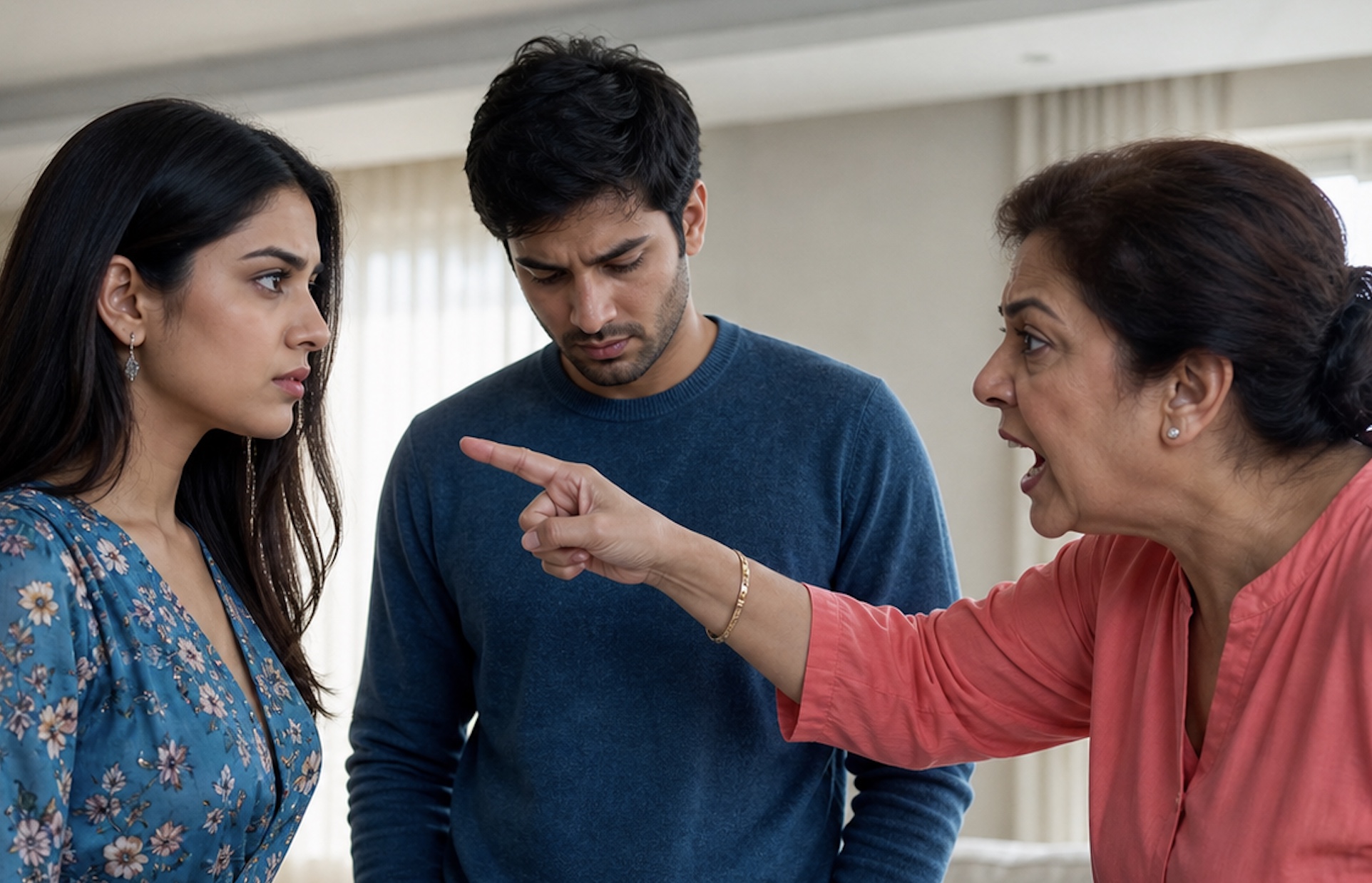
“Where exactly do you think you’re going to spend that money?! Don’t make me laugh, Angela. Do you even understand who’s in charge in this family?”
Her mother-in-law stood in the middle of the kitchen with her hands on her hips, her voice sharp and commanding, like an old Soviet school principal. Lyudmila Arkadyevna had a way of filling any room she entered. Not because of her height — she was actually quite short — but because of that particular manner of hers: chin lifted, eyes narrowed, a faint half-smile on her lips, as if she already knew she was going to win.
“You came into this family with nothing. My son supports you, provides for you, and now you’re going to throw money around as if it grows on trees?”
Angela stood by the stove and listened. She had learned to do that long ago — to stand still, to listen, to avoid reacting, to avoid adding fuel to the fire. Three years of marriage had built something like armor around her.
But today, something was different.
Maybe it was because she hadn’t slept all night, finishing the final report. Maybe it was because her team had worked like mad for three months to complete that project, and yesterday management had finally announced the bonuses. Her bonus — forty thousand rubles, honestly earned and transferred to her card that morning.
Or maybe it was simply because Lyudmila Arkadyevna was standing there with Angela’s phone in her hand, scrolling through the bank notification as if she had every right to do so.
“Put the phone down,” Angela said quietly.
“What?”
“Put my phone on the table.”
Her mother-in-law looked at her as if Angela had suggested she walk outside in her underwear.
“You’ve become completely shameless…”
But Angela was no longer listening. She picked up the phone from the edge of the table, where Lyudmila Arkadyevna had finally tossed it, and walked out of the kitchen.
Her husband, Roman, was sitting in the living room with his laptop. He worked as an analyst at a small consulting company, and he always had the look of a man who was too busy — even when he was just scrolling through his feed. Hearing raised voices, he lifted his head slightly, assessed the situation, and then lowered his eyes back to the screen.
That, too, was familiar.
“Roma,” Angela called, “your mother was just reading the notifications on my phone.”
“Anzh, come on, she was just…”
“Just? She said she wanted to take part of my bonus for a trip to Gelendzhik.”
A pause. Roman closed his laptop — slowly, carefully, like a man who still hadn’t decided which side he was on.
“Well, she has wanted to go to the sea for a long time. And anyway, it’s family money, Anzh…”
That was when Angela felt something inside her click. Quietly, almost soundlessly — but very clearly.
“Enough. This is my bonus for my project, and I will spend it on myself.”
Her voice was steady. No hysteria. No tears. She spoke the way people speak when they have made a decision and know there is no going back.
Lyudmila Arkadyevna, who had already appeared in the living room doorway, opened her mouth — and then shut it again. Apparently, she had not expected that tone.
“I didn’t see a single weekend for three months,” Angela continued. “I submitted reports at two in the morning. I earned that money. Myself. And you, Lyudmila Arkadyevna, have nothing to do with it.”
“How dare you…” her mother-in-law began, but Angela was already putting on her jacket.
“Roma, I’m going out. I’ll be back this evening.”
“Where are you going?” he asked, confused.
She didn’t answer.
Outside, the city was noisy and smelled of spring — exhaust fumes, coffee from the nearby café, and something vaguely fresh. Angela walked along the sidewalk without knowing where she was going, only needing to keep moving. Her head was surprisingly empty. There was no buzzing panic, no anxious whisper of, What if I’m wrong?
She went into the corner café — the very same one she used to stop by in the mornings before work, before marriage, when she had lived only ten minutes away. She ordered a flat white and sat by the window.
Why did Lyudmila Arkadyevna need her money?
The question, of course, was rhetorical. Her mother-in-law had her own pension, and quite a decent one at that. She had worked for forty years as an accountant in a large company and had retired with honors. Roman also helped her every month. She had money.
But this — reading someone else’s bank notification and immediately deciding that part of the sum belonged to her — this was about something else.
It was not about money.
It was a demonstration.
You are not the mistress of this house. Everything you have exists only by my permission.
Angela drank her coffee and thought calmly, almost with detachment. For three years she had tried to create something like neutrality in this family. She smiled at holidays. She endured comments about the “proper” way to iron Roman’s shirts. She stayed silent every time her mother-in-law said that “daughters-in-law used to be different.”
Angela had thought: We’ll get used to each other. It will get easier.
It hadn’t.
An hour later, she found herself in a shopping mall. She had not gone there to shop — it had simply happened. Her feet had led her there. She wandered aimlessly from floor to floor until she stopped in front of a small jewelry store display.
Inside lay a ring — simple, thin, with one small stone the color of sea water.
Angela looked at it for three full minutes.
Then she went inside.
She tried it on.
It fit perfectly.
“I’ll take it,” she told the saleswoman.
The decision surprised even her. She had never bought jewelry for herself like this, spontaneously, in the middle of a workweek. It had always seemed necessary to discuss such things first. What would Roman say? Was it too expensive? Too frivolous?
But now she simply bought it.
With her own money.
While the saleswoman packed the ring into a small box, Angela’s phone vibrated. Roman. She looked at the screen, then slipped the phone back into her pocket.
She would call him later.
Or she wouldn’t.
They would see.
She left the mall and stopped on the sidewalk, putting the ring on right there in the street. She looked at it. Something about that small gesture — buying herself something she wanted without asking permission, without explaining herself — felt more important than the piece of jewelry itself.
Lyudmila Arkadyevna, of course, would not calm down. That was obvious. She would call Roman and tell him how his wife had “made a scene” and “stormed out, slamming the door,” even though Angela had slammed no doors. Roman would nod, say something soothing to his mother, and in the evening he would try to talk to Angela — carefully, softly, in his usual way.
“You understand, she’s an older woman. You shouldn’t take it so seriously…”
And that, Angela thought, was where she would have to decide very clearly what she would answer.
Because something had changed today.
She did not yet know exactly what, or how deeply.
But she felt it as surely as one feels the first truly warm day after a long winter.
Her phone vibrated again.
This time it was not Roman.
It was an unknown number.
Angela stared at the screen for three seconds. The number was from Moscow, judging by the code. She almost declined the call, but something stopped her.
“Hello?”
“Angela Sergeyevna?” The voice was female, businesslike, slightly hurried. “This is Nina Pavlovna, HR Director at Horizont. I’m calling about a work matter. Is this a convenient time?”
Horizont was a major federal company, one of the leaders in her field. Angela knew about them, of course. Everyone in her industry knew about them.
“Yes, it’s convenient,” she said, and for some reason stepped aside, away from the mall entrance, as though the conversation required quiet and space.
“We reviewed your résumé and the final report on Project Aurora. It reached us through a partner network. We were very interested in your methodology. To put it briefly, we’d like to invite you for a meeting. It’s a serious position, above your current level.”
Angela was silent for a moment.
Then she asked:
“When?”
She returned home at half past seven. The apartment smelled of food — Roman was clearly trying to smooth things over with dinner. That was his signature method of reconciliation. He could cook well; that much was undeniable. A pan of rice and vegetables stood on the stove, and the table was set for two.
Lyudmila Arkadyevna was not there. She had gone home.
That was already something.
Roman was standing by the window with his phone. He turned when he heard the door.
“Where were you?”
“Running errands,” Angela answered shortly. She took off her shoes, hung up her jacket, and went into the kitchen.
He followed her silently, a little guilty, with the expression of a man who wanted to talk but did not know where to begin. He poured her tea, placed the cup beside her, and sat across from her.
“Anzhel… Mom didn’t mean to offend you. She just…”
“Roman,” Angela interrupted, “she read the notifications on my phone. Then she announced she would take part of my bonus for her vacation. That is not ‘just’ anything. That is something else entirely.”
He opened his mouth — then closed it.
Because there was nothing to say, and he knew it.
Roman was not a stupid man. Angela knew that for certain. He could analyze things, could see the whole picture — at work. At home, everything worked differently. At home, some other program switched on, one where his mother was always right, or almost right, or at the very least had to be understood and forgiven.
“Did you buy something?” he asked, noticing the ring on her hand.
“Yes. With my bonus.”
The pause was short, but full.
“It’s beautiful,” he finally said.
And there was something in that word that sounded like an attempt.
Angela looked at him.
Roman was a good husband — in the sense that he didn’t drink, didn’t cheat, came home on time, and sometimes brought flowers for no reason. But this trait of his — disappearing whenever Lyudmila Arkadyevna appeared on the horizon — had not faded with time.
If anything, it had grown stronger.
“I was invited to an interview today,” Angela said. “At Horizont. Have you heard of them?”
Roman raised his eyes.
“I have. They’re serious.”
“Yes. The position is higher than the one I have now. The meeting is on Friday, in Moscow.”
He was silent for about ten seconds. Angela could almost see calculations running through his head — fast and quiet.
“That means… moving?”
“Possibly. I don’t know yet. First, the meeting.”
That night she couldn’t sleep. She lay awake, staring at the ceiling while Roman breathed evenly beside her. Thoughts did not so much spin in her head as images did.
Lyudmila Arkadyevna with her phone.
The ring in its box.
Nina Pavlovna’s voice — businesslike, precise, without unnecessary words.
Three years.
For three years, Angela had tried to fit herself into this structure: the proper daughter-in-law, the understanding wife, the person who did not create problems.
And what had she received?
A mother-in-law who considered Angela’s money her own.
A husband who could cook rice, but could not tell his mother no.
She was not angry.
That was strange — there was no anger, only exhaustion and this new, unfamiliar clarity.
In the morning, after Roman had left for work, Lyudmila Arkadyevna called.
Angela answered.
“You behaved very badly yesterday,” her mother-in-law began without greeting. “I was simply checking the time on your phone. It was lying on the table. And you put on a whole performance.”
“Lyudmila Arkadyevna,” Angela said calmly, “you read my bank notifications and said you would take part of the money for your vacation. This is not about the phone.”
“I was joking!”
“All right. Noted.”
Silence.
Her mother-in-law had clearly expected something else — tears, apologies, the usual “No, no, everything is fine.”
She got none of it.
“Angela, do you understand how much I do for you? I gave my whole life to Romochka, and I accepted you like my own…”
“Lyudmila Arkadyevna, I’ll call you back later. I have things to do.”
And she ended the call.
Her hands were not shaking.
That surprised her a little.
On Friday, Angela boarded the Sapsan at seven in the morning. Roman drove her to the station. They barely spoke — they had not quarreled, they simply both remained silent, each absorbed in their own thoughts. On the platform, he hugged her awkwardly, as if he wanted to say something but could not bring himself to do it.
“Good luck,” he said.
“Thank you.”
The train moved smoothly. Outside the window, small forests and suburban platforms flashed by. Angela drank coffee from a paper cup and looked out. She thought that only a week ago, her life had seemed clear and predictable.
Now it felt as though someone had shifted the scenery.
Nina Pavlovna met her in a conference room on the twelfth floor of an office building in the city center. The view from the window looked expensive — glass and concrete, the river in the distance, a cloudless sky.
“I’m glad to meet you in person,” Nina Pavlovna said, shaking her hand firmly and professionally. “Please, have a seat. This should be an interesting conversation.”
Angela sat down, placed her bag on the floor, and straightened her shoulders.
At that moment, the conference room door opened, and another person entered — someone she had absolutely not expected to see there.
It was Dmitry Olegovich Krasheninnikov, Head of Strategic Analysis at her current company. Angela had seen him only three times in her life, always at general meetings, always surrounded by assistants and important-looking folders.
Angela did not even have time to think. She simply nodded automatically. He nodded back, sat down at the side of the table, and opened his laptop.
“Dmitry Olegovich is consulting with us on this position,” Nina Pavlovna explained. “He is familiar with your work. In fact, he was the one who recommended you to us.”
Angela looked at him.
“Your report on Aurora,” he said briefly, “is the best thing I’ve seen this year. The methodology is clean, the conclusions are unconventional. I wouldn’t have written it better myself.”
It was not a compliment in the usual sense. It was simply a statement of fact — without a smile, without warmth, without decorative intonation.
That was precisely why Angela believed him.
They spoke for a long time after that — about the position, the tasks, the team. Angela listened, answered, and sometimes asked questions. Calmly, the way she now knew how.
The ring flashed softly on her finger whenever she gestured. She noticed it at the edge of her awareness, and for some reason it made her feel more confident.
She had put her phone on silent.
When the meeting ended and Nina Pavlovna left to print some documents, Krasheninnikov closed his laptop and said:
“They will probably try to talk you out of it.”
“What do you mean?”
“I know whose daughter-in-law you are. Lyudmila Arkadyevna Gorina. She worked as chief accountant at Progress-Invest. We crossed paths about eight years ago. She is…” He paused, choosing the word. “Active.”
Angela looked at him.
“Did she call you?”
“The day before yesterday. She said you were emotionally unstable, conflict-prone, and that the Aurora report may not have been written by you personally.” He said it evenly, without drama. “I sent her scans of your draft materials — the ones you uploaded into the internal system with time stamps. Two in the morning. Three in the morning. Half past one. She did not call again.”
The silence in the conference room became so dense that Angela could hear her own breathing.
“Why are you telling me this?”
“Because you should know. So you understand what you may face at home.”
He stood, buttoned his jacket neatly, without hurry.
“The offer is serious. I hope you make the right decision.” A pause. “The right decision for yourself, I mean.”
And he left.
Angela boarded the Sapsan back that evening, just as the first lights were coming on over Moscow. Her mind worked clearly and coldly, like a good processor.
Lyudmila Arkadyevna had called the HR department of a major federal company in order to sink her own daughter-in-law.
She had not held her tongue.
She had not stopped herself.
She had not thought twice.
She had simply called.
As if she had the right.
Angela looked into the dark train window, at her own reflection, and thought — not with anger, but with almost scientific curiosity — how could a person be so certain that the entire world was their lawful territory?
Roman met her at the station. He stood by the car in his jacket, holding two paper cups of coffee. He silently handed one to her.
She took it.
They drove in silence. Only when they reached the building did he ask:
“So? How did it go?”
“Well. They’re making an offer. I’m waiting for the email.”
“It’s Moscow,” he said.
Not a question.
Just the words spoken aloud.
“Yes.”
He parked, turned off the engine, but did not get out. He sat there, looking at his hands.
“Anzh. Mom called me today. She said something about Horizont… that she had contacted them.”
“I know.”
He turned sharply toward her — for the first time in days, truly looking at her, without that cautious, evasive gaze.
“You know?”
“They told me at the meeting. Her call didn’t affect anything,” Angela said evenly. “But I want you to understand, Roma: your mother called the company where I was invited for a serious position and told them I was incompetent and unstable. That is not a joke. That is not ‘nothing.’ That was a deliberate action.”
He was silent for a long time.
“I’ll talk to her.”
“Good.” Angela opened the car door, then stopped. “Roma. I love you. But I will no longer pretend this is normal. If you need time to decide whose side you are on, I’ll wait. A little.”
She got out and walked toward the entrance.
The ring caught the light of a streetlamp and, for a second, flashed with something quiet and blue.
The email from Horizont arrived on Sunday morning. Angela read it over coffee, in silence, while Roman was still asleep.
The terms were serious.
So serious that she read them twice.
She put down her cup and looked out the window at the gray spring sky, the still-bare poplars, and the familiar bench in the courtyard where Roman had proposed to her three years earlier.
Then she opened her email and began typing her reply.
Roman read the letter himself. Angela had left the laptop open — not deliberately, she simply had not closed it. When he came into the kitchen, he looked like a man who had finally seen what he should have seen long ago.
“They’re offering you a department head position,” he said quietly.
“Yes.”
“Did you accept?”
“Yes.”
He sat across from her. For a long time, he looked at the ring on her finger — the very one she had bought on a random Tuesday, with her own money, without anyone’s permission.
“I talked to Mom last night,” he finally said. “Really talked. For the first time in years, probably.”
Angela waited.
“She didn’t apologize. You understand she won’t apologize, right?”
“I understand.”
“But I told her that if anything like this happens again, we won’t visit. At all.” He said it without drama, without a trembling voice. He simply said it. “She was silent for five minutes, then started talking about her blood pressure and how nobody loves her. I didn’t argue. I just repeated it again.”
Angela looked at him.
“That wasn’t easy,” she said.
“No,” he agreed. “But for three years you endured what wasn’t easy for you. I suppose that makes us even.”
Outside the window, the courtyard murmured with ordinary life. Somewhere, the entrance door slammed. A woman with a dog walked along the sidewalk.
A usual Sunday morning.
“I’ll go with you,” Roman said. “To Moscow. If you want.”
“I do,” she answered simply.
He nodded, stood up, and put the kettle on. His movements were calm, without unnecessary words, without performance.
Angela looked at the ring.
The sea-colored stone caught the morning light and came alive for a second — quietly, in its own way.
It had all started with a forty-thousand-ruble bonus.
And it ended with her finally beginning to live her own life.